Best Sales Sequences in 2026: Cadences That Actually Convert
The best sales sequences in 2026 blend email, calls, and LinkedIn into 8-14 timed touches. Here are the templates, cadence timing, and channel mix that convert.
You can copy the best subject line in the world and still get ignored — because a great sales sequence is not one perfect message. It is the right number of touches, on the right channels, spaced the right way, aimed at a verified human who actually exists. This guide breaks down the sequences that book meetings in 2026, with concrete timing, channel mix, and templates you can lift today.
TL;DR#
- The best sales sequences run 8–14 touches over 18–28 days across at least three channels (email, phone, LinkedIn). Single-channel email blasts are dead.
- Multichannel cadences outperform email-only by roughly 2–3x on reply and meeting-booked rates, according to outreach platform benchmarks.
- Timing beats volume. Front-load value in touches 1–4, escalate to phone and social in the middle, and close with a clean breakup email.
- Data quality is the silent multiplier. A perfect cadence to a bounced address converts zero. Verify before you send.
- Match the sequence to the persona: founders need short and direct, enterprise buyers need proof and patience.
What is a sales sequence?#
A sales sequence (also called a cadence) is a pre-planned series of outreach touches — emails, calls, LinkedIn actions, and sometimes texts — delivered to a prospect on a fixed schedule until they reply or the sequence ends.
Think of it like a relay race rather than a single sprint. No one touch is expected to win the deal; each one hands off momentum to the next. The first email plants a name, the LinkedIn view adds familiarity, the call adds a voice, and the breakup email creates urgency. The structure is what converts, not any individual message.
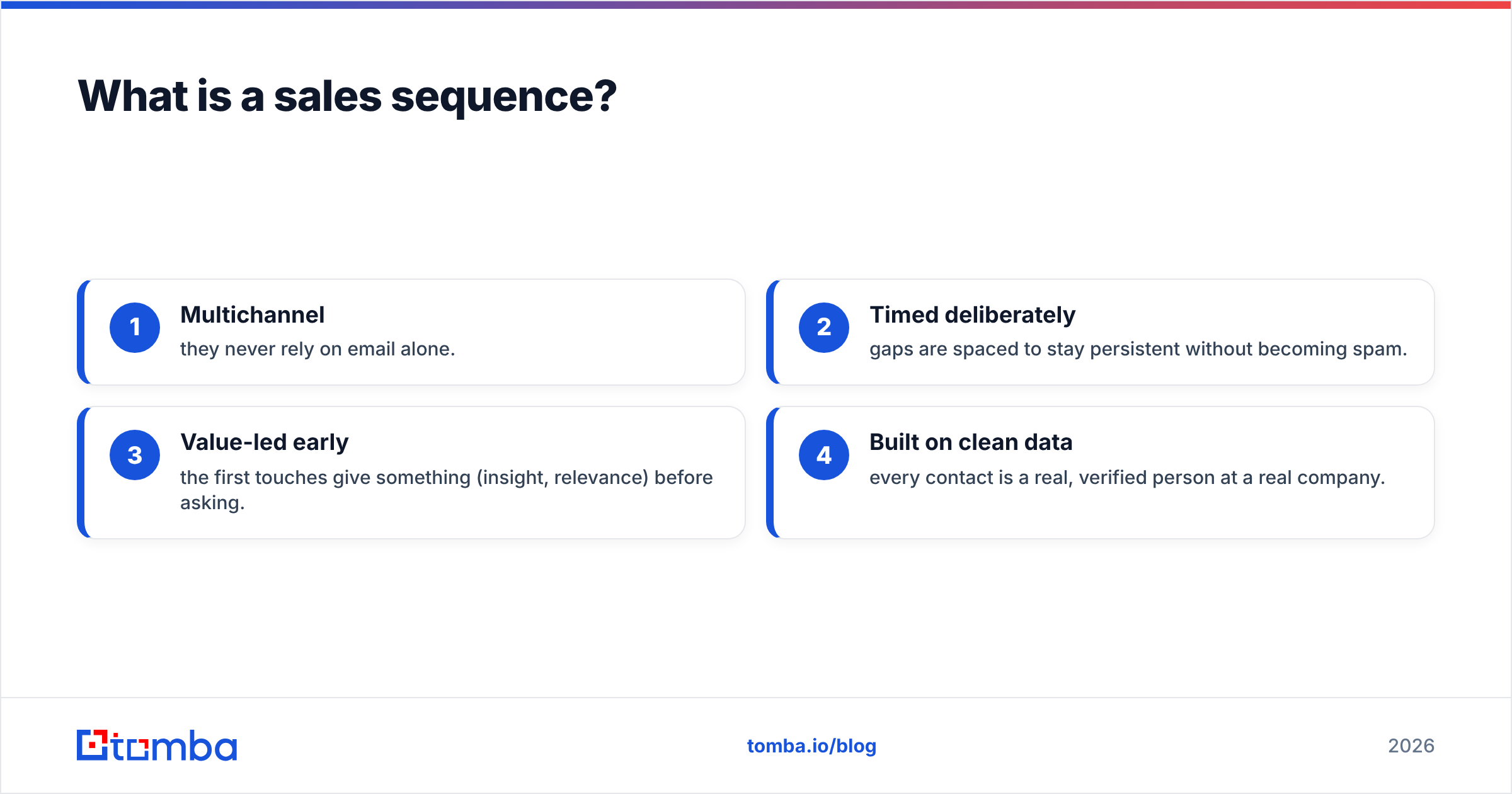
The best sequences share four traits:
- Multichannel — they never rely on email alone.
- Timed deliberately — gaps are spaced to stay persistent without becoming spam.
- Value-led early — the first touches give something (insight, relevance) before asking.
- Built on clean data — every contact is a real, verified person at a real company.
That last point is where most cadences quietly fail. You can run a flawless 12-step sequence into a catch-all domain or a stale address and never know why nothing landed. Running your list through an email verifier before launch protects your sender reputation and your reply rate at the same time.
Why do multichannel sequences beat email-only?#
Because attention is fragmented, and buyers ignore channels selectively. A prospect who deletes cold email on sight may still accept a LinkedIn connection or pick up an unknown number between meetings. Hitting the same person on three channels does not triple your annoyance — it triples your chances of catching them in a receptive moment.
Outreach and sales-engagement vendors consistently report that cadences mixing email, phone, and social book meaningfully more meetings than email-only cadences. The exact lift varies by industry, but the direction is never in doubt: more channels, more replies.
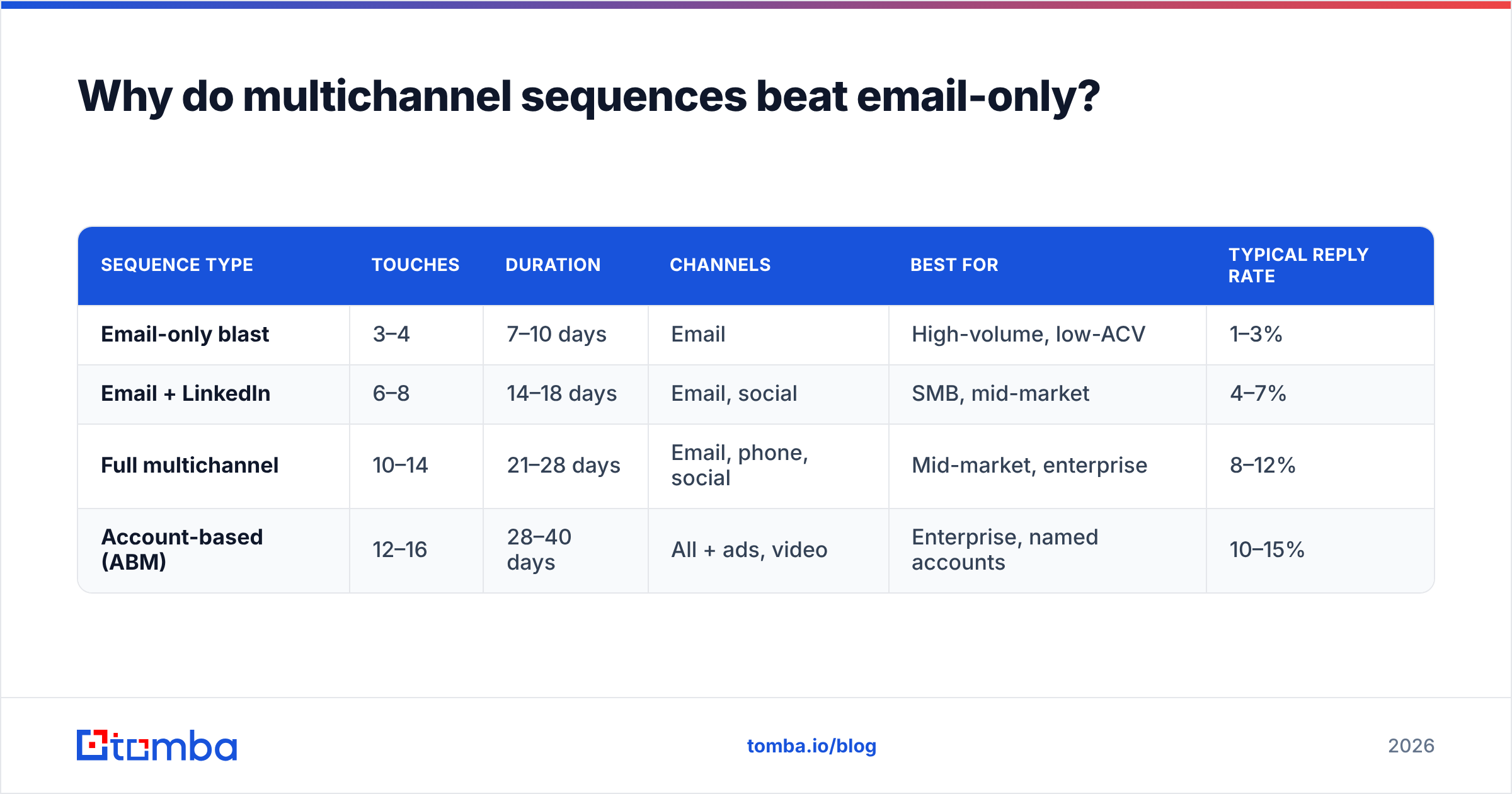
Here is how the common sequence types stack up.
| Sequence type | Touches | Duration | Channels | Best for | Typical reply rate |
|---|---|---|---|---|---|
| Email-only blast | 3–4 | 7–10 days | High-volume, low-ACV | 1–3% | |
| Email + LinkedIn | 6–8 | 14–18 days | Email, social | SMB, mid-market | 4–7% |
| Full multichannel | 10–14 | 21–28 days | Email, phone, social | Mid-market, enterprise | 8–12% |
| Account-based (ABM) | 12–16 | 28–40 days | All + ads, video | Enterprise, named accounts | 10–15% |
The pattern is clear: as you add channels and patience, reply rates climb — but so does the operational cost. The full multichannel cadence is the sweet spot for most B2B teams selling deals worth $5k–$50k.
What does the best multichannel sales sequence look like?#
Below is a battle-tested 12-touch cadence over 21 business days. It is the structure most modern SDR teams converge on, regardless of the tool they run it in. Adjust the copy, keep the rhythm.
Day 1 — Email #1 (Relevance): Reference a trigger — funding, a hire, a product launch, a LinkedIn post. One sentence of value, one soft ask. No pitch deck.
Day 1 — LinkedIn view: Visit the profile the same day. Many prospects notice and pre-warm before your second touch.
Day 3 — LinkedIn connection request: No note, or a one-line note tied to the same trigger. Higher accept rates than a salesy pitch.
Day 4 — Call #1 + voicemail: Short, specific, reference your email. Voicemail under 20 seconds.
Day 6 — Email #2 (Value): Share a resource, benchmark, or one-line insight. Still not a hard pitch. Reply to your first thread so it threads naturally.
Day 9 — Call #2 (no voicemail): Different time of day than Call #1.
Day 11 — LinkedIn message: Now that you are connected, a short, human message referencing the value you sent.
Day 14 — Email #3 (Case study): One proof point with a number. "We helped [similar company] cut X by Y%." One CTA.
Day 16 — Call #3 + voicemail: Reference the case study.
Day 18 — Email #4 (Direct ask): Drop the warm-up. Ask plainly for 15 minutes. Offer two specific times.
Day 20 — LinkedIn or call (final live touch): Last real attempt to reach a person.
Day 21 — Email #5 (Breakup): "I'll assume the timing isn't right and close your file." Breakup emails routinely outperform every other touch because they trigger loss aversion.
Notice the cadence breathes. It does not hammer the inbox five days straight. It interleaves channels so each touch feels like a different person trying to help, not one rep nagging.
How should you time the touches?#
The right gap depends on where you are in the sequence. Open with tighter spacing to build presence, then widen the gaps so you stay persistent without becoming a pest.
- Touches 1–4 (Days 1–4): Tight. You are establishing presence across channels fast.
- Touches 5–9 (Days 6–16): Medium. One to three business days apart. This is the patience zone where most deals actually turn.
- Touches 10–12 (Days 18–21): Closing. Slightly tighter again to create urgency before the breakup.
Two timing rules that matter more than people admit: never send two touches on the same channel back-to-back, and always vary the time of day for calls. A prospect who never answers at 9 a.m. may pick up at 4:45 p.m.
For phone-heavy sequences, getting the actual number is half the battle. A phone finder that surfaces verified B2B direct dials keeps your call steps from dead-ending on a switchboard.
What are the best sales sequence templates by persona?#
One cadence does not fit every buyer. Here are three proven structures mapped to who they work on.
1. The Founder/Exec sprint (short and sharp). Five touches over 10 days. Two emails, one call, two LinkedIn touches. Executives reward brevity and punish fluff. Lead with a peer reference and a number. No nurture — they decide fast or not at all.
2. The Mid-Market multichannel (the 12-touch above). The default. Balanced patience and persistence. Works for VP and director-level buyers who need a little proof but can still champion internally.
3. The Enterprise ABM cadence (long and layered). Fourteen-plus touches over 30–40 days, often run against multiple stakeholders in one account simultaneously. Adds video messages, personalized landing pages, and retargeting ads. The goal is account saturation, not a single reply.
For all three, the prerequisite is the same: accurate contact data for every name in the play. You can build a list from a company's website using domain search to pull every reachable email at the account, then enrich and verify before the first touch fires.
What kills even a great sequence?#
Most cadence failures are not copy problems. They are foundation problems. Watch for these:
- Bad data. Bounces wreck your sender reputation, and once your domain is flagged, even your good emails land in spam. This is the single biggest silent killer.
- No personalization layer. Sending the identical sequence to 5,000 people with only
{{first_name}}swapped reads as automation. Add one genuinely specific line per prospect in the first touch. - Channel monotony. Five emails in a row is not a multichannel sequence with a phone field attached. If the prospect only ever hears from you one way, you have an email blast.
- Pitching too early. Touches 1–3 should earn the right to ask. Leading with a demo request on Day 1 caps your reply rate.
- No exit. Sequences without a breakup touch leave deals in limbo. The breakup email is often your highest-converting message — never skip it.
A useful discipline: before launching any cadence, run the list through verification and dedupe it. Clean data is not glamorous, but it is the difference between a 9% reply rate and a blacklisted domain. Tomba's bulk email finder lets you find and verify hundreds of contacts in one pass so the whole sequence runs on solid ground.
How do you measure if a sequence is working?#
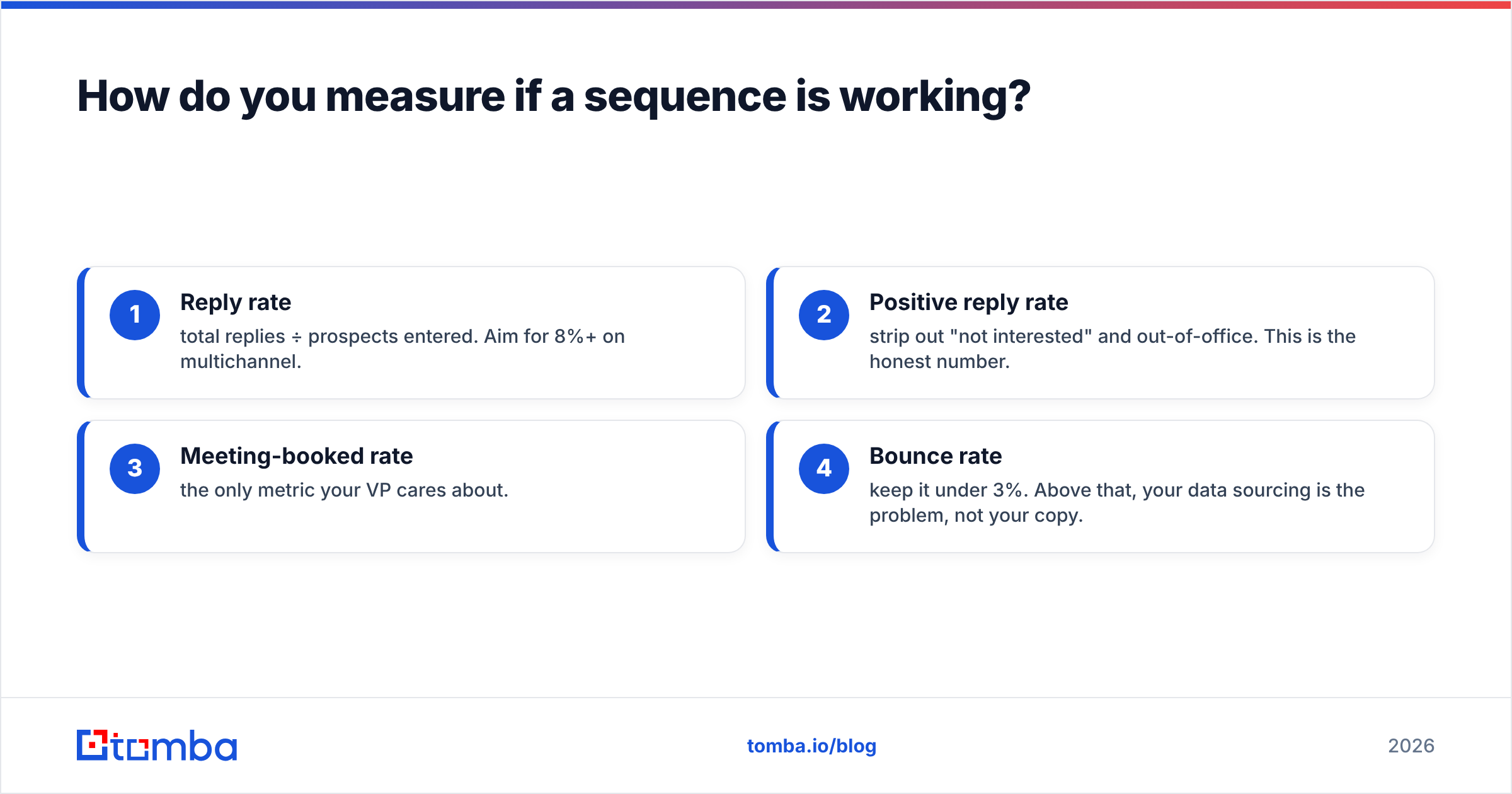
Track these four metrics per sequence, not per email:
- Reply rate — total replies ÷ prospects entered. Aim for 8%+ on multichannel.
- Positive reply rate — strip out "not interested" and out-of-office. This is the honest number.
- Meeting-booked rate — the only metric your VP cares about.
- Bounce rate — keep it under 3%. Above that, your data sourcing is the problem, not your copy.
A/B test one variable at a time — subject line, first-touch channel, breakup timing — and give each test enough volume to mean something. Anything under a few hundred prospects per variant is noise. For deeper benchmarks on what "good" looks like, G2's sales engagement category and HubSpot's annual sales data are reliable, vendor-neutral references.
Which tools run sales sequences best?#
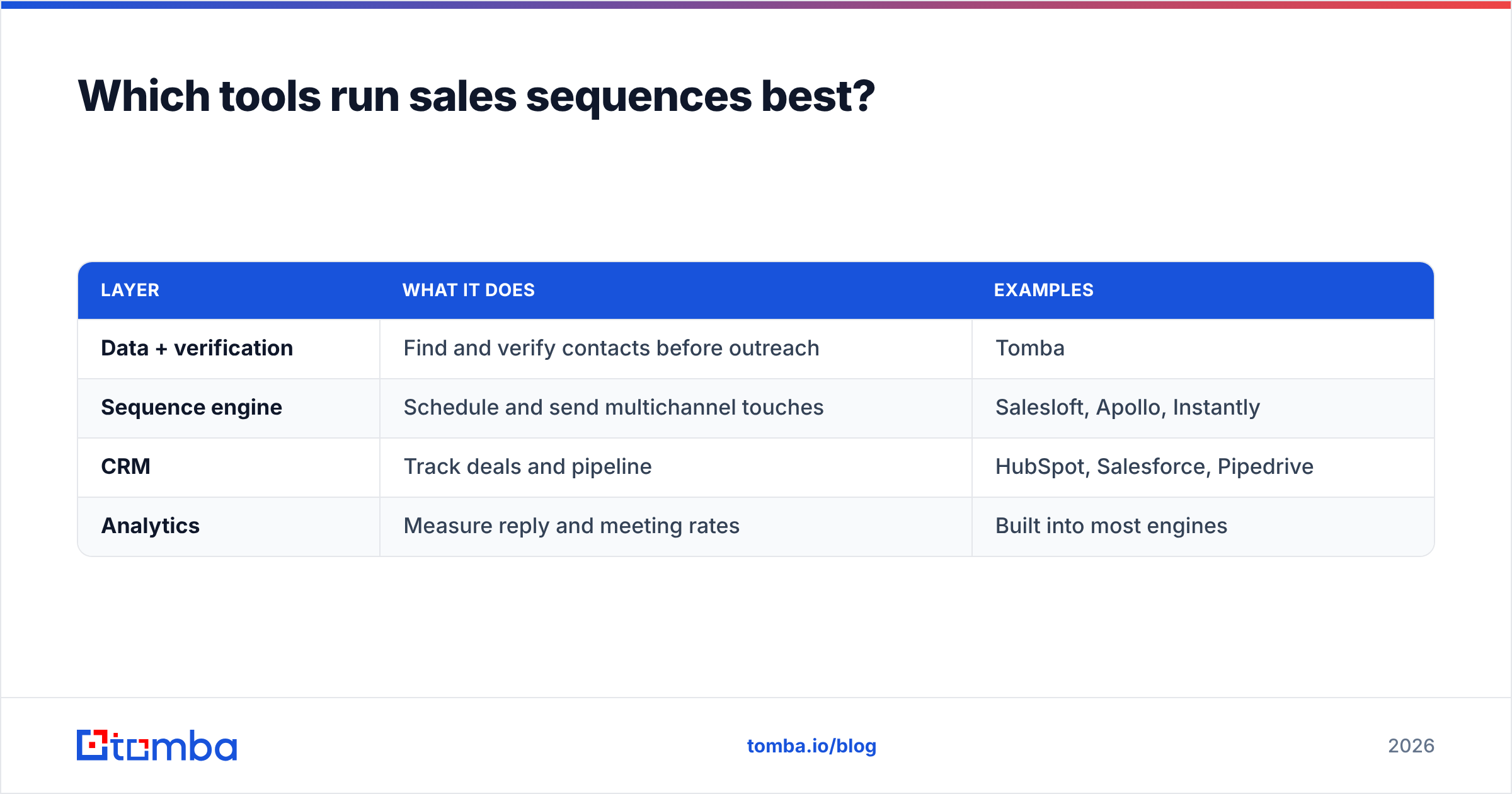
The execution layer (Outreach, Salesloft, Apollo, Instantly, and similar platforms) handles scheduling and delivery. But every one of them is only as good as the contact data you feed it. The sequence engine sends; it does not source or verify.
| Layer | What it does | Examples |
|---|---|---|
| Data + verification | Find and verify contacts before outreach | Tomba |
| Sequence engine | Schedule and send multichannel touches | Salesloft, Apollo, Instantly |
| CRM | Track deals and pipeline | HubSpot, Salesforce, Pipedrive |
| Analytics | Measure reply and meeting rates | Built into most engines |
The smart stack pairs a strong sequence engine with a dedicated data and verification source, then syncs both into the CRM. Tomba slots into the data layer through native integrations with HubSpot, Pipedrive, and Zapier, so verified contacts flow straight into your cadence tool without a CSV shuffle. See the full Tomba pricing tiers to match volume to your team size.
Frequently asked questions#
How many touches should a sales sequence have? For most B2B teams, 8–14 touches over three to four weeks. Fewer than 6 leaves meetings on the table; more than 16 hits diminishing returns and risks annoyance outside of named-account ABM plays.
Should I include phone calls in 2026? Yes. Calls remain one of the highest-converting touches when combined with email and LinkedIn. The trick is having accurate direct-dial numbers — most "no answer" results are bad data, not bad timing.
How long between touches? Tight at the start (1–2 days), medium in the middle (2–3 days), tighter again at the close. Never two same-channel touches back to back.
What's the best-performing single email in a sequence? Almost universally, the breakup email. It converts because it removes pressure and triggers loss aversion.
Start with data that actually lands#
The best sales sequence in the world fails if half your contacts bounce. Before you obsess over subject lines and cadence timing, fix the foundation: find the right people and confirm they're reachable. Use the Tomba Email Finder to source verified professional emails by name, company, or domain — then load them into your sequence engine and let the cadence do its job. Start free with 25 searches a month and scale up as your pipeline grows.
// get started
Find, verify and enrich your first contacts today
Start on the free plan with 25 searches a month, then scale when your team is ready.
Free plan · No credit card required · GDPR & CCPA
// about the author