Budget Objection Handling: Scripts That Close Deals in 2026
"It's too expensive" is rarely about money. Learn a repeatable budget objection handling framework, word-for-word scripts, and how to qualify budget before it ever derails a deal.
Budget Objection Handling: Scripts That Close Deals in 2026
You've nailed the demo. The buyer is nodding. Then it lands: "This looks great, but it's just not in our budget right now." Most reps either cave on price or start defending it. Both lose.
Budget objection handling is the skill that separates reps who hit quota from reps who blame the pipeline. Done right, it isn't about negotiation tactics or last-minute discounts — it's about diagnosing what the objection actually means and reframing the conversation around value before the price ever comes up.
TL;DR#
- "It's too expensive" is a symptom, not a diagnosis. It usually means unclear ROI, wrong timing, no authority, or a weak business case — each needs a different response.
- Qualify budget early so price never ambushes you late. The cheapest objection to handle is the one you prevented during discovery.
- Use the Acknowledge → Isolate → Reframe → Close loop instead of arguing. Scripts below.
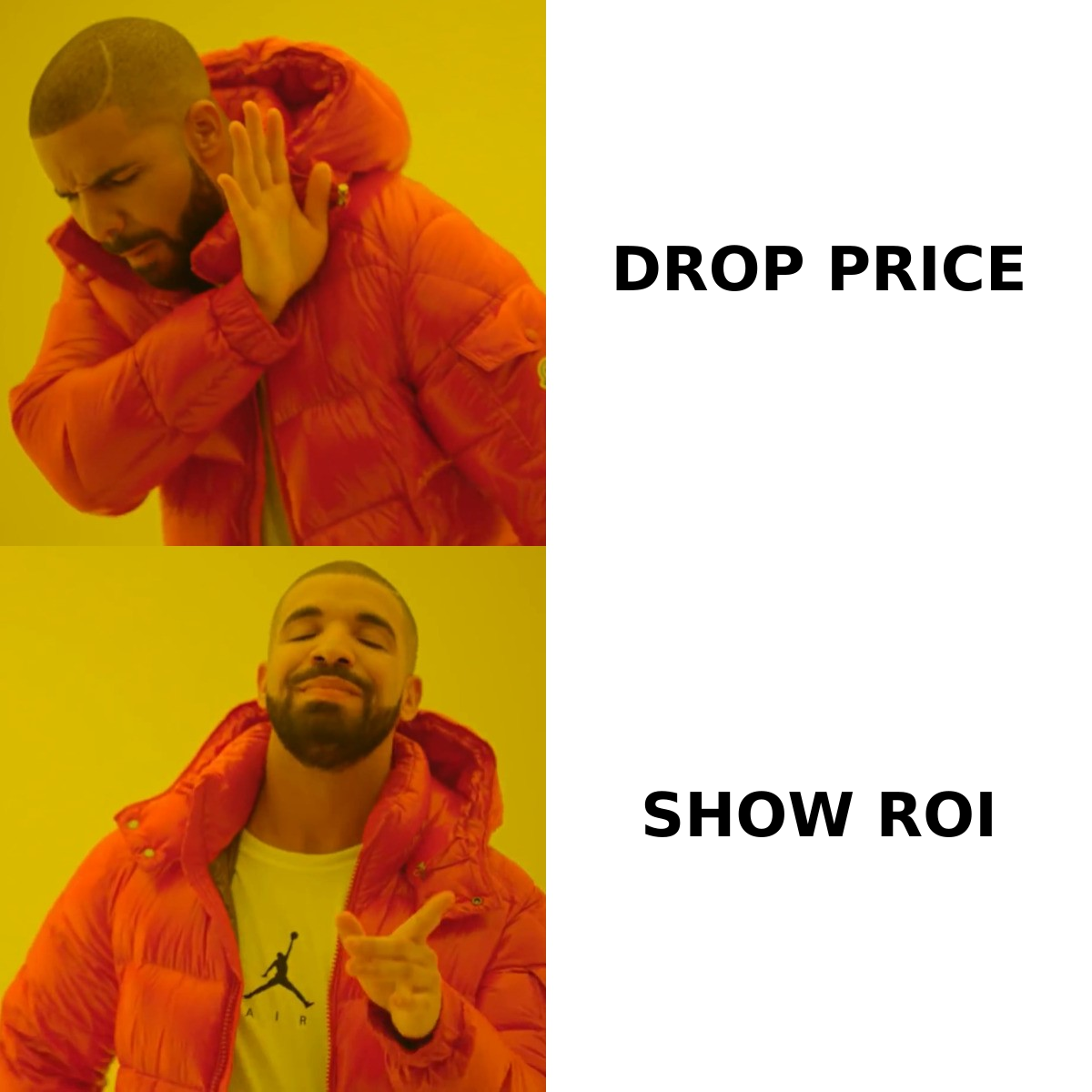
- Never lead with a discount. Discounting trains buyers to push and shrinks your margin permanently.
- Quantify the cost of inaction. A buyer who can't afford your tool often can't afford the status quo either — they just haven't done the math.
What is a budget objection, really?#
A budget objection is any pushback that frames your price as the obstacle: "too expensive," "no budget this quarter," "we can get it cheaper," or "I need to think about the cost." On the surface they all sound like money problems. They almost never are.
Think of it like a doctor hearing "my chest hurts." That's a symptom. It could be a pulled muscle, indigestion, or a heart attack — and the treatment for each is wildly different. Reaching for a discount when you hear a budget objection is like prescribing painkillers without a diagnosis. You might mask the issue, but you haven't solved it, and you've probably made it worse.
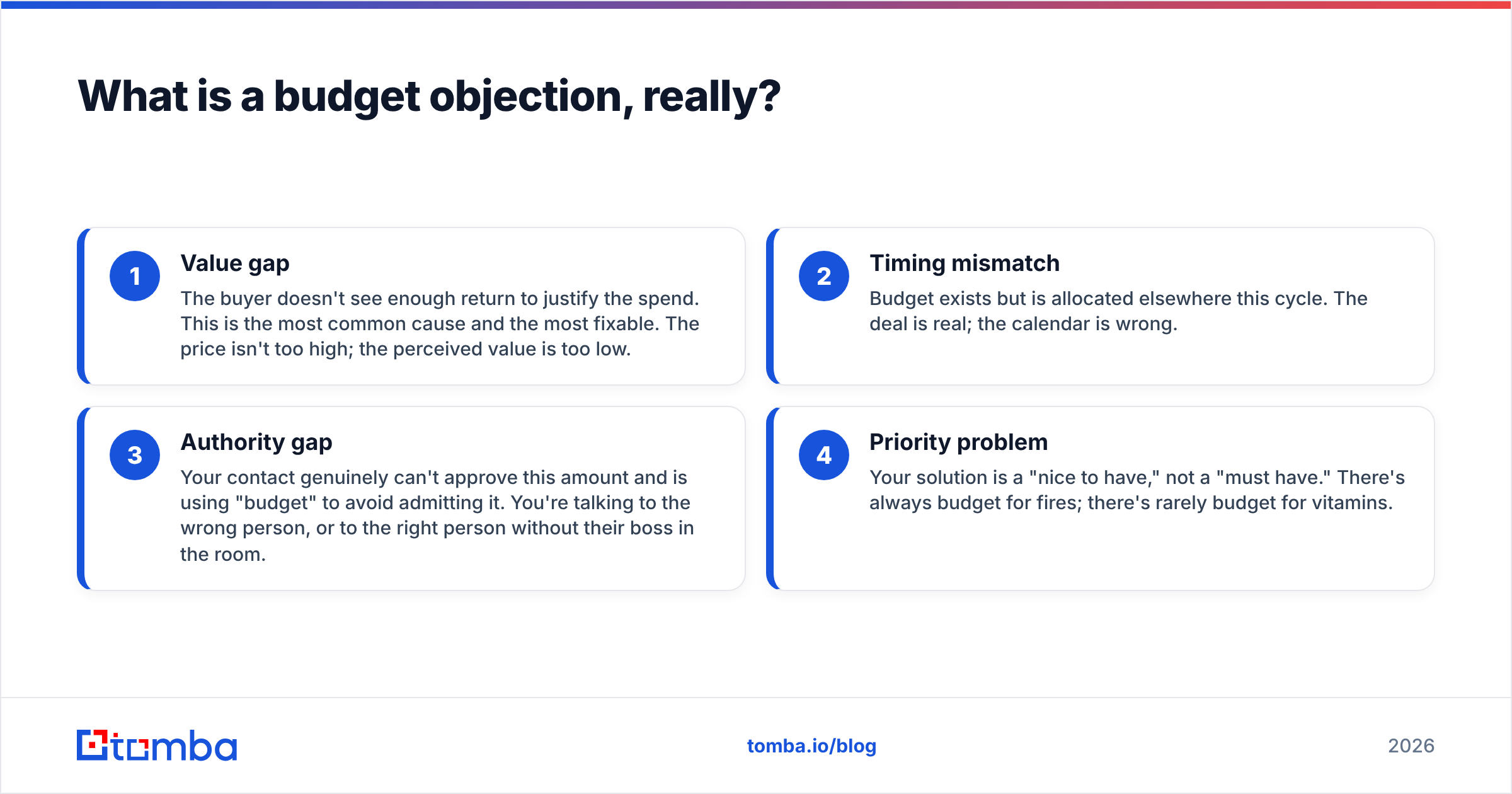
Here are the four root causes hiding behind most budget objections:
- Value gap — The buyer doesn't see enough return to justify the spend. This is the most common cause and the most fixable. The price isn't too high; the perceived value is too low.
- Timing mismatch — Budget exists but is allocated elsewhere this cycle. The deal is real; the calendar is wrong.
- Authority gap — Your contact genuinely can't approve this amount and is using "budget" to avoid admitting it. You're talking to the wrong person, or to the right person without their boss in the room.
- Priority problem — Your solution is a "nice to have," not a "must have." There's always budget for fires; there's rarely budget for vitamins.
Diagnose which one you're facing before you say another word. The script that wins a value-gap objection will actively lose a timing objection.
Why do most reps handle budget objections badly?#
Because they treat the objection as the start of a negotiation instead of the start of a diagnosis. The instinct is to respond to the literal words — "too expensive" — and the only lever that addresses "expensive" is price. So they drop it.
The problem with leading on price is structural. The moment you discount without being asked, three things happen: you signal your original price was inflated, you teach the buyer that pushing back is rewarded, and you anchor every future renewal lower. Research from sales-effectiveness firms consistently shows that reps who discount early close at lower rates than reps who hold price and reframe value — because the discount confirms the buyer's suspicion that the product wasn't worth the asking price.
The second failure mode is arguing. "Actually, when you look at the total cost of ownership..." The buyer raised an emotional, often face-saving objection, and you've responded with a spreadsheet lecture. You can be completely right and still lose, because nobody likes being corrected mid-objection.
The fix is a loop you run every time, regardless of the root cause.
What framework should you use? (Acknowledge → Isolate → Reframe → Close)#
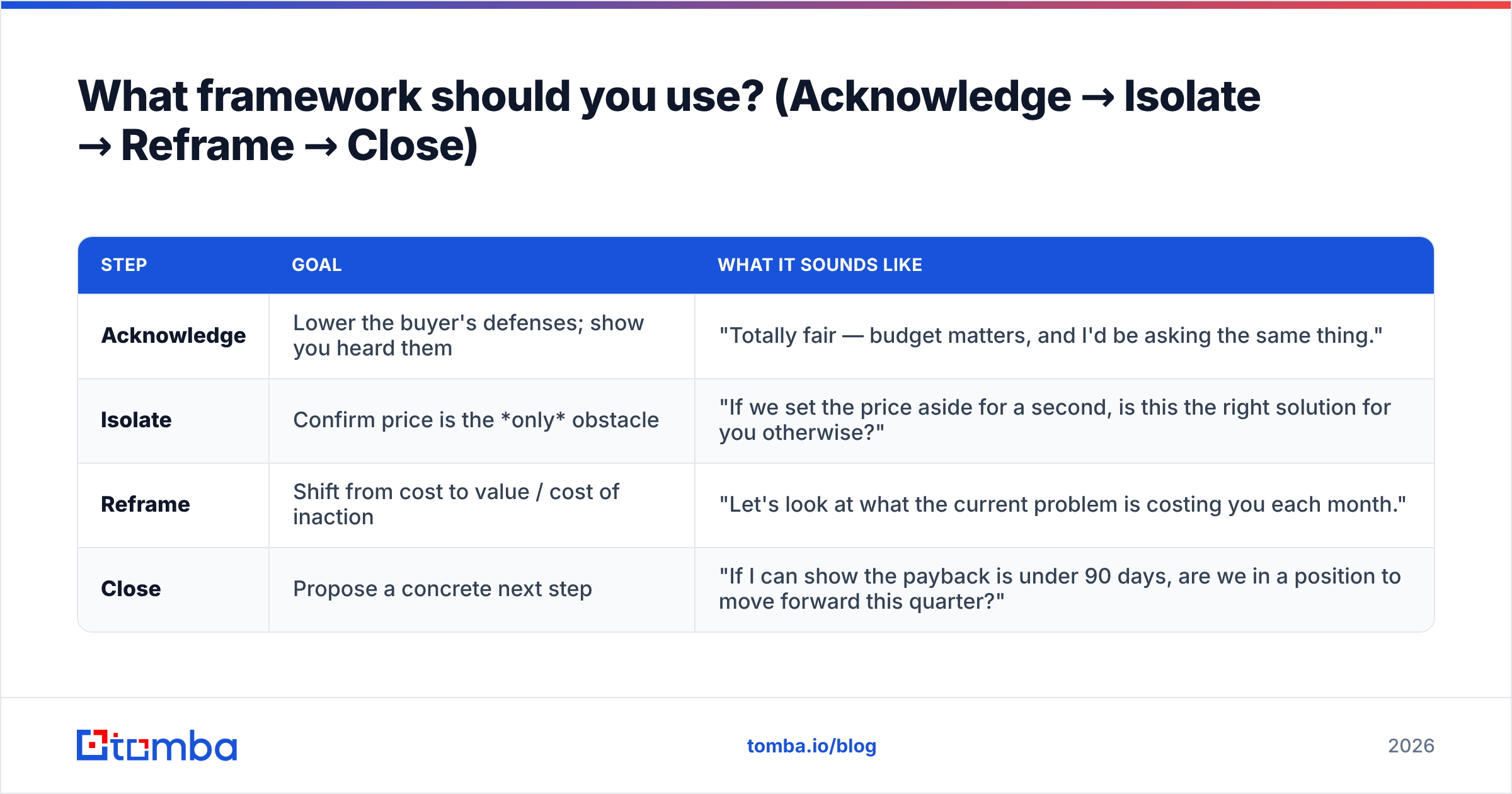
This four-step loop works because it slows you down, surfaces the real issue, and keeps you on the buyer's side of the table instead of across from them.
| Step | Goal | What it sounds like |
|---|---|---|
| Acknowledge | Lower the buyer's defenses; show you heard them | "Totally fair — budget matters, and I'd be asking the same thing." |
| Isolate | Confirm price is the only obstacle | "If we set the price aside for a second, is this the right solution for you otherwise?" |
| Reframe | Shift from cost to value / cost of inaction | "Let's look at what the current problem is costing you each month." |
| Close | Propose a concrete next step | "If I can show the payback is under 90 days, are we in a position to move forward this quarter?" |
The Isolate step is the one reps skip and the one that does the heavy lifting. When you ask "if price weren't an issue, is everything else a fit?" you get one of two answers. If they say yes, you've confirmed it's a pure budget conversation and you can reframe value with confidence. If they hesitate, the budget objection was a smokescreen — the real problem is trust, fit, or authority, and now you can address that instead of wasting your discount on a deal that wasn't going to close anyway.
Word-for-word scripts for the four root causes#
Diagnose first, then pick the matching script. Adapt the language to your voice — the structure matters more than the exact words.
Value gap — "It's too expensive."
"I hear that a lot, and it usually means the value isn't clear yet — which is on me. Can I ask: what would this need to do for you to make the price a no-brainer? ... Right, so if we're saving your team 10 hours a week, that's roughly [X] a month in recovered time. The subscription is a fraction of that. Does that change the math?"
Timing mismatch — "No budget until next quarter."
"Makes sense — budget cycles are real. Two options: we can line up a start date for Q[next] now so you lock today's pricing, or we run a paid pilot this quarter from a discretionary line so you walk into budget season with results, not a proposal. Which fits how your team buys?"
Authority gap — "I need to run the numbers."
"Happy to help with that. When you take this to [decision maker], what's the one number they'll want to see? Let's build that together so you're not defending it alone. Would it help if I joined that conversation to handle the technical questions?"
Priority problem — "It's not a priority right now."
"Fair. Out of curiosity, what is the top priority this quarter? ... Got it. Here's why I ask — [problem we solve] is usually what's quietly slowing those priorities down. If we could remove that drag, would it be worth 20 minutes to map it out?"
Notice none of these scripts touch the price. They change what the price is being compared to.
How do you quantify the cost of inaction?#
A buyer who says "we can't afford it" has almost always failed to calculate what not buying costs them. Your job is to make the status quo expensive in their mind.
Run the math out loud, using their numbers, not yours:
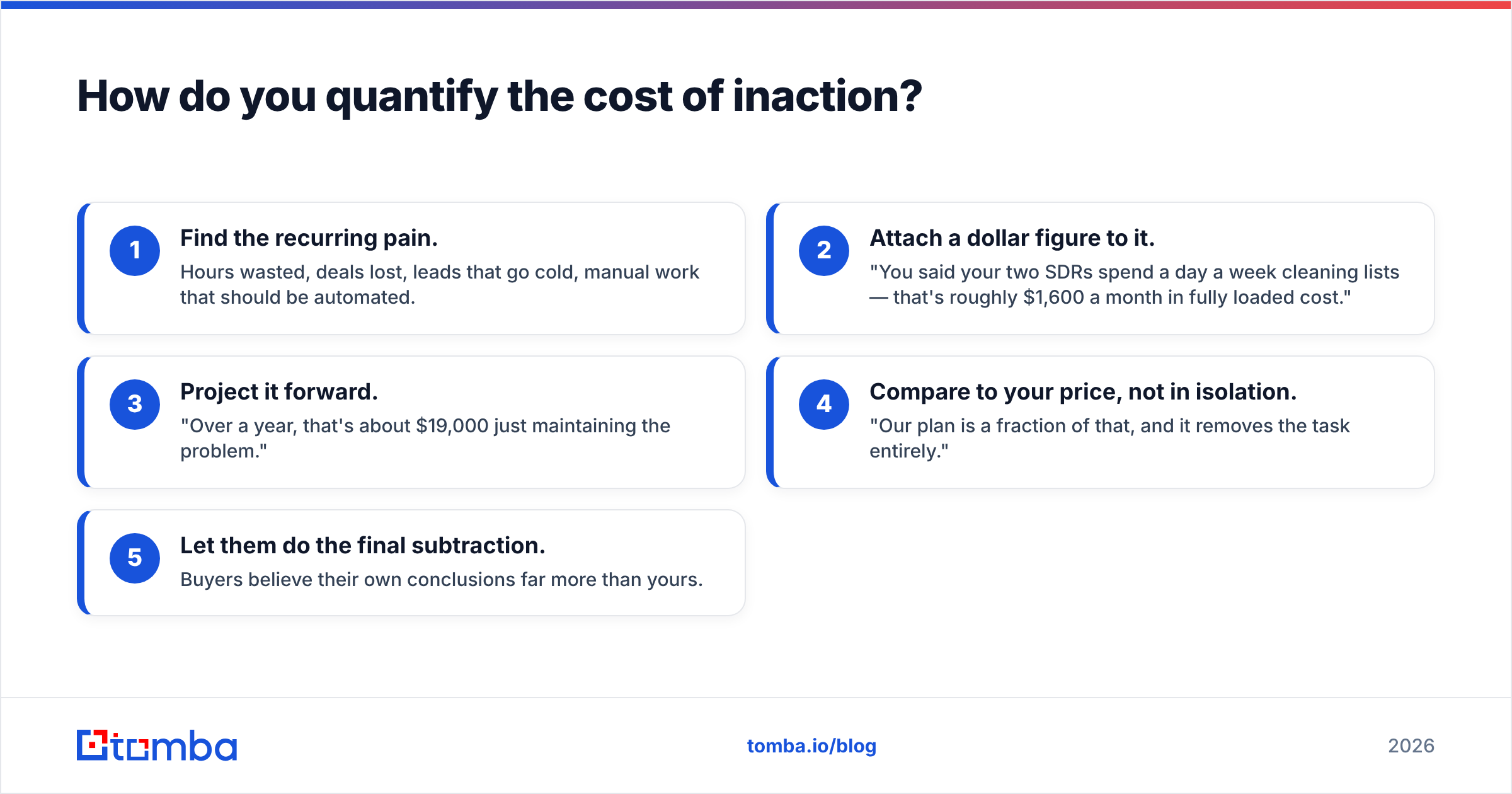
- Find the recurring pain. Hours wasted, deals lost, leads that go cold, manual work that should be automated.
- Attach a dollar figure to it. "You said your two SDRs spend a day a week cleaning lists — that's roughly $1,600 a month in fully loaded cost."
- Project it forward. "Over a year, that's about $19,000 just maintaining the problem."
- Compare to your price, not in isolation. "Our plan is a fraction of that, and it removes the task entirely."
- Let them do the final subtraction. Buyers believe their own conclusions far more than yours.
For sales teams specifically, the most expensive hidden cost is bad pipeline data. Reps burn hours chasing contacts who left the company, bounce emails that tank sender reputation, and book demos with people who can't buy. If your prospecting data is the leak, a tool like the Tomba Email Finder pays for itself by eliminating the wasted outreach — which is exactly the kind of "cost of inaction" math that dissolves a budget objection. The buyer isn't spending money; they're stopping a leak.
Can you prevent budget objections before they happen?#
Yes — and prevention beats handling every time. The best reps rarely hear late-stage budget objections because they qualify budget during discovery, when it's a neutral data point instead of a deal-ending wall.
Ask these early, conversationally:
- "Is there a budget allocated for solving this, or would we be building the case from scratch?"
- "When you've bought tools like this before, what range did they fall in?"
- "Who else signs off on a purchase this size?"
That last question doubles as authority qualification — it surfaces the MQL versus real-buyer distinction before you've invested ten hours in someone who can't say yes. The frameworks from established sales methodologies like HubSpot's guide to objection handling and qualification systems like BANT all share this core idea: budget is a discovery topic, not a closing surprise.
When you skip discovery qualification, you're effectively asking the buyer to fall in love with your product and invent a budget for it in the same conversation. That's two leaps. Split them.
Budget objection handling: what to do vs. what to avoid#
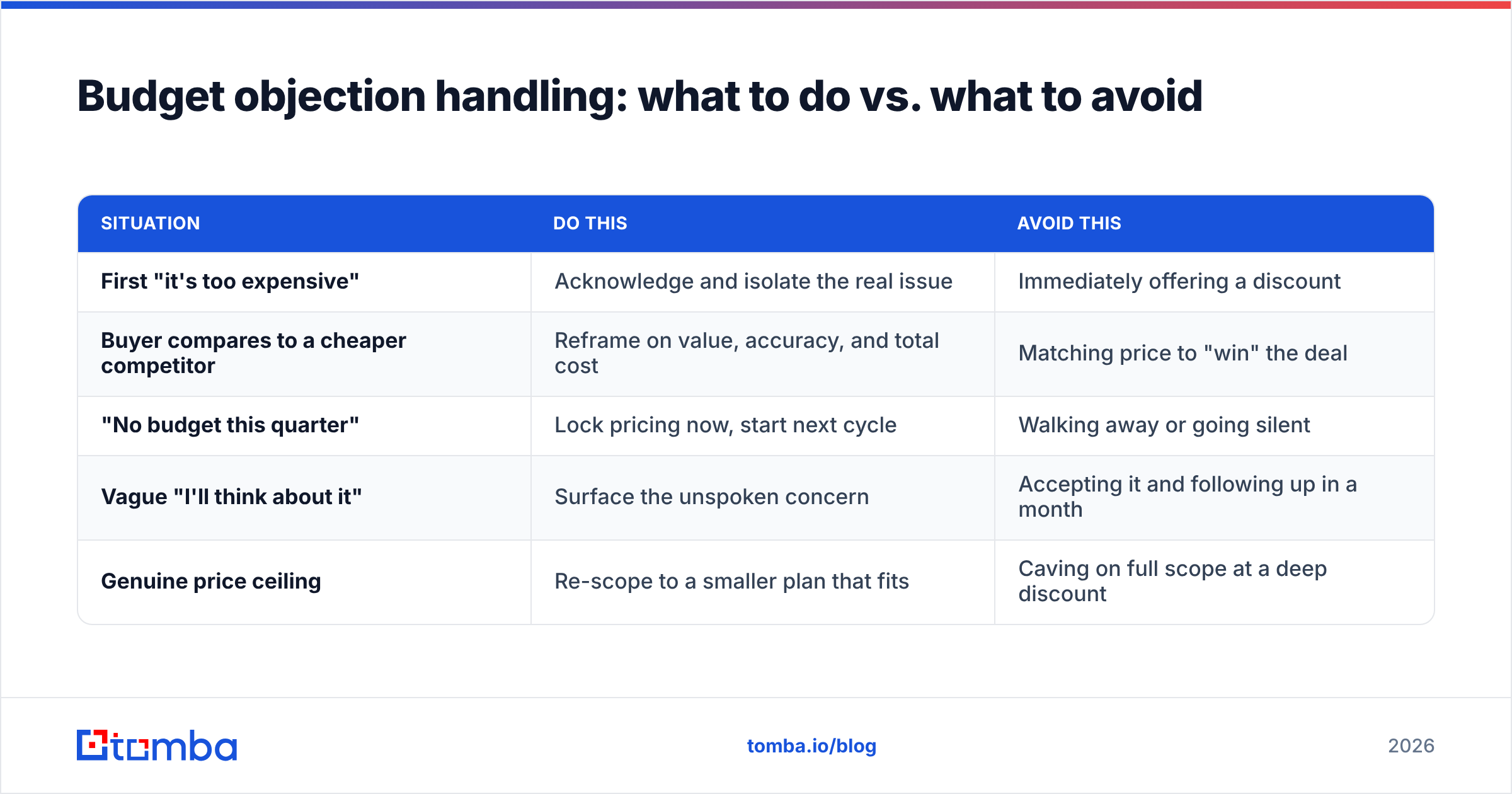
| Situation | Do this | Avoid this |
|---|---|---|
| First "it's too expensive" | Acknowledge and isolate the real issue | Immediately offering a discount |
| Buyer compares to a cheaper competitor | Reframe on value, accuracy, and total cost | Matching price to "win" the deal |
| "No budget this quarter" | Lock pricing now, start next cycle | Walking away or going silent |
| Vague "I'll think about it" | Surface the unspoken concern | Accepting it and following up in a month |
| Genuine price ceiling | Re-scope to a smaller plan that fits | Caving on full scope at a deep discount |
The re-scope move in that last row is underused. If a buyer truly can't reach your price, don't slash it — reduce the offer. Move them to a starter tier, fewer seats, or a narrower use case. You protect your per-unit value and create a natural expansion path. A buyer who starts on a $49/mo plan and sees results becomes a $249/mo customer next year; a buyer you discounted to $49 from $249 stays anchored at the discount forever.
How does data quality reduce price sensitivity?#
Here's the counterintuitive part: a large share of budget objections trace back to results, not pricing. When a buyer doubts your product will work, any price feels too high. When they're confident it'll deliver, price becomes a formality.
For prospecting and outreach tools, "will it work?" is really "is the data accurate?" Reps who've been burned by stale, bounce-heavy lists are naturally skeptical, and that skepticism shows up disguised as a budget objection. Address the real fear — accuracy and deliverability — and the price concern often evaporates.
This is why offering a real trial beats arguing about price. Let the buyer run your tool against their own list. When they see verified, deliverable contacts come back, the value gap closes itself. Pairing an email verifier with your finder so every address is confirmed before it hits a sequence is the kind of proof that makes a budget conversation short. You can compare what each tier includes on the Tomba pricing page, but the trial does more selling than the page ever will.
If you're evaluating tools yourself and want neutral, third-party signal, sites like G2 aggregate verified user reviews on accuracy and support — useful for separating marketing claims from actual performance before you commit budget.
What about competing on price directly?#
Sometimes the objection is genuine: a real competitor, a real cheaper quote. Don't panic and don't match blindly. Instead, expand the comparison.
A cheaper tool that returns 60% deliverable emails isn't cheaper — it's more expensive per usable contact, plus the hidden cost of damaged sender reputation when the bounces pile up. Walk the buyer through cost-per-result, not cost-per-license. If you sell on accuracy and they're comparing on sticker price, your job is to change the unit of measurement.
And if you genuinely lose on price to an inferior product, let it go. The customer who buys purely on price will churn for the same reason the moment someone undercuts you. Protecting margin sometimes means losing the deals that were never profitable.
Closing the loop#
Budget objection handling comes down to one discipline: refuse to accept "it's too expensive" at face value. Acknowledge it, isolate whether it's the real issue, reframe the conversation around value and the cost of inaction, and propose a concrete next step. Prevent what you can during discovery, and let proof — not discounts — do the convincing.
If the root of your team's budget objections is wasted spend on bad prospecting data, fix the leak at the source. The Tomba Email Finder returns verified, deliverable B2B emails by name, domain, or company — so your reps stop burning hours and credits on contacts who never existed. Start free with 25 searches a month, prove the ROI on your own list, and walk into your next budget conversation with results instead of a proposal.
// get started
Find, verify and enrich your first contacts today
Start on the free plan with 25 searches a month, then scale when your team is ready.
Free plan · No credit card required · GDPR & CCPA
// about the author