How to Build Rapport With Prospects in 2026 (Sales Guide)
Rapport is the difference between a deleted email and a booked meeting. Here is a concrete, research-backed system to build rapport with prospects in 2026 — without sounding fake.
Rapport is not small talk. It is the felt sense that you understand a prospect's world well enough to be worth their time. Get it right and discovery calls run themselves; get it wrong and even a perfect product demo lands flat. This guide breaks down how to build rapport with prospects in 2026 across email, phone, and social — with the research workflow that makes every opener feel earned instead of scripted.
TL;DR#
- Rapport is earned through relevance, not charm. The fastest way to build trust is to prove you did your homework before you reached out.
- Match the channel to the moment. Email earns the first reply, phone deepens it, LinkedIn keeps it warm between touches.
- Specificity beats flattery. "I saw your team shipped a new billing API" outperforms "Love what you're building" every time.
- Bad data kills rapport before you speak. Wrong name, wrong company, wrong role — one error and you are spam.
- Systematize it. Use a repeatable research-and-enrichment workflow so personalization scales past 10 prospects a week.
What does it actually mean to build rapport with prospects?#
Building rapport means creating a baseline of trust and mutual relevance so a prospect feels comfortable engaging with you honestly. Think of it like being a good dinner guest: you do not walk into someone's home and immediately ask for a favor. You notice the things they care about, you reference something real, and you give before you take. Technically, rapport lowers the perceived risk of the interaction, which is what makes a buyer willing to share budget, timeline, and pain.
The mistake most reps make is treating rapport as a personality trait — "I'm just naturally good with people." In reality it is a process. The reps who consistently book meetings are not more charismatic; they are more prepared. They know the prospect's role, their company's recent moves, and the one problem their solution actually solves for that segment.
That preparation is where rapport is won or lost. A 2025 HubSpot sales benchmark found that personalization tied to a specific business trigger meaningfully lifts reply rates over generic outreach — and the trigger only exists if you research first.
Why does rapport fail before the conversation even starts?#
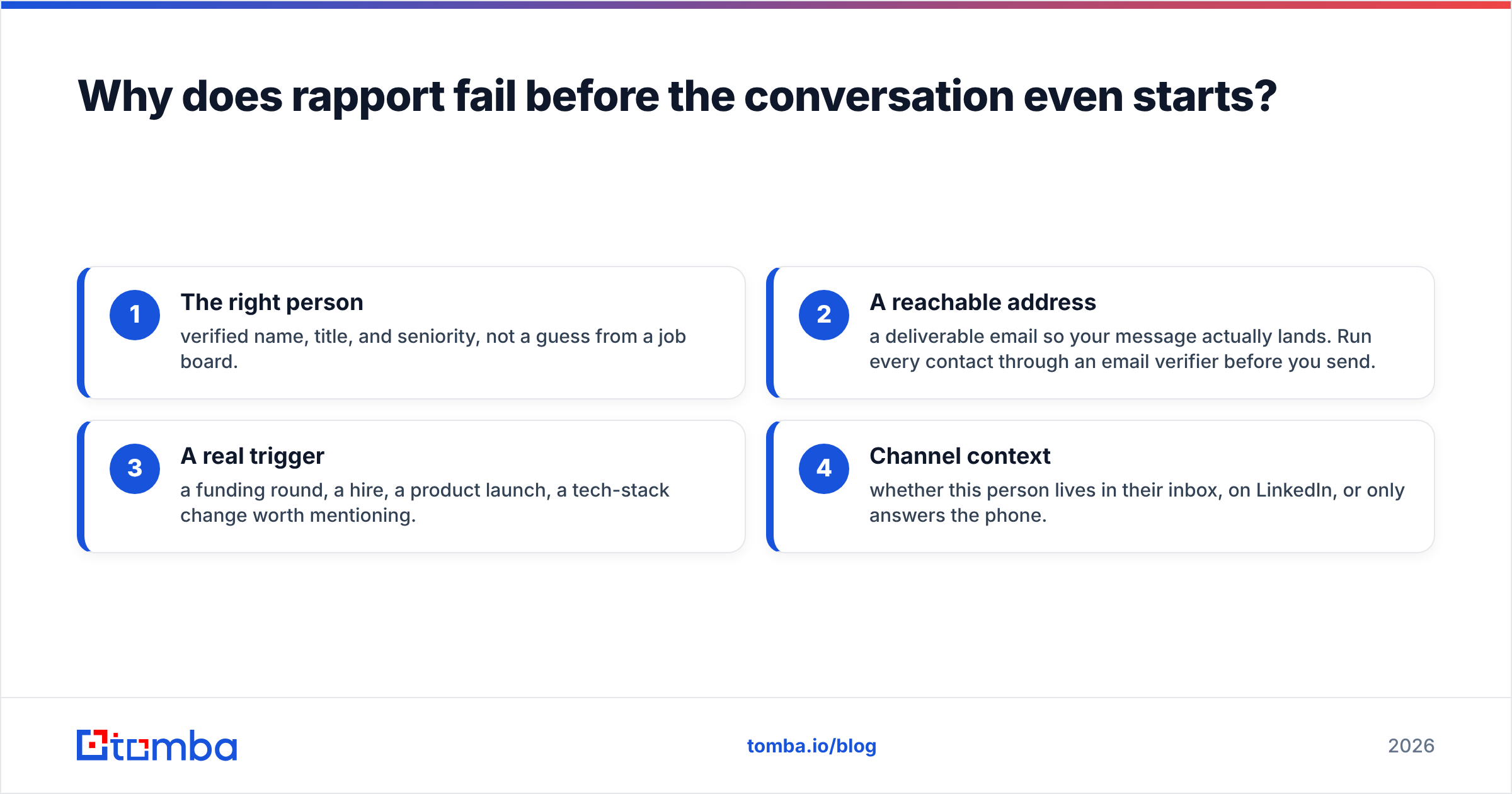
Rapport fails when your data is wrong. You can write the warmest, most human opener in the world, but if you address Sarah as "Steve," reference the wrong company, or pitch a CTO on a feature for marketers, you have signaled the opposite of rapport: you do not actually know them.
This is the unglamorous truth of modern prospecting. Tone and copy get all the attention, but the foundation is accuracy. Before you think about phrasing, you need:
- The right person — verified name, title, and seniority, not a guess from a job board.
- A reachable address — a deliverable email so your message actually lands. Run every contact through an email verifier before you send.
- A real trigger — a funding round, a hire, a product launch, a tech-stack change worth mentioning.
- Channel context — whether this person lives in their inbox, on LinkedIn, or only answers the phone.
Skip any of these and rapport becomes impossible, because the prospect's first impression is friction. If you are sending to outdated lists, no opener can save you — fix the data accuracy problem first.
How do you build rapport over email?#
Email is where most B2B rapport begins, so the first two lines carry the entire relationship. Lead with relevance, not with yourself. The structure that works:
- Line 1 — the observation. Something specific and recent about them. "Saw Acme just opened a London office" beats any compliment.
- Line 2 — the bridge. Connect that observation to a problem you understand. "Usually a second region means your support tooling gets stretched."
- Line 3 — the soft ask. Low-commitment, curiosity-driven. "Worth a 12-minute call to compare notes?"
Avoid the three rapport-killers: fake familiarity ("Hope you're crushing it!"), transparent flattery, and the wall-of-text pitch. Keep it under 90 words. The goal of email one is a reply, not a sale.
Personalization at scale is the hard part. Researching one prospect by hand is easy; researching 200 is a job. This is where a domain search and bulk enrichment step earns its keep — you pull the verified contacts and the company context in one pass, then layer the human observation on top.
Is phone or email better for deepening rapport?#
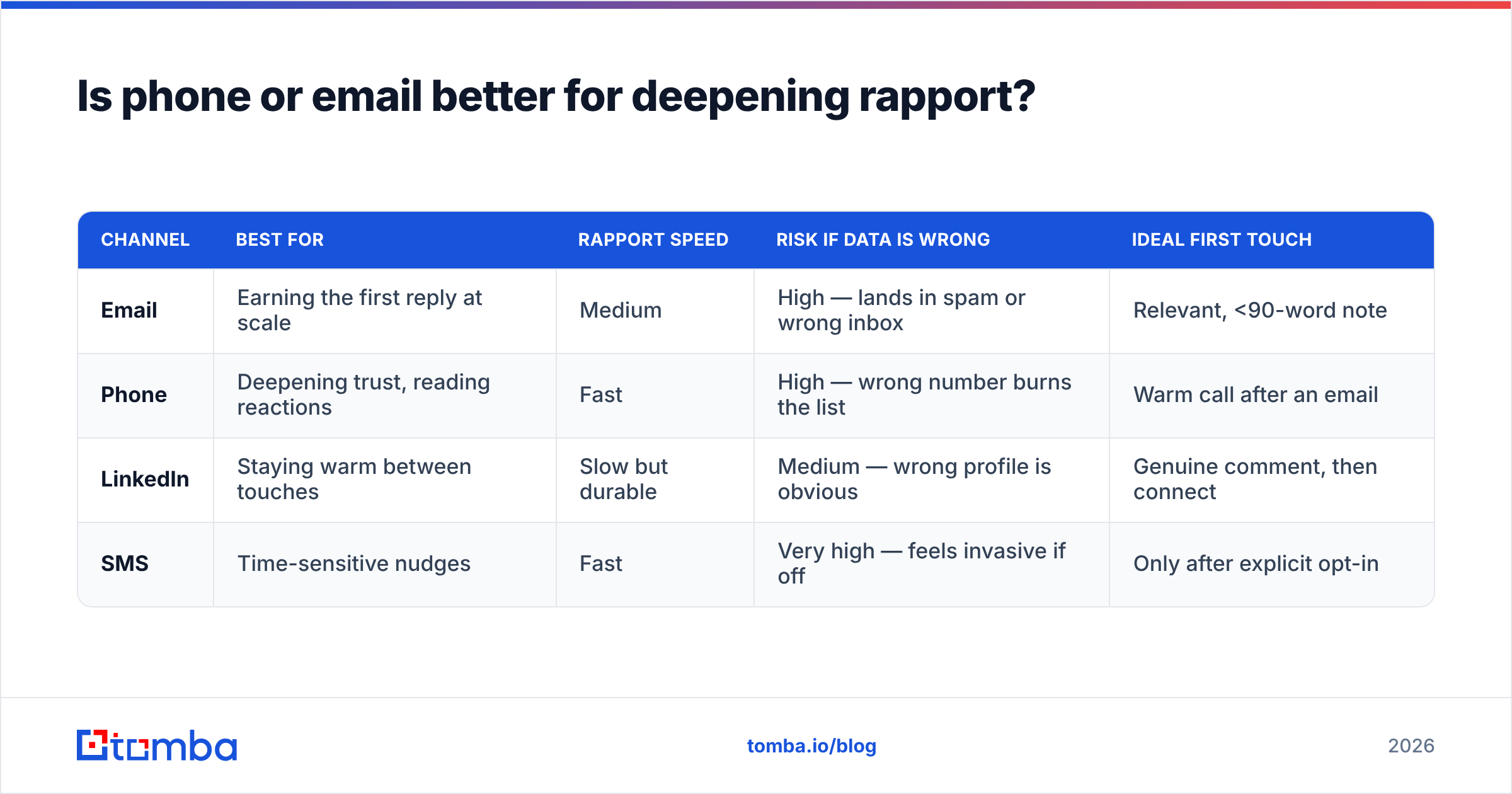
Neither wins alone — they compound. Email earns permission, the phone earns trust. Voice carries tone, pacing, and the ability to react in real time, which text never will. But cold-calling someone who has no idea who you are wastes the channel's biggest advantage. The sequence that builds rapport fastest is a coordinated one: a relevant email, a connection request, then a call that references both.
Here is how the primary channels compare for rapport-building specifically:
| Channel | Best for | Rapport speed | Risk if data is wrong | Ideal first touch |
|---|---|---|---|---|
| Earning the first reply at scale | Medium | High — lands in spam or wrong inbox | Relevant, <90-word note | |
| Phone | Deepening trust, reading reactions | Fast | High — wrong number burns the list | Warm call after an email |
| Staying warm between touches | Slow but durable | Medium — wrong profile is obvious | Genuine comment, then connect | |
| SMS | Time-sensitive nudges | Fast | Very high — feels invasive if off | Only after explicit opt-in |
To run a coordinated email-plus-phone play, you need both data points for the same person. Pulling a verified B2B phone number alongside the email means your call references the message they already saw — that continuity is rapport in action, not two cold strangers starting over.

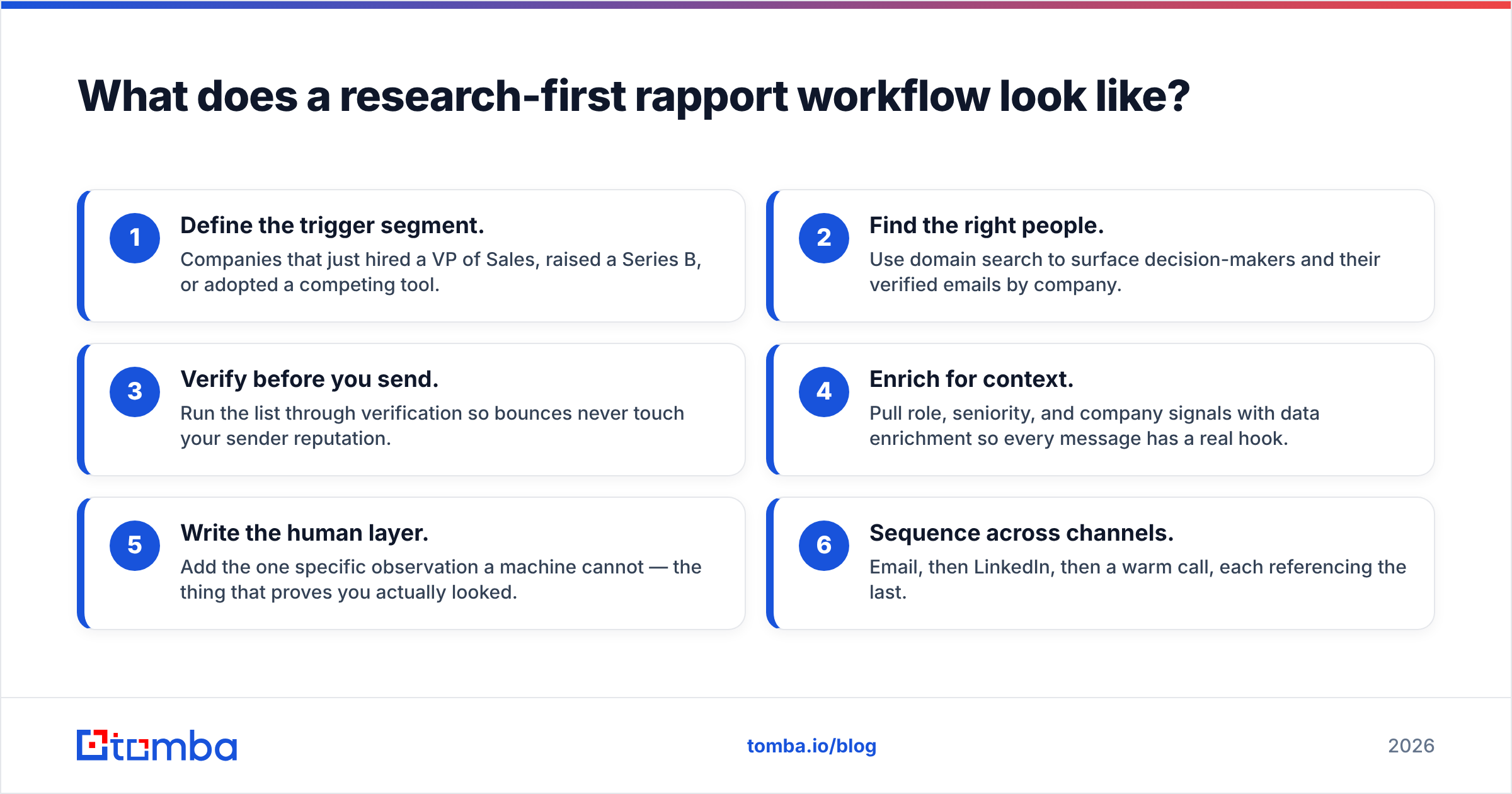
What does a research-first rapport workflow look like?#
A repeatable workflow turns rapport from a talent into a process. The point is to spend your creative energy on the human observation, and let tooling handle the lookup, verification, and enrichment underneath. A practical loop looks like this:
- Define the trigger segment. Companies that just hired a VP of Sales, raised a Series B, or adopted a competing tool.
- Find the right people. Use domain search to surface decision-makers and their verified emails by company.
- Verify before you send. Run the list through verification so bounces never touch your sender reputation.
- Enrich for context. Pull role, seniority, and company signals with data enrichment so every message has a real hook.
- Write the human layer. Add the one specific observation a machine cannot — the thing that proves you actually looked.
- Sequence across channels. Email, then LinkedIn, then a warm call, each referencing the last.
This is the difference between spraying 500 generic emails and sending 80 that feel hand-written. The second list books more meetings even though it is smaller, because every contact in it is accurate and every message is relevant.
How do you build rapport on a live call without sounding scripted?#
Drop the script and use a frame instead. A script makes you sound like every other rep; a frame keeps you flexible while staying intentional. The strongest live-call rapport techniques are simple and old:
- Mirror their pace and language. If they are terse, be terse. If they use a specific term for their problem, use that term back.
- Lead with a permission question. "Did I catch you at an okay time?" respects their autonomy and immediately lowers defenses.
- Reference the prior touch. "You opened the note I sent about your London office — figured I'd call rather than chase by email." This proves continuity.
- Listen more than you talk. The 43/57 talk-to-listen ratio that Gong has highlighted in call research is a rapport signal, not just a closing one.
- Name the tension. "You probably get ten of these calls a week" disarms skepticism by acknowledging it out loud.
Rapport on a call is mostly restraint. The rep who resists pitching for the first two minutes — who asks, listens, and reflects back — earns the right to keep talking.
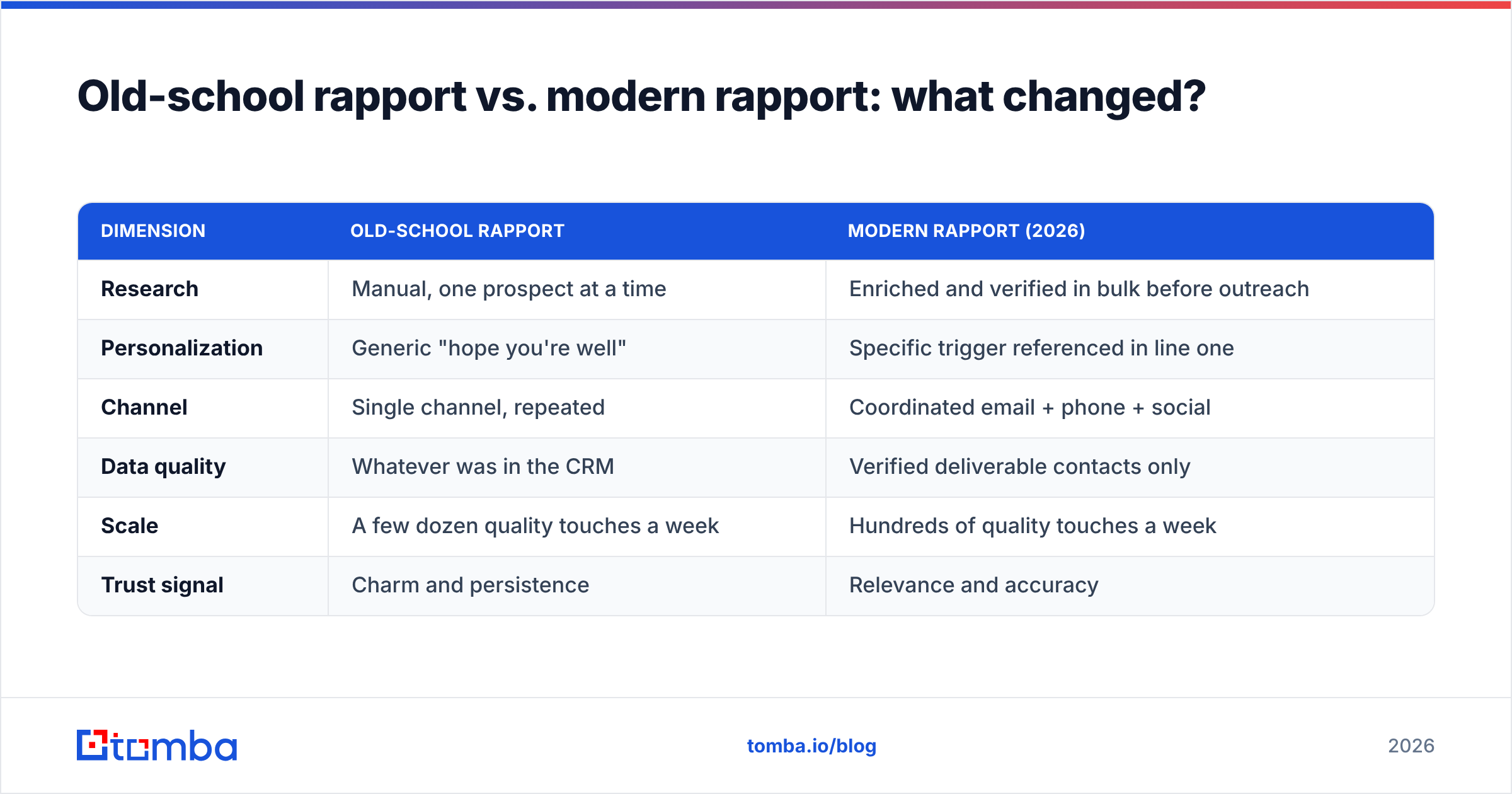
Old-school rapport vs. modern rapport: what changed?#
The principles are timeless; the execution is faster and more data-driven. Here is the contrast:
| Dimension | Old-school rapport | Modern rapport (2026) |
|---|---|---|
| Research | Manual, one prospect at a time | Enriched and verified in bulk before outreach |
| Personalization | Generic "hope you're well" | Specific trigger referenced in line one |
| Channel | Single channel, repeated | Coordinated email + phone + social |
| Data quality | Whatever was in the CRM | Verified deliverable contacts only |
| Scale | A few dozen quality touches a week | Hundreds of quality touches a week |
| Trust signal | Charm and persistence | Relevance and accuracy |
The losers in this shift are reps still relying on charm over preparation. The winners pair genuine human warmth with a data foundation that makes warmth credible at scale. You cannot fake "I understand your business" — you have to actually know it, and knowing it for hundreds of prospects requires the right Tomba pricing tier and tooling behind you.
What are the most common rapport mistakes to avoid?#
Most rapport failures come down to a handful of repeatable errors. Watch for these:
- Premature pitching. Asking for the sale before establishing relevance. Rapport first, offer second.
- Manufactured intimacy. "How's the family?" to someone you have never met reads as manipulation.
- Researching the company but not the person. Decision-makers want to feel seen as individuals, not as logos.
- Ignoring deliverability. A brilliant email in the spam folder builds zero rapport. Protect your sender reputation by only sending to verified addresses.
- One-and-done outreach. Rapport compounds over touches. A single email is an introduction, not a relationship.
- Talking past objections. When a prospect pushes back, acknowledge it before you respond. Steamrolling destroys trust instantly.
Avoiding these is less about technique and more about discipline. Slow down, verify, personalize, and let relevance do the heavy lifting.
How do you measure whether your rapport is working?#
Rapport is invisible, but its effects are measurable. Track these signals over a rolling 30-day window:
- Reply rate, not just open rate — replies mean your relevance landed.
- Positive sentiment in replies — "Tell me more" versus "Remove me."
- Meeting-hold rate — booked meetings that actually happen reflect trust, not curiosity.
- Multi-thread rate — prospects who introduce you to colleagues felt enough rapport to vouch for you.
If reply quality is low, the problem is almost always upstream: weak research, generic copy, or bad data. Fix the foundation and the conversation metrics follow.
Build rapport on a foundation of accurate data#
Rapport is relevance delivered to the right person, reliably. You can master every opener in this guide, but if your contacts are wrong or undeliverable, none of it reaches a human. Start with accuracy. The Tomba Email Finder gives you verified, deliverable email addresses by name, company, or domain — so every personalized message you write actually lands in front of the prospect you researched. Pair it with verification and enrichment, layer your human observation on top, and you turn cold contacts into conversations that feel earned. Begin with the free tier of 25 searches, then scale your rapport-building as your pipeline grows.
// get started
Find, verify and enrich your first contacts today
Start on the free plan with 25 searches a month, then scale when your team is ready.
Free plan · No credit card required · GDPR & CCPA
// about the author