Building a Sales Pitch in 2026: Framework, Examples & Tips
Building a sales pitch that actually converts isn't about smooth talk. It's a repeatable structure, sharp research, and tight timing. Here's the 2026 framework, with examples and a side-by-side of pitch types.
Building a sales pitch is less about charisma and more about engineering. The reps who close consistently aren't winging it — they run a tested structure, fed by real data, delivered at the right moment. This guide breaks down exactly how to build one in 2026, with examples, a template, and a comparison of the main pitch formats so you pick the right one for the situation.
TL;DR#
- A great pitch is a structure, not a script — research, hook, value, proof, objection-handling, and a single clear ask.
- Research is 50% of the win. A pitch built on accurate contact and company data converts far better than a generic one.
- Match the format to the moment — an elevator pitch, a cold email, and a demo deck are different tools.
- Lead with the prospect's problem, not your product. Buyers care about outcomes, not features.
- One ask per pitch. Confused prospects don't buy; they stall.
What is a sales pitch, really?#
A sales pitch is a focused, persuasive message that moves a specific prospect one step closer to a buying decision. Think of it like a doctor's consultation: a good doctor doesn't list every treatment they offer the moment you walk in. They ask where it hurts, diagnose the problem, then prescribe the one thing that fixes it. A weak pitch is the opposite — a salesperson reciting the full menu before they know what's wrong.
Technically, a pitch is a compressed argument. You're claiming "your situation will improve if you do X," and every line either supports that claim or gets cut. The most common failure in building a sales pitch is bloat: too many features, too many proof points, too many asks. Compression is the skill.
Pitches also aren't one-size-fits-all. The 20-second version you give in a hallway is structurally different from the 12-slide deck you present in a discovery call. We'll compare those formats below, but the underlying logic — diagnose, then prescribe — stays constant.
What are the core components of building a sales pitch?#
Every pitch that converts shares the same skeleton. Memorize these six parts and you can assemble a pitch for any channel in minutes:
- The hook — A first line that earns the next ten seconds. Reference a trigger event, a specific pain, or a surprising stat relevant to the prospect.
- The problem — Name the pain in the prospect's own language. If they nod, you've earned the right to keep talking.
- The value — The outcome you deliver, framed as their result ("cut prospecting time in half"), not your feature ("we have a Chrome extension").
- The proof — One concrete piece of evidence: a metric, a comparable customer, a short case study. One, not five.
- The objection pre-empt — Address the obvious "yeah, but…" before they say it. Pre-handling builds trust.
- The ask — A single, specific next step. "Can we book 20 minutes Thursday?" beats "let me know if you're interested."
The mistake most reps make is treating these as optional or reordering them randomly. They aren't optional. Skip the proof and you sound like hype. Skip the ask and the conversation evaporates. The order matters too — proof before problem feels like bragging, and an ask before value feels pushy.
How do you research before building a sales pitch?#
Research is where pitches are won or lost, and it happens before you write a single word. A relevant pitch beats an eloquent one every time. The prospect doesn't care how polished you are — they care whether you understand their world.
Here's the practical research stack:
- The person — role, tenure, recent posts or job changes, and a verified email so your message actually lands.
- The company — headcount, funding, tech stack, recent news, and the specific team that owns your problem.
- The trigger — a hiring spike, a new tool adoption, a leadership change, or a public goal that makes now the right time.
- The format — how this person prefers to be reached, and what their inbox already looks like.
This is also where data quality quietly decides your outcome. If you've researched the perfect angle but your message bounces, none of it matters. That's why your prospecting workflow should start with a reliable email finder and a verification pass before outreach. Building a sales pitch on top of a clean, accurate contact list is the difference between a 2% reply rate and a 12% one.
For account-level research, domain search lets you map every relevant contact at a target company, so you pitch the actual decision-maker instead of whoever you found first. And once you've got a list, data enrichment fills in the role, seniority, and company details that make personalization fast instead of manual.
According to HubSpot's sales research, personalization and relevance are consistently among the strongest predictors of response — and you can't personalize what you haven't researched.
What's the best sales pitch structure for each format?#
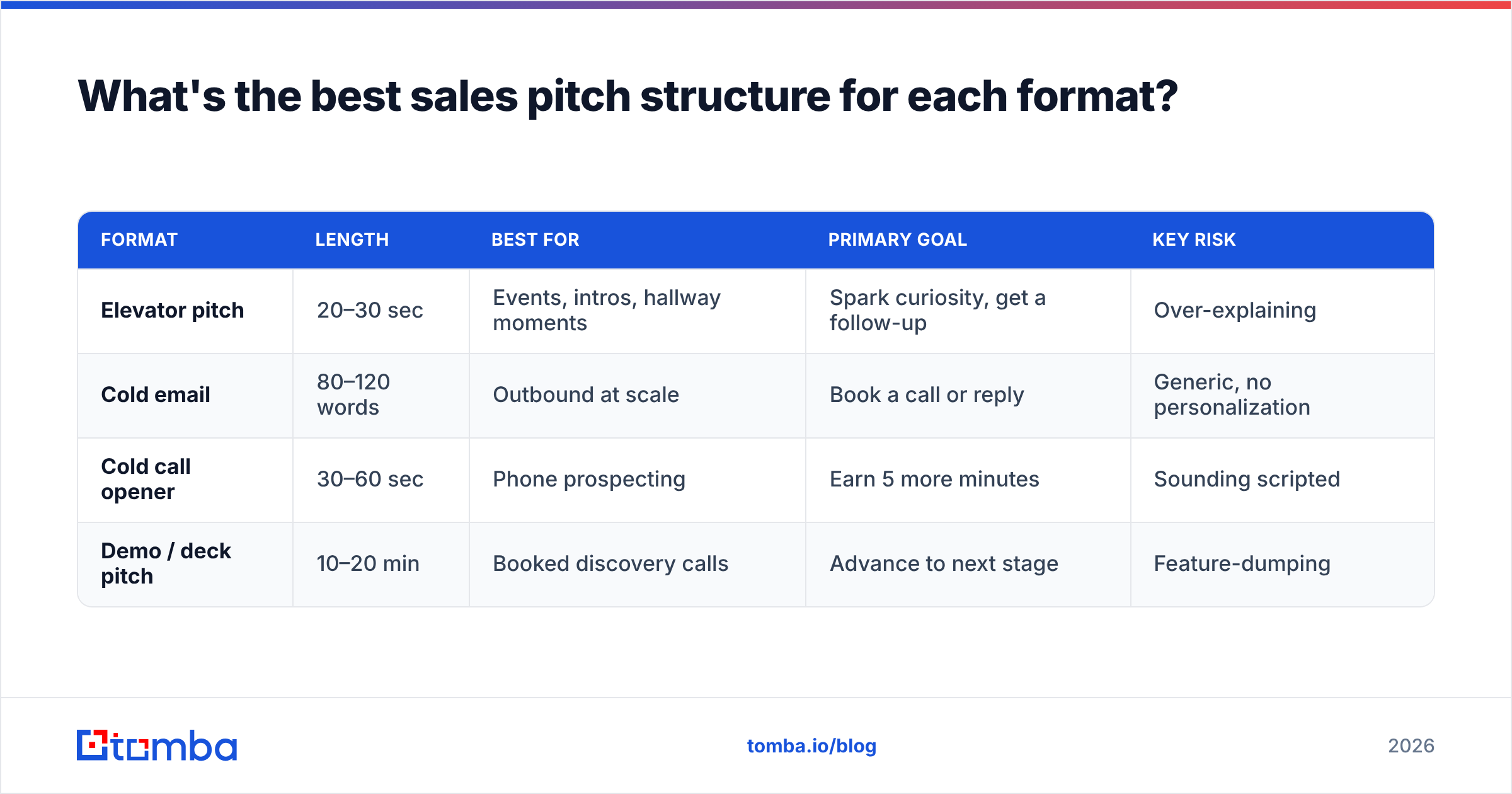
Different situations need different pitch shapes. Use the wrong format and even a great message lands flat. Here's a side-by-side of the four formats you'll use most, when to reach for each, and what "good" looks like.
| Format | Length | Best for | Primary goal | Key risk |
|---|---|---|---|---|
| Elevator pitch | 20–30 sec | Events, intros, hallway moments | Spark curiosity, get a follow-up | Over-explaining |
| Cold email | 80–120 words | Outbound at scale | Book a call or reply | Generic, no personalization |
| Cold call opener | 30–60 sec | Phone prospecting | Earn 5 more minutes | Sounding scripted |
| Demo / deck pitch | 10–20 min | Booked discovery calls | Advance to next stage | Feature-dumping |
Notice the pattern: the shorter the format, the more ruthless the compression. An elevator pitch has room for a hook and a value line, nothing else. A demo has room to develop proof and handle objections in depth. Building a sales pitch well means knowing which parts to expand and which to cut for the channel you're in.
A quick example of each in action:
- Elevator: "We help B2B sales teams stop wasting time on bad contact data — most cut their prospecting time roughly in half. Mind if I send you a one-pager?"
- Cold email: Open with the trigger ("Saw you're hiring three SDRs"), name the problem ("scaling outbound usually means data quality drops"), give the value and proof in one line, then ask for 20 minutes.
- Cold call: "Hi Sarah — I know I'm interrupting. Thirty seconds and then I'll let you decide if it's worth more?" Permission-based openers outperform pitches that barrel ahead.
- Demo: Diagnose first ("walk me through how your team finds contacts today"), then map every slide to what they just told you.
If phone is part of your motion, pairing a tight call opener with verified B2B phone numbers keeps your connect rate from cratering on dead lines.
How do you make a sales pitch persuasive without sounding pushy?#
The fastest way to sound pushy is to make the pitch about you. Flip it. Persuasion in 2026 is built on relevance and restraint, not pressure. Buyers have infinite alternatives and zero patience for hype.

A few principles that consistently move pitches from pushy to compelling:
- Use their words. Mirror the language from their job posting, LinkedIn, or website. It signals you did the work.
- Quantify the outcome. "Save time" is forgettable. "Cut list-building from 3 hours to 30 minutes" sticks.
- Show, don't claim. A 15-second screen recording or a single hard metric beats three adjectives.
- Give them an out. "If this isn't a priority right now, no worries" lowers defenses and, paradoxically, raises replies.
- One ask. Every additional ask halves the odds of any of them happening.
There's also a structural trick from behavioral research: lead with the problem, not the solution. When you name a pain accurately, the prospect's brain fills in the urgency for you. Gartner's B2B buying research shows buyers spend the majority of their journey not talking to vendors — which means your pitch has to do its persuading in a very small window. Relevance is how you win that window.
What are the most common sales pitch mistakes?#
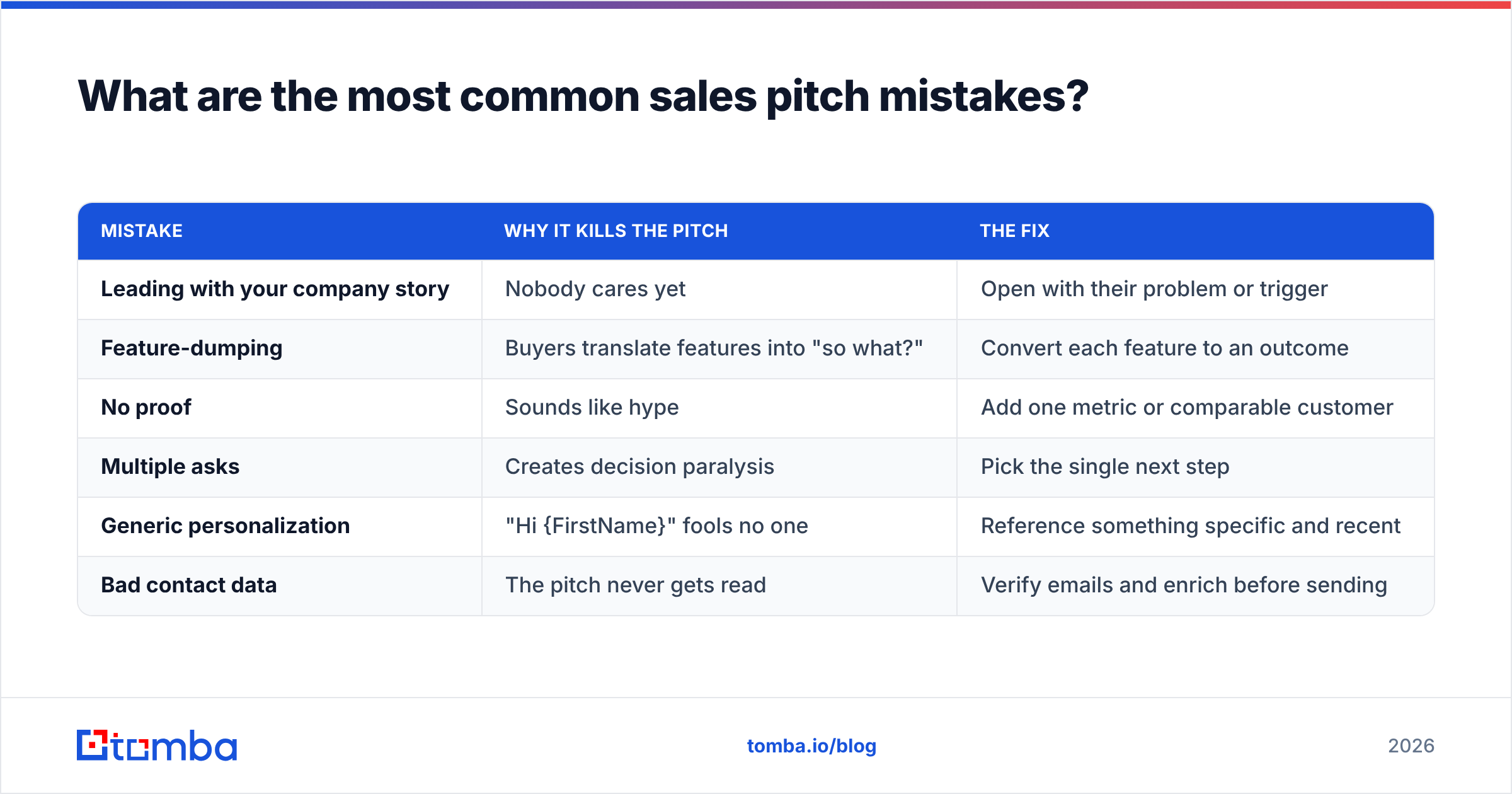
Most weak pitches fail for predictable reasons. Run this checklist against your last five pitches and you'll likely spot two or three:
| Mistake | Why it kills the pitch | The fix |
|---|---|---|
| Leading with your company story | Nobody cares yet | Open with their problem or trigger |
| Feature-dumping | Buyers translate features into "so what?" | Convert each feature to an outcome |
| No proof | Sounds like hype | Add one metric or comparable customer |
| Multiple asks | Creates decision paralysis | Pick the single next step |
| Generic personalization | "Hi {FirstName}" fools no one | Reference something specific and recent |
| Bad contact data | The pitch never gets read | Verify emails and enrich before sending |
That last row is the silent killer. You can nail every other element and still get nowhere if your message bounces or reaches the wrong person. Before any campaign, run your list through an email verifier so your carefully built pitch actually reaches a human inbox. A bounced pitch is a 0% conversion rate no matter how good the copy is.
How do you build a repeatable sales pitch process?#
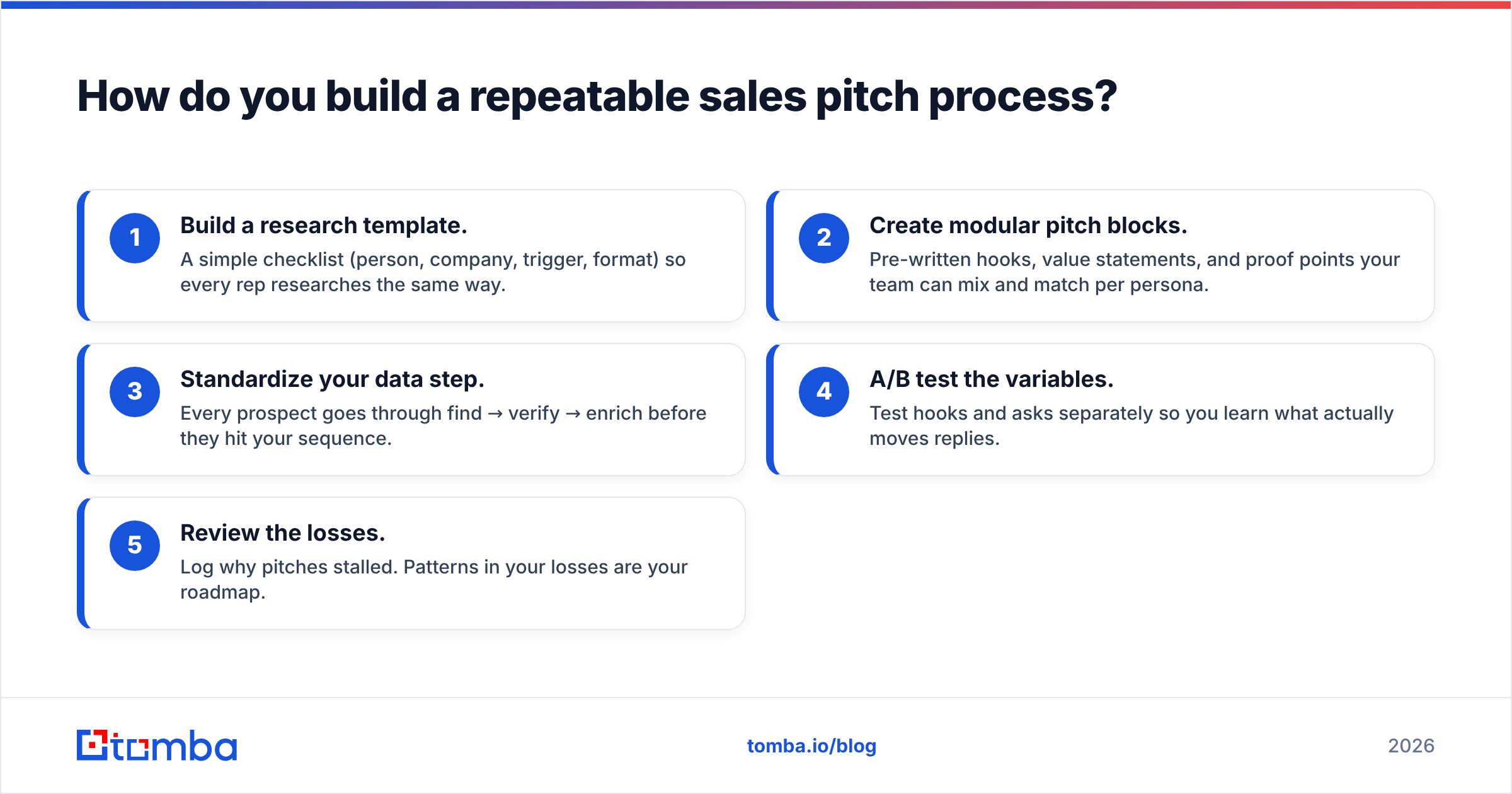
The goal isn't one great pitch — it's a system that produces good pitches on demand. Here's how top teams operationalize it:
- Build a research template. A simple checklist (person, company, trigger, format) so every rep researches the same way.
- Create modular pitch blocks. Pre-written hooks, value statements, and proof points your team can mix and match per persona.
- Standardize your data step. Every prospect goes through find → verify → enrich before they hit your sequence.
- A/B test the variables. Test hooks and asks separately so you learn what actually moves replies.
- Review the losses. Log why pitches stalled. Patterns in your losses are your roadmap.
For teams running this at volume, automating the data layer matters most. A bulk email finder lets you research and verify hundreds of contacts at once, so your reps spend their time pitching instead of hunting for addresses. The pitch is the creative part; the data should be the boring, reliable part.
This is also where consistency compounds. When every rep follows the same structure and works from the same clean data, your pipeline becomes predictable — and a predictable pitch process is what turns a few good closers into a whole team that hits quota. Vendor-neutral review sites like G2 are full of teams reporting that the bottleneck was never talent; it was the messy, manual front end of prospecting.
How long should a sales pitch be?#
Short answer: as short as it can be while still doing its job. A cold email pitch should run 80–120 words. An elevator pitch is 20–30 seconds. A discovery-call pitch can stretch to 15–20 minutes because it's a dialogue, not a monologue.
The real metric isn't word count — it's how fast you get to relevance. If your first two sentences don't make the prospect think "this is about me," length won't save you. Cut everything that isn't the hook, the value, the proof, and the ask, then cut a little more.
Putting it all together#
Building a sales pitch that converts comes down to three things: research that makes you relevant, a structure that makes you clear, and data that makes sure you're heard. Skip any one and the other two can't carry the load. The reps who win in 2026 aren't the smoothest talkers — they're the ones who show up already understanding the prospect's world and asking for exactly one next step.
Start with the foundation everything else depends on: knowing you're reaching the right person at a real, verified address. Tomba's Email Finder lets you find and verify professional emails by name, company, or domain, so the pitch you worked hard to build actually lands in the right inbox. The free tier gives you 25 searches a month to test it; paid plans start at $49/mo on the Starter tier — see full Tomba pricing for Growth ($99/mo) and Pro ($249/mo). Build the pitch, but build it on data you can trust.
// get started
Find, verify and enrich your first contacts today
Start on the free plan with 25 searches a month, then scale when your team is ready.
Free plan · No credit card required · GDPR & CCPA
// about the author