How to Reach Business Decision Makers in 2026 (B2B Playbook)
Stop pitching gatekeepers. Learn how to identify, map, and reach the business decision makers who actually sign B2B deals — with verified contact data.
Most B2B deals stall for one boring reason: the rep is talking to the wrong person. You can write the sharpest cold email of your life, but if it lands in the inbox of someone who can't sign, approve budget, or even forward it internally, you've wasted the touch. Reaching business decision makers — the people who actually control the outcome — is the difference between a pipeline that closes and a pipeline that just looks busy.
This guide breaks down who decision makers actually are in 2026, how to map them inside an account, and how to reach them with data that doesn't bounce.
TL;DR#
- Business decision makers are the people with budget authority, veto power, or sign-off on a purchase — not just anyone with a senior title.
- Modern B2B purchases involve a buying committee of 6–10 people (per Gartner), so you need to map a group, not chase one hero contact.
- Title alone is a weak signal. Qualify by authority, budget, and pain ownership before you spend a touch.
- Reaching them takes three things: the right person, a verified contact channel, and a reason to care.
- Verified email and phone data — like what you get from a email finder plus verification — is what keeps your outreach out of spam and in front of the buyer.
Who counts as a business decision maker?#
A business decision maker is anyone who can move a deal forward or kill it. That sounds obvious, but it trips up most reps because they equate "senior title" with "decision maker." A VP of Engineering with no budget line is less of a decision maker for your $2k tool than the team lead who owns the problem and has a discretionary spend.
Think of an account like a household deciding on a kitchen renovation. The person who signs the check (economic buyer) isn't always the one who picked the contractor (technical buyer), and neither is the person who has to live with the result every day (the end user who becomes your champion). All three shape the decision. Sell to only one and the deal wobbles.
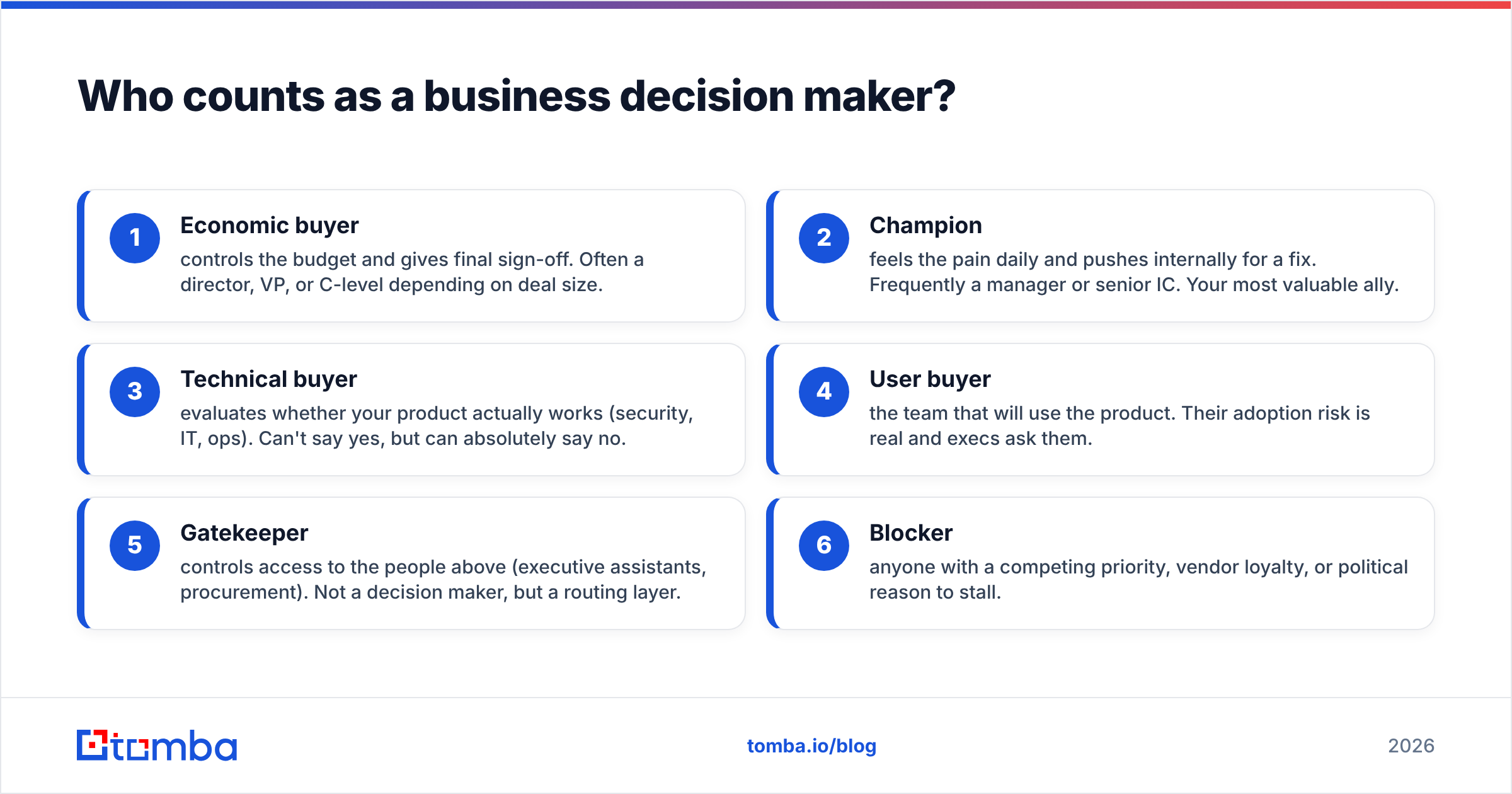
Here's how the roles typically break down inside a B2B buying committee:
- Economic buyer — controls the budget and gives final sign-off. Often a director, VP, or C-level depending on deal size.
- Champion — feels the pain daily and pushes internally for a fix. Frequently a manager or senior IC. Your most valuable ally.
- Technical buyer — evaluates whether your product actually works (security, IT, ops). Can't say yes, but can absolutely say no.
- User buyer — the team that will use the product. Their adoption risk is real and execs ask them.
- Gatekeeper — controls access to the people above (executive assistants, procurement). Not a decision maker, but a routing layer.
- Blocker — anyone with a competing priority, vendor loyalty, or political reason to stall.
The mistake is treating these as one person. In a deal over ~$25k, they almost never are.
Why is reaching decision makers harder in 2026?#
Three structural shifts made decision makers harder to reach than they were even three years ago.
First, buying committees grew. Gartner's research has consistently shown the typical B2B purchase now involves around 6 to 10 stakeholders, each armed with their own stack of conflicting information. You're not persuading a person; you're arming a committee.
Second, buyers self-educate before they talk to you. By the time a decision maker replies, they've already read reviews on G2, compared you to two competitors, and formed an opinion. Your outreach has to survive that scrutiny.
Third, inbox defenses got tougher. Google and Yahoo's sender requirements, stricter spam filtering, and decision-maker inboxes guarded by rules and assistants mean a generic blast simply never arrives. Deliverability is now a prerequisite, not an afterthought — which is why understanding email deliverability matters as much as your copy.
Put together: you need a tighter target list, better data, and a sharper reason to reach out. Volume alone is dead.
How do you identify the right decision maker in an account?#
Conclusion first: start from the problem you solve, then work backward to the person who owns that problem and the person who funds fixing it. Title is your last filter, not your first.
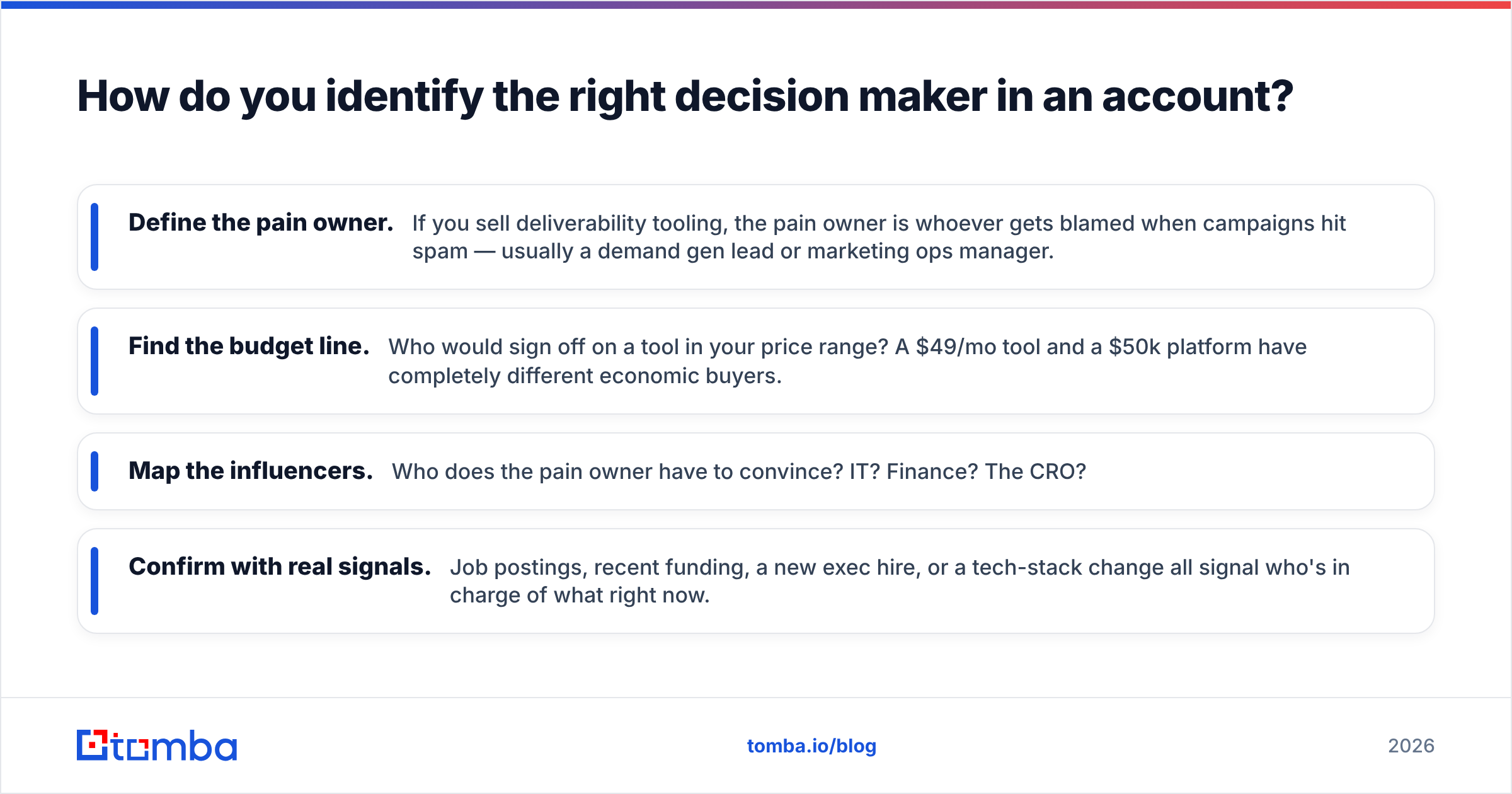
A practical sequence:
- Define the pain owner. If you sell deliverability tooling, the pain owner is whoever gets blamed when campaigns hit spam — usually a demand gen lead or marketing ops manager.
- Find the budget line. Who would sign off on a tool in your price range? A $49/mo tool and a $50k platform have completely different economic buyers.
- Map the influencers. Who does the pain owner have to convince? IT? Finance? The CRO?
- Confirm with real signals. Job postings, recent funding, a new exec hire, or a tech-stack change all signal who's in charge of what right now.
Once you know the roles, you need names and contact details. This is where a domain search earns its keep — give it a company domain and get back the people and email patterns at that org, so you can build the committee instead of guessing one contact.
What signals separate a real decision maker from a dead end?#
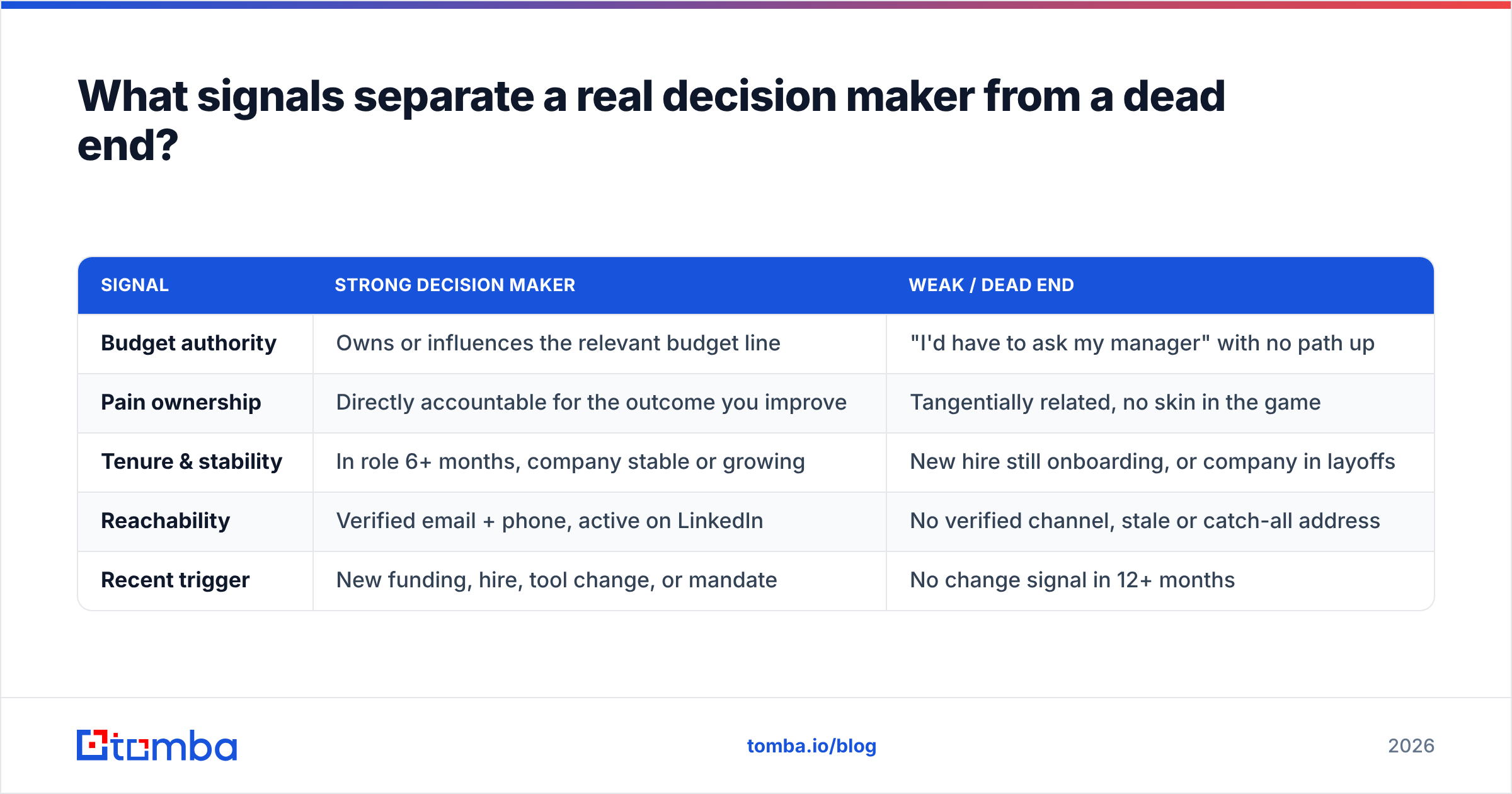
Not every senior title is worth a touch. Score prospects on three axes before you commit:
| Signal | Strong decision maker | Weak / dead end |
|---|---|---|
| Budget authority | Owns or influences the relevant budget line | "I'd have to ask my manager" with no path up |
| Pain ownership | Directly accountable for the outcome you improve | Tangentially related, no skin in the game |
| Tenure & stability | In role 6+ months, company stable or growing | New hire still onboarding, or company in layoffs |
| Reachability | Verified email + phone, active on LinkedIn | No verified channel, stale or catch-all address |
| Recent trigger | New funding, hire, tool change, or mandate | No change signal in 12+ months |
If a contact scores weak on three or more rows, deprioritize them. Your time is the scarce resource, not the size of your list.
How do you actually reach business decision makers?#
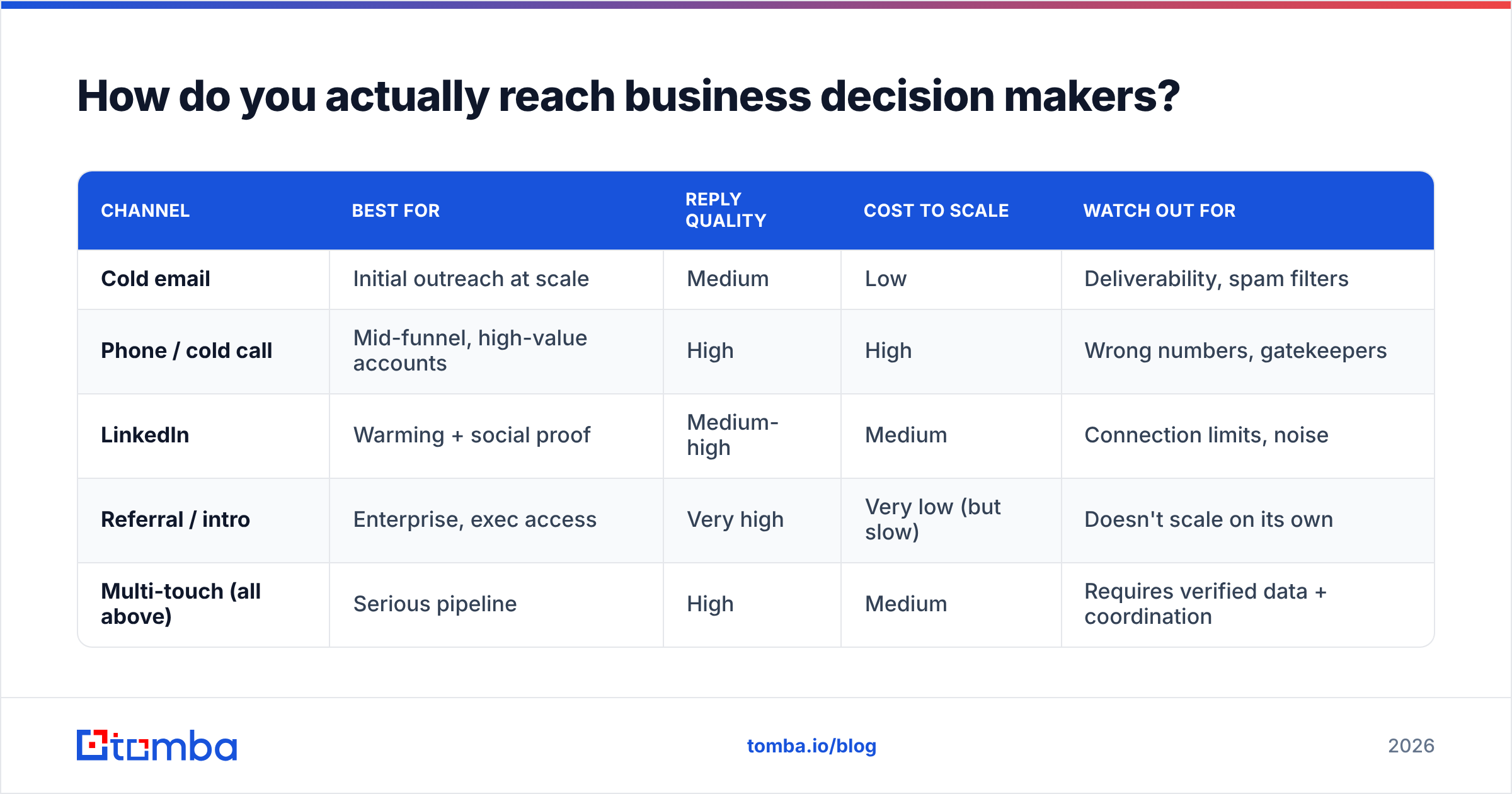
You need a verified channel and a multi-touch approach. One email is a coin flip; a coordinated sequence across email, phone, and LinkedIn is how you actually get a reply from someone busy.
Here's a comparison of the main channels and where each fits:
| Channel | Best for | Reply quality | Cost to scale | Watch out for |
|---|---|---|---|---|
| Cold email | Initial outreach at scale | Medium | Low | Deliverability, spam filters |
| Phone / cold call | Mid-funnel, high-value accounts | High | High | Wrong numbers, gatekeepers |
| Warming + social proof | Medium-high | Medium | Connection limits, noise | |
| Referral / intro | Enterprise, exec access | Very high | Very low (but slow) | Doesn't scale on its own |
| Multi-touch (all above) | Serious pipeline | High | Medium | Requires verified data + coordination |
The non-negotiable underneath all of these is data quality. A cold call to a disconnected number or an email to a guessed address doesn't just fail — it actively damages your sender reputation and your rep's morale.
To run a real multi-touch motion, you typically need:
- Verified emails so your sequence lands. Run every address through an email verifier before it enters a campaign.
- Direct phone numbers for the accounts worth a call — a phone finder gets you mobile and direct lines instead of the main switchboard.
- LinkedIn-to-email mapping so a social touch and an email touch hit the same person. A LinkedIn finder bridges the profile you found and the inbox you can actually reach.

How does verified contact data change your win rate?#
It changes the math at every stage. Bad data inflates your "sent" number and deflates everything that matters after it — opens, replies, meetings. Good data does the opposite.
Walk through a simple example. Say you build a list of 500 decision makers:
- With unverified data: ~25% bounce, your domain reputation drops, and the surviving emails land in spam. You might get 5–10 replies and a warning from your ESP.
- With verified data: bounces stay under 2%, your sender reputation holds, more mail reaches the primary inbox, and the same copy now pulls 25–40 replies.
Same list, same copy — the only variable is whether the addresses were real and reachable. That's why teams that take sender reputation seriously verify first and personalize second. You can also enrich each contact with firmographic and role data using data enrichment, so your message speaks to the buyer's actual context instead of a generic spray.
For a sense of how much vendor pricing varies once you're choosing tools, HubSpot and similar platforms publish their tiers openly — worth comparing against a focused finder like Tomba if you only need contact data, not a full suite.
How should you tier and prioritize your decision-maker list?#
Not every verified decision maker deserves the same effort. Tier them so your best motion goes to your best accounts.
- Tier 1 — high value, strong fit: Full multi-touch. Personalized email, a phone call, a LinkedIn touch, and ideally a referral path. Worth a researched, one-to-one approach.
- Tier 2 — good fit, medium value: Templated-but-relevant email sequence plus a LinkedIn connection. Phone only if they engage.
- Tier 3 — broad fit, lower value: Efficient email sequence with light personalization (industry, role, recent trigger). Scale this with automation.
- Tier 4 — speculative: Nurture only. Newsletter, content, occasional check-in. Don't burn a rep's time here.
The point of tiering is honesty about where effort pays off. A 50-account Tier 1 list run well will out-close a 5,000-contact blast every quarter.
Common mistakes when targeting decision makers#
- Chasing only the C-suite. The CEO rarely evaluates a $99/mo tool. Find the actual owner of the problem, who is usually a manager or director.
- Ignoring the champion. Execs ask the people below them. A strong internal champion is worth more than a lukewarm exec.
- Guessing emails. A pattern guess that bounces costs you reputation. Verify, don't gamble.
- One-and-done outreach. Decision makers are busy. It takes a coordinated sequence, not a single email, to earn a reply.
- No reason to care. "Just checking in" gets ignored. Lead with a trigger or a specific, relevant pain.
Avoid these five and you'll already be ahead of most outbound teams.
Frequently asked questions#
What is a business decision maker in B2B sales? Someone with the authority to approve, fund, or veto a purchase. In practice it's usually a small committee — an economic buyer who controls budget, a champion who owns the pain, and a technical buyer who validates the solution.
How do I find the email of a decision maker? Identify the right person by role and pain ownership, then use a tool that returns verified addresses for that name and company domain. Always verify before sending so you protect your sender reputation.
How many decision makers are in a typical B2B deal? Gartner research puts the typical buying committee at roughly 6 to 10 people. The number rises with deal size and risk, so map the group rather than betting on one contact.
Is title a reliable way to find decision makers? No. Title is a weak first filter. Qualify by budget authority, pain ownership, tenure, and a recent buying trigger before you invest touches.
Start with the right names and verified data#
Reaching business decision makers is less about clever copy and more about precision: the right person, a verified channel, and a reason to care. Get the targeting and the data right, and ordinary outreach starts converting. Get them wrong, and even brilliant outreach dies in spam.
If you want to build accurate, committee-level contact lists fast, start with the Tomba Email Finder. Search by company domain or name, pull the decision makers at each account, and verify every address before it enters a sequence — so your outreach reaches the people who actually sign. Check the Tomba pricing tiers (a free tier to test, then plans from $49/mo) and put real names behind your next campaign.
// get started
Find, verify and enrich your first contacts today
Start on the free plan with 25 searches a month, then scale when your team is ready.
Free plan · No credit card required · GDPR & CCPA
// about the author