Business Development Representative: The 2026 BDR Playbook
What a business development representative actually does in 2026 — the role, the metrics, the tech stack, and how BDRs differ from SDRs and AEs.
A business development representative (BDR) is the person who turns a cold market into a pipeline. They research accounts, find the right contacts, run outbound sequences, and book qualified meetings for closers. If you are hiring one, becoming one, or building a team of them, this is the practical breakdown for 2026 — what the role really involves, how it is measured, and the stack that separates a BDR who hits quota from one who burns through a list and stalls.
TL;DR#
- A business development representative owns outbound pipeline generation: account research, contact discovery, multichannel outreach, and qualification — then hands warm meetings to Account Executives.
- BDR vs SDR: BDRs focus on outbound and net-new accounts; SDRs typically work inbound leads. The titles overlap, but the motion differs.
- Core BDR metrics in 2026 are meetings booked, pipeline created, and reply-to-meeting conversion — not raw activity counts.
- The biggest performance lever is data quality: verified emails and direct dials beat volume every time.
- A modern BDR stack pairs a CRM and sequencer with an accurate email finder and phone finder so reps spend time selling, not guessing addresses.
What does a business development representative do?#
A business development representative builds the top of the sales funnel. The job is not "send more emails" — it is to identify accounts that fit your ideal customer profile, reach the decision-makers inside them, and create enough interest to book a qualified conversation.
In a typical week, a BDR will:
- Build target account lists — segment by industry, headcount, tech stack, funding, or trigger events.
- Find and verify contacts — locate the right buyer and confirm their email and phone are real before sending.
- Run multichannel sequences — email, LinkedIn, and phone touches spaced over one to three weeks.
- Qualify replies — separate genuine interest from polite brush-offs using a framework like BANT or MEDDIC.
- Book and hand off meetings — schedule the AE call and brief the closer with context.
- Log everything in the CRM — clean records are what make the next quarter repeatable.
The role is part researcher, part copywriter, part operator. The best BDRs treat outbound as a system, not a grind.
BDR vs SDR vs AE: how are they different?#
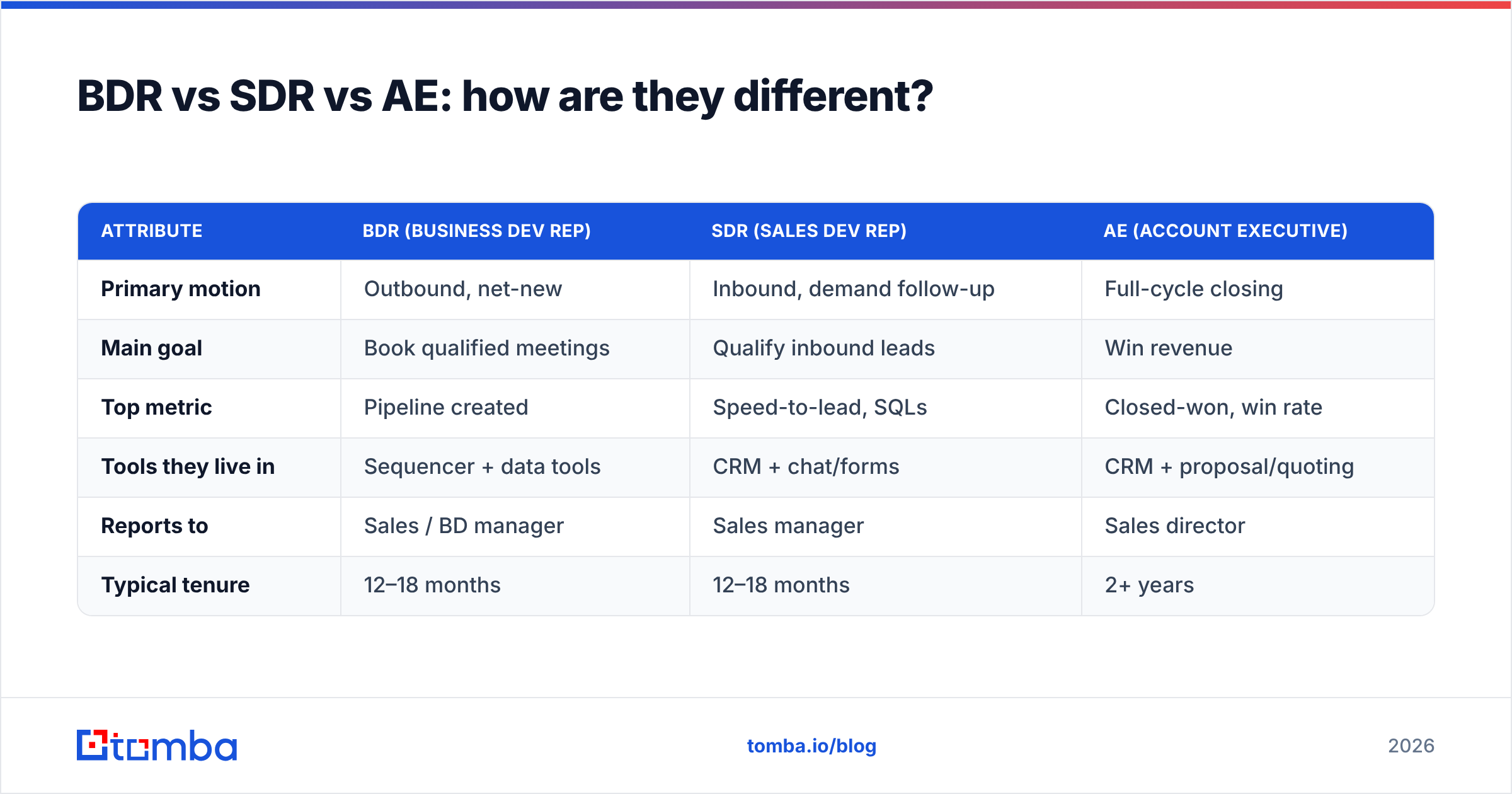
The titles get used loosely, so here is the distinction most teams actually run with. A BDR generates outbound pipeline, an SDR usually qualifies inbound demand, and an Account Executive owns the deal from demo to close.
| Attribute | BDR (Business Dev Rep) | SDR (Sales Dev Rep) | AE (Account Executive) |
|---|---|---|---|
| Primary motion | Outbound, net-new | Inbound, demand follow-up | Full-cycle closing |
| Main goal | Book qualified meetings | Qualify inbound leads | Win revenue |
| Top metric | Pipeline created | Speed-to-lead, SQLs | Closed-won, win rate |
| Tools they live in | Sequencer + data tools | CRM + chat/forms | CRM + proposal/quoting |
| Reports to | Sales / BD manager | Sales manager | Sales director |
| Typical tenure | 12–18 months | 12–18 months | 2+ years |
In smaller orgs one person does both BDR and SDR work. In larger orgs the split is deliberate: outbound and inbound require different skills, cadences, and comp plans. If you want a deeper definition of the modeled pipeline these roles feed, the concept of a marketing qualified lead is where inbound and outbound definitions usually collide.
What skills make a great business development representative?#
Outbound rewards a specific blend of traits. The strongest BDRs share five:
- Research discipline — they read the 10-K, the job posts, and the LinkedIn activity before writing a single line.
- Concise writing — a good cold email is three sentences and one ask, not a brochure.
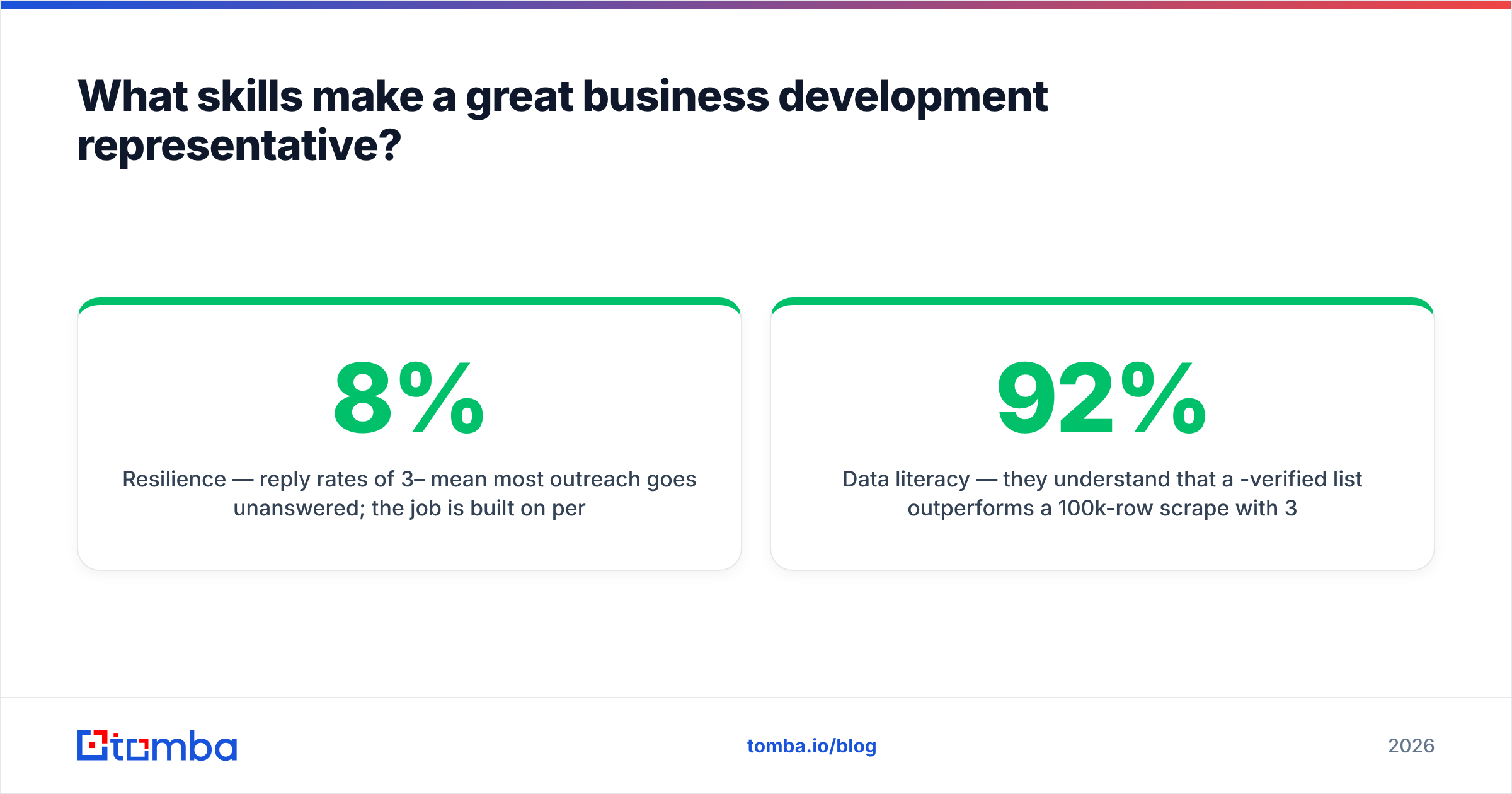
- Resilience — reply rates of 3–8% mean most outreach goes unanswered; the job is built on persistence.
- Curiosity over scripts — they ask better discovery questions instead of reading from a card.
- Data literacy — they understand that a 92%-verified list outperforms a 100k-row scrape with 30% bounces.
That last point is where most ramping reps lose months. You cannot out-hustle bad data. Sending to unverified addresses tanks your sender reputation and quietly kills deliverability for the whole team.
How is a BDR measured in 2026?#
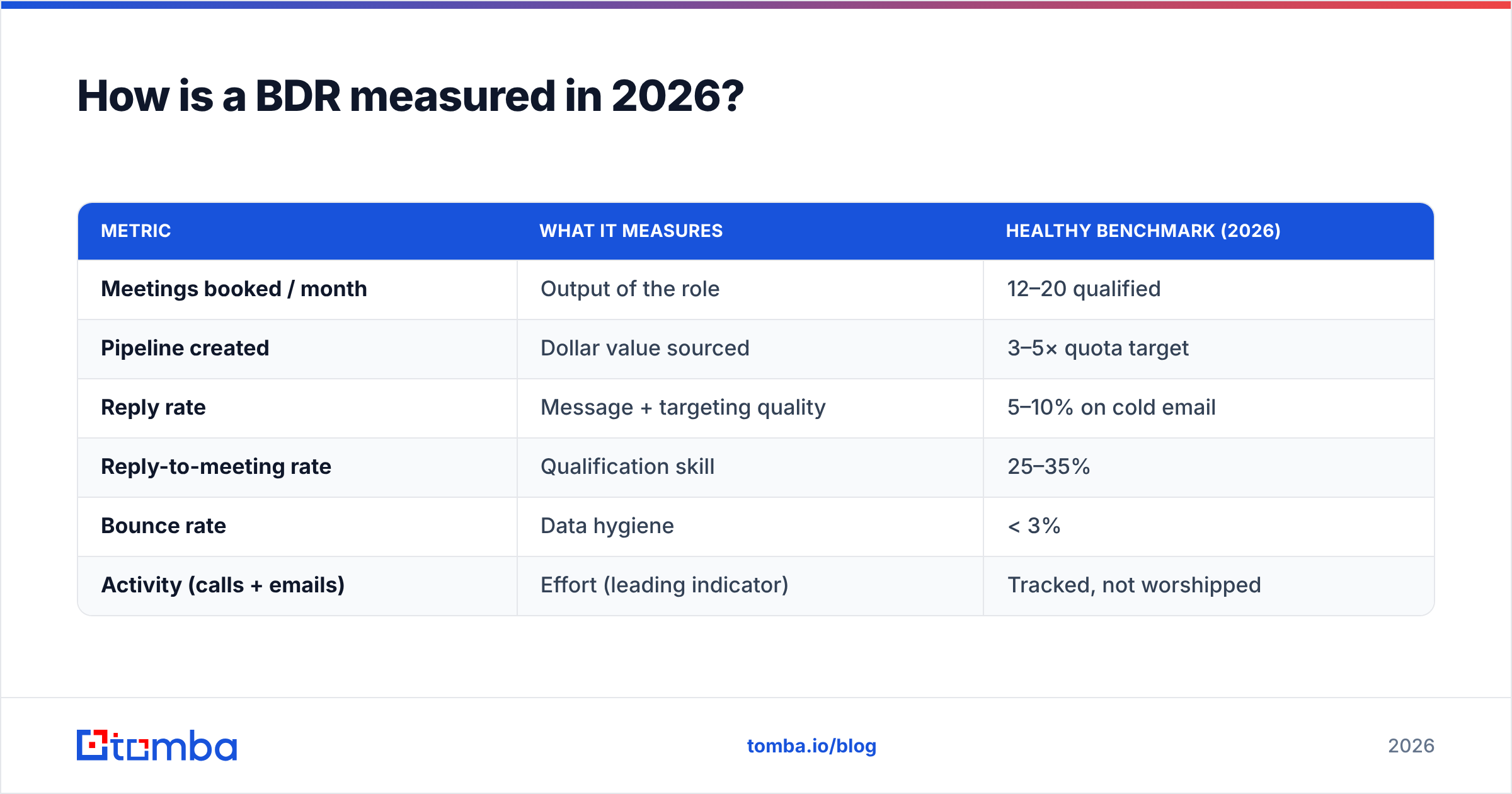
BDR scorecards have shifted from "activity" to "outcomes." Dialing 100 numbers a day means nothing if none connect. The metrics that matter now are conversion-weighted.
| Metric | What it measures | Healthy benchmark (2026) |
|---|---|---|
| Meetings booked / month | Output of the role | 12–20 qualified |
| Pipeline created | Dollar value sourced | 3–5× quota target |
| Reply rate | Message + targeting quality | 5–10% on cold email |
| Reply-to-meeting rate | Qualification skill | 25–35% |
| Bounce rate | Data hygiene | < 3% |
| Activity (calls + emails) | Effort (leading indicator) | Tracked, not worshipped |
Notice bounce rate sitting next to the glamour metrics. A bounce rate above 3% is an early warning that your data source is decaying — and it directly suppresses every downstream number. This is why disciplined teams run lists through an email verifier before a sequence ever starts.
What does the BDR tech stack look like?#
A 2026 BDR runs a tight, four-layer stack. Each layer removes a different kind of friction.
- CRM — the system of record (Salesforce, HubSpot, Pipedrive). Everything logs here.
- Sequencer / engagement — automates multichannel cadences and tracks opens, clicks, and replies.
- Data and discovery — finds accounts, contacts, verified emails, and direct dials. This is the layer that feeds the other three.
- Enrichment and signals — appends firmographics and intent so reps prioritize the right accounts first.
The discovery layer is where reps win or lose their week. If finding a verified email takes five minutes per contact, a rep clears maybe 40 contacts a day. Cut that to seconds and the same rep clears hundreds. A domain search returns every public address pattern for a company at once, and bulk workflows let a BDR enrich a whole account list before the first send. Layer in data enrichment and the rep walks into each call already knowing role, seniority, and company size.
How much does a business development representative earn?#
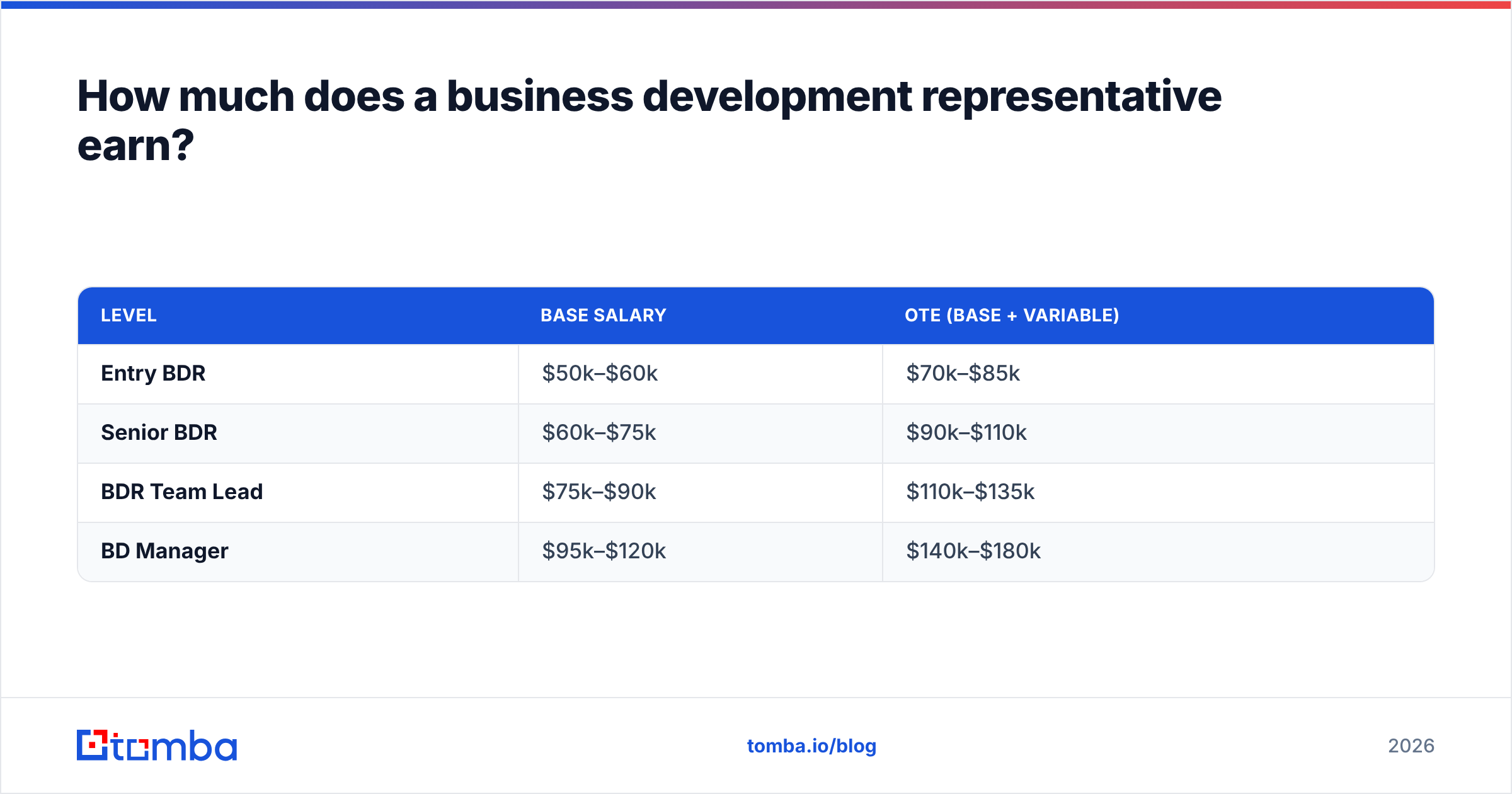
BDR compensation is structured as base plus variable, with on-target earnings (OTE) split roughly 70/30. Figures vary by region and segment, but US benchmarks in 2026 land in these ranges:
| Level | Base salary | OTE (base + variable) |
|---|---|---|
| Entry BDR | $50k–$60k | $70k–$85k |
| Senior BDR | $60k–$75k | $90k–$110k |
| BDR Team Lead | $75k–$90k | $110k–$135k |
| BD Manager | $95k–$120k | $140k–$180k |
The variable portion is tied to meetings booked and pipeline that converts to opportunities — not just meetings that show up. Comp plans increasingly hold a clawback or qualification gate so reps are paid for real pipeline, which again rewards good targeting and clean data over spray-and-pray volume. For benchmarking compensation and tool reviews, third-party sources like G2 and salary data aggregators are more reliable than vendor blogs.
What is the BDR career path?#
BDR is a launchpad, not a destination. Most people spend 12–18 months in the seat before moving up. The two common tracks:
- Closing track: BDR → Account Executive → Senior AE → Sales Manager. This is the default for reps who love the deal.
- Operations / leadership track: BDR → Senior BDR → Team Lead → BD/Sales Manager → Director of Sales Development. This suits reps who like building systems and coaching.
A third path has grown fast: BDR → RevOps or sales enablement, for reps who become obsessed with the data, tooling, and process side of the funnel. Understanding revenue operations early makes a BDR far more promotable, because they can speak the language of the people who design the pipeline they fill.
How do you build an outbound sequence that books meetings?#
A repeatable BDR sequence balances channels and respects the prospect's time. A proven 14-day structure:
- Day 1 — Email 1: personalized opener tied to a trigger event, one clear ask.
- Day 2 — LinkedIn connection request, no pitch.
- Day 4 — Email 2: short value-add (a relevant stat, case, or resource).
- Day 6 — Phone call + voicemail referencing the email.
- Day 9 — Email 3: a different angle or a question.
- Day 12 — LinkedIn message or comment on their content.
- Day 14 — Email 4: brief breakup message ("should I close the loop?").
Two rules separate sequences that work from ones that get reported as spam. First, personalize the first line of every email — the trigger, the role, the recent change. Second, never send to an unverified address. A single sequence blasted at a stale list can torch your domain's email deliverability for months. Verify first, then personalize, then send.
For the phone touches, having an accurate direct dial instead of a switchboard number changes everything. A connected call is worth dozens of unanswered emails, which is why direct-dial coverage has become a core part of the data layer rather than an afterthought.
What separates top BDR teams from average ones?#
The gap is rarely talent — it is operating rhythm and data quality. High-performing teams do three things consistently:
- They own their ICP ruthlessly. Fewer, better-fit accounts beat a giant list. Disqualifying fast is a skill.
- They protect deliverability like an asset. Verified lists, warmed domains, and bounce monitoring are non-negotiable.
- They instrument everything. Every reply, meeting, and bounce is logged so the next quarter is a refinement, not a reset.
Average teams measure effort; great teams measure conversion and fix the constraint. In 2026 the constraint is almost always the same — reps drowning in research and bad contact data instead of having conversations. Solve the data layer and the activity metrics take care of themselves. Compare tooling options and tiers on the Tomba pricing page if you are evaluating where to start.
Frequently asked questions#
Is business development representative the same as sales development representative? Not quite. In most orgs a BDR runs outbound to net-new accounts while an SDR qualifies inbound demand. Some companies use the titles interchangeably, so always read the job description, not just the acronym.
Is BDR an entry-level role? Usually yes. It is the most common entry point into B2B tech sales and a direct on-ramp to becoming an Account Executive or a sales leader within two years.
What is the hardest part of being a BDR? Volume of rejection plus the research load. The reps who last automate the tedious parts — list building, email discovery, enrichment — so their energy goes into messaging and conversations.
Do BDRs cold call in 2026? Yes, but smarter. Calls are one channel inside a multichannel sequence, and they only work with accurate direct dials. Random switchboard dialing is dead.
Ready to build pipeline instead of chasing emails?#
The fastest win for any business development representative is fixing the data layer first. When every contact you reach is real and verified, your reply rates climb, your bounce rate drops, and your sender reputation stays clean enough to keep landing in the inbox. Start with the Tomba Email Finder to turn a target account list into verified, ready-to-sequence contacts in seconds — the free tier gives you 25 searches a month to test it against your own ICP, and paid plans start at $49/mo when you are ready to scale. Spend your hours selling, not guessing addresses.
// get started
Find, verify and enrich your first contacts today
Start on the free plan with 25 searches a month, then scale when your team is ready.
Free plan · No credit card required · GDPR & CCPA
// about the author