Business Development Reps in 2026: The Complete BDR Playbook
What business development reps actually do, how the BDR role differs from SDRs and AEs, the metrics that matter, and the 2026 tech stack that makes a BDR team produce pipeline instead of busywork.
TL;DR
- Business development reps (BDRs) own the top of the funnel: they research accounts, find the right contacts, and book qualified meetings for closers. They are pipeline builders, not deal closers.
- BDR ≠ SDR ≠ AE. The lines blur by company, but the cleanest split is BDR = outbound/new logos, SDR = inbound/marketing leads, AE = closing.
- A BDR's output is meetings booked and pipeline sourced — not dials made. Activity is a means, not the metric.
- The single biggest lever on BDR productivity is data quality. Bad contact data sinks even a great rep's sequence.
- In 2026 the winning BDR stack is lean: accurate contact data, a sequencer, a CRM, and an AI research layer — not 14 overlapping tools.
What is a business development rep?#
A business development rep is the person who turns a list of companies into a calendar full of qualified conversations. Think of a BDR as the scout ahead of an expedition: they don't plant the flag (that's the closer's job), but without them the closer is wandering blind. They identify which accounts are worth pursuing, find the humans inside those accounts who can actually buy, and start the conversation that becomes a sales opportunity.
Technically, the BDR sits at the very top of the revenue funnel. Their job ends where the account executive's begins — usually at a booked, qualified meeting that the AE accepts. Everything before that handoff is BDR territory: account research, contact discovery, multi-channel outreach (email, phone, LinkedIn), objection handling on the first touch, and qualification against a framework like BANT or MEDDIC.
The role exists because closing and prospecting are different skills that compete for the same hours. Ask one person to do both and prospecting always loses — it's the part you can postpone. Splitting the BDR function out protects pipeline generation from being crowded out by next-quarter's deals.

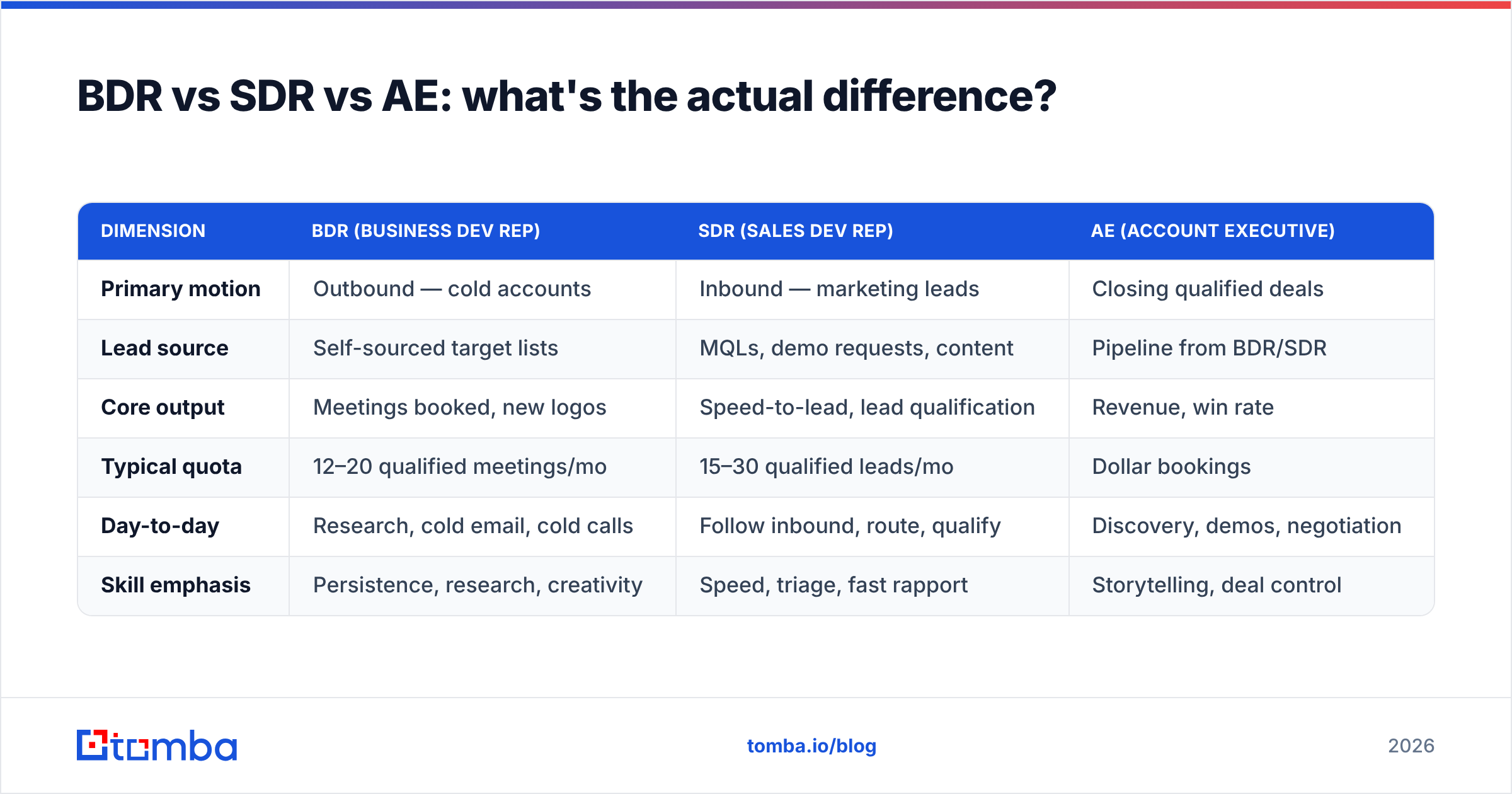
BDR vs SDR vs AE: what's the actual difference?#
The titles get used interchangeably, and honestly most orgs draw the line differently. But there's a conventional split worth knowing because it shapes how you hire, comp, and measure.
| Dimension | BDR (Business Dev Rep) | SDR (Sales Dev Rep) | AE (Account Executive) |
|---|---|---|---|
| Primary motion | Outbound — cold accounts | Inbound — marketing leads | Closing qualified deals |
| Lead source | Self-sourced target lists | MQLs, demo requests, content | Pipeline from BDR/SDR |
| Core output | Meetings booked, new logos | Speed-to-lead, lead qualification | Revenue, win rate |
| Typical quota | 12–20 qualified meetings/mo | 15–30 qualified leads/mo | Dollar bookings |
| Day-to-day | Research, cold email, cold calls | Follow inbound, route, qualify | Discovery, demos, negotiation |
| Skill emphasis | Persistence, research, creativity | Speed, triage, fast rapport | Storytelling, deal control |
A few honest caveats. First, plenty of companies call every junior rep an "SDR" and use "BDR" for the same thing. Second, the inbound/outbound split is the most useful distinction in practice — if a rep is chasing cold accounts they've never heard of, that's business development work regardless of the badge. Third, some teams add a third rung (like a "sales development manager" or a pod lead) that owns the handoff quality between roles.
If you want a deeper grounding in the qualification stage that separates a marketing qualified lead from a sales-ready one, that's worth reading alongside this — it's the seam where BDR and AE work meets.
What do business development reps actually do all day?#
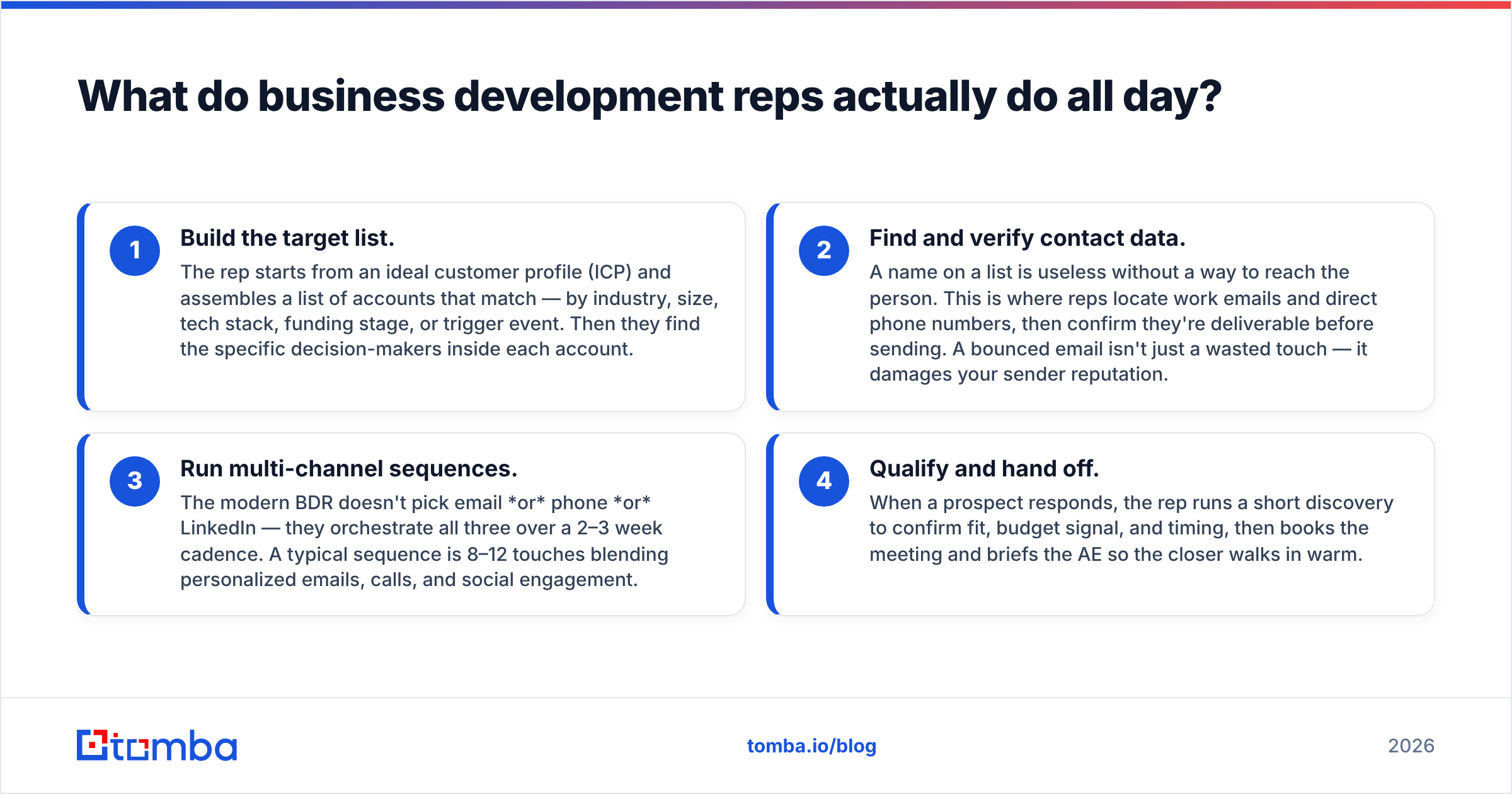
Strip away the title and a BDR's day is four repeating loops. Each one compounds the next.
- Build the target list. The rep starts from an ideal customer profile (ICP) and assembles a list of accounts that match — by industry, size, tech stack, funding stage, or trigger event. Then they find the specific decision-makers inside each account.
- Find and verify contact data. A name on a list is useless without a way to reach the person. This is where reps locate work emails and direct phone numbers, then confirm they're deliverable before sending. A bounced email isn't just a wasted touch — it damages your sender reputation.
- Run multi-channel sequences. The modern BDR doesn't pick email or phone or LinkedIn — they orchestrate all three over a 2–3 week cadence. A typical sequence is 8–12 touches blending personalized emails, calls, and social engagement.
- Qualify and hand off. When a prospect responds, the rep runs a short discovery to confirm fit, budget signal, and timing, then books the meeting and briefs the AE so the closer walks in warm.
The trap most teams fall into: optimizing loop #3 (more touches, more automation) while neglecting loops #1 and #2. You can A/B test subject lines all day, but if half your list has the wrong email address, you're tuning the radio on a car with no engine.
Wait — that's the wrong direction.
How do you measure a business development rep?#
Measure outputs, not theater. The classic mistake is rewarding activity — dials, emails sent, "touches" — as if motion equals progress. It doesn't. A rep who sends 400 emails to bad addresses looks busy and produces nothing.
Here's the metric hierarchy that actually drives pipeline, from lagging (what you care about) to leading (what you can coach):
- Pipeline sourced ($). The lagging outcome. How much qualified pipeline did this rep's meetings turn into? This is the number the CFO cares about.
- Qualified meetings booked & accepted. The BDR's true quota. "Accepted" matters — a meeting the AE rejects as junk doesn't count.
- Reply rate and positive reply rate. Leading indicators of message-market fit. Track positive replies separately; a 12% reply rate that's all "unsubscribe" is a warning, not a win.
- Connect rate (calls) and meeting-set rate. Tells you whether the problem is reaching people or converting conversations.
- Bounce rate. Keep it under ~3%. A climbing bounce rate is the canary for data-quality rot and is a leading cause of email deliverability damage.
According to industry benchmarks compiled by analysts like Gartner and peer-review sites like G2, top outbound teams obsess over reply quality and data hygiene far more than raw volume. The pattern is consistent: the highest-performing BDRs aren't the ones who send the most — they're the ones whose lists are cleanest and whose messages are most relevant.
What does the 2026 BDR tech stack look like?#
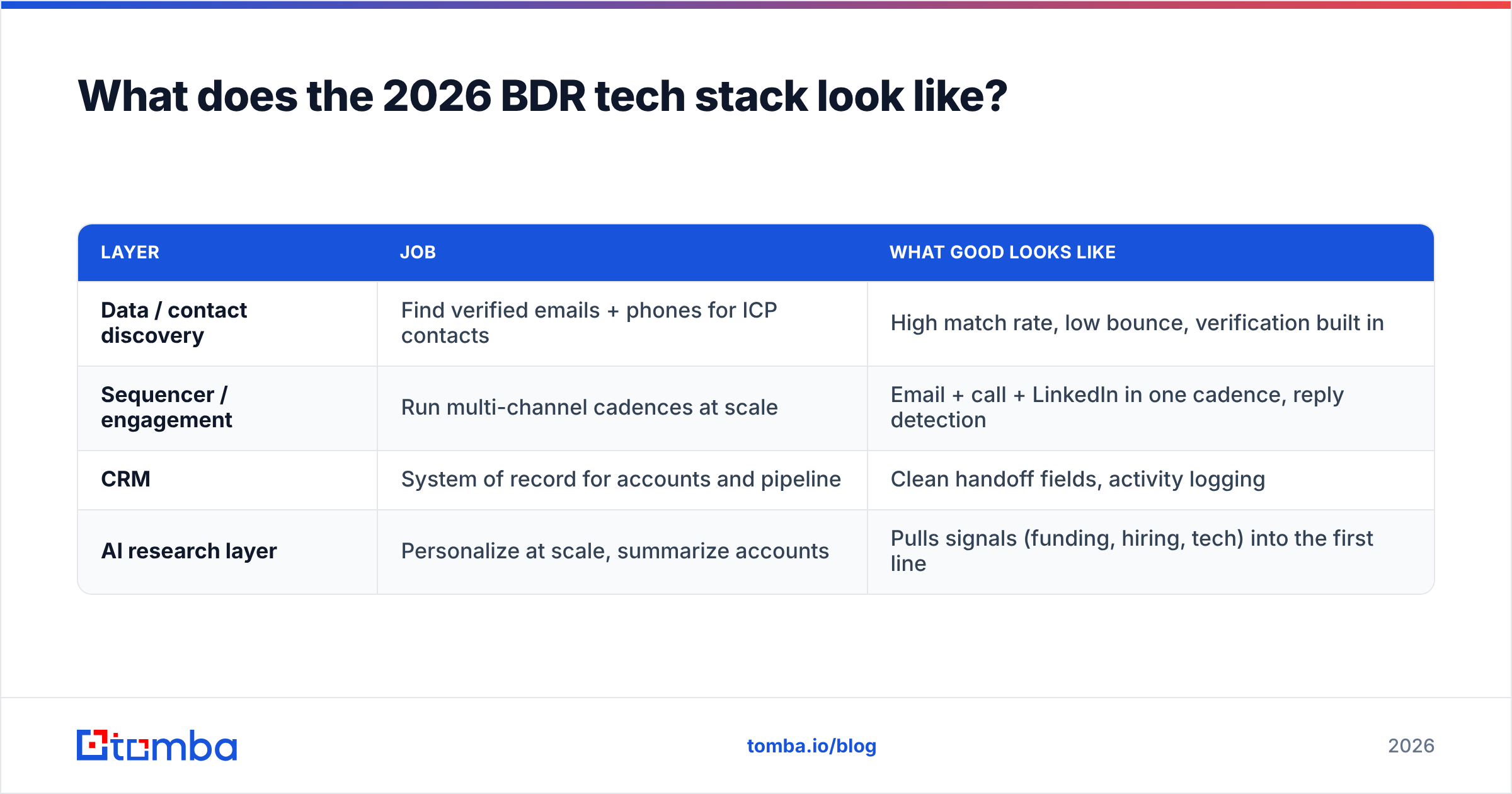
Lean and accurate beats sprawling and noisy. A few years ago the fashionable answer was a 12-tool stack. In 2026 the best teams have consolidated, because every extra tool is another data silo, another sync to break, and another seat to pay for. The modern stack has four layers.
| Layer | Job | What good looks like |
|---|---|---|
| Data / contact discovery | Find verified emails + phones for ICP contacts | High match rate, low bounce, verification built in |
| Sequencer / engagement | Run multi-channel cadences at scale | Email + call + LinkedIn in one cadence, reply detection |
| CRM | System of record for accounts and pipeline | Clean handoff fields, activity logging |
| AI research layer | Personalize at scale, summarize accounts | Pulls signals (funding, hiring, tech) into the first line |
The data layer is the foundation — and the one teams most often get wrong. If your contact data has a 70% match rate and a 9% bounce rate, no sequencer or AI copywriter saves you. This is why accurate sourcing tools matter so much: a good email finder plus a real-time email verifier does more for reply rates than any subject-line trick.
For teams running list-building at volume, the workflow usually looks like: pull target companies → run a domain search to map the org and surface the right contacts → verify before sending → push clean records into the sequencer. Automating that pipeline through an API or a bulk email finder is what separates a BDR who books 18 meetings a month from one stuck at 6.
A word of caution on the AI research layer: it's genuinely useful for summarizing accounts and surfacing trigger events, but it amplifies whatever data you feed it. Personalized outreach to the wrong person is still the wrong person. Fix the data first, then let AI make the relevant message even more relevant.
How do you ramp a new business development rep fast?#
Front-load the data and the script; let the rep focus on conversations. The difference between a 30-day ramp and a 90-day ramp is almost entirely about how much you've systematized before the rep's first day.
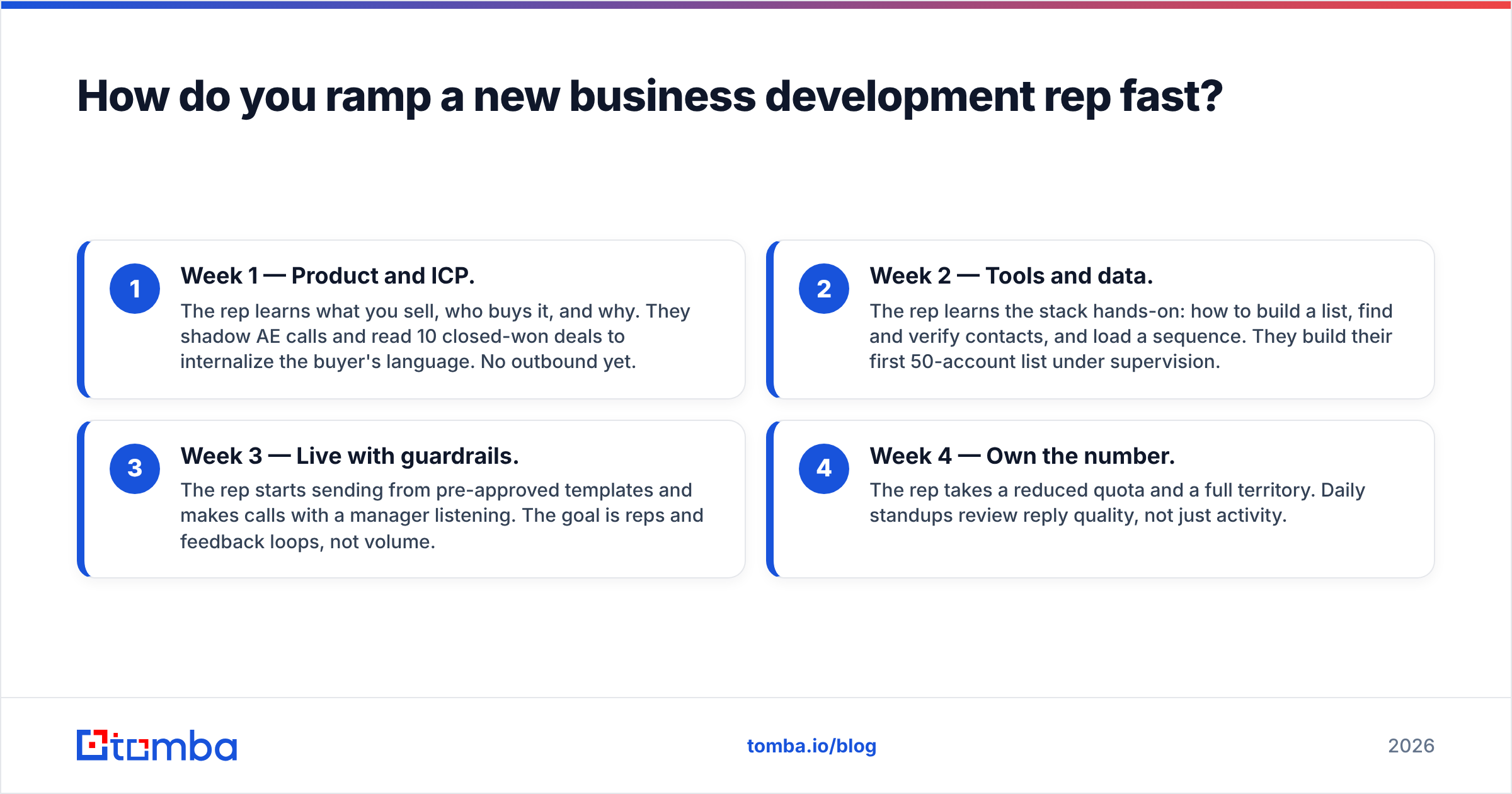
A proven 4-week ramp structure:
- Week 1 — Product and ICP. The rep learns what you sell, who buys it, and why. They shadow AE calls and read 10 closed-won deals to internalize the buyer's language. No outbound yet.
- Week 2 — Tools and data. The rep learns the stack hands-on: how to build a list, find and verify contacts, and load a sequence. They build their first 50-account list under supervision.
- Week 3 — Live with guardrails. The rep starts sending from pre-approved templates and makes calls with a manager listening. The goal is reps and feedback loops, not volume.
- Week 4 — Own the number. The rep takes a reduced quota and a full territory. Daily standups review reply quality, not just activity.
The teams that ramp fastest share one habit: they give new reps a clean, pre-verified starter list instead of making them learn prospecting and data-hygiene simultaneously. Learning to write a good cold email is hard enough without also debugging why half your sends bounced.
Is the BDR role being replaced by AI?#
No — it's being restructured. The doom take is that AI agents will do all the prospecting and BDRs vanish. The reality in 2026 is more interesting: AI is eating the mechanical parts of the job (list-building, research summaries, first-draft personalization) while the human parts (judgment, objection handling, knowing when a "no" is really a "not yet") become more valuable, not less.
The practical effect is leverage. A BDR who used to spend three hours a day hunting for email addresses and copy-pasting research now spends those hours in conversations, because an API and an AI layer handle the grunt work. The headcount math shifts from "how many reps can manually process this list" to "how much pipeline can one well-equipped rep generate." Teams that lean into this — automating data and research, keeping humans on relationships — are the ones pulling ahead.
What doesn't change: someone still has to decide which accounts deserve attention, craft the angle that earns a reply, and handle the messy human moment when a prospect pushes back. That's the durable core of business development, and it's not going anywhere.
Putting it together#
Business development reps are the engine of net-new pipeline. The role is distinct from SDR and AE work, it's measured by qualified meetings and sourced pipeline rather than raw activity, and its single biggest performance lever is the quality of the contact data feeding the top of the funnel. Get the data right, give reps a lean stack and a real ramp, and let AI handle the mechanical work — that's the 2026 playbook in one sentence.
If your BDR team is losing hours to bad addresses and dead-end lists, fix the foundation first. Tomba's Email Finder gives reps verified work emails by name, company, or domain — with verification built in so bounces stay low and sender reputation stays intact. Start on the free tier (25 searches/month) to test match rates against your own ICP, then scale up: the Starter plan is $49/mo and the Growth plan $99/mo when you're ready to run real volume. See full Tomba pricing and put your reps back where they belong — in conversations, not spreadsheets.
// get started
Find, verify and enrich your first contacts today
Start on the free plan with 25 searches a month, then scale when your team is ready.
Free plan · No credit card required · GDPR & CCPA
// about the author