Business to Government Sales: The 2026 B2G Playbook
B2G sales has longer cycles, stricter compliance, and bigger contracts than B2B. Here is the 2026 playbook for winning government deals start to finish.
Selling to a city, a school district, or a federal agency is not just B2B with a longer form. The buyer is spending public money, the process is governed by procurement law, and the person who signs is rarely the person who championed you. Business to government sales rewards patience, paperwork, and precise targeting more than charm.
This guide breaks down how B2G actually works in 2026, where it differs from B2B, and the repeatable motion you can use to find the right contacts and win contracts.
TL;DR#
- Business to government sales (B2G) means selling products or services to public-sector buyers — federal, state, local, and education ("SLED").
- Cycles are long (6–18+ months), budgets are fixed to fiscal years, and compliance gates everything. Relationship-led B2B tactics alone won't carry you.
- Winning requires registration (SAM.gov, GSA Schedules), responding to RFPs/RFQs, and mapping a buying committee of 7–11 people you rarely meet.
- Pipeline quality beats volume. You need verified contacts for procurement officers, program managers, and technical evaluators — not a scraped list.
- Tools like a B2B email finder and data enrichment let you build accurate target lists for the agencies that actually buy what you sell.
What is business to government sales?#
Business to government sales is the process of selling goods, services, or technology to public-sector organizations instead of private companies or consumers. It is commonly abbreviated B2G, and in North America the broader market is often called SLED — State, Local, and Education — plus the federal layer on top.
The category is enormous. Governments are among the largest buyers on earth: they purchase software, cybersecurity, construction, consulting, medical supplies, vehicles, and almost everything else. In the United States alone, federal contract spending runs into the hundreds of billions annually, and you can inspect much of it publicly on USAspending.gov.
What makes B2G distinct is not what is sold but how it is bought. Public buyers must justify spending taxpayer money, so the process is formalized through registration systems, competitive bidding, fixed budgets, and audit trails. That structure is the whole game.
How is B2G different from B2B sales?#
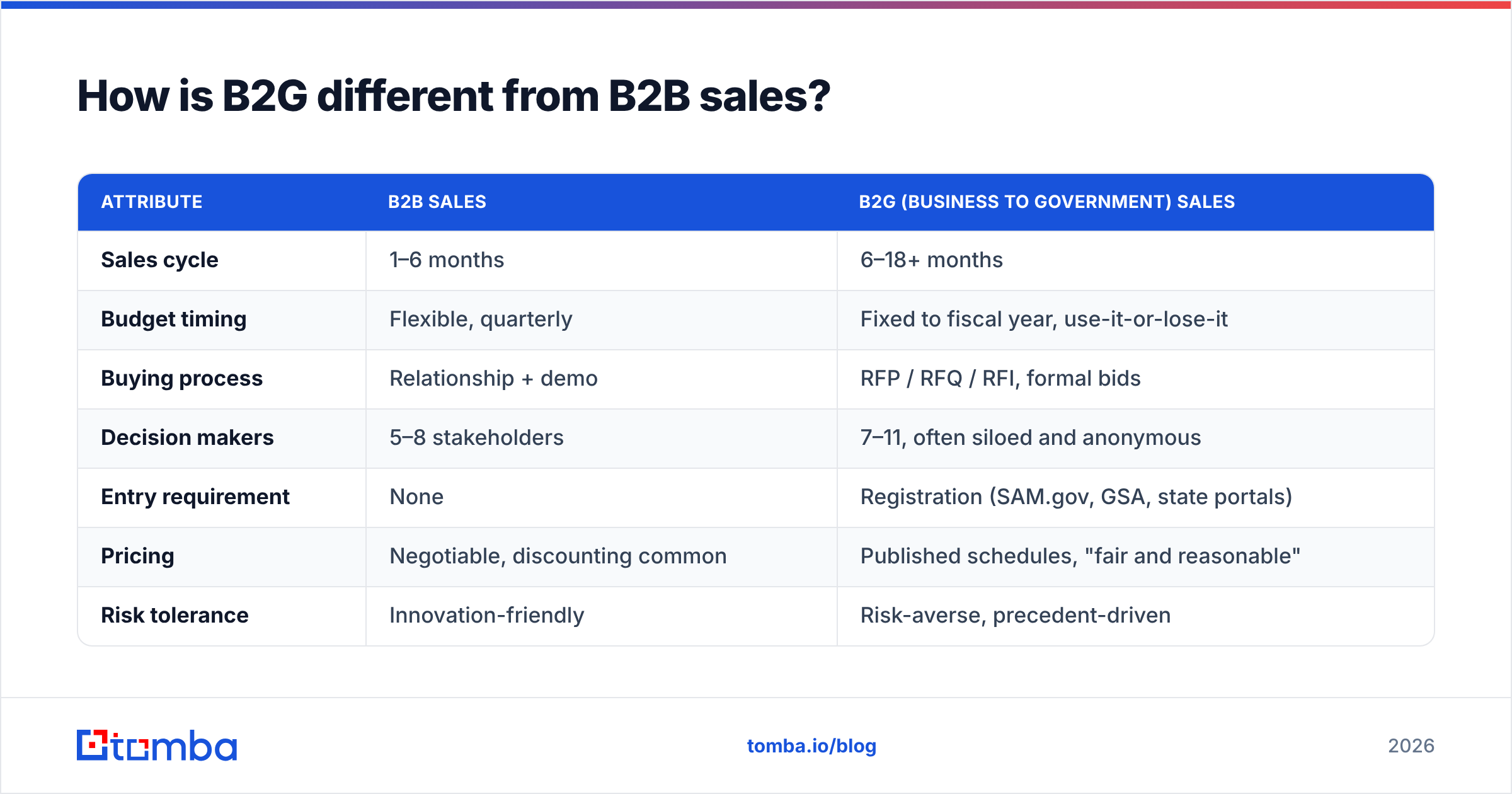
The short version: same destination, very different road. A B2B rep optimizes for speed and rapport. A B2G rep optimizes for compliance and process navigation. Here is how the two compare across the attributes that actually change your playbook.
| Attribute | B2B sales | B2G (business to government) sales |
|---|---|---|
| Sales cycle | 1–6 months | 6–18+ months |
| Budget timing | Flexible, quarterly | Fixed to fiscal year, use-it-or-lose-it |
| Buying process | Relationship + demo | RFP / RFQ / RFI, formal bids |
| Decision makers | 5–8 stakeholders | 7–11, often siloed and anonymous |
| Entry requirement | None | Registration (SAM.gov, GSA, state portals) |
| Pricing | Negotiable, discounting common | Published schedules, "fair and reasonable" |
| Risk tolerance | Innovation-friendly | Risk-averse, precedent-driven |
| Payment terms | Net 30–60 | Net 30–90, milestone-based |
Three differences deserve special attention:
- Procurement is law, not preference. A government buyer often cannot simply pick you because they like your product. Above certain dollar thresholds they must run a competitive process. Skipping it can void the deal.
- The fiscal year drives urgency. Many agencies operate on an October–September federal year (states vary). Budgets that aren't spent can disappear, which creates real end-of-year buying windows — and dead zones during budget negotiations.
- You're selling to a committee you can't see. The contracting officer is the legal gatekeeper, but the program manager owns the need and technical evaluators score your bid. Influence flows through people whose emails aren't on the RFP.
Who are the decision makers in government sales?#
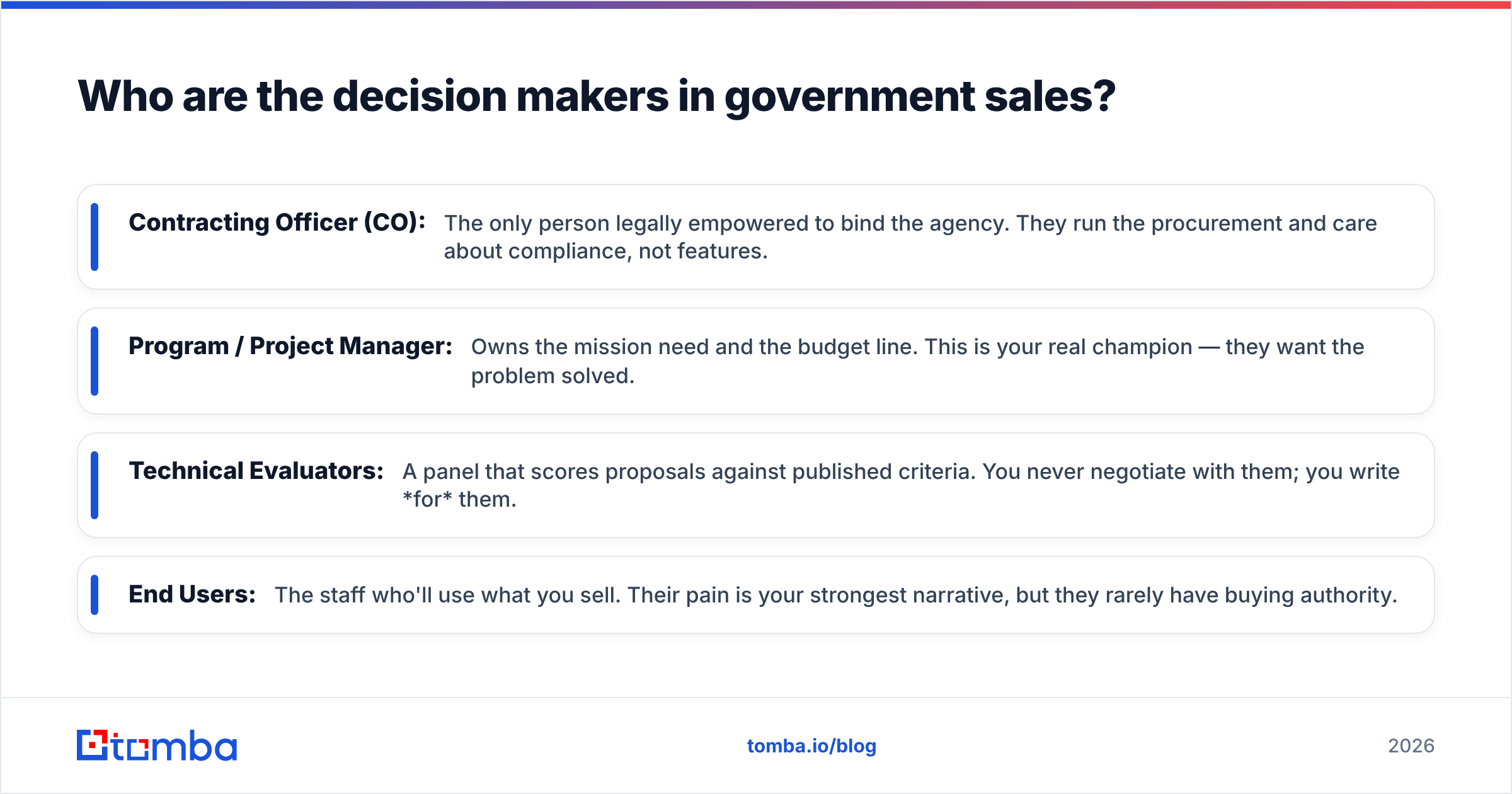
In B2G the org chart is your map, and most of it is hidden from the public posting. A typical opportunity involves four roles:
- Contracting Officer (CO): The only person legally empowered to bind the agency. They run the procurement and care about compliance, not features.
- Program / Project Manager: Owns the mission need and the budget line. This is your real champion — they want the problem solved.
- Technical Evaluators: A panel that scores proposals against published criteria. You never negotiate with them; you write for them.
- End Users: The staff who'll use what you sell. Their pain is your strongest narrative, but they rarely have buying authority.
Reaching the program manager and end users early — before the RFP is written — is what separates incumbents from also-rans. That is a contact-discovery problem. You'll often have a department name and a website but no direct line, which is exactly where a domain search across an agency's domain helps you surface the right people and their email patterns. When you need a phone conversation with a program lead, a phone finder closes the last gap.
How do you find and qualify government buyers?#
Pipeline is the part most teams get wrong. They blast a generic list, get flagged as spam by .gov filters, and burn their sender reputation. B2G prospecting is the opposite of spray-and-pray — it is narrow, verified, and research-heavy.
A clean motion looks like this:
- Identify the agencies that buy your category. Use spend data (USAspending, state transparency portals) and award histories to find agencies with a track record of purchasing what you sell.
- Map the relevant department and people. Find the program office, not just the front desk. Look for program managers, directors, and technical leads tied to your domain.
- Build verified contact data. Get accurate emails and phone numbers for those individuals. Government addresses follow strict patterns (often firstname.lastname@agency.gov), which makes pattern-based discovery reliable.
- Verify before you send. Bounces to .gov domains hurt deliverability fast. Run every address through an email verifier so your list is clean before the first touch.
- Enrich and prioritize. Layer in role, seniority, and agency size so reps spend time on the accounts with real budget authority.
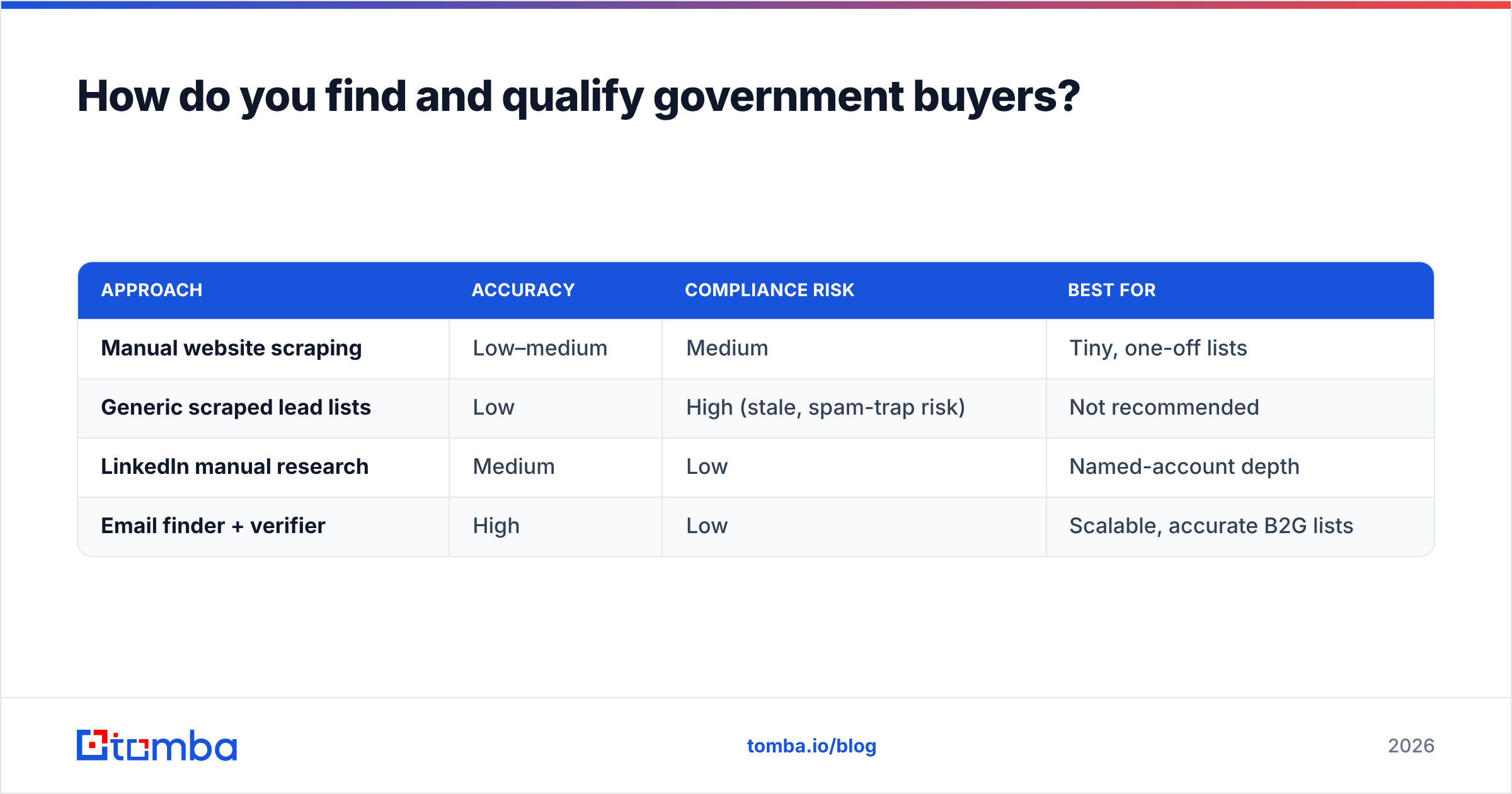
Because contact accuracy is everything here, the tooling matters. The table below shows where common data approaches land for a public-sector list.
| Approach | Accuracy | Compliance risk | Best for |
|---|---|---|---|
| Manual website scraping | Low–medium | Medium | Tiny, one-off lists |
| Generic scraped lead lists | Low | High (stale, spam-trap risk) | Not recommended |
| LinkedIn manual research | Medium | Low | Named-account depth |
| Email finder + verifier | High | Low | Scalable, accurate B2G lists |
For most teams, an email finder paired with verification is the only approach that scales without torching deliverability. You can find emails by name, by domain, or in bulk, then confirm each one is live before it ever reaches a government inbox.
What does the B2G procurement process look like?#
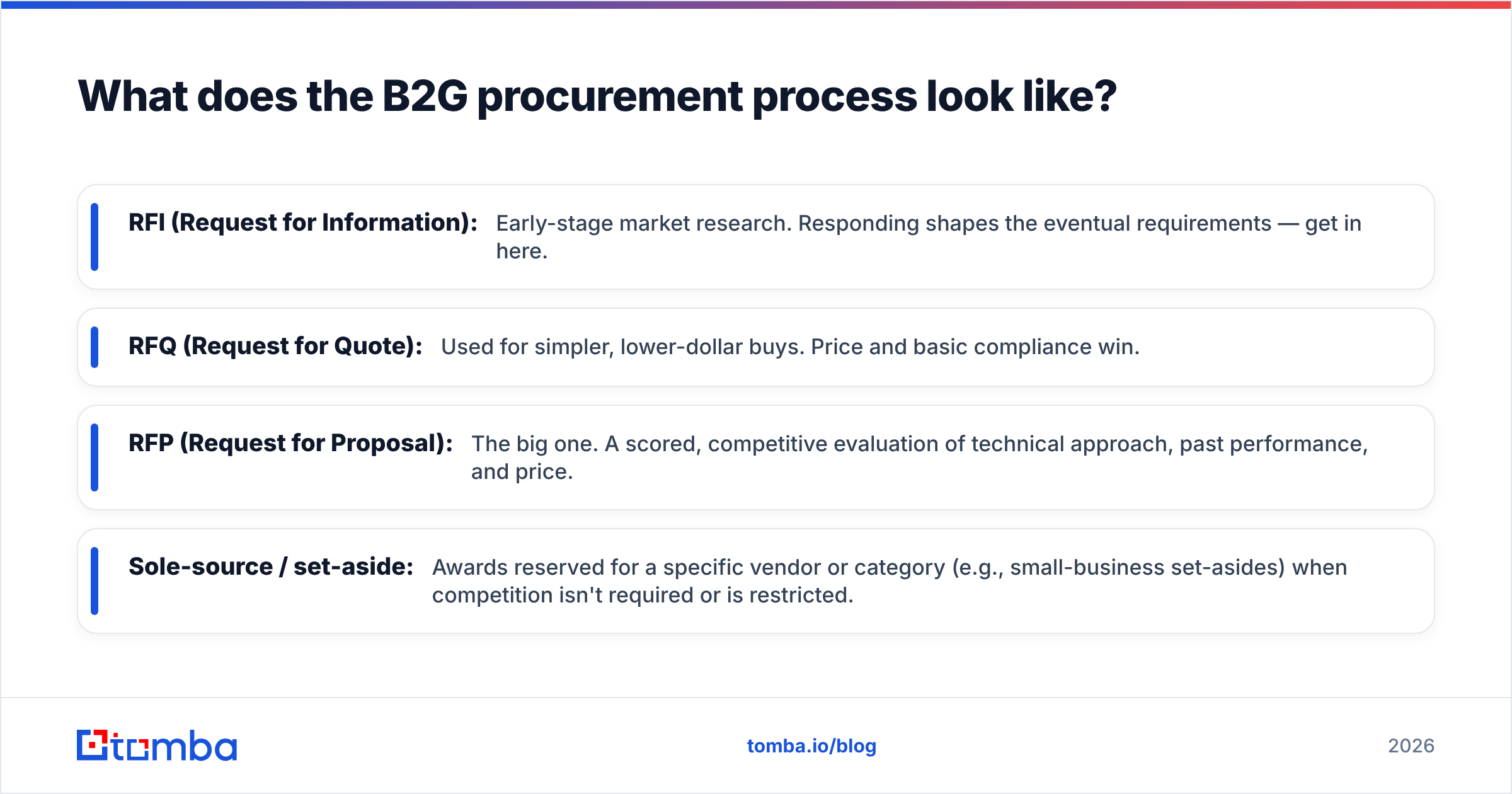
Government buying runs on a vocabulary of acronyms. Learn these and the process stops feeling opaque:
- RFI (Request for Information): Early-stage market research. Responding shapes the eventual requirements — get in here.
- RFQ (Request for Quote): Used for simpler, lower-dollar buys. Price and basic compliance win.
- RFP (Request for Proposal): The big one. A scored, competitive evaluation of technical approach, past performance, and price.
- Sole-source / set-aside: Awards reserved for a specific vendor or category (e.g., small-business set-asides) when competition isn't required or is restricted.
To even be eligible federally, you generally need to register in SAM.gov (the System for Award Management) and, for many software and services categories, get onto a GSA Schedule or an equivalent contract vehicle. You can start the registration process directly at SAM.gov and review schedule options through the U.S. General Services Administration. States and cities run their own vendor portals — there is no single login that covers everyone.
The strategic insight: the RFP is the end of the sale, not the beginning. By the time a formal RFP drops, the incumbent or the vendor who helped shape the requirements is usually positioned to win. Your job is to be present during the RFI and budgeting phase, months earlier, building relationships with program managers. That timing is why early contact discovery — and the contact enrichment behind it — is so valuable.
How long is the B2G sales cycle and how do you manage it?#
Plan for 6 to 18 months, and sometimes longer for large capital projects. The cycle is gated by budget approvals, procurement law, and committee scheduling — none of which you control. Trying to rush it reads as not understanding government, which kills trust.
Manage it with three habits:
- Map to the fiscal calendar. Know each target agency's fiscal year and budget cycle. Time your outreach to land before budgets are set, not after they're spent.
- Track relationships, not just opportunities. A program manager you helped this year writes the requirements next year. Log every contact in your CRM and keep nurturing across cycles.
- Build past performance deliberately. Your first government contract is the hardest. Smaller pilots, subcontracting under a prime, or local-government deals all build the track record that scores points on bigger bids.
For a deeper look at structuring multi-stage, long-horizon deals, our writing on the sales process and pipeline management complements the B2G-specific steps here.
What does a B2G outreach motion actually look like?#
Concrete and repeatable beats clever. Here is a motion a small vendor can run:
- Pick a niche and a region. "Cybersecurity for school districts in the Midwest" beats "government" as a target.
- Pull award data for districts that have bought adjacent services, and list 50 named accounts.
- For each account, find the IT director, the procurement contact, and the relevant program lead using domain-based discovery on the agency's email pattern.
- Verify every address and remove catch-all or risky ones to protect your sender reputation.
- Open with value, not a pitch: reference a grant they won, a published priority, or a peer district's outcome. Government buyers respond to relevance and proof.
- Follow up patiently across the fiscal cycle. Offer to participate in RFIs. Provide pricing guidance that helps them budget.
- When the RFP drops, you're already known — and you helped define what "good" looks like.
This is where having clean, structured contact data compounds. Reps who spend their week guessing at email formats and getting bounces never reach step 5. Reps with verified data spend that time on research and relationships. Check the Tomba pricing tiers to match list volume to your team size — the Free tier covers early experiments, and Growth or Pro scales a full SLED territory.
Common mistakes in business to government sales#
- Treating B2G like fast B2B. Aggressive closing tactics backfire. Patience signals competence.
- Ignoring small contracts. A $20k pilot builds the past performance that wins the $2M deal.
- Showing up only at RFP time. If the first time the agency hears from you is the RFP, you've already lost to whoever shaped it.
- Dirty contact lists. Bouncing emails to .gov domains damages deliverability and your reputation with the exact buyers you need. Verify first, always.
- Skipping registration. No SAM.gov or vehicle, no eligibility — full stop for federal work.
The bottom line#
Business to government sales is a long game won on accuracy, timing, and relationships built before the paperwork starts. The vendors who win aren't the loudest — they're the ones present early, registered correctly, and connected to the right program managers and procurement officers across multiple budget cycles.
All of that starts with knowing exactly who to reach and being able to reach them. Tomba's Email Finder lets you build verified, accurate contact lists for the agencies and departments that buy what you sell — search by name, by domain, or in bulk, then verify every address before you send so your outreach lands in government inboxes instead of spam folders. Start free with 25 searches, and scale up as your public-sector pipeline grows.
Ready to find emails that actually work?
Join 150,000+ professionals who stopped guessing and started sending. Free credits on signup — no credit card required.
Get the Tomba newsletter
Practical outbound tactics and product updates — once every two weeks.
About the author