Buyer Focused Selling: The 2026 Guide to Winning B2B Deals
Buyer focused selling flips the script from pushing product to solving problems. Here's the 2026 playbook, with frameworks, a comparison table, and the data tactics that make it work.
TL;DR
- Buyer focused selling means organizing your entire sales motion around how the customer decides — their problems, their internal process, their risk — instead of around your pitch deck and your quota.
- It is not "being nice." It is a measurable discipline: better discovery, fewer forced demos, shorter cycles on the deals that should close, and faster disqualification on the ones that shouldn't.
- Reps who lead with buyer context out-convert product-led pitchers because B2B buyers now do most of their research before they ever talk to you.
- The biggest blocker is bad inputs. You can't be buyer-focused if your contact data is wrong, your targeting is loose, or you're emailing the wrong person.
- This guide covers the mindset, a side-by-side comparison with seller-centric selling, a step-by-step framework, the metrics that prove it works, and the tooling that makes it repeatable.
What is buyer focused selling?#
Buyer focused selling is a sales approach where every action — the research, the first email, the discovery call, the proposal — is built around the buyer's decision journey rather than the seller's product story.
Think of it like a good doctor versus a bad one. A bad doctor walks in already holding the prescription and spends the visit convincing you to take it. A good doctor asks where it hurts, runs the right tests, rules things out, and only then recommends a treatment you actually trust. Same medicine, completely different outcome — because one started with the patient and one started with the pill.
In practice, buyer focused selling shifts three things:
- Who leads the conversation. The buyer's situation sets the agenda, not your feature list.
- What "progress" means. A deal advances when the buyer gets closer to a confident decision, not when you complete the next stage in your CRM.
- When you walk away. You disqualify early and honestly when there's no real fit, instead of dragging a bad-fit deal through six calls.
This matters more in 2026 than it did five years ago. According to Gartner research on B2B buying, buyers spend the majority of their journey researching independently and only a small slice of it talking to any one sales rep. By the time they reach you, they've formed opinions. Pitching at them ignores everything they already know. Selling with them respects it.
How is buyer focused selling different from traditional selling?#
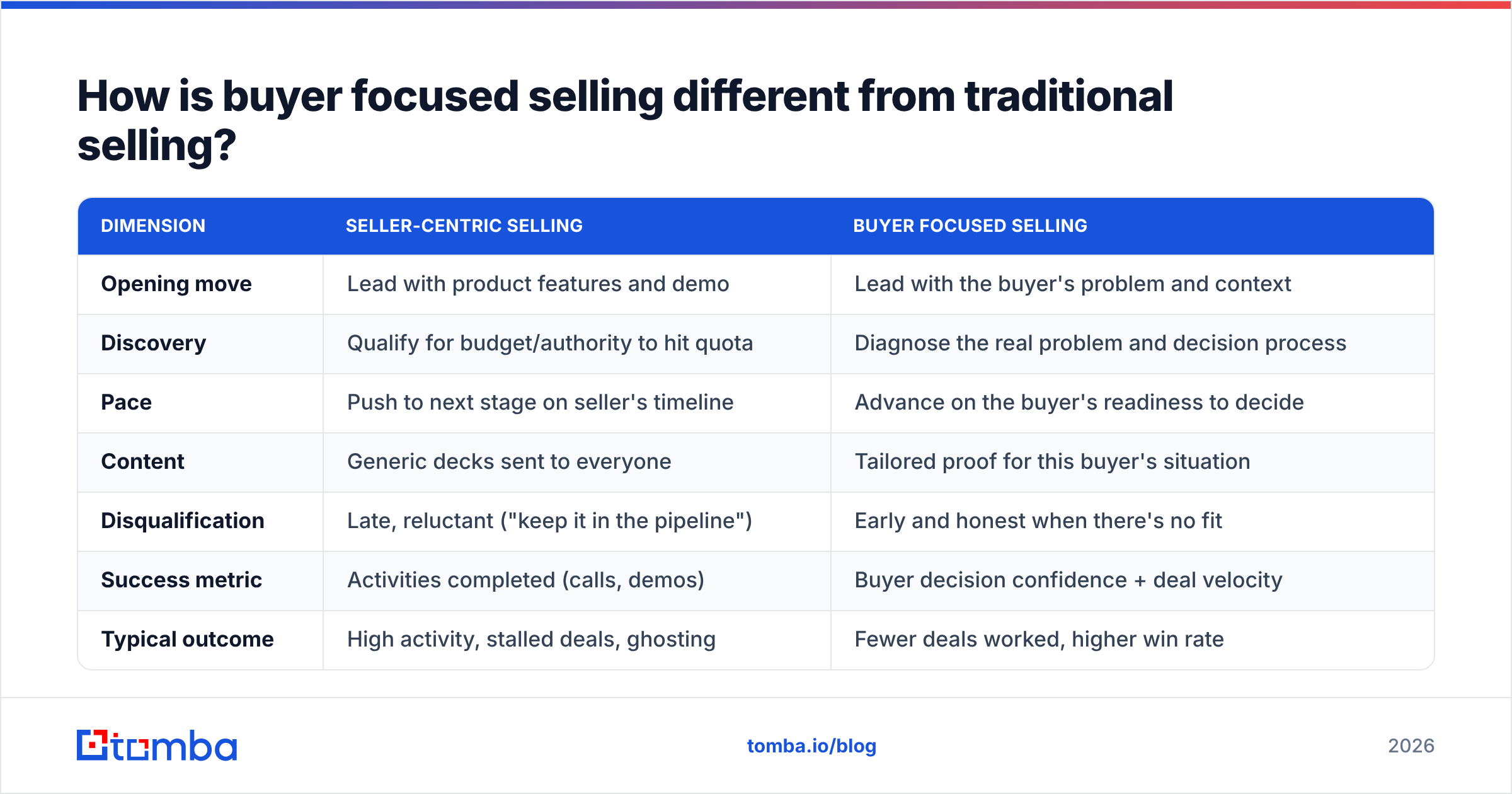
The short version: traditional selling optimizes for the seller's process; buyer focused selling optimizes for the buyer's confidence. Here's the side-by-side.
| Dimension | Seller-Centric Selling | Buyer Focused Selling |
|---|---|---|
| Opening move | Lead with product features and demo | Lead with the buyer's problem and context |
| Discovery | Qualify for budget/authority to hit quota | Diagnose the real problem and decision process |
| Pace | Push to next stage on seller's timeline | Advance on the buyer's readiness to decide |
| Content | Generic decks sent to everyone | Tailored proof for this buyer's situation |
| Disqualification | Late, reluctant ("keep it in the pipeline") | Early and honest when there's no fit |
| Success metric | Activities completed (calls, demos) | Buyer decision confidence + deal velocity |
| Typical outcome | High activity, stalled deals, ghosting | Fewer deals worked, higher win rate |
The trap is thinking buyer-focused means passive or slow. It's the opposite. Because you spend your energy only on buyers who have a real problem you can solve, you actually move faster on the deals that matter and stop wasting weeks on the ones that won't close. Speed comes from focus, not from pressure.
This is also why buyer focused selling pairs naturally with strong outbound sales strategy. Outbound gets you in front of the right accounts; a buyer-focused motion makes sure the conversation is worth having once you're there.
Why does buyer focused selling work better in 2026?#
It works because the balance of information has flipped. Buyers can self-educate on pricing, alternatives, and reviews through sites like G2 before they ever fill out a form. The rep is no longer the gatekeeper of information — they're a guide through a decision the buyer is already making.
Three forces make the buyer-focused approach the higher-converting choice now:
- Information parity. Your prospect has read the comparison posts, the Reddit threads, and the review sites. A scripted pitch that ignores that reading insults their effort.
- Buying-committee complexity. Most B2B deals involve multiple stakeholders. A buyer-focused rep maps and serves the whole committee; a product-pusher pitches one champion and gets stuck.
- Trust scarcity. Inboxes are flooded. The rep who clearly understands the buyer's world earns the reply. As inbox volume climbs, relevance — not volume — drives response rate.
HubSpot's sales research consistently shows that trust and relevance, not persistence alone, separate top performers from the rest. Buyer focused selling is how you operationalize trust.
What does a buyer focused selling framework look like?#
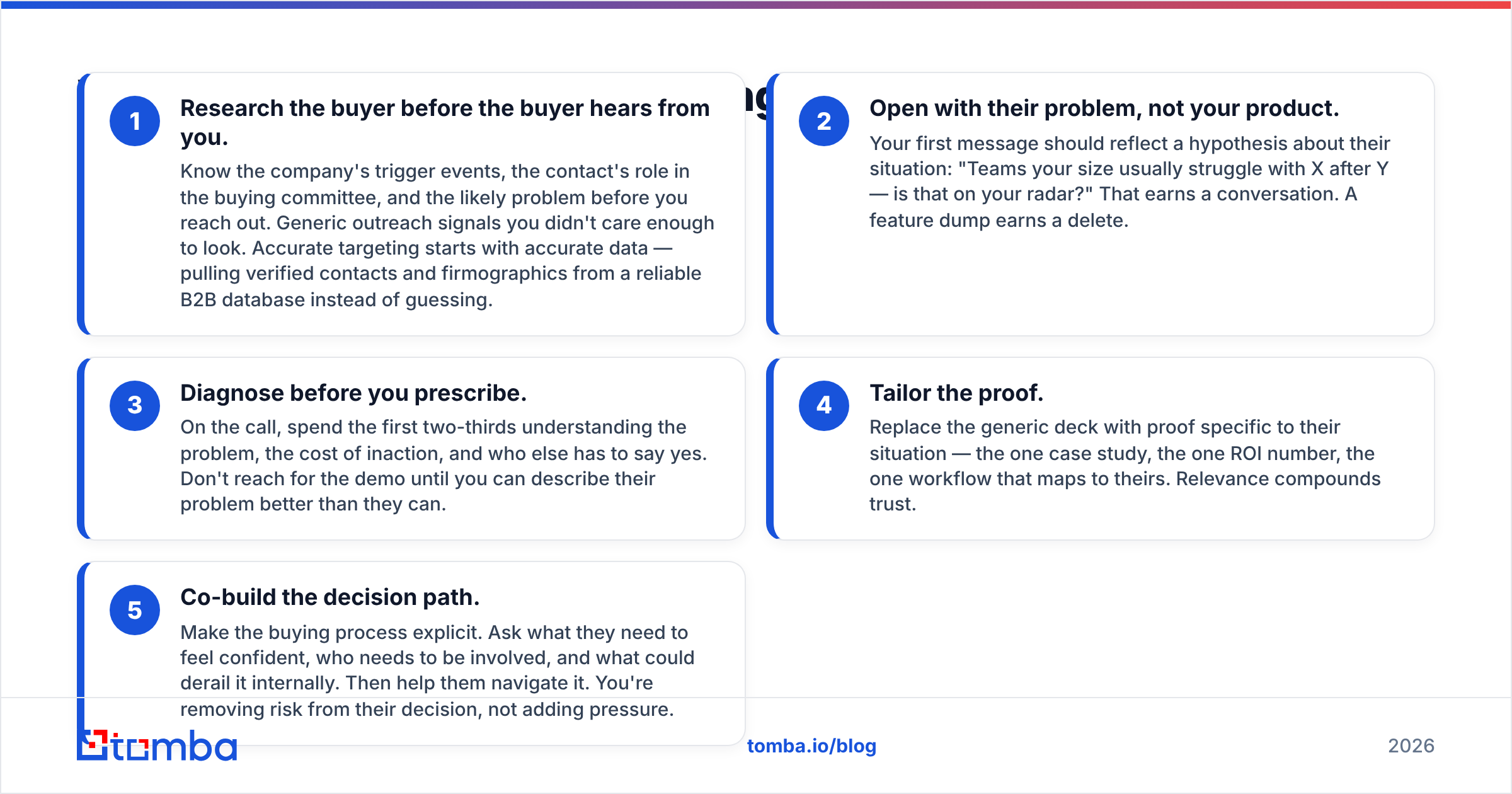
Here is a repeatable five-step framework. The bold leads are the steps; the detail is how you actually run each one.
- Research the buyer before the buyer hears from you. Know the company's trigger events, the contact's role in the buying committee, and the likely problem before you reach out. Generic outreach signals you didn't care enough to look. Accurate targeting starts with accurate data — pulling verified contacts and firmographics from a reliable B2B database instead of guessing.
- Open with their problem, not your product. Your first message should reflect a hypothesis about their situation: "Teams your size usually struggle with X after Y — is that on your radar?" That earns a conversation. A feature dump earns a delete.
- Diagnose before you prescribe. On the call, spend the first two-thirds understanding the problem, the cost of inaction, and who else has to say yes. Don't reach for the demo until you can describe their problem better than they can.
- Tailor the proof. Replace the generic deck with proof specific to their situation — the one case study, the one ROI number, the one workflow that maps to theirs. Relevance compounds trust.
- Co-build the decision path. Make the buying process explicit. Ask what they need to feel confident, who needs to be involved, and what could derail it internally. Then help them navigate it. You're removing risk from their decision, not adding pressure.
Notice that four of the five steps happen before or instead of a traditional pitch. That's the whole point.
How do you measure buyer focused selling?#
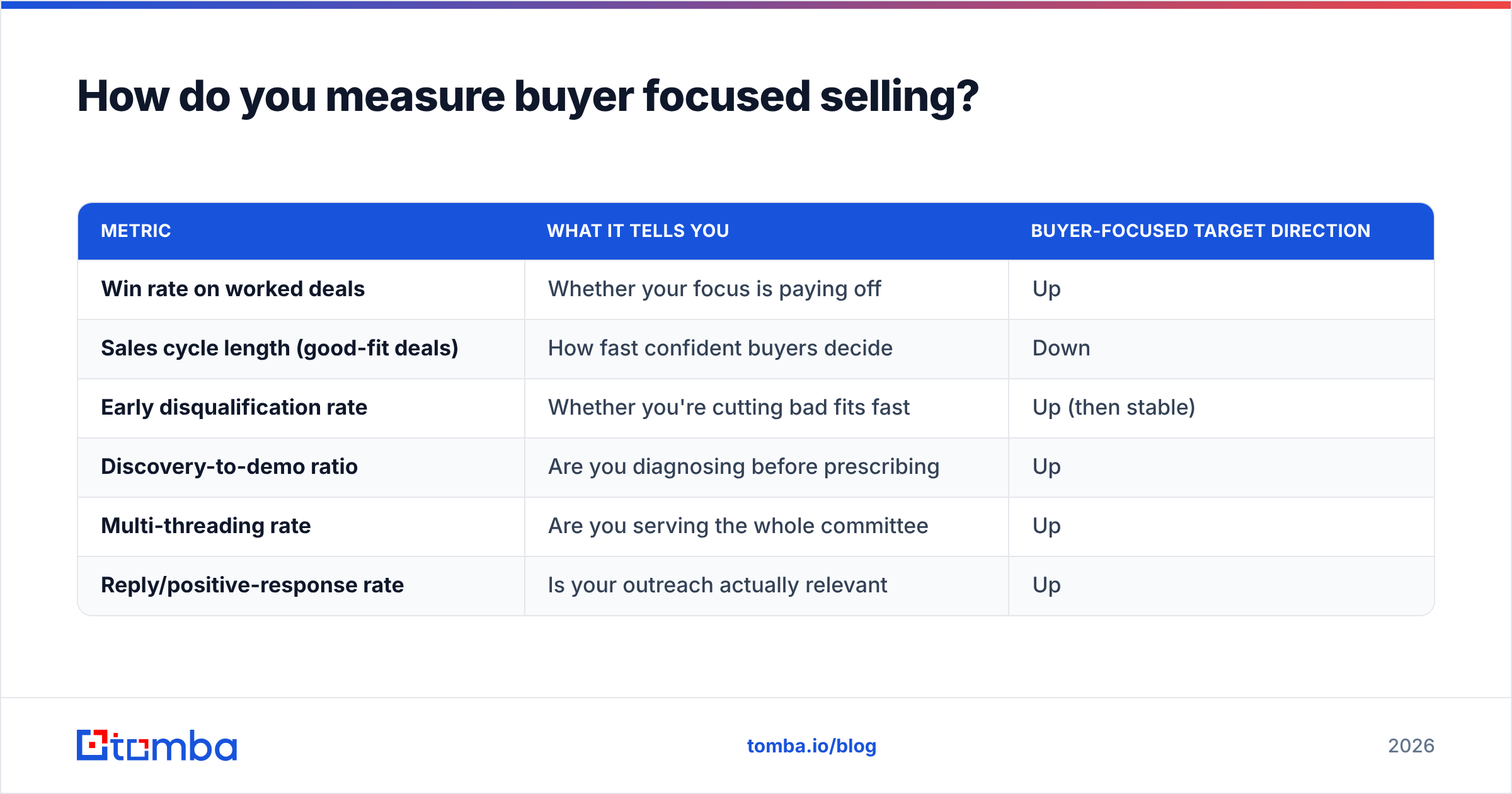
You measure it with outcome and velocity metrics, not activity metrics. Counting dials and demos rewards the seller-centric behavior you're trying to leave behind. Track these instead.
| Metric | What it tells you | Buyer-focused target direction |
|---|---|---|
| Win rate on worked deals | Whether your focus is paying off | Up |
| Sales cycle length (good-fit deals) | How fast confident buyers decide | Down |
| Early disqualification rate | Whether you're cutting bad fits fast | Up (then stable) |
| Discovery-to-demo ratio | Are you diagnosing before prescribing | Up |
| Multi-threading rate | Are you serving the whole committee | Up |
| Reply/positive-response rate | Is your outreach actually relevant | Up |
A counterintuitive sign of success: your total number of active deals may drop while revenue rises. That's healthy. You're trading a bloated pipeline of maybes for a lean pipeline of real opportunities. If your win rate climbs while your deal count falls, buyer-focused selling is working.
The reason most teams fail at this is data hygiene, not willpower. Reps default to spray-and-pray when their list is full of stale titles, wrong emails, and people who left the company a year ago. You can't be buyer-focused with seller-grade data.
What tooling supports a buyer focused motion?#
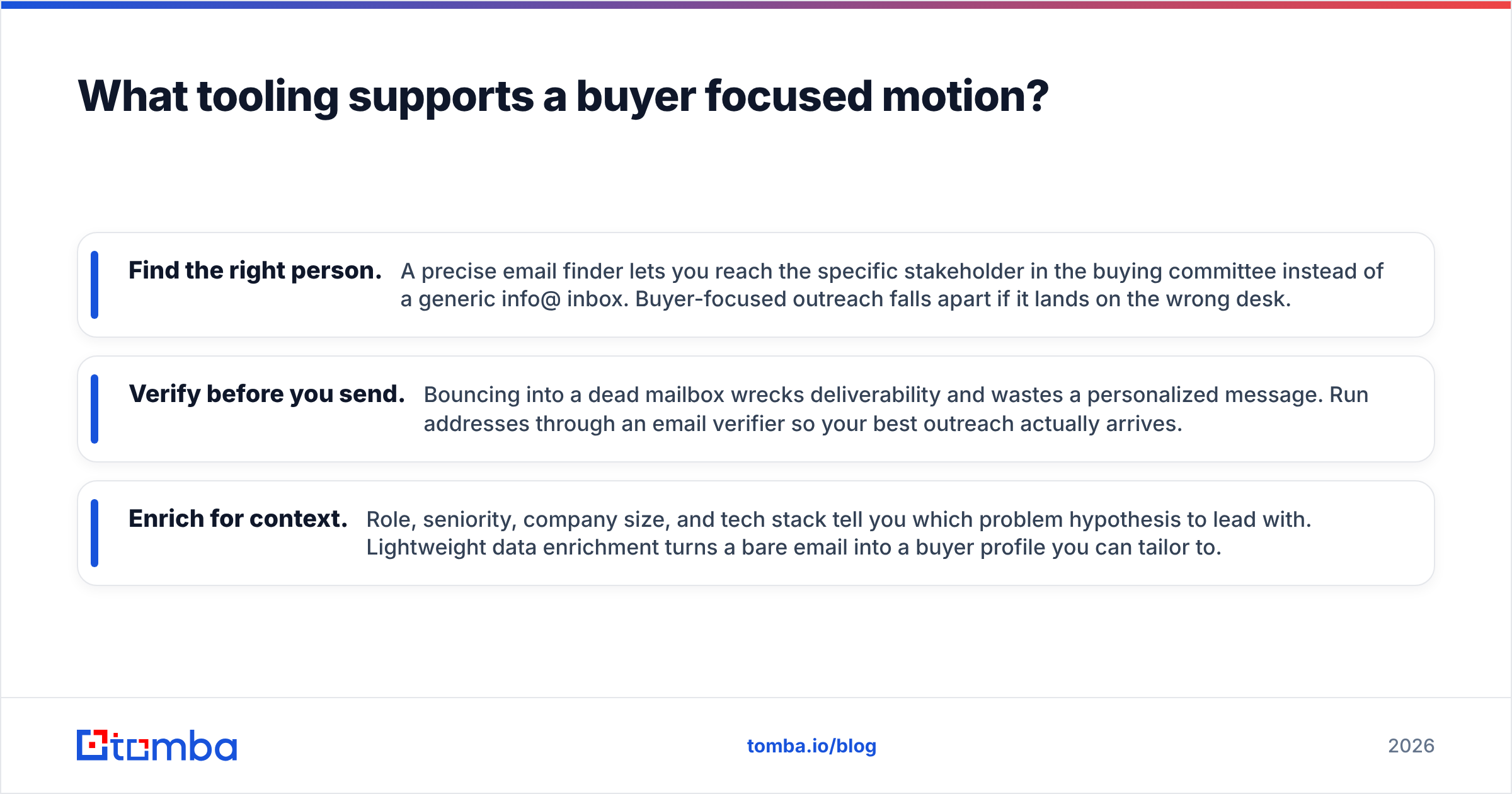
The right stack removes the friction that pushes reps back toward lazy, product-first habits. You need three capabilities: accurate contact discovery, verification, and enrichment so that every personalized message reaches a real person at the right account.
- Find the right person. A precise email finder lets you reach the specific stakeholder in the buying committee instead of a generic info@ inbox. Buyer-focused outreach falls apart if it lands on the wrong desk.
- Verify before you send. Bouncing into a dead mailbox wrecks deliverability and wastes a personalized message. Run addresses through an email verifier so your best outreach actually arrives.
- Enrich for context. Role, seniority, company size, and tech stack tell you which problem hypothesis to lead with. Lightweight data enrichment turns a bare email into a buyer profile you can tailor to.
The point of tooling here is not automation for volume — it's automation for relevance. You're spending the time you saved on research and personalization, not on blasting more generic emails. A buyer-focused rep with clean data sends fewer messages and books more meetings.
If you want to put a number on it: Tomba pricing starts free with 25 searches a month, then $49/mo on Starter and $99/mo on Growth — modest next to the cost of a single rep burning a quarter on bad-fit deals.
What mistakes derail buyer focused selling?#
Even teams that buy into the philosophy stumble on execution. The common failure modes:
- Fake personalization. A merge field with the prospect's first name is not buyer focus. Referencing a real trigger event or a specific pain is. Buyers can tell the difference instantly.
- Discovery theater. Asking "what keeps you up at night?" and then launching into the same demo regardless of the answer. If discovery doesn't change your pitch, it wasn't discovery.
- Single-threading. Falling in love with one champion and ignoring the economic buyer and the skeptics. Buyer-focused means serving the whole committee, including the people who can kill the deal.
- Refusing to disqualify. Keeping a clearly bad-fit deal alive because the pipeline looks thin. This is the seller's anxiety overriding the buyer's reality.
- Dirty data underneath it all. Personalization built on wrong titles or dead emails is worse than no personalization — it advertises that you didn't check.
Fix the data layer first. It's the foundation everything else stands on. A buyer-focused script on top of a bad list still fails; clean targeting on top of a buyer-focused mindset compounds.
How do you roll out buyer focused selling on a team?#
Start small and prove it, then scale. A realistic 90-day rollout:
- Weeks 1–2: Audit your current data and disqualification habits. Clean the list and define what "good fit" actually means for your product.
- Weeks 3–6: Rewrite outreach to lead with buyer problems. Retrain discovery calls to diagnose before demoing. Track reply rate and discovery-to-demo ratio.
- Weeks 7–12: Measure win rate and cycle length against your baseline. Coach to the metrics, not the activity. Expand what's working.
The mindset shift is the hard part; the tooling is the easy part. But the tooling makes the mindset stick, because it removes the excuse to fall back on volume.
The bottom line#
Buyer focused selling wins because it matches how people actually buy in 2026: informed, cautious, committee-driven, and allergic to being pitched. Organize around the buyer's decision, measure outcomes instead of activity, disqualify honestly, and build the whole thing on accurate data.
That last part is where most teams quietly lose. If your outreach is landing on wrong contacts and dead inboxes, no amount of buyer-focus philosophy will save it. Start by getting the right person's verified email in front of every rep — try the Tomba Email Finder free for 25 searches, point your buyer-focused message at the people who can actually say yes, and let relevance do the closing.
// get started
Find, verify and enrich your first contacts today
Start on the free plan with 25 searches a month, then scale when your team is ready.
Free plan · No credit card required · GDPR & CCPA
// about the author