Buyer Intent Questions: 25 to Ask and Qualify Faster in 2026
The right buyer intent questions separate tire-kickers from ready-to-buy prospects. Here are 25 to ask, when to ask them, and how to read the answers.
TL;DR
- Buyer intent questions are discovery prompts that reveal whether a prospect has the budget, urgency, authority, and active problem to actually buy — not just curiosity.
- Ask them in a deliberate order: surface the problem first, quantify the pain, confirm timing and authority, then test for budget. Lead with budget and you sound like a vendor, not an advisor.
- The best questions are open-ended and forward-looking ("What happens if this isn't fixed by Q3?"), not yes/no checkboxes.
- Pair what people say with behavioral signals — site visits, pricing-page views, repeat opens — to avoid coaching prospects into fake urgency.
- Score every answer so qualification is consistent across the team instead of living in one rep's gut.
What are buyer intent questions?#
Buyer intent questions are the discovery questions that tell you how close a prospect actually is to a purchase decision. Think of them like a doctor's intake questions: before any prescription, the doctor asks what hurts, how long it's been hurting, what you've already tried, and what happens if you ignore it. Skip the intake and you're guessing.
In B2B sales, intent lives on a spectrum. Someone downloading a checklist has curiosity. Someone asking for a security review and a rollout timeline has intent. The questions below help you locate a prospect on that spectrum in the first 15 minutes of a call, so you spend demo time on people who can say yes — and politely recycle the rest.
This matters more in 2026 than it did five years ago. Buying committees have grown — Gartner pegs the typical B2B buying group at six to ten stakeholders — and self-service research means prospects show up to calls already half-educated. Your edge is no longer information. It's diagnosis.
Why do buyer intent questions matter for qualification?#
Because the alternative is volume-based hope. Reps who don't qualify on intent fill their pipeline with polite "maybes," forecast them anyway, and watch deals slip quarter after quarter. The cost isn't just the lost deal — it's the demo hours, the proposals, and the follow-up sequences spent on accounts that were never going to move.
Good intent questions fix three specific leaks:
- They expose timing early. A prospect with a real deadline behaves differently from one "just exploring." One sentence — "What's driving the timeline on this?" — separates them.
- They surface the buying committee. When you ask who else weighs in, a single-threaded deal becomes a multi-threaded one before it stalls at legal.
- They quantify pain in the buyer's words. A problem the prospect can put a number on ("we lose about 12 hours a week to this") is a problem they'll pay to solve.
There's a deliverability parallel here too: just as you verify an address before you send so you don't burn your sender reputation, you verify intent before you invest so you don't burn your calendar. If you're building lists upstream, a clean source from a quality email finder keeps the wrong-fit contacts out before intent questions even start.
What are the best buyer intent questions to ask?#
Group your questions by what they're trying to uncover. You won't ask all 25 on one call — you'll pull the right four or five based on where the conversation goes.
Problem and pain (start here)#
- What prompted you to look at solutions like this now?
- Walk me through how your team handles this today.
- Where does that process break down most often?
- If nothing changes, what does that cost you over the next two quarters?
- How are you measuring success for whoever owns this?
Urgency and timing#
- Is there a specific event or deadline driving this?
- What's the priority of this versus the other things on your plate?
- When would you want a solution live and producing results?
- What's held you back from solving this already?
Authority and the buying committee#
- Besides you, who else needs to weigh in on a decision like this?
- How has your team bought tools like this before?
- Who would feel the impact most once it's in place?
- What would the approval process look like internally?
Budget and value#
- Have you set aside budget for this, or are we building the case together?
- How do you typically justify spend like this to finance?
- What would the solution need to deliver to be an easy yes?
Competitive and status-quo#
- What other options are you weighing, including doing nothing?
- What would make you stick with your current approach?
- What's your biggest concern about switching?
Notice the order. You earn the right to ask about budget by first proving you understand the problem. Open with "What's your budget?" and you've told the prospect you see a wallet, not a person. HubSpot's research on discovery calls makes the same point: reps who diagnose before they pitch close at meaningfully higher rates. (HubSpot's discovery question guidance is a useful complement here.)
How do you read the answers — what counts as a strong signal?#
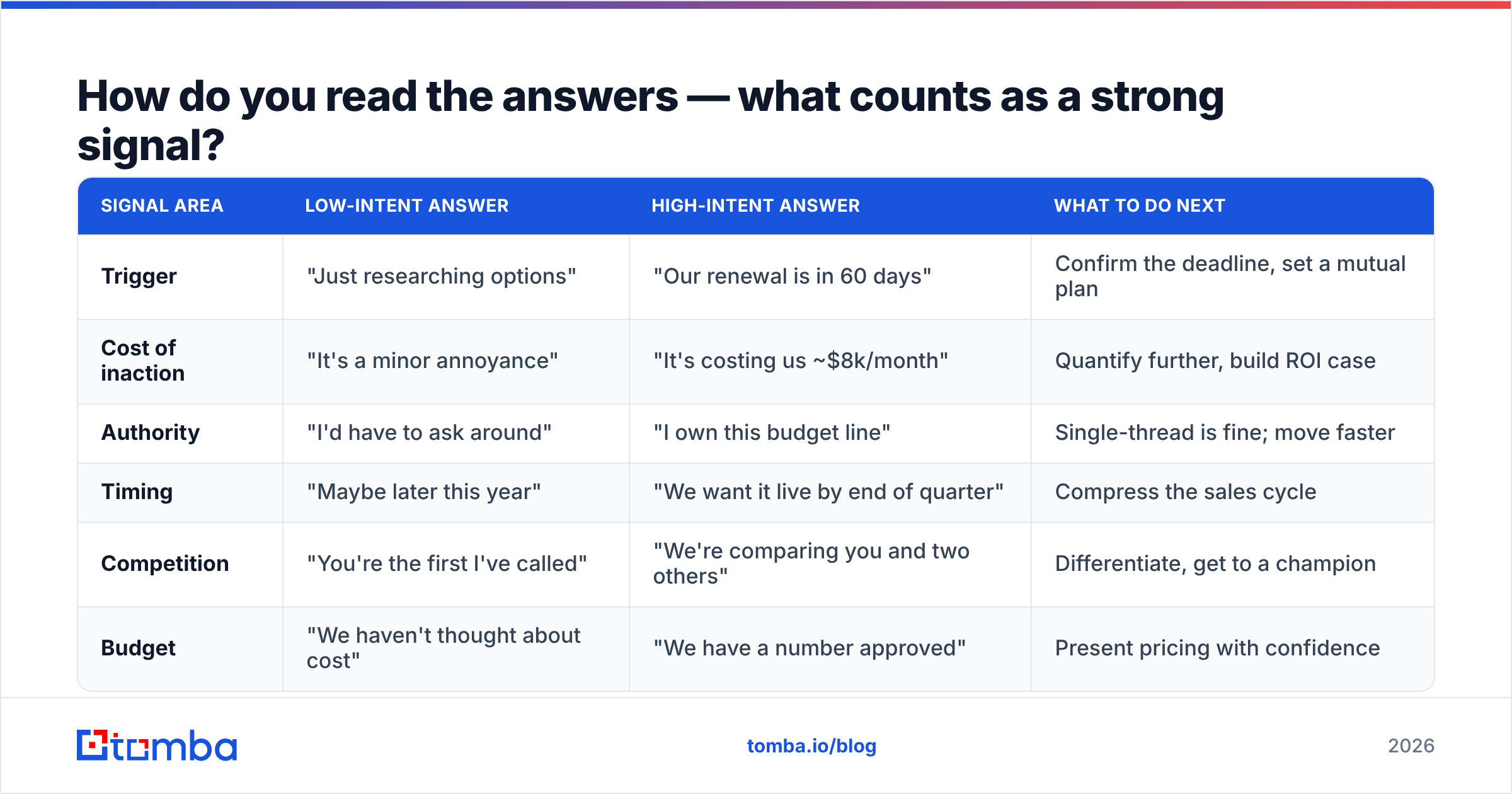
A question is only as good as your ability to interpret the answer. Here's how the same prompts map to high versus low intent.
| Signal area | Low-intent answer | High-intent answer | What to do next |
|---|---|---|---|
| Trigger | "Just researching options" | "Our renewal is in 60 days" | Confirm the deadline, set a mutual plan |
| Cost of inaction | "It's a minor annoyance" | "It's costing us ~$8k/month" | Quantify further, build ROI case |
| Authority | "I'd have to ask around" | "I own this budget line" | Single-thread is fine; move faster |
| Timing | "Maybe later this year" | "We want it live by end of quarter" | Compress the sales cycle |
| Competition | "You're the first I've called" | "We're comparing you and two others" | Differentiate, get to a champion |
| Budget | "We haven't thought about cost" | "We have a number approved" | Present pricing with confidence |
Two high-intent answers and you have a real opportunity. Four or more and you should be talking implementation, not features. Mostly low-intent answers? Don't force it — nurture them and re-engage when a trigger fires.
This is also where you separate a marketing qualified lead from a sales-ready one. An MQL raised a hand; a sales-qualified opportunity passed your intent questions. Treating them the same is how pipelines bloat with deals that never close.
Should you trust what buyers say or what they do?#
Both — and weight behavior heavily. People are unreliable narrators of their own urgency. A prospect will tell you "next quarter" to be polite, then go silent. Meanwhile their actions — visiting your pricing page three times, forwarding your case study, pulling two colleagues into the next call — tell the truth.
The strongest qualification combines stated and behavioral intent:
- Stated intent comes from your questions: deadlines, budget, committee, pain.
- Behavioral intent comes from signals: repeat site visits, content downloads, email engagement, and third-party intent data showing the account is researching your category.
When the two agree, you have conviction. When they conflict — a prospect says "no rush" but keeps opening your emails at 11pm — believe the behavior and gently probe the gap: "I noticed you pulled the security doc — is compliance part of the evaluation?"

Identifying which accounts are showing behavioral signals is its own discipline. Tools like website visitor reveal help you see which companies are circling before they ever fill out a form, so your intent questions start with accounts that are already warm. Pair that with data enrichment and you walk into the call already knowing company size, tech stack, and who the likely committee members are.
How is a buyer intent question different from a generic discovery question?#
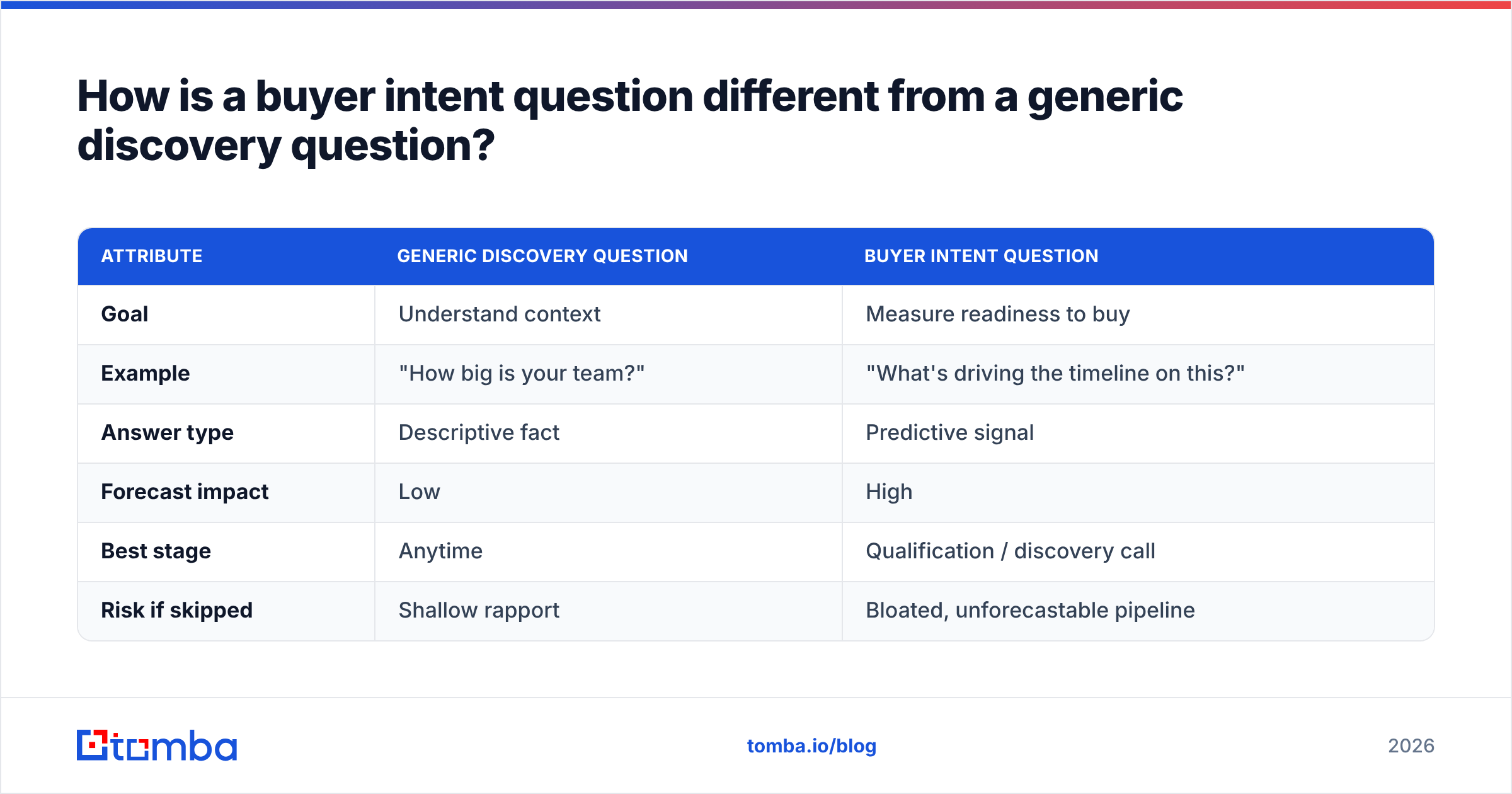
Every buyer intent question is a discovery question, but not every discovery question measures intent. The difference is whether the answer changes your forecast.
| Attribute | Generic discovery question | Buyer intent question |
|---|---|---|
| Goal | Understand context | Measure readiness to buy |
| Example | "How big is your team?" | "What's driving the timeline on this?" |
| Answer type | Descriptive fact | Predictive signal |
| Forecast impact | Low | High |
| Best stage | Anytime | Qualification / discovery call |
| Risk if skipped | Shallow rapport | Bloated, unforecastable pipeline |
"How big is your team?" is useful background, but it won't tell you whether the deal closes this quarter. "What happens if this isn't solved by your renewal date?" will. Spend your limited call time on the second kind.
A practical filter: after you draft a question, ask yourself "Could the answer move this deal up or down my forecast?" If not, it's context, not intent — keep it short and move on.
How do you score buyer intent so the whole team is consistent?#
Turn answers into numbers. Gut-feel qualification doesn't scale, and it makes coaching impossible because every rep "knows" intent differently. A lightweight scoring model fixes that.
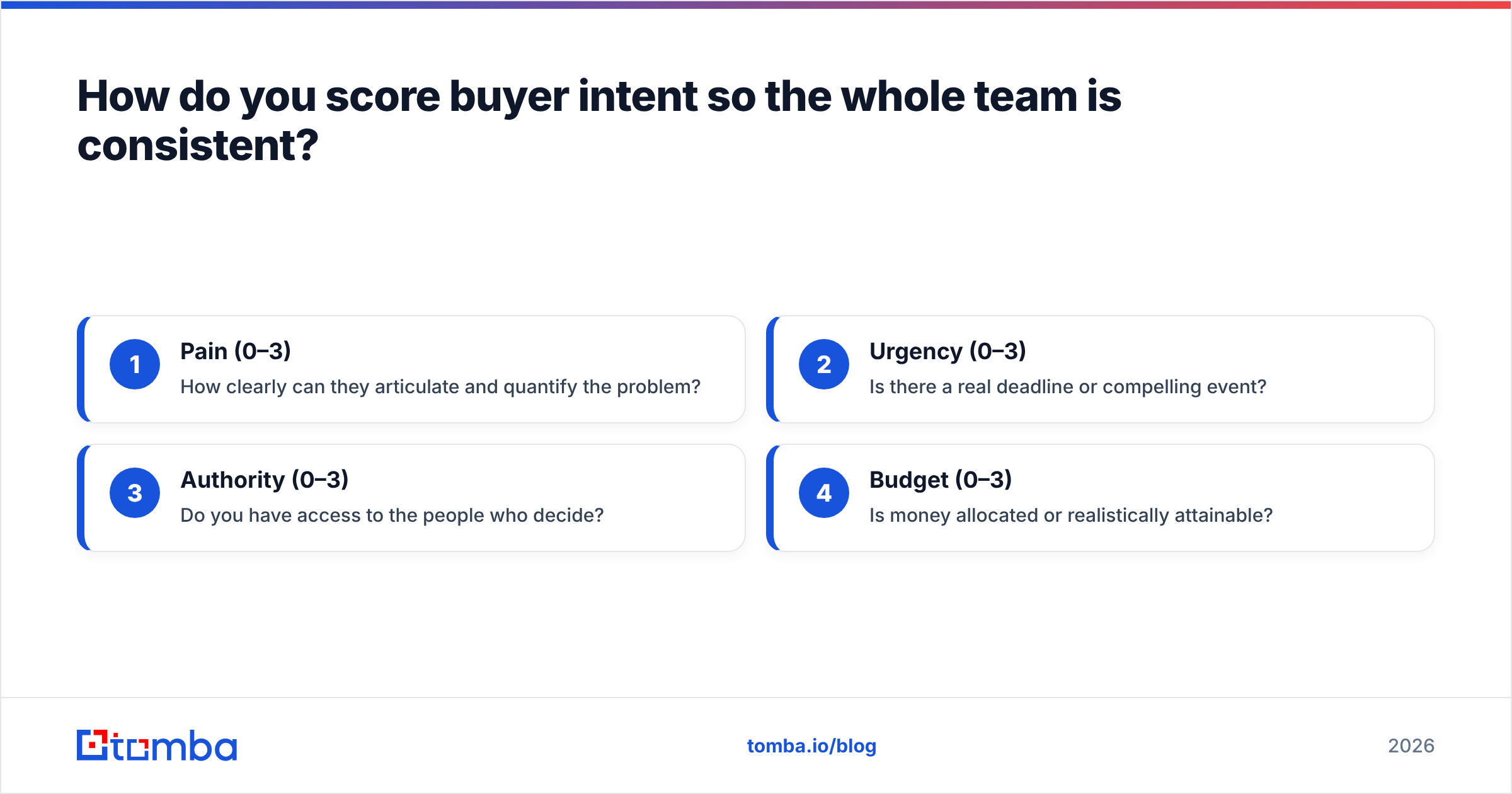
Assign points across four dimensions, then set a threshold for what moves to a demo:
- Pain (0–3) — How clearly can they articulate and quantify the problem?
- Urgency (0–3) — Is there a real deadline or compelling event?
- Authority (0–3) — Do you have access to the people who decide?
- Budget (0–3) — Is money allocated or realistically attainable?
Score 8+ out of 12 and the opportunity is sales-ready. Score 4–7 and it goes to nurture with a specific re-engagement trigger. Below 4, disqualify and free up the calendar. This is the same logic behind formal lead management and scoring practices — you're just applying it live, in the conversation. Frameworks like BANT, MEDDIC, and GPCTBA/C&I (popularized across the industry; G2 maintains a solid overview of sales qualification frameworks) are all variations on this idea: convert a conversation into a comparable score.
The payoff is forecast accuracy. When every rep scores the same way, your pipeline review stops being a debate about feelings and becomes a conversation about evidence.
What buyer intent questions should you avoid?#
A few common mistakes quietly poison discovery:
- Leading questions. "You'd want this done before year-end, right?" coaches the prospect into fake urgency. Ask "What's your ideal timeline?" and let them answer.
- Stacked questions. Firing three questions at once means you get one shallow answer. Ask one, then shut up.
- Premature budget probing. Budget is a trust question. Earn it by demonstrating you understand the problem first.
- Yes/no checkboxes. "Do you have budget?" gets a defensive "maybe." "How do you usually fund initiatives like this?" gets a story.
- Ignoring the status quo. Your real competitor is usually "do nothing." If you never ask why they'd stick with today's process, you can't beat it.
The throughline: questions that invite a narrative beat questions that demand a verdict. People reveal intent when they're explaining, not when they're defending.
How do you put this into a repeatable call flow?#
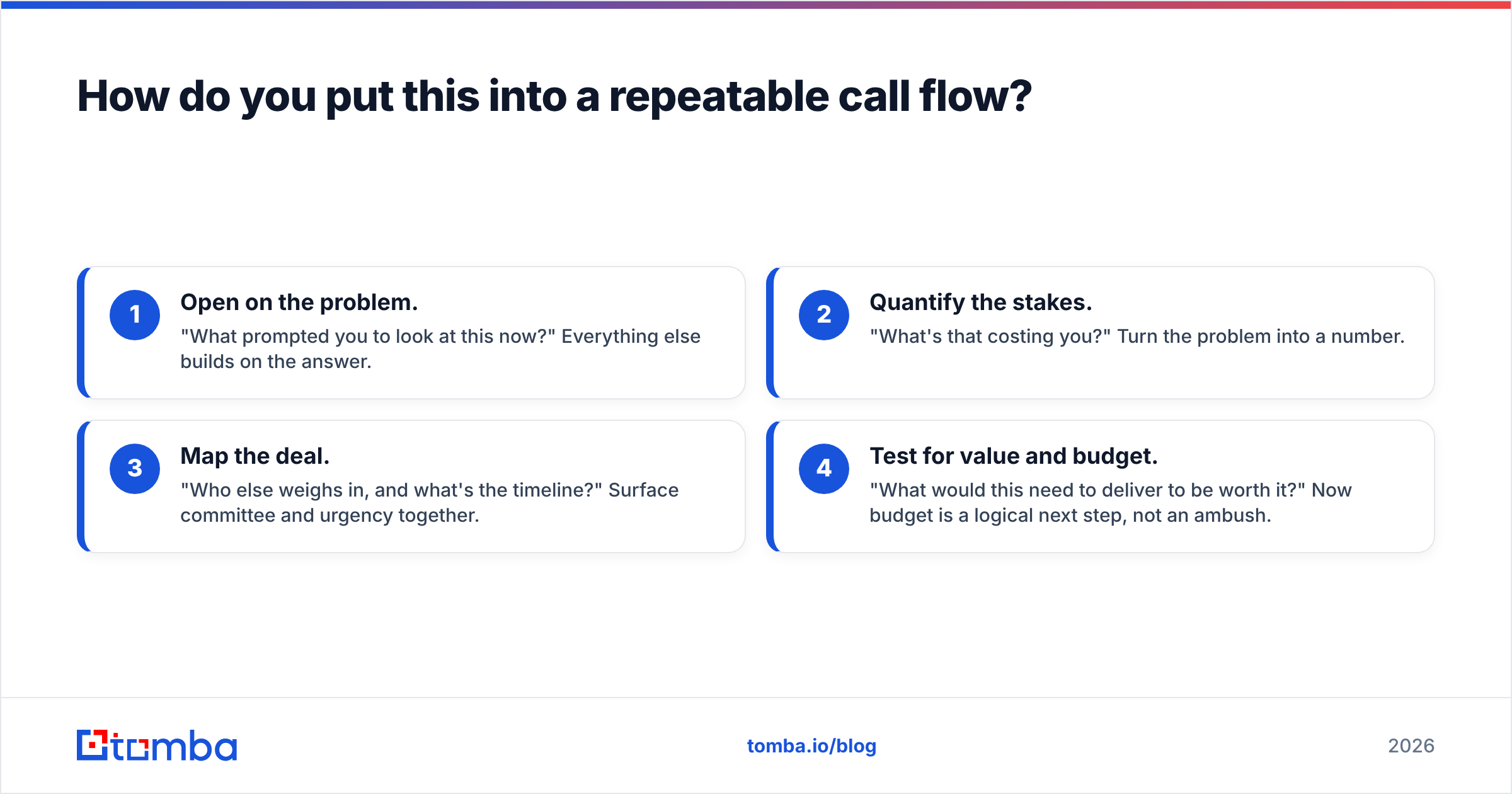
Sequence beats scripting. You don't need to memorize 25 questions — you need a four-beat rhythm you can run on any call:
- Open on the problem. "What prompted you to look at this now?" Everything else builds on the answer.
- Quantify the stakes. "What's that costing you?" Turn the problem into a number.
- Map the deal. "Who else weighs in, and what's the timeline?" Surface committee and urgency together.
- Test for value and budget. "What would this need to deliver to be worth it?" Now budget is a logical next step, not an ambush.
Document the answers in your CRM the same day, score them, and set the next action before you hang up. The reps who do this consistently aren't more charismatic — they're more systematic. And systematic is something you can train, measure, and improve.
If you want the upstream half handled too — finding the right-fit contacts and committee members before the call so your intent questions land on people who can actually buy — start with the Tomba Email Finder. Pull accurate, verified contacts by company or domain, enrich them with role and seniority data, and walk into every discovery call already knowing who holds the budget. Spin up a free account (25 searches a month, no card), and when you're ready to scale, the Tomba pricing starts at $49/mo. Better questions only matter when you're asking the right people — Tomba makes sure you are.
// get started
Find, verify and enrich your first contacts today
Start on the free plan with 25 searches a month, then scale when your team is ready.
Free plan · No credit card required · GDPR & CCPA
// about the author