Buyer Pain Points in 2026: How to Find and Solve Them
Most reps pitch features at problems buyers never confirmed. Here is how to find, prove, and solve real buyer pain points in 2026 — with a framework you can run this week.
You can have the sharpest product demo on the planet and still lose the deal — because you solved a problem the buyer never agreed they had. Buyer pain points are the gap between where a prospect is and where they need to be, and every cold email, discovery call, and proposal that ignores that gap gets ignored right back.
This guide breaks down what buyer pain points actually are in 2026, how to find them at scale, and how to write outreach that names the pain before you name your product.
TL;DR#
- Buyer pain points are specific, costly problems a prospect wants solved — not vague "challenges." Naming the exact pain is what separates booked meetings from ignored emails.
- There are four core types: financial, productivity, process, and support. Most reps only ever pitch to one.
- You find them through research, not guesswork: review mining, job-post signals, earnings calls, and CRM data beat improvised discovery questions.
- Pain has to be proven and quantified before you pitch. "This costs you X hours a week" converts; "we have a great feature" does not.
- The full workflow is find the right accounts → reach the right person → lead with their pain → quantify it → solve it. Tooling matters most at the contact-data step.
What are buyer pain points?#
A buyer pain point is a specific problem your prospect is actively motivated to fix. Think of it like a rock in someone's shoe: they don't need a lecture on footwear science, they need the rock gone — now, before the next mile.
The keyword is specific. "We want to grow revenue" is a goal, not a pain. "Our SDRs waste two hours a day building lead lists by hand and our pipeline is short by 30%" is a pain point. It has a cause, a cost, and a victim. According to Gartner, B2B buyers spend only about 17% of their purchase journey actually meeting with sales reps — which means the few minutes you get must hit a real, felt problem, not a generic value prop.
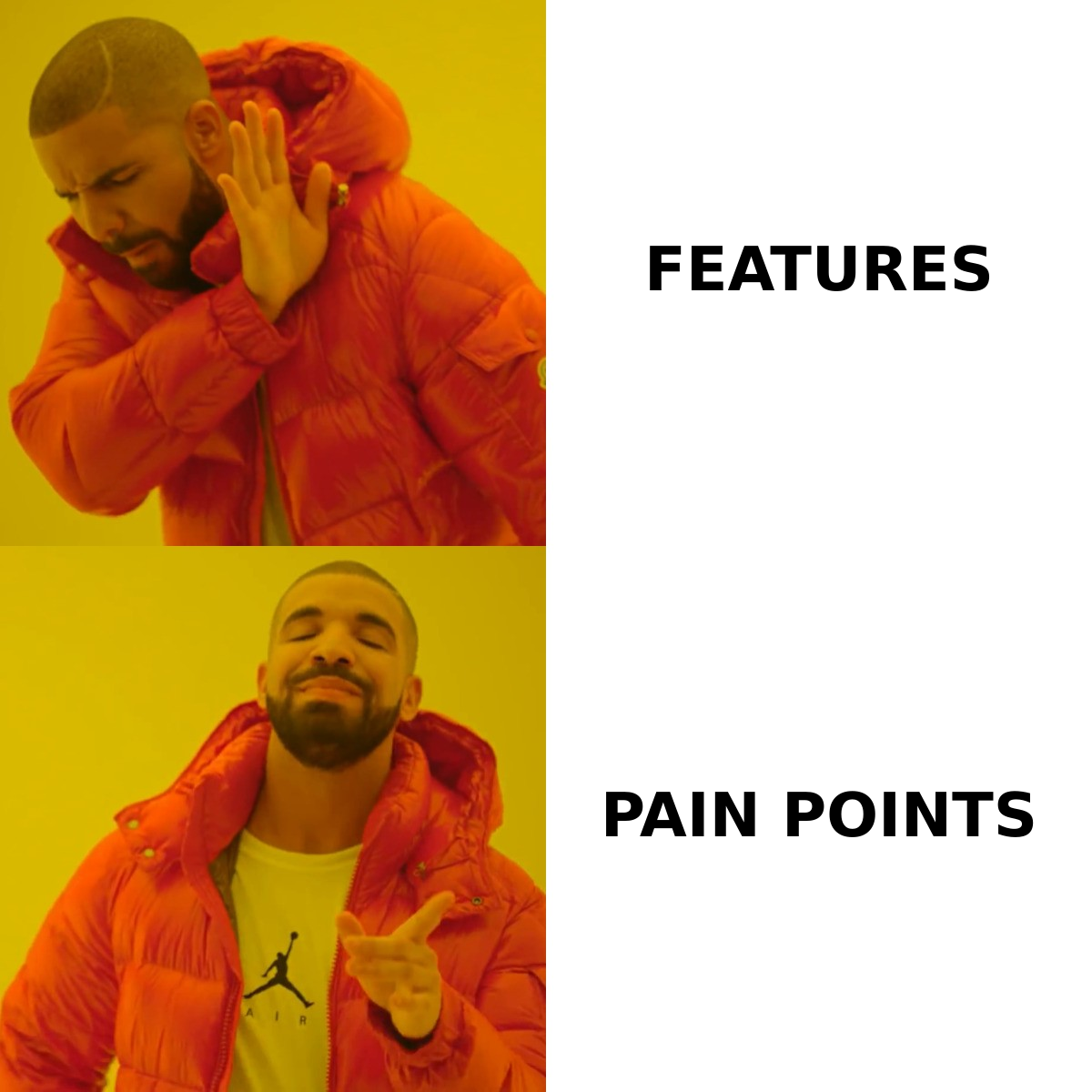
Most failed outreach makes the same mistake: it leads with the seller's features instead of the buyer's friction.
What are the four types of buyer pain points?#
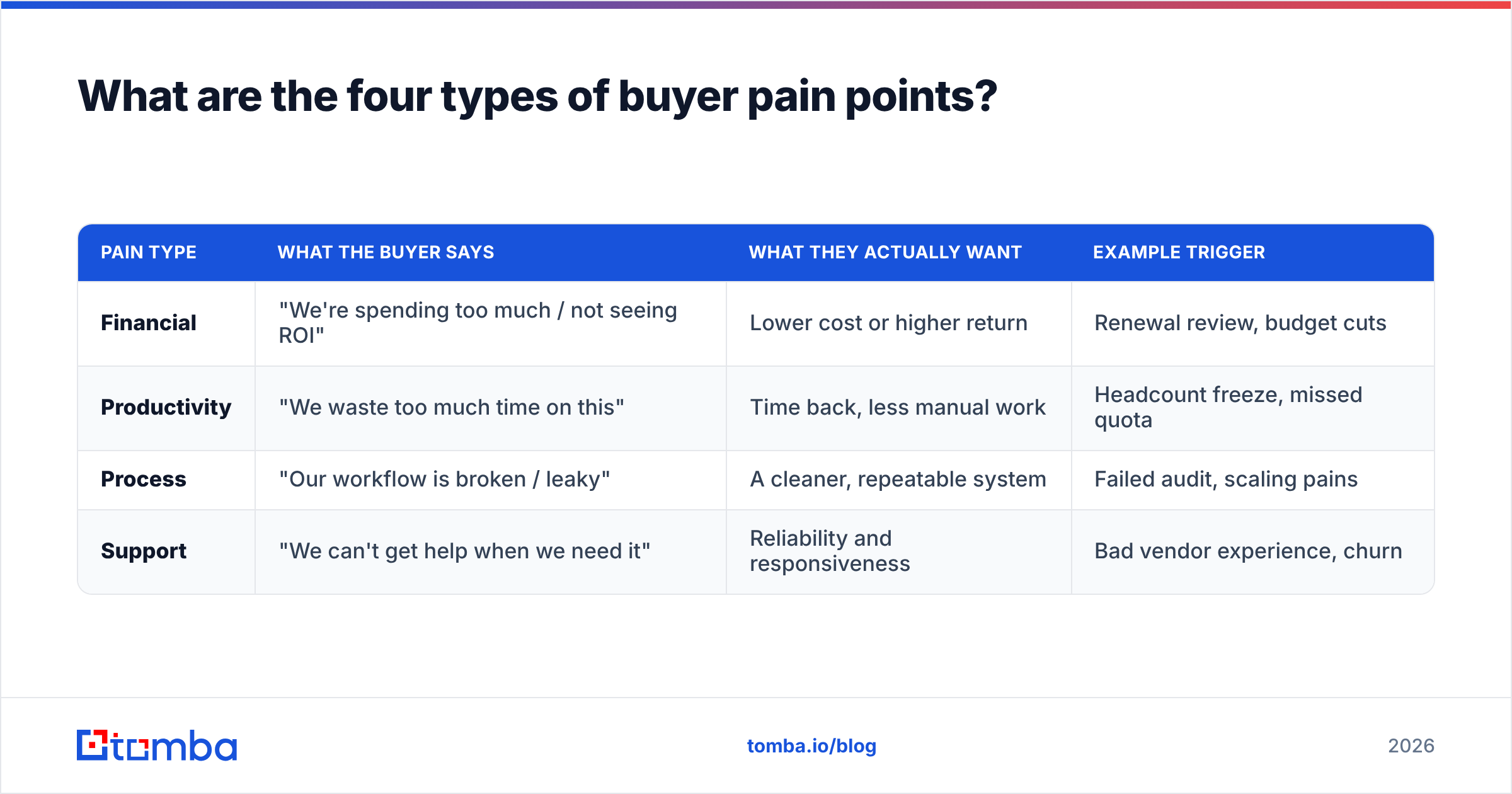
Pain points cluster into four buckets. The trap is that most sellers default to one — usually financial — and miss the pain the buyer actually feels day to day. Map your prospect against all four before you decide your angle.
| Pain type | What the buyer says | What they actually want | Example trigger |
|---|---|---|---|
| Financial | "We're spending too much / not seeing ROI" | Lower cost or higher return | Renewal review, budget cuts |
| Productivity | "We waste too much time on this" | Time back, less manual work | Headcount freeze, missed quota |
| Process | "Our workflow is broken / leaky" | A cleaner, repeatable system | Failed audit, scaling pains |
| Support | "We can't get help when we need it" | Reliability and responsiveness | Bad vendor experience, churn |
A single account often has more than one. The financial buyer signs the check, but the productivity pain is what the end user complains about in the Slack channel. Strong outbound names the pain the person you're emailing feels, then ties it to the financial pain the budget owner cares about.
A quick gut-check for each type#
- Financial pain — Can you put a dollar figure on the status quo? If you can't, neither can they.
- Productivity pain — How many hours per week does the current process burn? Multiply by a loaded salary rate.
- Process pain — Where does work fall through the cracks? Leaky handoffs between tools or teams are gold.
- Support pain — Is their current vendor ghosting them? Switching costs feel small when service is bad.
How do you identify buyer pain points before you reach out?#
You research them. Guessing the pain and hoping discovery confirms it is how reps waste their best accounts on bad first impressions. Here's where real pain signals live in 2026:
- Review sites — G2 and Capterra reviews of your prospect's current vendor are a confession booth. One-star reviews list the exact pains you can solve, in the buyer's own words.
- Job postings — A company hiring three RevOps analysts is telling you their process is breaking under scale. Listings name the tools, the gaps, and the priorities.
- Earnings calls and press — Public companies broadcast their strategic pain quarterly. "We're focused on operational efficiency" is a productivity pain with a budget attached.
- Website and tech stack signals — What a company runs reveals what it's missing. Tools that surface website visitor reveal data show you who is already researching solutions like yours.
- Your own CRM — Closed-lost notes and support tickets are a pattern library of the pains your best customers shared before they bought. (If your notes are a mess, that's a process pain of your own — see what a CRM is for.)
The point of all this research is to walk into the conversation already knowing the rock in their shoe. Then your job is just to prove it's there and offer to remove it.
How do you turn a pain point into outreach that converts?#
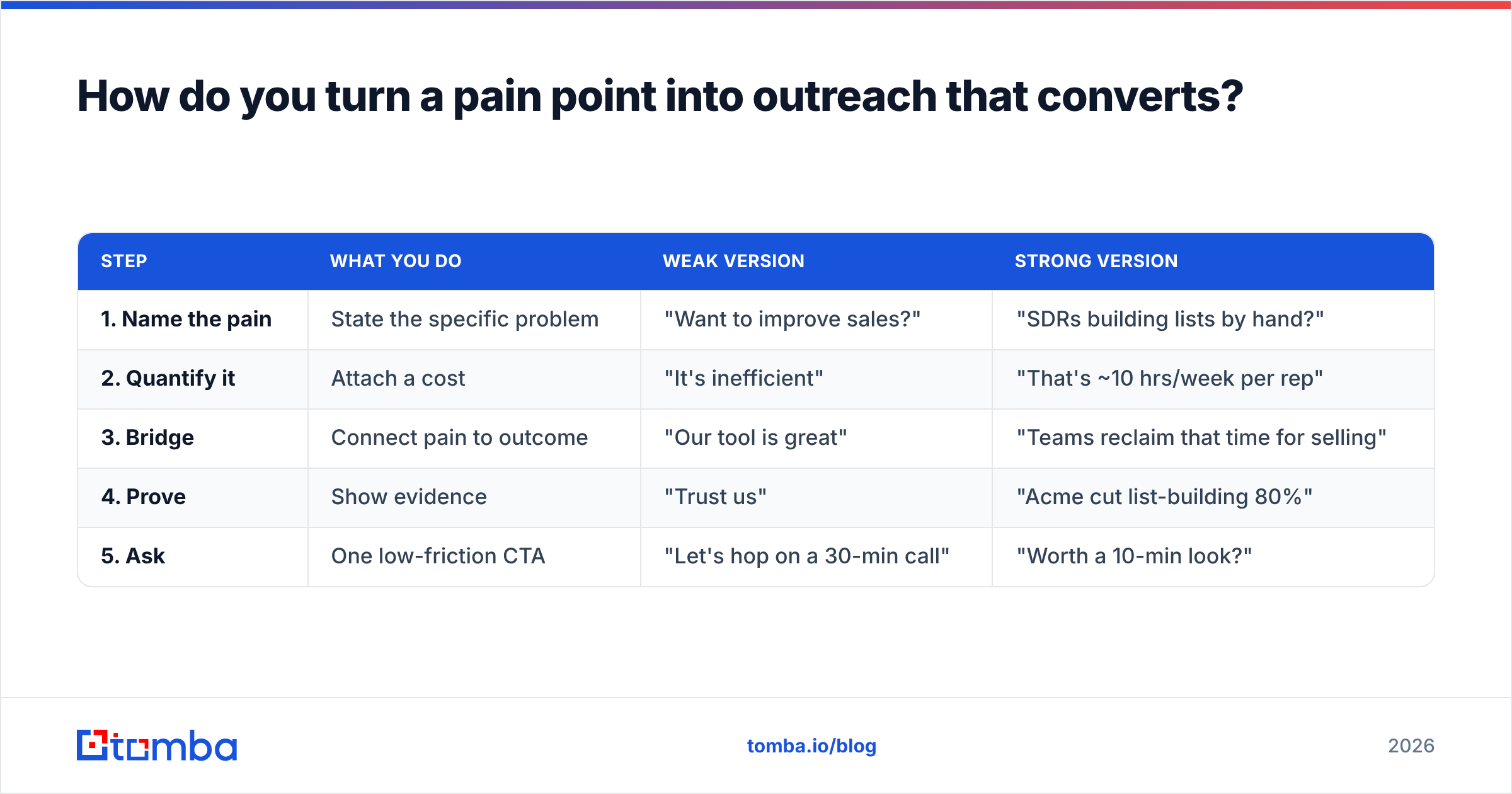
Lead with the pain, prove it with a number, and only then introduce the fix. The structure below works whether it's a cold email, a LinkedIn message, or the opening line of a call.
| Step | What you do | Weak version | Strong version |
|---|---|---|---|
| 1. Name the pain | State the specific problem | "Want to improve sales?" | "SDRs building lists by hand?" |
| 2. Quantify it | Attach a cost | "It's inefficient" | "That's ~10 hrs/week per rep" |
| 3. Bridge | Connect pain to outcome | "Our tool is great" | "Teams reclaim that time for selling" |
| 4. Prove | Show evidence | "Trust us" | "Acme cut list-building 80%" |
| 5. Ask | One low-friction CTA | "Let's hop on a 30-min call" | "Worth a 10-min look?" |
The sequencing matters more than the wording. Buyers tune out the instant you start talking about yourself before you've earned it by naming their problem accurately. When you lead with a pain they recognize, you've passed the only test that gets you a reply: this person understands my world.

Why does contact data make or break pain-point selling?#
Because the most precise pain-point message in the world is worthless if it lands in the wrong inbox — or bounces. You can do flawless research on an account and still fail at the last mile: reaching the actual human who owns that pain.
This is where prospecting quietly breaks down. Reps spend hours identifying a process pain at a target company, then send the pitch to a generic info@ address or a contact who left eight months ago. The pain was real; the delivery was dead on arrival.
A reliable contact layer fixes the last mile:
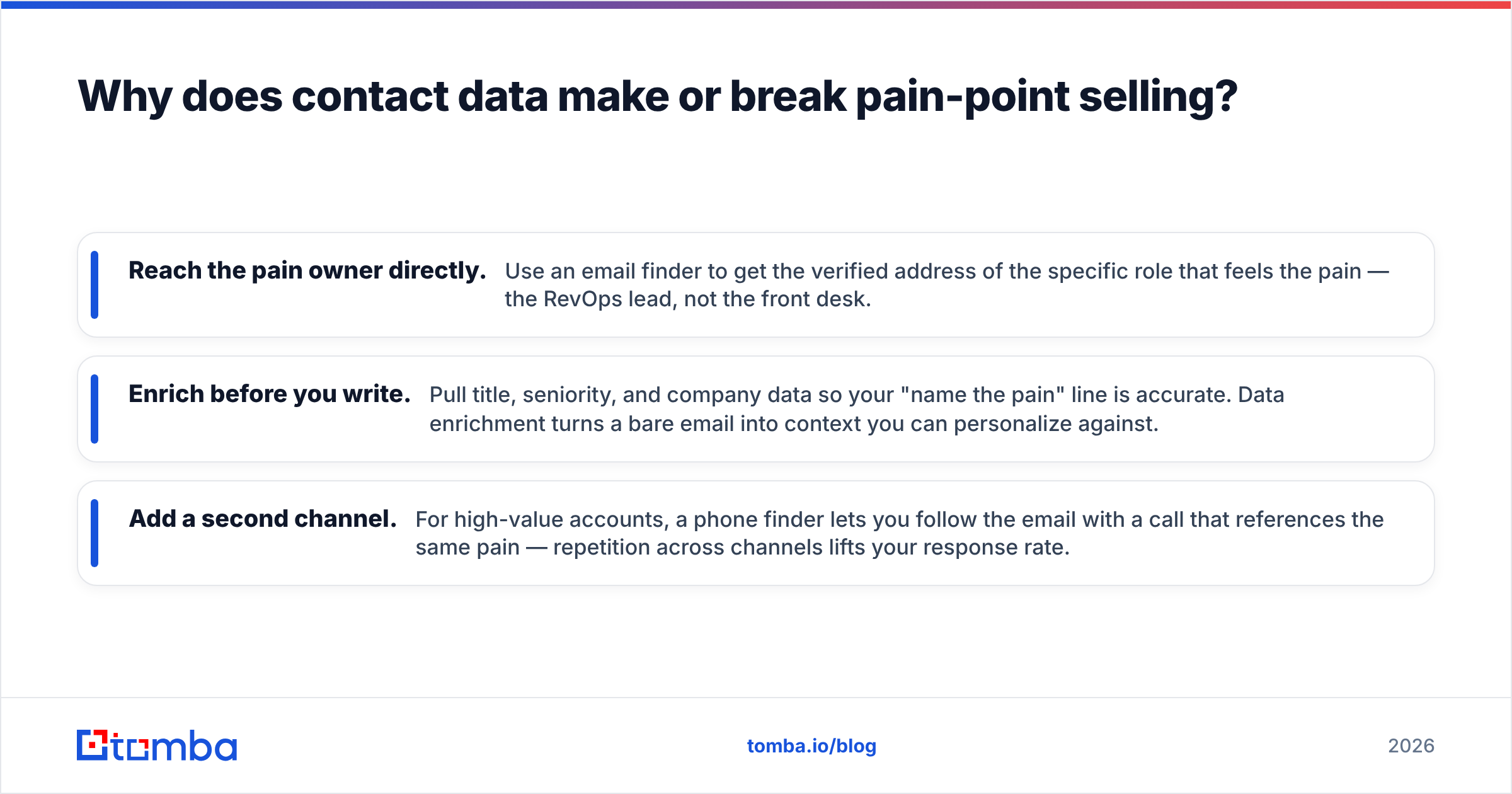
- Reach the pain owner directly. Use an email finder to get the verified address of the specific role that feels the pain — the RevOps lead, not the front desk.
- Enrich before you write. Pull title, seniority, and company data so your "name the pain" line is accurate. Data enrichment turns a bare email into context you can personalize against.
- Add a second channel. For high-value accounts, a phone finder lets you follow the email with a call that references the same pain — repetition across channels lifts your response rate.
You don't need more volume; you need to put the right pain in front of the right person without your message bouncing. That's a data problem before it's a copywriting problem.
How does pain-point research scale without burning your day?#
Manual research is fine for ten accounts. For a thousand, you need a repeatable loop that separates "find the account" from "find the contact." Here's a lightweight system:
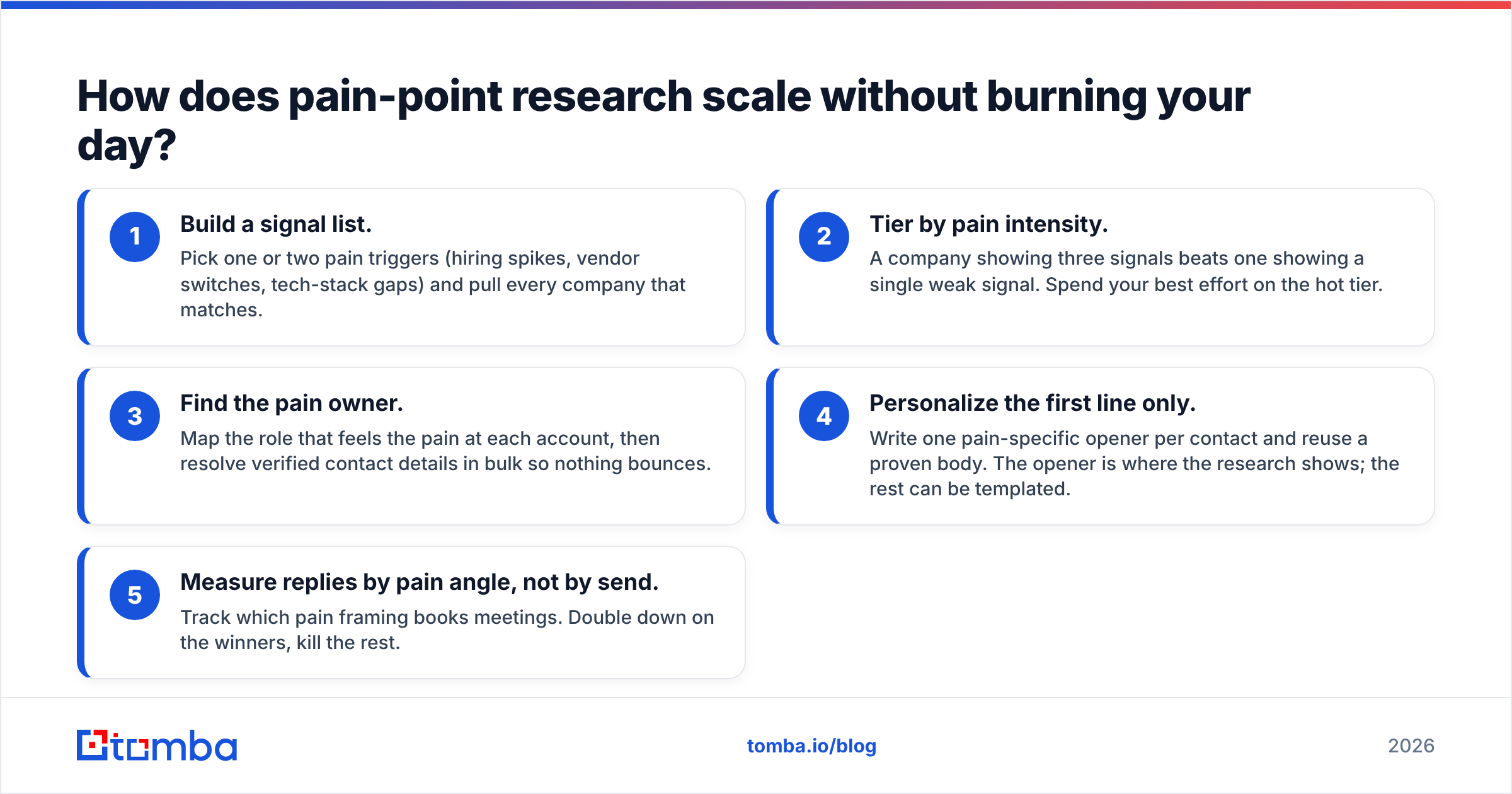
- Build a signal list. Pick one or two pain triggers (hiring spikes, vendor switches, tech-stack gaps) and pull every company that matches.
- Tier by pain intensity. A company showing three signals beats one showing a single weak signal. Spend your best effort on the hot tier.
- Find the pain owner. Map the role that feels the pain at each account, then resolve verified contact details in bulk so nothing bounces.
- Personalize the first line only. Write one pain-specific opener per contact and reuse a proven body. The opener is where the research shows; the rest can be templated.
- Measure replies by pain angle, not by send. Track which pain framing books meetings. Double down on the winners, kill the rest.
The teams that win in 2026 treat pain-point research as a pipeline, not a one-off art project. The research compounds: every closed deal teaches you which pains predict a buy, which sharpens the next signal list. For a sense of how the tooling stacks up across plans, the Tomba pricing page lays out where bulk workflows fit.
What pain points should you avoid leading with?#
Not every problem is worth your opener. Avoid these:
- Pains the buyer hasn't admitted yet. If they don't feel it, naming it sounds like an accusation. Lead with felt pain; introduce latent pain later.
- Pains too small to fund. A two-minute annoyance won't unlock budget. Aim for pains with a real cost attached.
- Pains you can't actually solve. Naming a problem you can't fix builds hope you'll have to walk back. Credibility dies there.
- Generic industry "trends." "AI is changing everything" is not a pain point. It's noise, and every competitor is saying it.
The discipline is the same as good outbound strategy generally: relevance beats reach. One precise, fundable, solvable pain in the right inbox outperforms a hundred vague pitches.
Putting it together#
Buyer pain points are the load-bearing wall of every B2B sale. Get them right and your outreach reads like you've been sitting in their team's standup. Get them wrong — or skip them to talk about your features — and you're just another email that gets archived in under two seconds.
The workflow is simple to say and hard to fake: research the real pain, prove it with a number, reach the exact person who owns it, and lead with their problem instead of your product. The only step most teams skip is the boring one — getting accurate, verified contact data so the right message reaches the right human.
Start there. Use the Tomba Email Finder to find and verify the decision-maker behind every pain point you uncover, then spend your energy on the part that actually wins deals: showing the buyer you understand their rock, and offering to remove it. Spin up the free tier (25 searches a month), and scale into the Starter plan at $49/mo once your pain-point pipeline starts booking meetings.
// get started
Find, verify and enrich your first contacts today
Start on the free plan with 25 searches a month, then scale when your team is ready.
Free plan · No credit card required · GDPR & CCPA
// about the author