Buyer Persona Pain Points: 2026 Guide for B2B Sales Teams
Most B2B personas list job titles and ignore what actually keeps buyers up at night. Here's how to map buyer persona pain points in 2026 and turn them into outreach that books meetings.
You can recite your buyer's job title, company size, and tech stack. None of that tells you why they would ever reply to your email. The thing that moves a deal is the problem the buyer is privately frustrated by — the buyer persona pain point — and most go-to-market teams document everything except that.
This guide is a practical system for finding, ranking, and using buyer persona pain points so your prospecting actually lands in 2026. No filler, no "know your customer" platitudes — just the research moves, a scoring model, and copy patterns that turn pain into pipeline.
TL;DR#
- A buyer persona pain point is a specific, costed problem your buyer feels — not a demographic attribute. "VP of Sales at a 200-person SaaS" is a persona; "reps waste 11 hours a week on bad contact data" is the pain point.
- There are four pain categories worth mapping: financial, productivity, process, and support. Most teams only document one.
- Pain points come from primary research, not brainstorming — win/loss calls, support tickets, review mining, and sales-call transcripts beat a whiteboard every time.
- Score each pain on frequency × intensity × your fit, then build outreach around the top two. A ranked list beats a long list.
- Accurate contact data is the bridge between knowing the pain and reaching the person who feels it — which is where tools like the Tomba Email Finder come in.
What are buyer persona pain points?#
A buyer persona pain point is a specific problem a buyer experiences that is painful enough to spend money solving. The keyword is specific. "Wants to grow faster" is a wish. "Loses 30% of inbound leads because routing is manual and slow" is a pain point — it has a cause, a cost, and an owner.
Think of it like a doctor's visit. A demographic profile is the patient's age, weight, and address. The pain point is where it hurts and how badly. You would never trust a doctor who prescribed treatment based only on your zip code, yet that is exactly what a persona built from firmographics alone does.
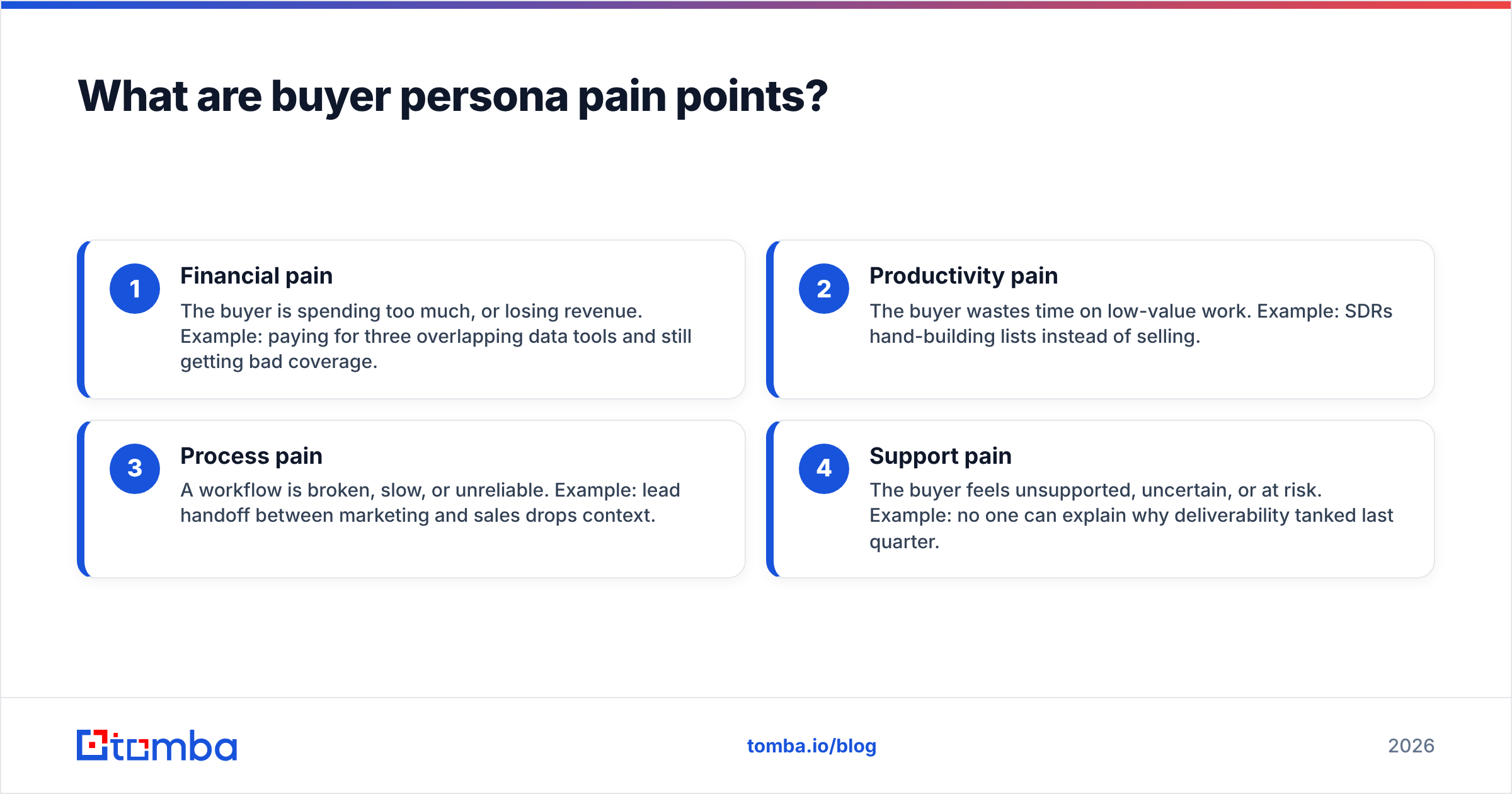
Pain points cluster into four types. Documenting all four — instead of fixating on one — is what separates a usable persona from a poster on the wall.
- Financial pain — The buyer is spending too much, or losing revenue. Example: paying for three overlapping data tools and still getting bad coverage.
- Productivity pain — The buyer wastes time on low-value work. Example: SDRs hand-building lists instead of selling.
- Process pain — A workflow is broken, slow, or unreliable. Example: lead handoff between marketing and sales drops context.
- Support pain — The buyer feels unsupported, uncertain, or at risk. Example: no one can explain why deliverability tanked last quarter.
/blog/generated/memes/2026-06-21/buyer-persona-pain-points-meme-1.png
The reason this matters: buyers don't buy categories, they buy relief. When your message names the exact pain in the buyer's own language, you skip the "what is this and why should I care" stage entirely. That is why a marketing qualified lead sourced against a real pain converts far better than one matched on title alone.
Why do most B2B personas miss the pain entirely?#
Because they're built backwards. Teams start with who they want to sell to (a tidy firmographic profile) and reverse-engineer a story about that person's day. The result reads well in a slide deck and fails the moment a real prospect pushes back.
Three failure patterns show up again and again:
- The demographic decoy. The persona is 80% attributes (industry, headcount, location, tools) and 20% vague goals. Attributes help you target; they don't help you persuade.
- The single-pain trap. The team latches onto the one pain their product solves and ignores the others the buyer ranks higher. You win the argument you started and lose the one the buyer cared about.
- The invented quote. "As a busy VP, I struggle to stay on top of my pipeline." Nobody said that. It was written in a meeting. Real pain has texture, numbers, and an edge of frustration that you can only capture by listening.
The fix is not a better template. It's a better input. Pain points are discovered, not authored — and the discovery work is where the advantage hides, because most competitors skip it.
How do you research buyer persona pain points?#
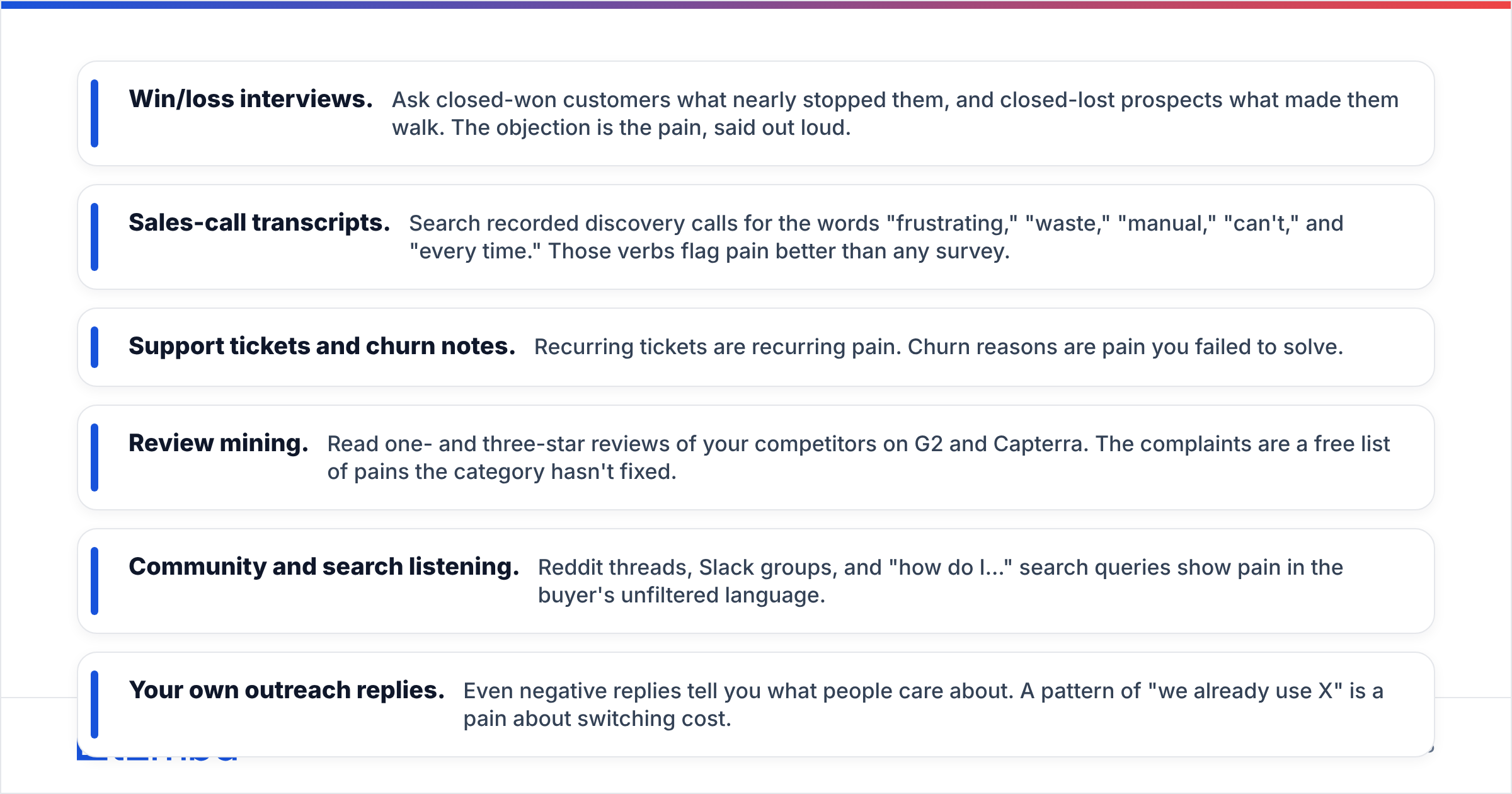
Use primary sources first, secondary sources to confirm. Here are the highest-signal research moves, ranked by how close they sit to the buyer's actual voice.
- Win/loss interviews. Ask closed-won customers what nearly stopped them, and closed-lost prospects what made them walk. The objection is the pain, said out loud.
- Sales-call transcripts. Search recorded discovery calls for the words "frustrating," "waste," "manual," "can't," and "every time." Those verbs flag pain better than any survey.
- Support tickets and churn notes. Recurring tickets are recurring pain. Churn reasons are pain you failed to solve.
- Review mining. Read one- and three-star reviews of your competitors on G2 and Capterra. The complaints are a free list of pains the category hasn't fixed.
- Community and search listening. Reddit threads, Slack groups, and "how do I…" search queries show pain in the buyer's unfiltered language.
- Your own outreach replies. Even negative replies tell you what people care about. A pattern of "we already use X" is a pain about switching cost.
A note on volume: you don't need 200 interviews. Five well-run win/loss calls plus 30 mined reviews will surface the same three to five dominant pains every time. The signal saturates fast.
Once you've collected raw pains, your next problem is reaching the people who have them — which means turning a list of target companies into real, reachable contacts. A domain search across your account list gives you the named decision-makers, and data enrichment fills in the role and seniority context so you know whose pain you're actually addressing.
How do you rank and prioritize pain points?#
Don't act on a long list — act on the top two. Score every pain you found on three dimensions, multiply, and sort. The formula is deliberately simple so the whole team can apply it:
Pain Score = Frequency × Intensity × Fit
- Frequency (1–5) — How many buyers in this segment feel it? A pain five buyers mention beats a pain one buyer obsesses over.
- Intensity (1–5) — How much does it hurt? Revenue loss and personal job risk score high; mild annoyance scores low.
- Fit (1–5) — How well does your product uniquely relieve it? A pain a competitor solves better is not your pain to sell.
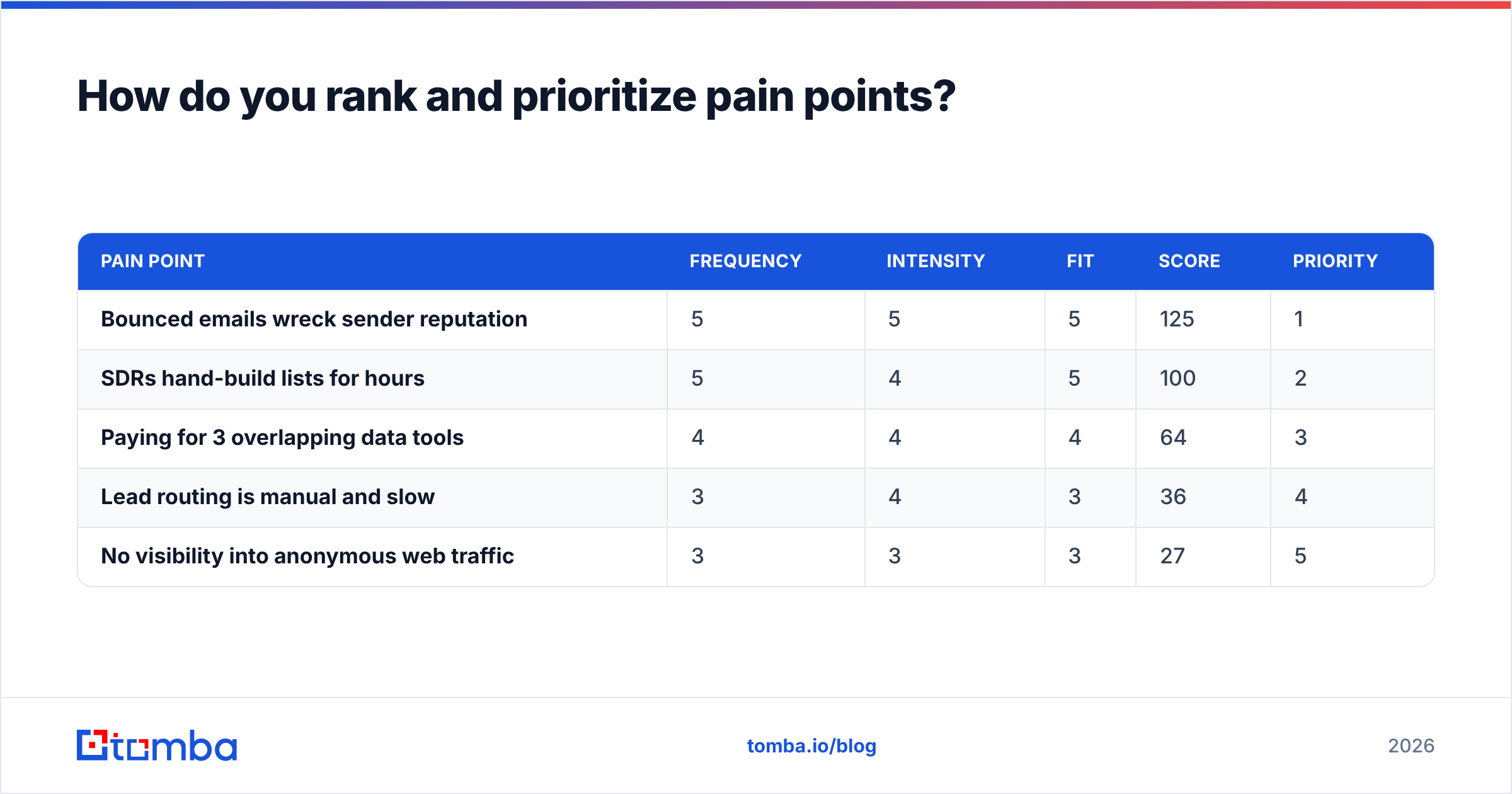
Here's how a worked example looks for a B2B data-and-outreach buyer:
| Pain point | Frequency | Intensity | Fit | Score | Priority |
|---|---|---|---|---|---|
| Bounced emails wreck sender reputation | 5 | 5 | 5 | 125 | 1 |
| SDRs hand-build lists for hours | 5 | 4 | 5 | 100 | 2 |
| Paying for 3 overlapping data tools | 4 | 4 | 4 | 64 | 3 |
| Lead routing is manual and slow | 3 | 4 | 3 | 36 | 4 |
| No visibility into anonymous web traffic | 3 | 3 | 3 | 27 | 5 |
The top two pains — reputation damage from bounces, and time lost to manual list-building — become the spine of your messaging, your landing pages, and your sales scripts. The bottom three become secondary talking points, not headlines. This is the discipline most teams skip: they treat all pains as equal and dilute every message.
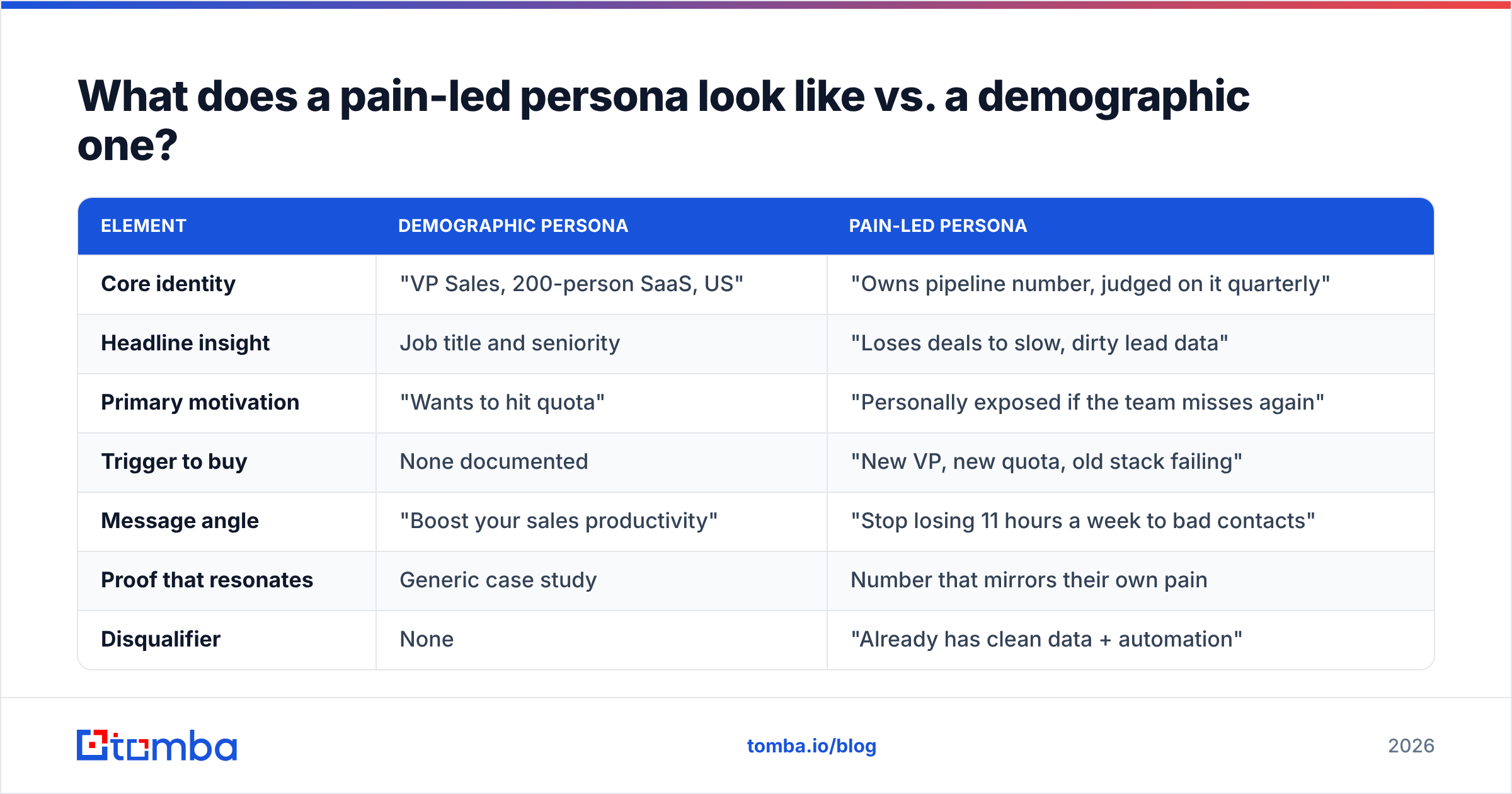
What does a pain-led persona look like vs. a demographic one?#
Side by side, the difference is obvious. One tells you who to email; the other tells you what to say so they reply.
| Element | Demographic persona | Pain-led persona |
|---|---|---|
| Core identity | "VP Sales, 200-person SaaS, US" | "Owns pipeline number, judged on it quarterly" |
| Headline insight | Job title and seniority | "Loses deals to slow, dirty lead data" |
| Primary motivation | "Wants to hit quota" | "Personally exposed if the team misses again" |
| Trigger to buy | None documented | "New VP, new quota, old stack failing" |
| Message angle | "Boost your sales productivity" | "Stop losing 11 hours a week to bad contacts" |
| Proof that resonates | Generic case study | Number that mirrors their own pain |
| Disqualifier | None | "Already has clean data + automation" |
The pain-led column is harder to write because it requires research. That difficulty is exactly why it works — your competitors quit at the demographic column.
/blog/generated/memes/2026-06-21/buyer-persona-pain-points-meme-2.png
How do you turn pain points into outreach that converts?#
Match the message to the pain, and the channel to the buyer. The pattern is the same whether it's email, a call, or a LinkedIn note: name the pain, quantify it, then bridge to relief.
A reliable cold-email structure built on a ranked pain:
- Line 1 — Name the pain in their words. "Most RevOps leads I talk to are stitching together three data tools and still getting 20% bounce rates."
- Line 2 — Quantify the cost. "That's a few hundred wasted sends a week and a sender reputation that keeps slipping."
- Line 3 — Bridge to relief, not features. "We help teams cut bounces under 2% from one verified source."
- Line 4 — Low-friction ask. "Worth a 10-minute look at your numbers?"
Notice what's missing: no company history, no feature list, no "we're excited to introduce." Every line earns the next. For more structure, Tomba's cold email templates follow this pain-first pattern, and a subject line generator helps you lead with the pain in the inbox preview where it counts most.
Two execution rules that decide whether any of this works:
- Reach the right person. A perfect pain message sent to the wrong contact is wasted. Verify roles before you send.
- Protect deliverability. The best message never read is worth nothing. Clean your list with an email verifier before any send so your pain-led copy actually reaches the inbox.
This is the unglamorous truth behind pain-led outreach: research tells you what to say, but data infrastructure decides whether it arrives. The two are a system, not separate jobs.
How often should you refresh buyer persona pain points?#
Treat pain points as living, not fixed. Re-validate them on a cadence, because buyer priorities shift with the market, budgets, and tooling. A practical rhythm:
- Quarterly — Re-score your pain list against fresh win/loss notes. Priorities reorder more often than new pains appear.
- After any product or pricing change — Your fit score moves the moment your capabilities do.
- When reply rates drop — A falling response rate on a once-strong message usually means the pain got solved elsewhere or deprioritized, not that the copy got worse.
- When you enter a new segment — A new industry or company size is a new pain map. Don't reuse the old one.
Tie this back to measurable outcomes. If you track response rate by pain-led message variant, your persona research stops being a one-time document and becomes a feedback loop that compounds.
Common mistakes to avoid#
- Listing symptoms, not pains. "Low open rates" is a symptom. The pain is "I can't tell if our outreach is even reaching people." Sell to the pain underneath.
- Selling the pain you fix instead of the pain they feel. If your product solves pain #4 but the buyer ranks pain #1, lead with how you ease #1 — even partially — to earn the conversation.
- One persona for every buyer. A champion, an economic buyer, and a blocker feel different pains about the same purchase. Map them separately.
- Confusing goals with pains. "Grow revenue 20%" is a goal everyone shares. The pain is the specific obstacle in the way of it. Goals don't differentiate; pains do.
Which approach is right for your team?#
If you're early and resource-constrained, start with the lightweight path: mine 30 reviews, run five win/loss calls, score the pains, and rewrite your top message. That alone outperforms most fully built personas because it's grounded in real voice.
If you're scaling, formalize it: a quarterly pain-scoring ritual, pain-tagged in your CRM, and outreach variants mapped to each top pain so you can measure which pain pulls hardest. Either way, the bottleneck is rarely the framework — it's having clean, reachable contact data for the people who actually feel the pain.
That's where Tomba fits. Once you know the pain and the persona, the Tomba Email Finder gets you verified, deliverable contacts for the exact decision-makers you've profiled — by name, company, or domain — so your pain-led message reaches a real inbox instead of bouncing. Start free with 25 searches a month, and scale on transparent Tomba pricing (Starter at $49/mo, Growth at $99/mo) as your outbound grows. Map the pain, then go reach the people who feel it.
// get started
Find, verify and enrich your first contacts today
Start on the free plan with 25 searches a month, then scale when your team is ready.
Free plan · No credit card required · GDPR & CCPA
// about the author