Buyer Persona Research in 2026: A Step-by-Step B2B Guide
Buyer persona research turns vague targeting into a repeatable system. Here is the 2026 framework B2B teams use to build, validate, and act on data-backed personas.
Buyer persona research is the process of building evidence-based profiles of the people who actually buy from you — their role, goals, triggers, objections, and where they hang out — so your sales and marketing stop guessing. Done right, it is the difference between outreach that lands and outreach that gets archived in two seconds.
This guide walks through a 2026 framework you can run this quarter: where to pull data, how to interview, a reusable template, and how to convert finished personas into real pipeline.
TL;DR#
- Buyer persona research is structured discovery — interviews, CRM data, and intent signals — that produces 3–5 actionable profiles, not stock-photo cartoons.
- Skip the demographics-only template. In B2B, jobs-to-be-done, triggers, and objections drive conversions far more than "age 35–45, likes coffee."
- Combine three data layers: qualitative (customer interviews), quantitative (CRM + product analytics), and firmographic/contact (enrichment and email data).
- Validate personas against closed-won and closed-lost deals before you trust them — most teams discover their assumed buyer is not the real decision-maker.
- Refresh personas every 6–12 months; markets, buying committees, and titles shift fast.
What is buyer persona research?#
A buyer persona is a semi-fictional model of your ideal customer, built from real data about existing and prospective buyers. Buyer persona research is the work that produces that model: interviewing customers, mining your CRM, analyzing won and lost deals, and enriching it all with firmographic and contact data.
Think of it like a detective building a suspect profile. A bad profile is "probably a tall man." A good profile is "left-handed, drives a diesel, shops at this specific store on Thursdays." The second one lets you actually find the person. The same gap separates a generic persona from one your reps can act on.
In B2B specifically, you are rarely selling to one person. You are selling to a buying committee — typically 6 to 10 stakeholders in mid-market and enterprise deals. So persona research is not one profile; it is a small set covering the economic buyer, the champion, the end user, and the blockers.
Buyer persona vs. ICP vs. target audience#
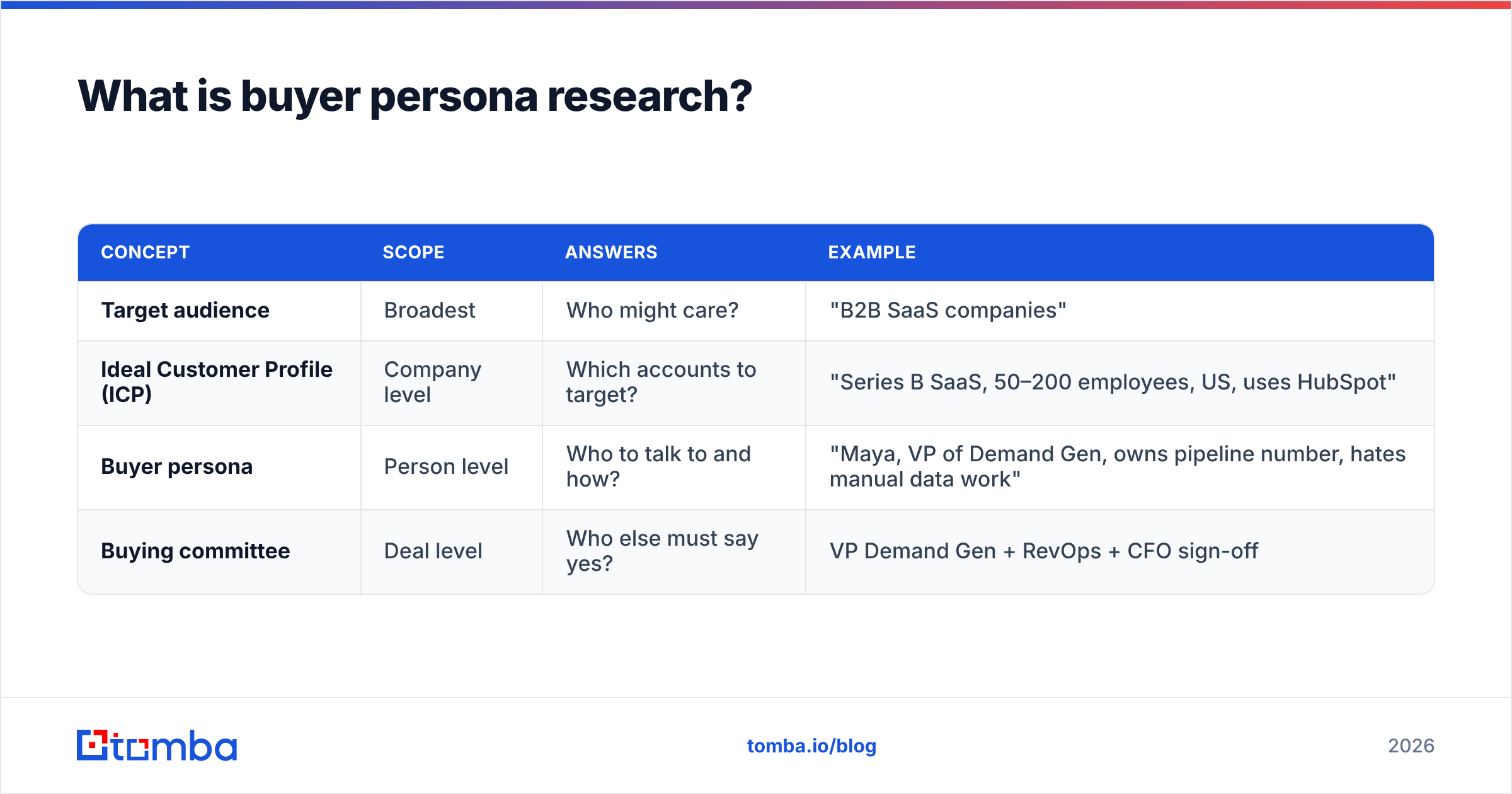
These three terms get used interchangeably and they should not be. Here is how they stack.
| Concept | Scope | Answers | Example |
|---|---|---|---|
| Target audience | Broadest | Who might care? | "B2B SaaS companies" |
| Ideal Customer Profile (ICP) | Company level | Which accounts to target? | "Series B SaaS, 50–200 employees, US, uses HubSpot" |
| Buyer persona | Person level | Who to talk to and how? | "Maya, VP of Demand Gen, owns pipeline number, hates manual data work" |
| Buying committee | Deal level | Who else must say yes? | VP Demand Gen + RevOps + CFO sign-off |
The ICP tells you which doors to knock on. The buyer persona tells you who answers and what to say. You need both. If you want a refresher on account-level definitions, our B2B glossary breaks these down term by term.
Why does buyer persona research matter in 2026?#
Conclusion first: bad personas waste your two scarcest resources — rep time and sender reputation. Every email sent to the wrong title is a deliverability risk and a lost hour.
Three shifts make persona research more valuable than it was even two years ago:
- Buying committees grew. More stakeholders means more personas to map per deal, and a champion-only strategy stalls in procurement.
- AI-generated outreach flooded inboxes. Generic messaging is now actively penalized by prospects and spam filters alike. Specificity, grounded in real persona insight, is the only thing that cuts through.
- Data decay accelerated. Roughly 25–30% of B2B contact data goes stale each year as people change jobs. Personas built on a 2024 contact list are partly fiction by 2026.
The payoff is concrete. Teams that ground messaging in researched personas consistently report higher reply rates and shorter sales cycles, because the message matches the moment. HubSpot's research on buyer personas has long shown that segmented, persona-driven campaigns outperform spray-and-pray by a wide margin.
How do you do buyer persona research, step by step?#
Here is the five-phase process. Run it in order; each phase feeds the next.
Step 1: Pull your quantitative baseline#
Start with what you already own. Before you talk to a single human, mine your CRM and product analytics for patterns.
- Closed-won analysis: What do your best customers have in common? Industry, size, the title that signed, time-to-close.
- Closed-lost analysis: Equally important. Where do deals die, and which persona killed them?
- Product usage: Which roles actually log in and get value after the sale?
- Lead source: Which channels produce the personas that convert, not just the ones that fill the funnel.
This baseline keeps your interviews honest. If your data says CFOs sign 70% of deals but your reps only talk to managers, you have already found a gap.
Step 2: Interview real customers#
This is the irreplaceable step. Aim for 5–10 interviews per persona. Talk to recent buyers (the memory is fresh) across won and lost deals.
Ask about the job to be done, not features:
- What was happening the day you decided to look for a solution? (the trigger)
- What did you try before us?
- Who else was involved in the decision, and what did each person care about?
- What almost stopped you from buying?
- How did you justify the spend internally?
Record everything. The exact phrases customers use become your messaging copy — there is no better source of voice-of-customer language.
Step 3: Enrich and segment with real contact data#
Interviews give you depth; enrichment gives you scale. Once you know the shape of a persona, you need to find more people who match it — with verified contact details so your outreach actually arrives.
This is where a data enrichment layer earns its keep. Take the firmographic pattern from Step 1, then use a domain search to surface the right titles at matching companies and a verified email finder to reach them without burning your domain on bounces. Clean data here protects the email deliverability you will rely on later.
Step 4: Build the persona profile#
Now synthesize. Each persona should fit on one page and contain only what changes a rep's behavior. Skip the favorite-snack trivia.
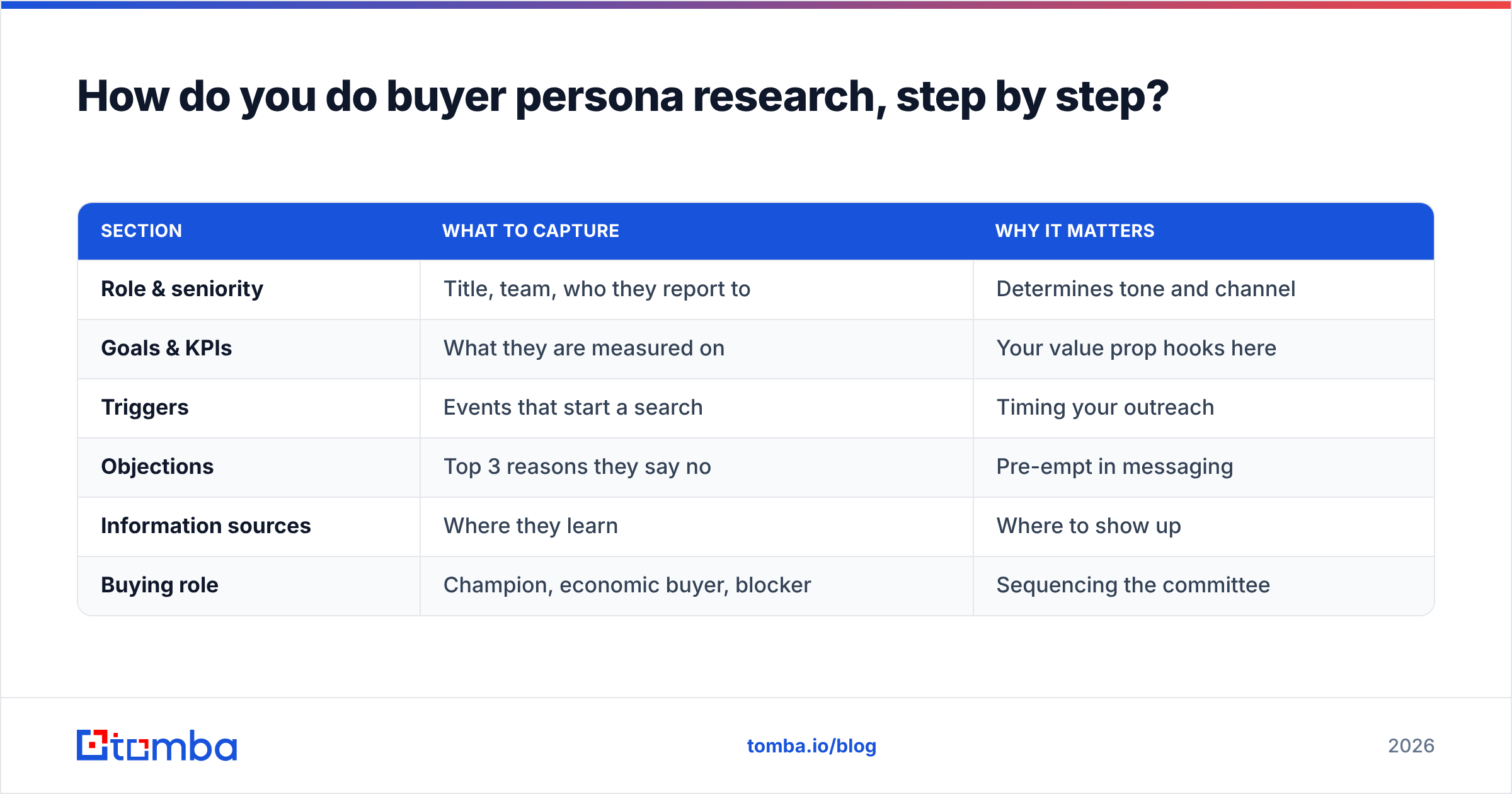
| Section | What to capture | Why it matters |
|---|---|---|
| Role & seniority | Title, team, who they report to | Determines tone and channel |
| Goals & KPIs | What they are measured on | Your value prop hooks here |
| Triggers | Events that start a search | Timing your outreach |
| Objections | Top 3 reasons they say no | Pre-empt in messaging |
| Information sources | Where they learn | Where to show up |
| Buying role | Champion, economic buyer, blocker | Sequencing the committee |
Step 5: Validate and socialize#
A persona nobody uses is a wasted week. Pressure-test each profile against three closed-won and three closed-lost deals. Does it predict who was involved and why they bought? Then put it where reps work — the CRM, the sequence builder, the call script — not in a slide deck that dies in a shared drive.
What data sources should you use for buyer persona research?#
The strongest personas blend three layers. Relying on only one produces predictable blind spots.
- Qualitative (the "why"): Customer interviews, sales call recordings, support tickets, win/loss notes, and review-site language from G2 and Capterra. This is where motivation lives.
- Quantitative (the "what"): CRM fields, product analytics, marketing-attribution data, and survey results. This is where you confirm scale and spot patterns.
- Firmographic & contact (the "who"): Company size, industry, tech stack, and verified contact details. This is where you turn a persona into a reachable list.
A common mistake is treating review mining and call recordings as optional. They are gold — your prospects describe their pain in their own words, which you can lift directly into subject lines. Pair that voice-of-customer data with a verified B2B database and you can move from insight to outreach in the same afternoon.
What does a B2B buyer persona template look like?#
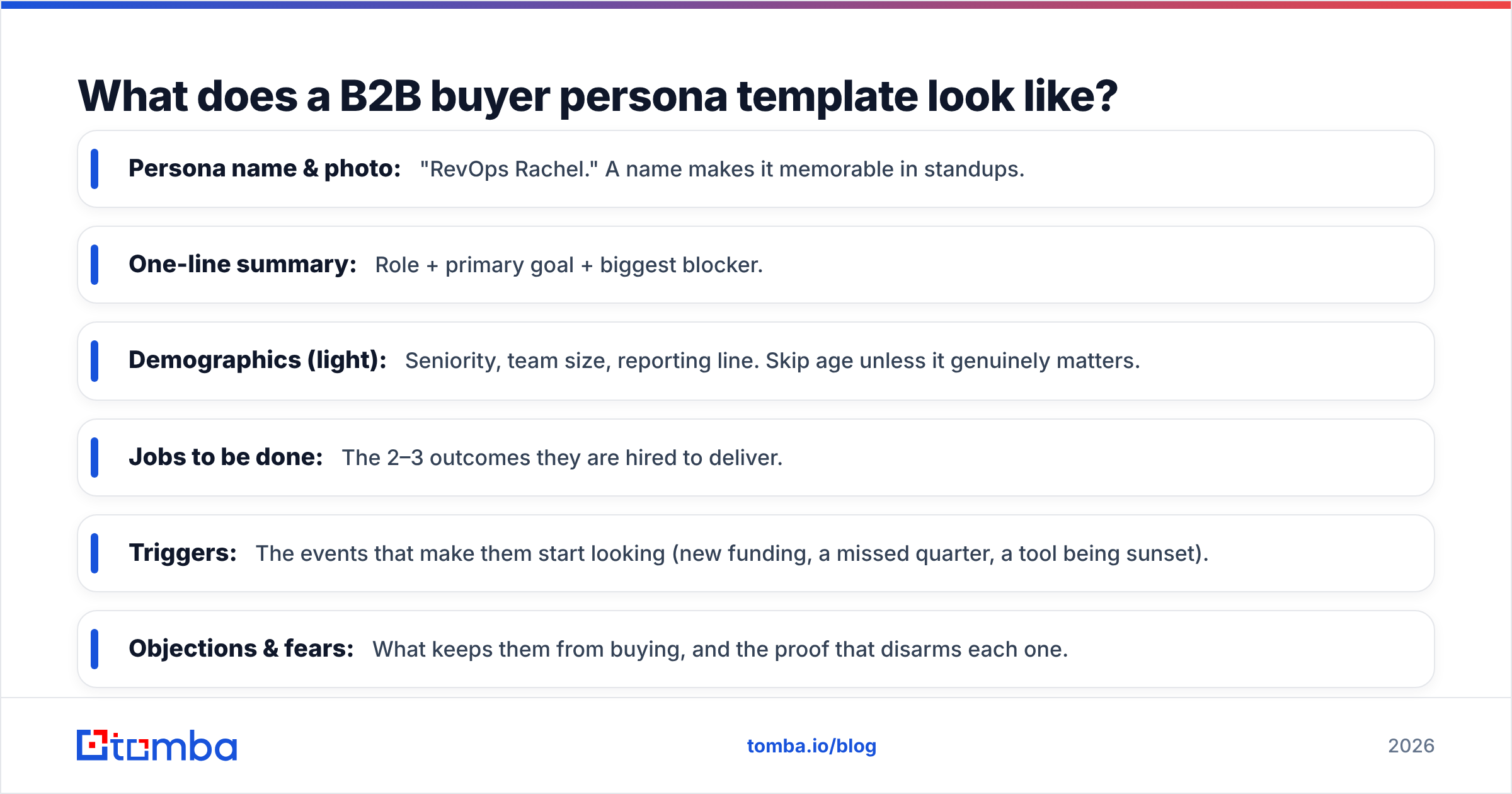
Keep it tight. Below is a fill-in-the-blank structure you can drop into Notion or a CRM custom object today.
- Persona name & photo: "RevOps Rachel." A name makes it memorable in standups.
- One-line summary: Role + primary goal + biggest blocker.
- Demographics (light): Seniority, team size, reporting line. Skip age unless it genuinely matters.
- Jobs to be done: The 2–3 outcomes they are hired to deliver.
- Triggers: The events that make them start looking (new funding, a missed quarter, a tool being sunset).
- Objections & fears: What keeps them from buying, and the proof that disarms each one.
- Channels & sources: Where they research — LinkedIn, specific newsletters, peer Slack groups.
- Buying committee role: Are they the signer, the champion, or the gatekeeper?
- Messaging angles: Two or three hooks tied to their goals, in their language.
For the committee mapping, our notes on LinkedIn outreach cover how to sequence champions and economic buyers without spamming the whole org at once.
What are the most common buyer persona research mistakes?#
Even experienced teams fall into the same traps. Watch for these:
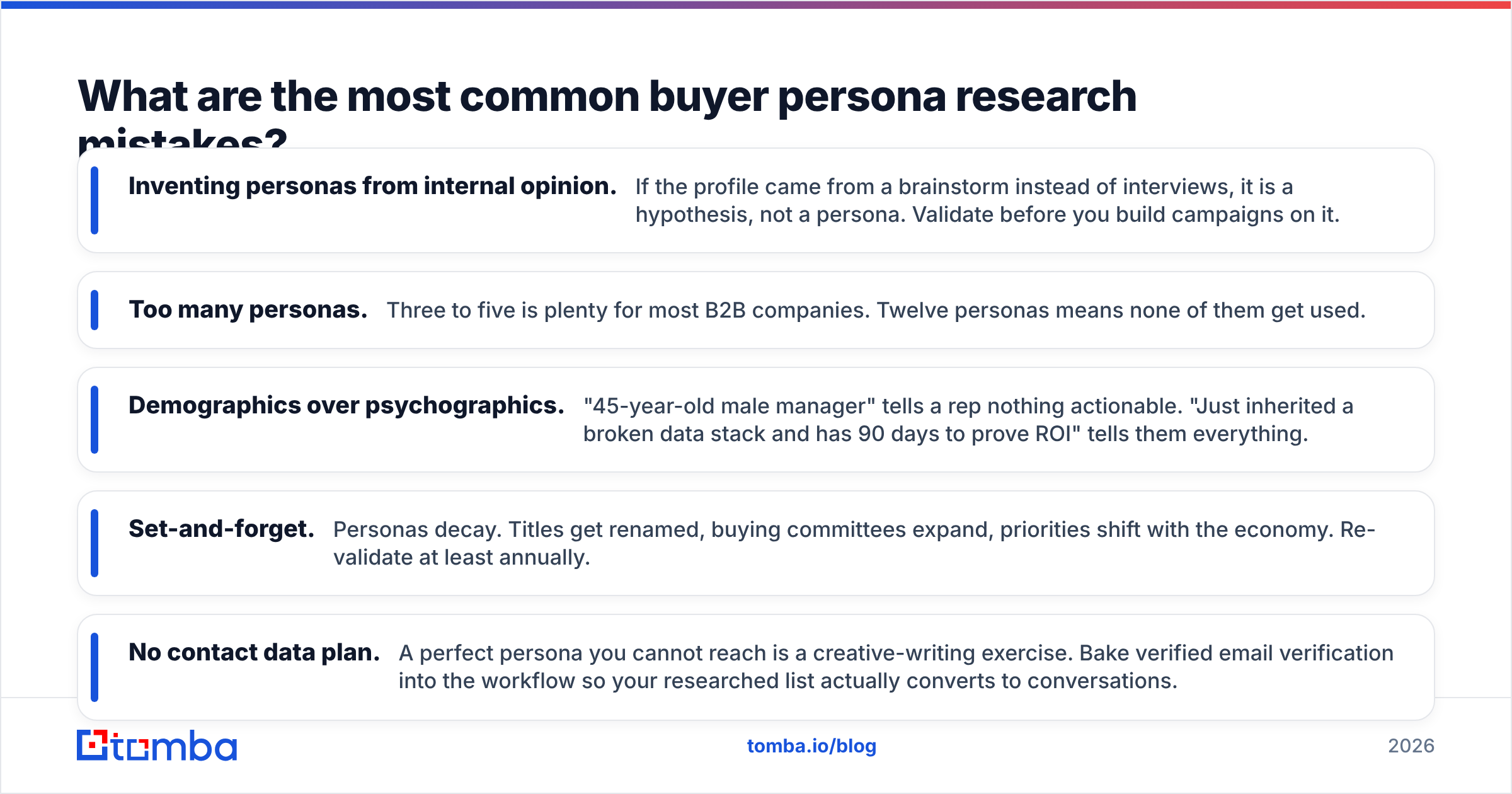
- Inventing personas from internal opinion. If the profile came from a brainstorm instead of interviews, it is a hypothesis, not a persona. Validate before you build campaigns on it.
- Too many personas. Three to five is plenty for most B2B companies. Twelve personas means none of them get used.
- Demographics over psychographics. "45-year-old male manager" tells a rep nothing actionable. "Just inherited a broken data stack and has 90 days to prove ROI" tells them everything.
- Set-and-forget. Personas decay. Titles get renamed, buying committees expand, priorities shift with the economy. Re-validate at least annually.
- No contact data plan. A perfect persona you cannot reach is a creative-writing exercise. Bake verified email verification into the workflow so your researched list actually converts to conversations.
According to Gartner research on B2B buying, the typical purchase now involves a sprawling, non-linear journey across many stakeholders — which is exactly why a single demographic persona fails and a committee-aware set succeeds.
How often should you update buyer personas?#
Short answer: review every 6 months, fully refresh every 12. Trigger an off-cycle update whenever you launch in a new segment, see win rates drop in a known persona, or notice your champion title is being renamed across target accounts.
A lightweight quarterly check — pull the last 20 closed deals and ask "did our personas predict these buyers?" — catches drift early without a full research sprint. Tie this cadence to your broader revenue operations rhythm so persona refreshes are owned, not orphaned.
Putting it to work#
Buyer persona research only pays off when it touches outreach. Once your personas are validated, you need to find the real humans who match them — with emails that are verified, not guessed. That is exactly where the Tomba Email Finder fits: feed it the titles and domains your persona research surfaced, and it returns verified professional email addresses so your carefully crafted messaging reaches a real inbox instead of bouncing.
Start free with 25 searches a month, scale on the Starter plan at $49/mo when you are ready, and check the full Tomba pricing for higher-volume tiers. Build the personas, then go find them.
Ready to find emails that actually work?
Join 150,000+ professionals who stopped guessing and started sending. Free credits on signup — no credit card required.
Get the Tomba newsletter
Practical outbound tactics and product updates — once every two weeks.
About the author