Buyer Persona Template: The Complete B2B Guide for 2026
A buyer persona template turns scattered assumptions into a repeatable targeting system. Here is the exact framework, a fill-in-the-blank table, and how to back it with real data in 2026.
Buyer Persona Template: The Complete B2B Guide for 2026
Most "buyer personas" are fiction. Someone names a character "Marketing Mary," guesses her age, picks a stock photo, and the document dies in a Google Drive folder nobody opens. A real buyer persona template does the opposite job: it forces you to write down what you actually know about the people who buy, flag what you are guessing, and tie every field to a decision your team makes this quarter.
This guide gives you that template — the exact fields, a fill-in-the-blank table, two B2B examples, and the research workflow that keeps it from rotting.
TL;DR#
- A buyer persona template is a structured profile of your ideal buyer: their role, goals, pains, buying triggers, objections, and where they research solutions.
- Skip demographics-only personas. The fields that move revenue are jobs-to-be-done, trigger events, and objections — not age or favorite coffee.
- Build 3–5 personas max. More than that and your messaging fragments faster than your team can execute.
- Back every field with real data: customer interviews, CRM win/loss notes, and enrichment data instead of gut feel.
- A persona is a living document. Review it quarterly against closed-won and closed-lost deals or it goes stale.
What is a buyer persona template?#
A buyer persona template is a reusable framework — a fill-in-the-blank document — for describing a specific type of person who buys (or influences the purchase of) your product. Think of it like a casting brief for a film. The director does not write "find an actor." They specify the role, the motivation, the backstory, and the scene the character has to carry. Your persona template does the same for the humans your sales and marketing teams are trying to reach.
Technically, it is a one-page profile that standardizes how you capture buyer attributes so every team member fills it in the same way. That consistency is the whole point: when marketing, sales, and product all describe "the VP of RevOps" using the same fields, your messaging, targeting, and roadmap finally point in one direction.
A persona is not your ideal customer profile (ICP). The ICP describes the company worth selling to — industry, size, revenue, tech stack. The persona describes the person inside that company you have to convince. You need both, and they work as a pair.
)
What fields does a B2B buyer persona template include?#
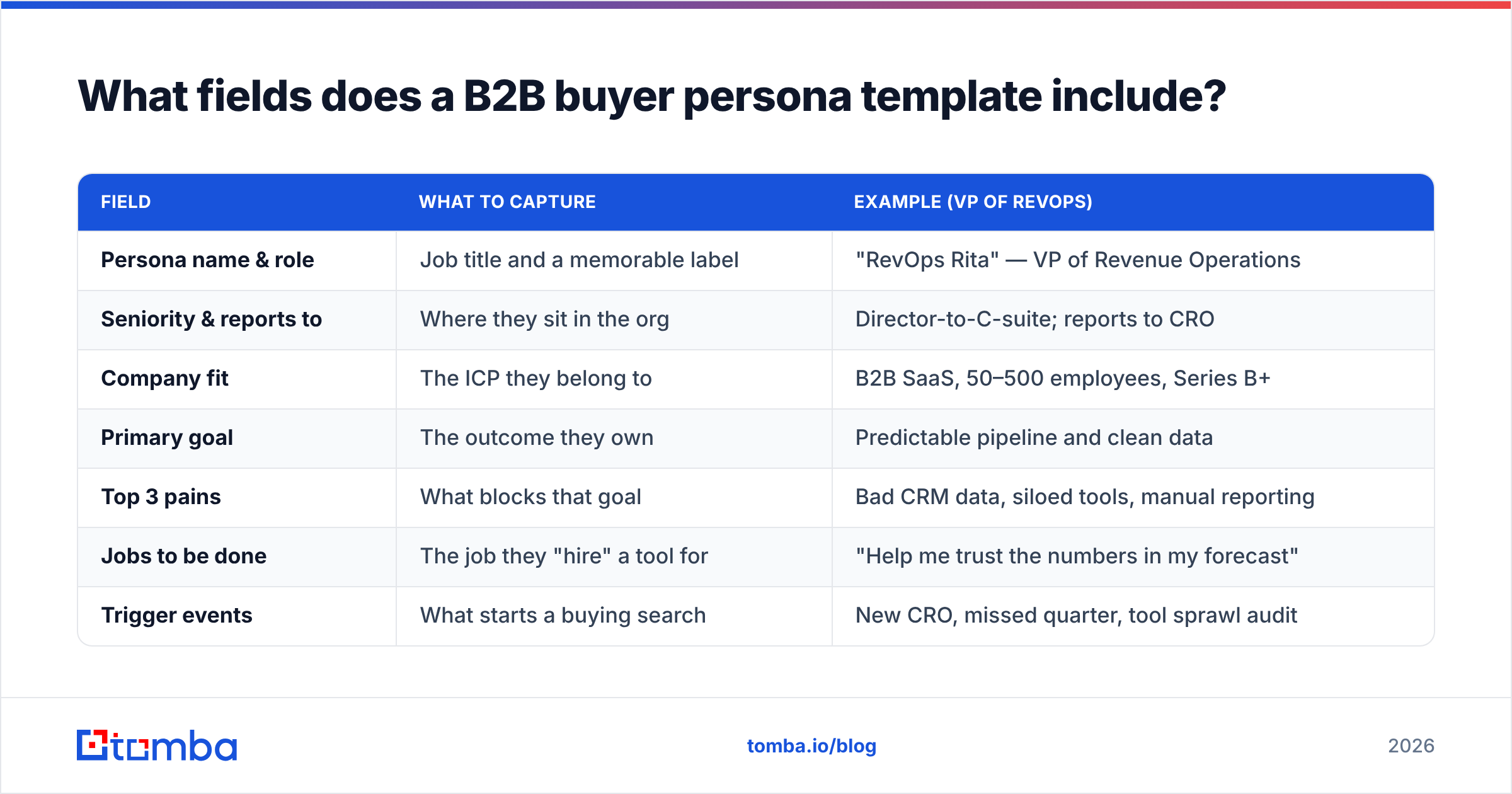
Here is the core template. Copy these fields directly. The first column is the field; fill in the rest per persona.
| Field | What to capture | Example (VP of RevOps) |
|---|---|---|
| Persona name & role | Job title and a memorable label | "RevOps Rita" — VP of Revenue Operations |
| Seniority & reports to | Where they sit in the org | Director-to-C-suite; reports to CRO |
| Company fit | The ICP they belong to | B2B SaaS, 50–500 employees, Series B+ |
| Primary goal | The outcome they own | Predictable pipeline and clean data |
| Top 3 pains | What blocks that goal | Bad CRM data, siloed tools, manual reporting |
| Jobs to be done | The job they "hire" a tool for | "Help me trust the numbers in my forecast" |
| Trigger events | What starts a buying search | New CRO, missed quarter, tool sprawl audit |
| Common objections | Why deals stall | Price, switching cost, IT/security review |
| Decision role | Champion, decision-maker, blocker | Champion + economic buyer |
| Research channels | Where they look for answers | LinkedIn, G2, peer Slack groups, vendor docs |
| Success metric | How they measure a win | Forecast accuracy, data coverage rate |
If you only have time for three fields, capture jobs to be done, trigger events, and objections. Those three answer the questions that actually shape outreach: Why would they buy? When? And what stops them? Demographic fields like age are mostly decoration in B2B.
A simple structure to fill in first#
When you sit down with a blank template, work through it in this order so each section feeds the next:
- Start with the role, not the person. Pull the five most common job titles from your closed-won deals. Those are your real personas, ranked by revenue.
- Write the goal in their words. Use language pulled verbatim from interviews or call recordings, not your marketing copy.
- List pains as obstacles to that goal. Every pain should connect to the goal above it. If it does not, cut it.
- Identify the trigger event. What changed in their world the week they started looking? This is the single highest-leverage field for timing outreach.
- Document objections from lost deals. Mine your CRM's closed-lost notes — the objections are already written down.
- Map the buying committee. Note whether this persona signs, recommends, or can veto.
Buyer persona template: two B2B examples#
Templates are abstract until you see them filled. Here are two compressed examples for a B2B SaaS prospecting tool.
Example 1 — "RevOps Rita" (economic buyer) Rita is a VP of Revenue Operations at a 200-person SaaS company. Her goal is a forecast leadership can trust. Her pain is that 30% of CRM records are stale or missing contacts, so reps waste hours and the numbers drift. She starts looking after a board meeting where the forecast missed. She objects on switching cost and security review. She is the economic buyer and needs an ROI story plus a SOC 2 answer.
Example 2 — "SDR Sam" (end user & champion) Sam is a sales development rep who lives in the day-to-day grind. His goal is hitting a meetings-booked quota. His pain is bouncing emails and dead-end phone numbers that tank his connect rate. His trigger is a new quarterly target he cannot hit with his current list quality. He objects to "another tool to learn." He is the champion — if the product makes his day easier, he sells it internally for you.
Notice how different the messaging needs to be. Rita wants forecast reliability and compliance; Sam wants more connects with less manual work. One template, two completely different outreach angles — which is exactly why you separate them.
How do you research a buyer persona with real data?#
Conclusion first: a persona is only as good as the evidence behind it, so you build it from three sources — conversations, your own CRM, and enrichment data — not from a brainstorm in a conference room.
1. Customer interviews. Talk to 5–10 recent customers per persona. Ask what their job looked like the day before they bought, what almost stopped them, and what alternatives they considered. The phrasing they use becomes your copy.
2. Win/loss analysis. Your CRM already holds the truth. Closed-won notes reveal triggers and decision roles; closed-lost notes reveal objections. Tag and count them. Patterns emerge fast.
3. Data enrichment. Once you know the shape of a persona, you need accurate contact and firmographic data to find more of them and to verify your assumptions about seniority, company size, and tech stack. This is where a reliable data layer matters. Tools like Tomba's data enrichment fill in job titles, company details, and verified contact points so your persona fields rest on facts rather than a stale spreadsheet. If you are mapping which titles cluster at a target account, a domain search surfaces the real people and roles behind a company before you ever guess at them.
For the qualitative frame, HubSpot's guide to buyer personas and the original concept work popularized by firms like Forrester are solid starting references. Cross-check your assumptions against third-party review sites such as G2 to see the language buyers use unprompted.
)
How many buyer personas should you create?#
Three to five. That is the answer for almost every B2B company.
Fewer than three usually means you are lumping distinct buyers together and your messaging stays generic. More than five almost always means you have confused segments with personas — you have sliced the same buyer into demographic variations that all want the same thing. The test: if two personas would receive nearly identical outreach, merge them.
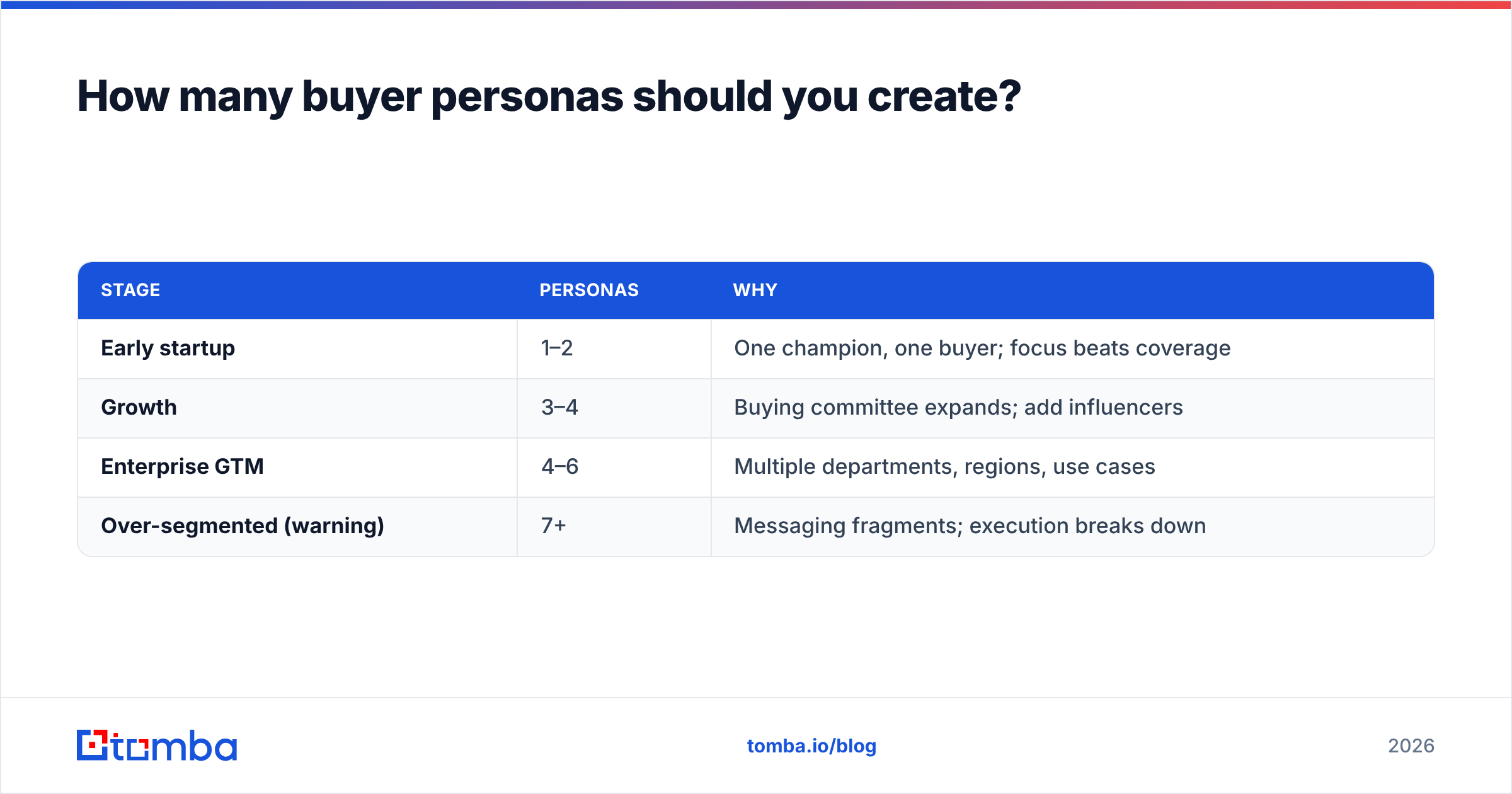
Here is how persona count typically maps to company stage:
| Stage | Personas | Why |
|---|---|---|
| Early startup | 1–2 | One champion, one buyer; focus beats coverage |
| Growth | 3–4 | Buying committee expands; add influencers |
| Enterprise GTM | 4–6 | Multiple departments, regions, use cases |
| Over-segmented (warning) | 7+ | Messaging fragments; execution breaks down |
Start narrow. You can always split a persona later when the data shows two genuinely different buying motions hiding inside one profile.
What mistakes make buyer personas useless?#
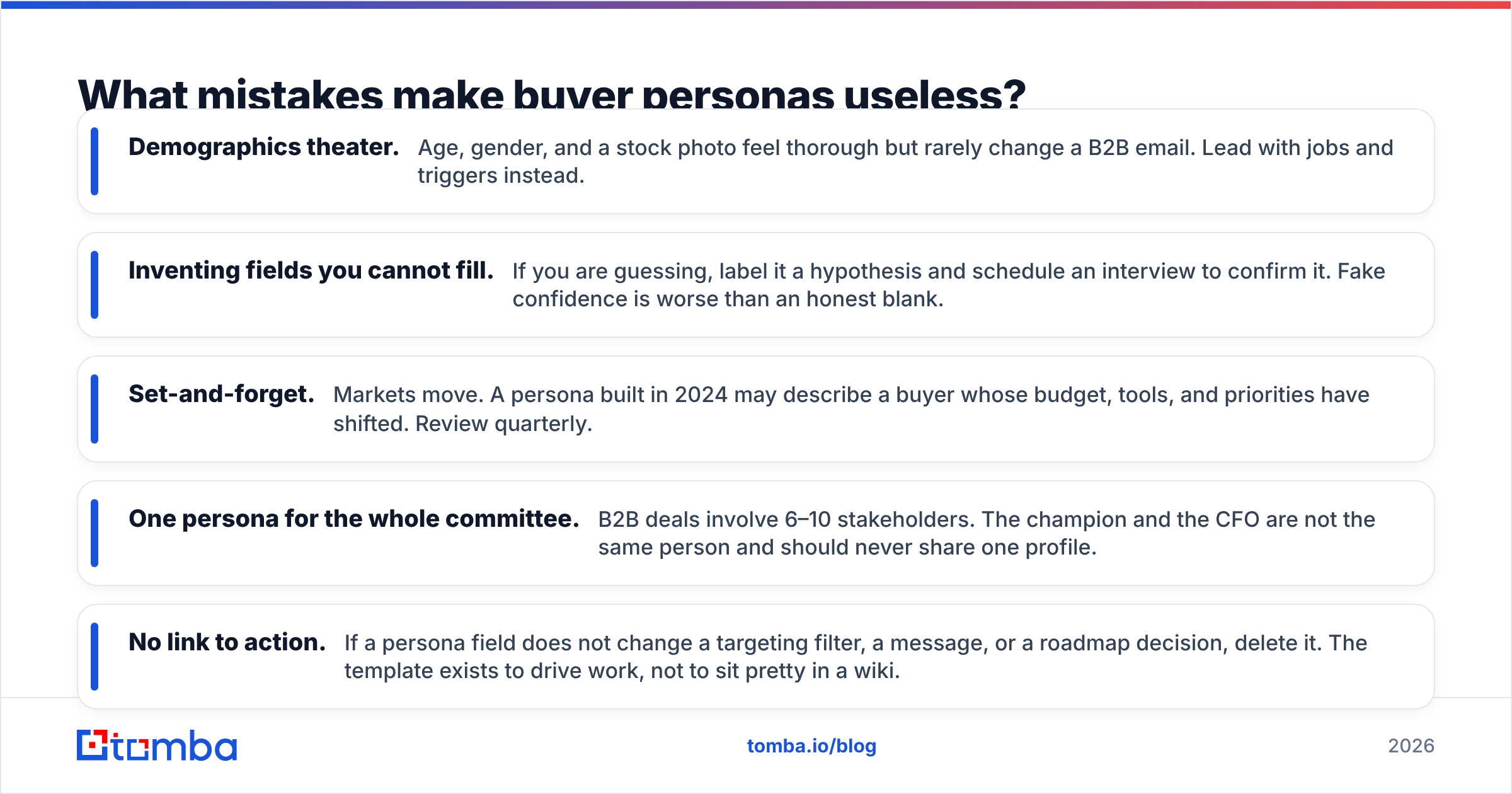
The graveyard of dead personas is full of the same five mistakes. Avoid these and your template stays alive.
- Demographics theater. Age, gender, and a stock photo feel thorough but rarely change a B2B email. Lead with jobs and triggers instead.
- Inventing fields you cannot fill. If you are guessing, label it a hypothesis and schedule an interview to confirm it. Fake confidence is worse than an honest blank.
- Set-and-forget. Markets move. A persona built in 2024 may describe a buyer whose budget, tools, and priorities have shifted. Review quarterly.
- One persona for the whole committee. B2B deals involve 6–10 stakeholders. The champion and the CFO are not the same person and should never share one profile.
- No link to action. If a persona field does not change a targeting filter, a message, or a roadmap decision, delete it. The template exists to drive work, not to sit pretty in a wiki.
The fix for all five is the same discipline: every field is either backed by evidence or flagged as an assumption, and every persona maps to a decision your team makes this quarter.
How do you turn a persona into actual prospecting?#
A persona earns its keep the moment it changes who you contact and what you say. Here is the handoff from document to pipeline.
First, translate persona fields into search filters: the titles, seniority, company size, and industry that define the role. Second, build a list of real people who match — this is where your persona becomes a target account list. Use a bulk email finder to pull verified contacts for everyone matching "SDR Sam" or "RevOps Rita" across your target accounts, then run them through an email verifier so your carefully researched outreach does not bounce and burn sender reputation.
Third, write per-persona sequences. Rita gets an ROI-and-compliance angle anchored to her trigger event; Sam gets a connect-rate-and-time-saved angle anchored to his. Same product, two messages, both pulled straight from the template.
This is the loop that separates a persona that drives revenue from a persona that decorates a slide: research → fill template → build matching list → verify → message by persona → feed win/loss data back into the template. For pricing on the data tools that power that loop, the Tomba pricing page lays out plans from a free tier through Enterprise.
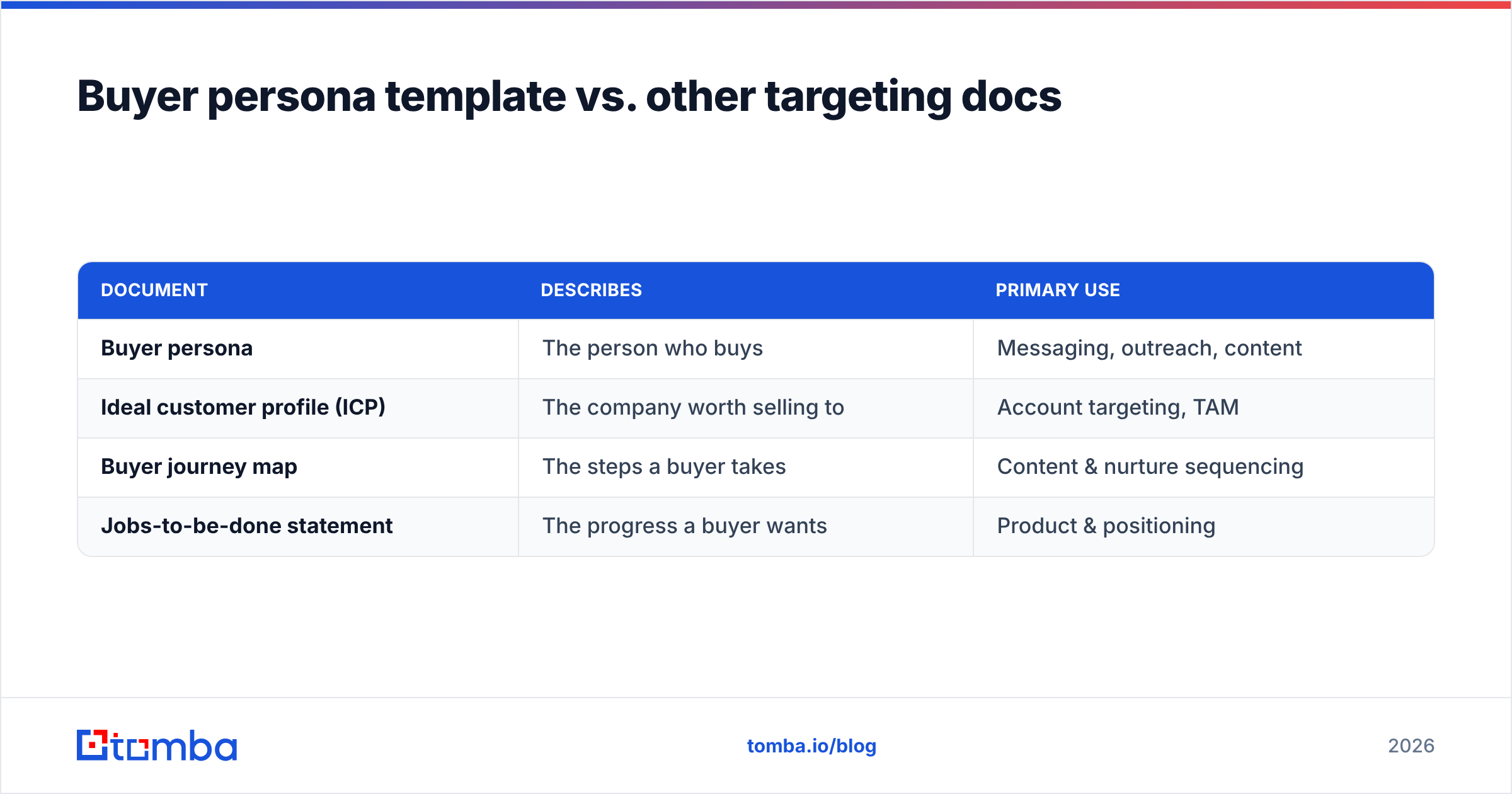
Buyer persona template vs. other targeting docs#
To keep your documents straight, here is how the persona fits alongside the other artifacts teams confuse it with.
| Document | Describes | Primary use |
|---|---|---|
| Buyer persona | The person who buys | Messaging, outreach, content |
| Ideal customer profile (ICP) | The company worth selling to | Account targeting, TAM |
| Buyer journey map | The steps a buyer takes | Content & nurture sequencing |
| Jobs-to-be-done statement | The progress a buyer wants | Product & positioning |
Use them together. The ICP tells you which companies to enter, the persona tells you who to reach inside them, the journey map tells you when, and the JTBD keeps your positioning honest. The persona template is the connective tissue that makes the other three actionable for a rep on a Tuesday morning.
Frequently asked questions#
Is a buyer persona the same as a target audience? No. A target audience is a broad group ("B2B marketers"). A buyer persona is a specific, detailed profile of one representative person within that audience, built to guide concrete messaging and targeting decisions.
How long should a buyer persona be? One page. If it spills onto a second page, you are likely padding with fields that do not change a decision. Density beats length.
How often should I update my personas? Quarterly at minimum, and immediately after any major market shift, product launch, or pricing change. Audit them against your last quarter's closed-won and closed-lost deals.
Do I need personas if I sell to a small niche? Yes, but you may only need one or two. Even a tight niche has distinct roles — the champion who loves your product and the executive who signs the check rarely care about the same things.
Start building data-backed personas#
A buyer persona template is only as strong as the data filling it. Once you have defined your personas, the next step is finding and verifying the real people who match them — at scale, without bouncing emails or stale records. The Tomba Email Finder turns your persona's role, company, and seniority filters into verified, ready-to-contact leads, so the profiles you researched become a pipeline you can actually work. Start on the free tier (25 searches/month), validate your personas against live data, and scale up when the targeting proves out.
// get started
Find, verify and enrich your first contacts today
Start on the free plan with 25 searches a month, then scale when your team is ready.
Free plan · No credit card required · GDPR & CCPA
// about the author