Buyer Profile Example: A 2026 Template for B2B Sales Teams
See a complete buyer profile example built for B2B sales, plus a fill-in template, firmographic fields, and the data sources that keep it accurate in 2026.
You can have the best cold email copy in the world and still miss quota if you are sending it to the wrong people. A buyer profile fixes that. It is the difference between "anyone with a pulse and a credit card" and "VP of Marketing at a 50–200 person SaaS company who just hired two SDRs."
This guide gives you a real buyer profile example you can copy, the exact fields that belong in it, and a practical way to keep the data behind it accurate. No theory dumps — just the template and how to use it.
TL;DR#
- A buyer profile (often used interchangeably with ICP) describes the company and person most likely to buy, stay, and refer — based on real data, not vibes.
- A useful buyer profile example combines firmographics (size, industry, revenue), technographics (tools they use), triggers (hiring, funding), and persona details (role, pains, goals).
- Below you get a filled-in B2B buyer profile example plus a blank template you can paste into a doc or CRM.
- The profile is only as good as the contact data behind it — pair it with a reliable email finder and verification step before you reach out.
- Review the profile quarterly. Markets shift, your best-fit segment shifts with them.
What is a buyer profile?#
A buyer profile is a short, evidence-based description of the customer who gets the most value from your product and gives you the most value back. Think of it like a dating profile written by your accountant: it is not about who you wish you sold to, it is about who actually closes fast, pays on time, and renews.
People throw three terms around as if they are identical — they overlap, but they answer different questions:
- Ideal Customer Profile (ICP) — describes the company that is the perfect fit (industry, headcount, revenue, region). It answers "which accounts should we target?"
- Buyer persona — describes the individual human inside that company who makes or influences the decision. It answers "who do we talk to, and what do they care about?"
- Buyer profile — in B2B, the practical blend of both: the right account and the right person inside it.
If you only build an ICP, you target good companies and email the wrong contact. If you only build personas, you write great messaging aimed at people who can't afford you. The buyer profile example below stitches them together so your reps target and message in one motion.
What goes into a buyer profile? (the fields that matter)#
Skip the 30-field monster template. These are the categories that actually change who you contact and what you say:
- Firmographics — industry, company size (headcount), annual revenue, geography, business model (B2B SaaS, agency, ecommerce).
- Technographics — the tools they already run (CRM, marketing automation, cloud stack). A company on HubSpot signals different needs than one on a homegrown system.
- Buying triggers — recent funding, leadership hires, rapid headcount growth, expansion into a new market, or a public pain point.
- Persona details — job title, seniority, reporting line, daily responsibilities, KPIs they are measured on.
- Pains and goals — the specific problem your product removes and the outcome they are chasing.
- Disqualifiers — the red flags that mean "do not pursue" (too small, wrong region, regulated industry you can't serve).
That last one is underrated. A sharp buyer profile example tells reps who to ignore as clearly as who to chase, which protects pipeline quality and keeps your response rate high.
A complete B2B buyer profile example#
Here is a filled-in example for a fictional company, "FlowMetrics," selling a mid-market analytics platform. Use it as a model for your own.
| Attribute | Detail |
|---|---|
| Profile name | "Scaling SaaS Marketer" |
| Industry | B2B SaaS (vertical: martech, fintech, HR tech) |
| Company size | 50–250 employees |
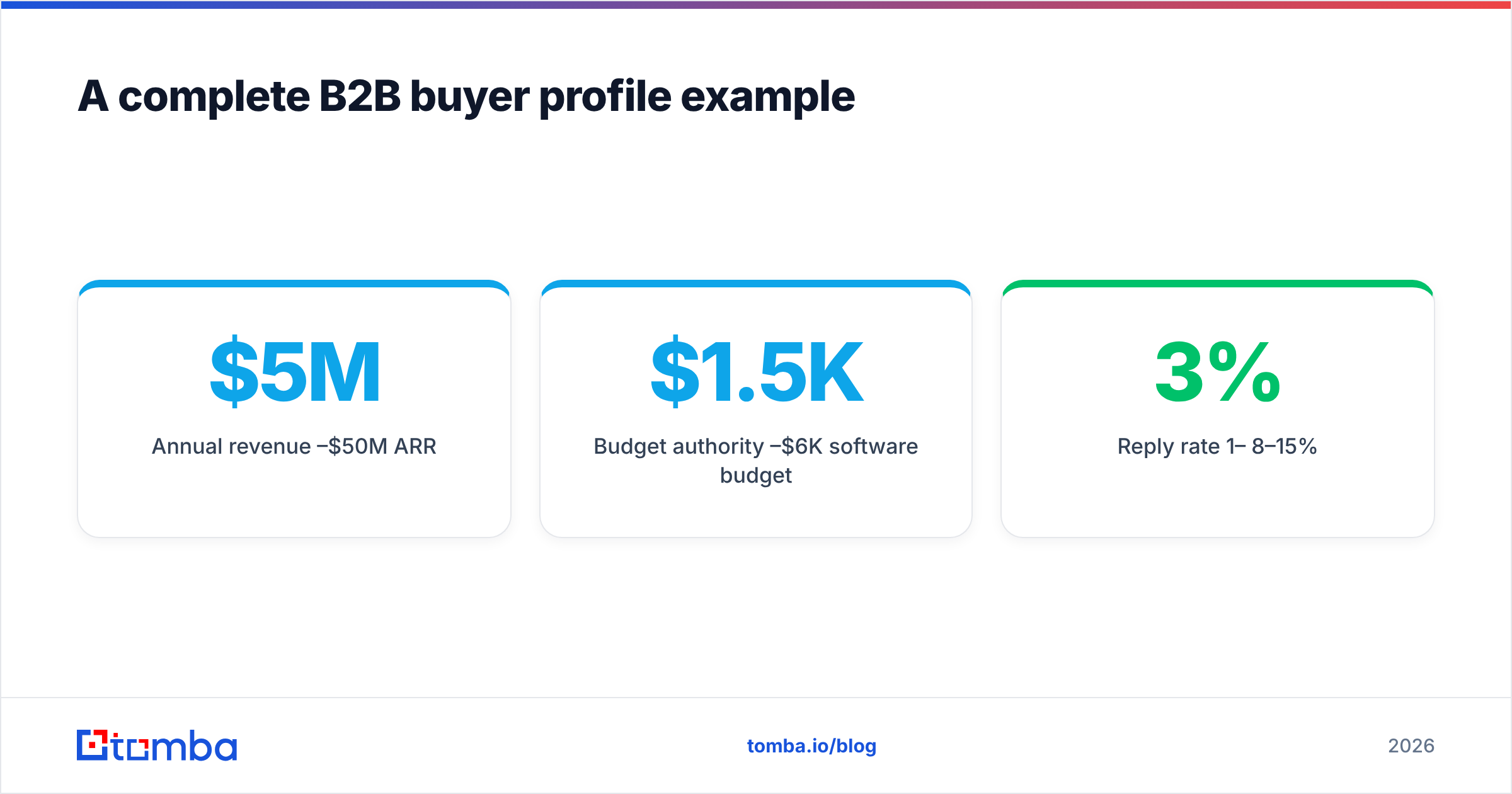
| Annual revenue | $5M–$50M ARR |
| Geography | US, Canada, UK |
| Tech stack | HubSpot or Salesforce, Segment, Google Analytics |
| Buying trigger | Raised Series A/B in last 12 months; hired 2+ marketers |
| Decision maker | VP of Marketing / Head of Growth |
| Influencers | Marketing Ops Manager, RevOps lead |
| Top pain | Can't tie campaign spend to revenue across tools |
| Primary goal | Prove marketing ROI to the board |
| Budget authority | $1.5K–$6K/mo software budget |
| Disqualifiers | <20 employees, no marketing ops hire, pre-revenue |
Notice every row is something a rep can act on. "VP of Marketing at a 50–250 person SaaS company that just raised a round" is searchable. "Innovative companies that value data" is not.
Now compare the two approaches side by side, because this is where most teams leak money:
| Dimension | Vague targeting | Sharp buyer profile |
|---|---|---|
| Who you contact | "Marketers" | VP Marketing, 50–250 employee SaaS |
| Message relevance | Generic | Tied to a known trigger and pain |
| Reply rate | 1–3% | 8–15% |
| Sales cycle | Long, unpredictable | Shorter, repeatable |
| Wasted credits | High | Low |
The right column is not magic. It is the same outreach effort pointed at a defined audience, which is the entire economic argument for building the profile in the first place.
Why does a buyer profile actually move revenue?#
Because every downstream activity inherits the quality of your targeting. A clear profile lifts win rate by concentrating effort where deals already want to happen.
Three concrete payoffs:
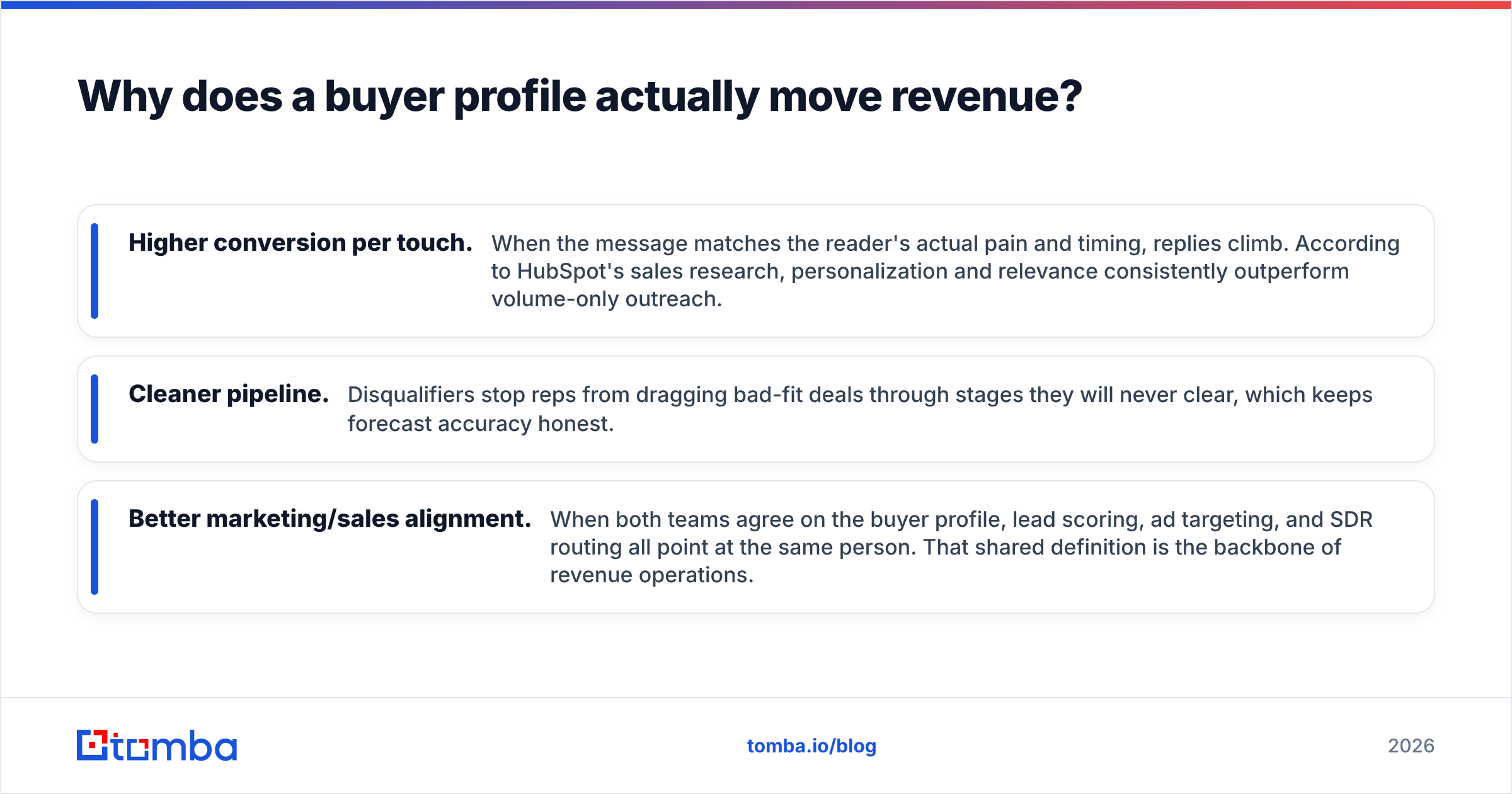
- Higher conversion per touch. When the message matches the reader's actual pain and timing, replies climb. According to HubSpot's sales research, personalization and relevance consistently outperform volume-only outreach.
- Cleaner pipeline. Disqualifiers stop reps from dragging bad-fit deals through stages they will never clear, which keeps forecast accuracy honest.
- Better marketing/sales alignment. When both teams agree on the buyer profile, lead scoring, ad targeting, and SDR routing all point at the same person. That shared definition is the backbone of revenue operations.
Industry analysts have made the same point for years — firms like Gartner repeatedly tie go-to-market efficiency to tight account selection rather than raw activity. Targeting beats hustle.
How do you build a buyer profile from your own data?#
Don't invent it. Mine it. Your existing customers are the answer key.
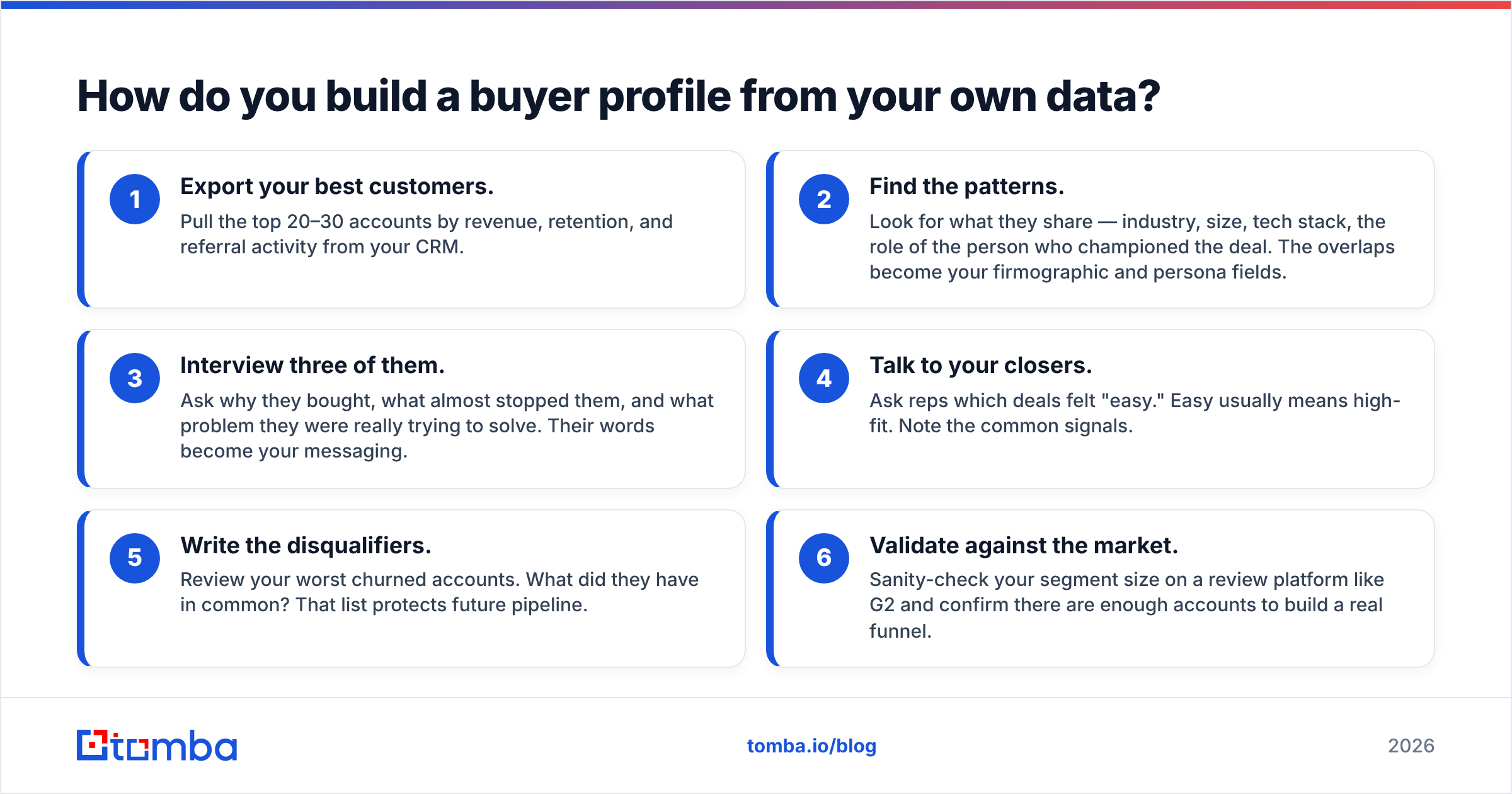
- Export your best customers. Pull the top 20–30 accounts by revenue, retention, and referral activity from your CRM.
- Find the patterns. Look for what they share — industry, size, tech stack, the role of the person who championed the deal. The overlaps become your firmographic and persona fields.
- Interview three of them. Ask why they bought, what almost stopped them, and what problem they were really trying to solve. Their words become your messaging.
- Talk to your closers. Ask reps which deals felt "easy." Easy usually means high-fit. Note the common signals.
- Write the disqualifiers. Review your worst churned accounts. What did they have in common? That list protects future pipeline.
- Validate against the market. Sanity-check your segment size on a review platform like G2 and confirm there are enough accounts to build a real funnel.
The output of those six steps is your first buyer profile example — and it will already beat whatever assumptions your team is running on today.
Blank buyer profile template (copy this)#
Paste this into a Google Doc, Notion, or a CRM custom-field set and fill each line. Keep it to one page — if it doesn't fit on a page, reps won't use it.
- Profile name: (a memorable nickname, e.g. "Scaling SaaS Marketer")
- Industry / vertical: _______
- Company size (headcount): _______
- Annual revenue range: _______
- Geography: _______
- Tech stack signals: _______
- Buying triggers: _______
- Primary decision maker (title): _______
- Key influencers (titles): _______
- Top pain we remove: _______
- Primary goal they chase: _______
- Typical budget: _______
- Disqualifiers: _______
- Best opening hook: _______
For multiple segments, duplicate the template — most B2B companies run two to four buyer profiles, not one. Just don't let "two to four" quietly become twelve.
How do you find and reach the people in your profile?#
A profile is a map; you still need the addresses. Once you know the titles and company traits you want, you need accurate contact data to act on it — otherwise you are personalizing emails into a void.
This is the step most teams underestimate. Here is the workflow that connects profile to pipeline:
- List target accounts that match your firmographics (use a B2B database or filtered search).
- Identify the right person at each account by the title in your profile.
- Get verified contact details using domain search to pull emails by company, or an email finder for a specific name.
- Verify before sending with an email verifier so bounces don't wreck your sender reputation.
- Enrich the record with role and company data so your message references the right trigger.
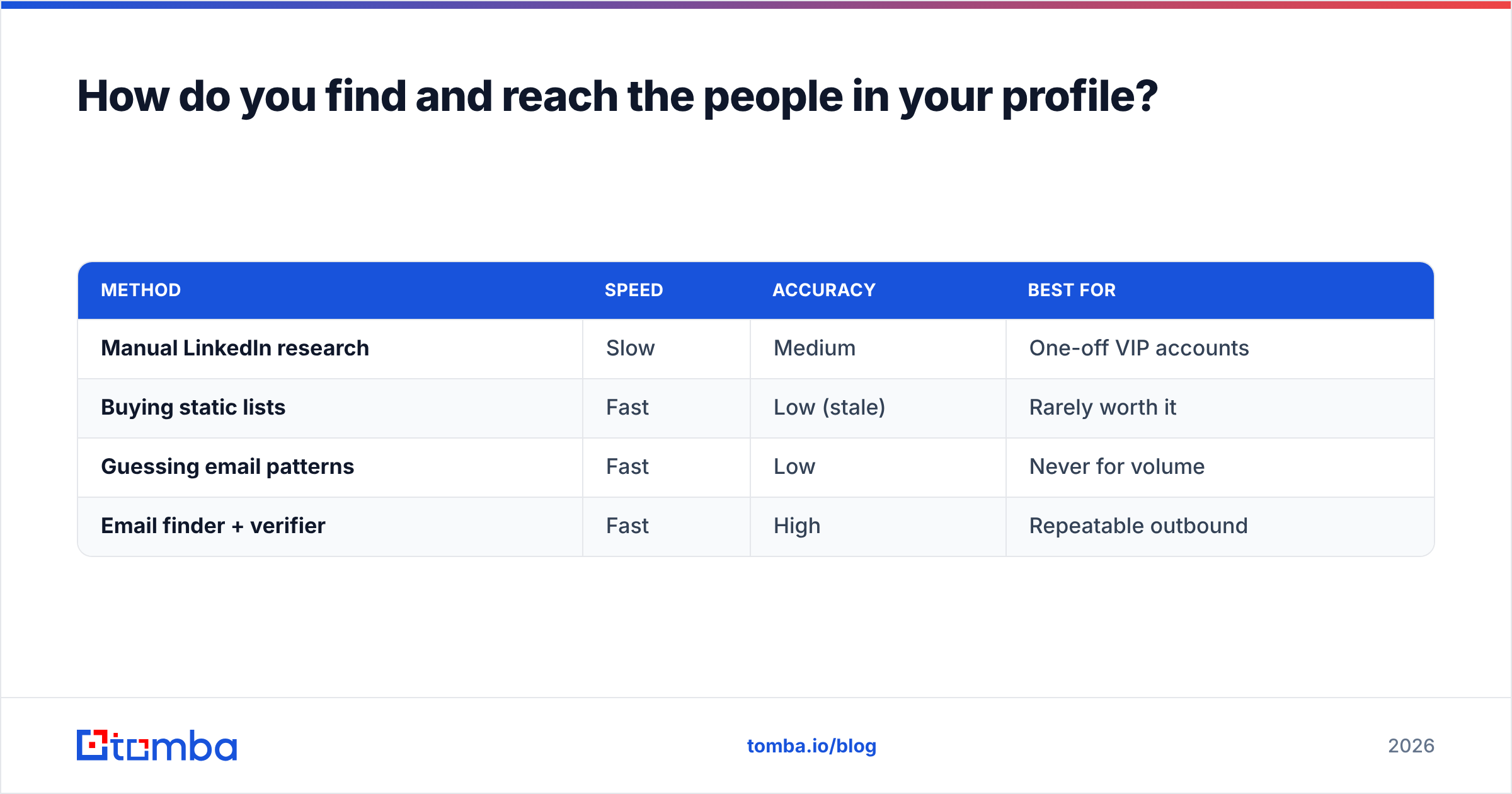
Here is how common data approaches stack up for this job:
| Method | Speed | Accuracy | Best for |
|---|---|---|---|
| Manual LinkedIn research | Slow | Medium | One-off VIP accounts |
| Buying static lists | Fast | Low (stale) | Rarely worth it |
| Guessing email patterns | Fast | Low | Never for volume |
| Email finder + verifier | Fast | High | Repeatable outbound |
Skip the static lists and the guesswork. Both inflate bounce rates and burn the sender reputation you need to land in the inbox. A find-then-verify loop keeps your data fresh and your deliverability intact. For volume, a bulk email finder runs the whole target account list at once.
How often should you update your buyer profile?#
Treat it as a living document, not a stone tablet. Review it at least quarterly, and trigger an off-cycle review whenever:
- You launch a new product or pricing tier.
- You enter a new market or region.
- Win rates drop in a segment that used to convert.
- A new competitor reshapes part of your market.
Each review, re-run the customer-export analysis. Your best-fit customer in Q4 2026 may not be the one you defined in Q1. Keeping the profile current is cheaper than the wasted outreach a stale one creates.
Common mistakes to avoid#
- Aspirational targeting. Listing the logos you want instead of the customers you win. Build from real wins.
- Too many profiles. If everyone is a buyer, no one is. Cap it at two to four.
- Persona without account fit. Great messaging aimed at companies that can't buy is wasted effort.
- No disqualifiers. Without them, reps chase everything and close nothing efficiently.
- Ignoring data quality. A perfect profile fed by bad emails still bounces. Verify everything.
Frequently asked questions#
Is a buyer profile the same as a buyer persona? No. A buyer persona describes the individual (their role, goals, pains). A buyer profile in B2B combines that persona with the ideal account it lives in — so you target the right company and the right person together.
How many buyer profiles should a B2B company have? Most run two to four. One per major segment or use case is plenty. More than that usually signals you haven't decided who you serve best.
What data do I need to build one? Your CRM (for best-customer patterns), a few customer interviews, and accurate firmographic plus contact data. Tools like data enrichment fill the gaps your CRM can't.
Can I build a buyer profile without a big budget? Yes. Start with your existing customer list and a free tier of a contact-data tool. You can refine the profile manually before paying for scale.
Turn your buyer profile into pipeline#
A buyer profile only earns its keep when you act on it — and acting on it means reaching real, verified people at real, in-profile accounts. That is exactly what Tomba's Email Finder is built for: feed it the company domains and titles from your profile, get back verified professional emails, and skip the guesswork that bloats bounce rates.
Start on the free tier (25 searches/mo) to test it against your profile, then scale on a Starter plan at $49/mo when the targeting proves out. Compare options on the Tomba pricing page. Build the profile once, point your best data tool at it, and let your reps spend their time on conversations instead of research.
// get started
Find, verify and enrich your first contacts today
Start on the free plan with 25 searches a month, then scale when your team is ready.
Free plan · No credit card required · GDPR & CCPA
// about the author