Buying Triggers: How to Time Outbound Sales in 2026
Buying triggers tell you when a prospect is ready to act. Learn the 10 highest-converting triggers, how to track them, and how to turn signals into booked meetings.
TL;DR
- A buying trigger is any event that signals a company or person just became more likely to buy — a funding round, a new VP hire, a tech change, or a job posting.
- Trigger-based outbound beats spray-and-pray because you reach prospects in the narrow window when a problem is top of mind and budget is moving.
- The highest-converting triggers in 2026 are leadership changes, funding, hiring spikes, tech-stack shifts, and product launches.
- You need three things to run on triggers: a signal source, a way to enrich the right contact, and a fast play that fires within 48 hours.
- Tools like Tomba turn a triggered company into a verified decision-maker email in seconds, so your timing advantage doesn't die at the "who do I email?" step.
What is a buying trigger?#
A buying trigger is an event that moves a prospect from "not in market" to "maybe in market." Think of it like surfing. You don't paddle randomly and hope a wave appears — you watch the horizon, spot the swell forming, and start paddling so you're already moving when it lifts you. A buying trigger is that swell: the observable thing that happens before a purchase, giving you a few days or weeks to be the first vendor in the conversation.
Technically, a trigger is a timestamped signal tied to an account or contact that correlates with increased purchase intent. A company raising a Series B is suddenly hiring, re-platforming, and spending. A newly appointed Head of Revenue Operations wants to make their mark in the first 90 days. A job post for a "Demand Generation Manager" tells you the marketing team is about to expand and shop for tools.
The difference between a trigger and generic firmographic data matters. Firmographics ("500-employee SaaS company in fintech") tell you who fits. Triggers tell you when to act. You need both, but timing is what separates a 1% reply rate from a 10% one.
Why do buying triggers beat spray-and-pray outbound?#
Because relevance is a function of timing, and timing is the one variable most reps ignore.
Cold outbound to a static list assumes everyone is equally ready to buy on the day you happen to email them. They're not. On any given week, the vast majority of your total addressable market is perfectly happy with the status quo. Emailing them is noise. The small slice experiencing a trigger — a painful new hire gap, a system migration, a compliance deadline — is the slice that converts.
When you align your message to a fresh event, three things change:
- Open rates climb because your subject line references something real and recent ("Congrats on the Series A" or "Saw you're hiring three SDRs").
- Reply rates climb because the prospect already has the problem on their desk.
- Sales cycles shorten because you arrive while budget is being allocated rather than after it's been spent.

The economics are simple. If you have 10,000 accounts and 3% are showing a trigger in a given month, that's 300 high-intent accounts. Working those 300 well will out-produce blasting all 10,000. This is the core idea behind modern sales prospecting — concentrate effort where intent is highest.
What are the most common types of buying triggers?#
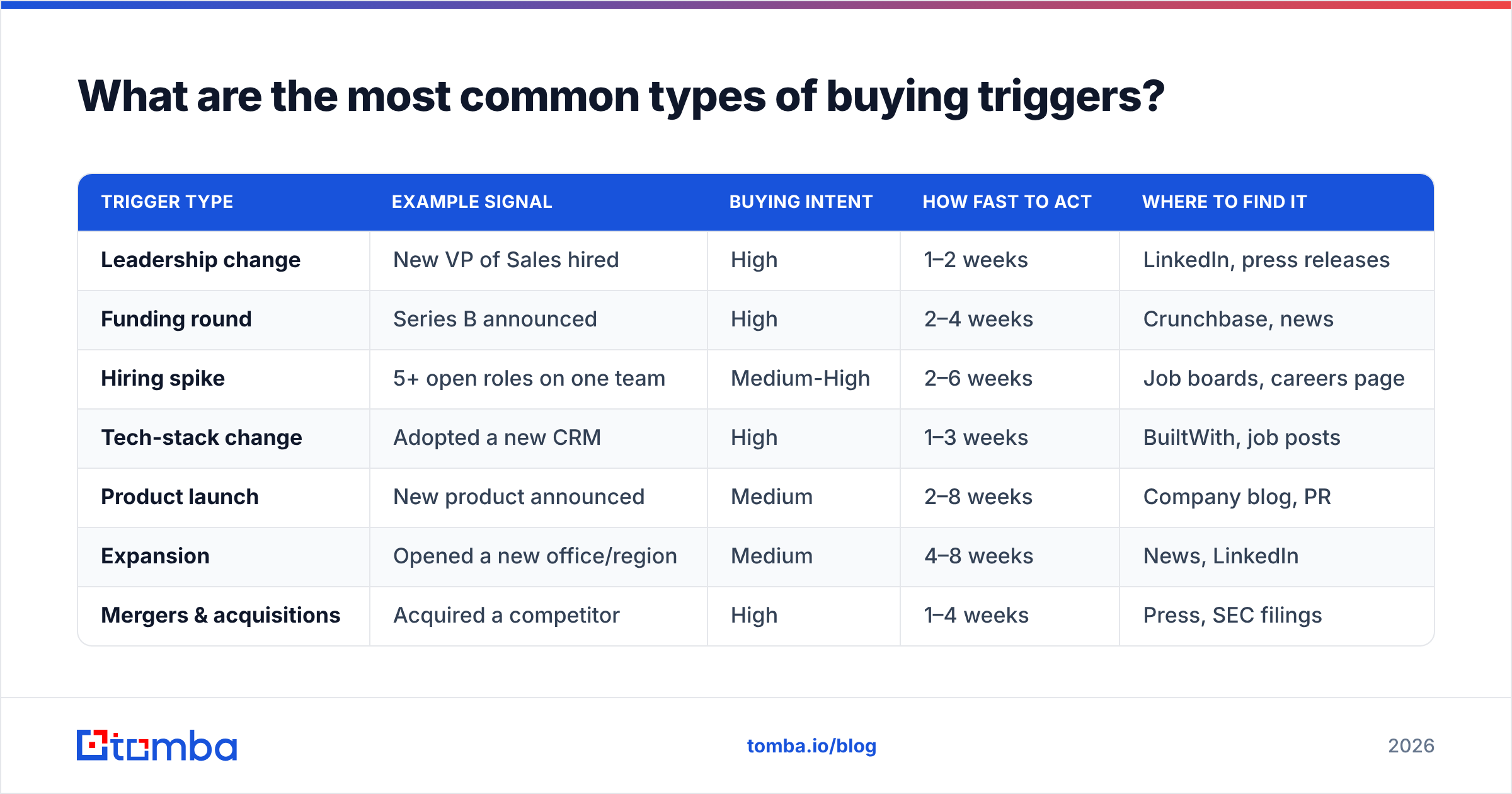
Not all triggers are equal. Some signal immediate budget; others signal a longer nurture. Here's how the major categories compare.
| Trigger type | Example signal | Buying intent | How fast to act | Where to find it |
|---|---|---|---|---|
| Leadership change | New VP of Sales hired | High | 1–2 weeks | LinkedIn, press releases |
| Funding round | Series B announced | High | 2–4 weeks | Crunchbase, news |
| Hiring spike | 5+ open roles on one team | Medium-High | 2–6 weeks | Job boards, careers page |
| Tech-stack change | Adopted a new CRM | High | 1–3 weeks | BuiltWith, job posts |
| Product launch | New product announced | Medium | 2–8 weeks | Company blog, PR |
| Expansion | Opened a new office/region | Medium | 4–8 weeks | News, LinkedIn |
| Mergers & acquisitions | Acquired a competitor | High | 1–4 weeks | Press, SEC filings |
| Website/intent activity | Repeat visits to pricing page | High | 24–72 hours | Visitor reveal tools |
A few notes on reading this table. Leadership changes are the single most reliable trigger because new executives reshape their stack fast — a new RevOps leader will audit tools within their first quarter. Funding is loud but crowded; every vendor emails the same fresh raise, so your differentiation has to be sharper. Website intent is the fastest-decaying trigger of all — if someone hits your pricing page three times today, a reply tomorrow is far better than a reply next week.
How do you turn a trigger into a booked meeting?#
A trigger is worthless until it becomes a message in front of the right person. The workflow has four steps, and each one has a failure mode that kills the timing advantage.
1. Detect the signal. Set up sources for each trigger type you care about — Crunchbase alerts for funding, LinkedIn Sales Navigator for job changes, a job-board scraper for hiring, a visitor reveal tool for intent. The failure mode here is noise: tracking 20 trigger types badly is worse than tracking 4 well.
2. Identify the right contact. A funding announcement is an account-level signal. You still need a person. If the trigger is "company hired a new CFO," the contact is obvious. If it's "company raised a Series B and is hiring SDRs," the contact is probably the VP of Sales or Head of RevOps. This is where most trigger plays stall — the rep knows the company but burns an hour hunting for the decision-maker.
3. Get a verified contact method. A name without a deliverable email is a dead end. This is the step where speed compounds: you found the trigger in minutes, identified the role in minutes, and now you need the email in seconds. Tools like the Tomba Email Finder take a company domain and a name and return a verified professional email, while domain search pulls every known contact at the account so you can pick the right one. Run it through an email verifier and your bounce rate stays low — critical when you're emailing fresh signals at volume.
4. Fire a fast, specific play. Reference the trigger in the first line, connect it to a problem, and make one clear ask. Speed matters: a triggered email sent within 48 hours converts far better than the same email sent two weeks later when the signal has gone cold.

What tools track buying triggers in 2026?#
The stack splits into three layers: signal detection, contact resolution, and outreach. Here's how the common approaches compare on the dimensions that matter for a triggered workflow.
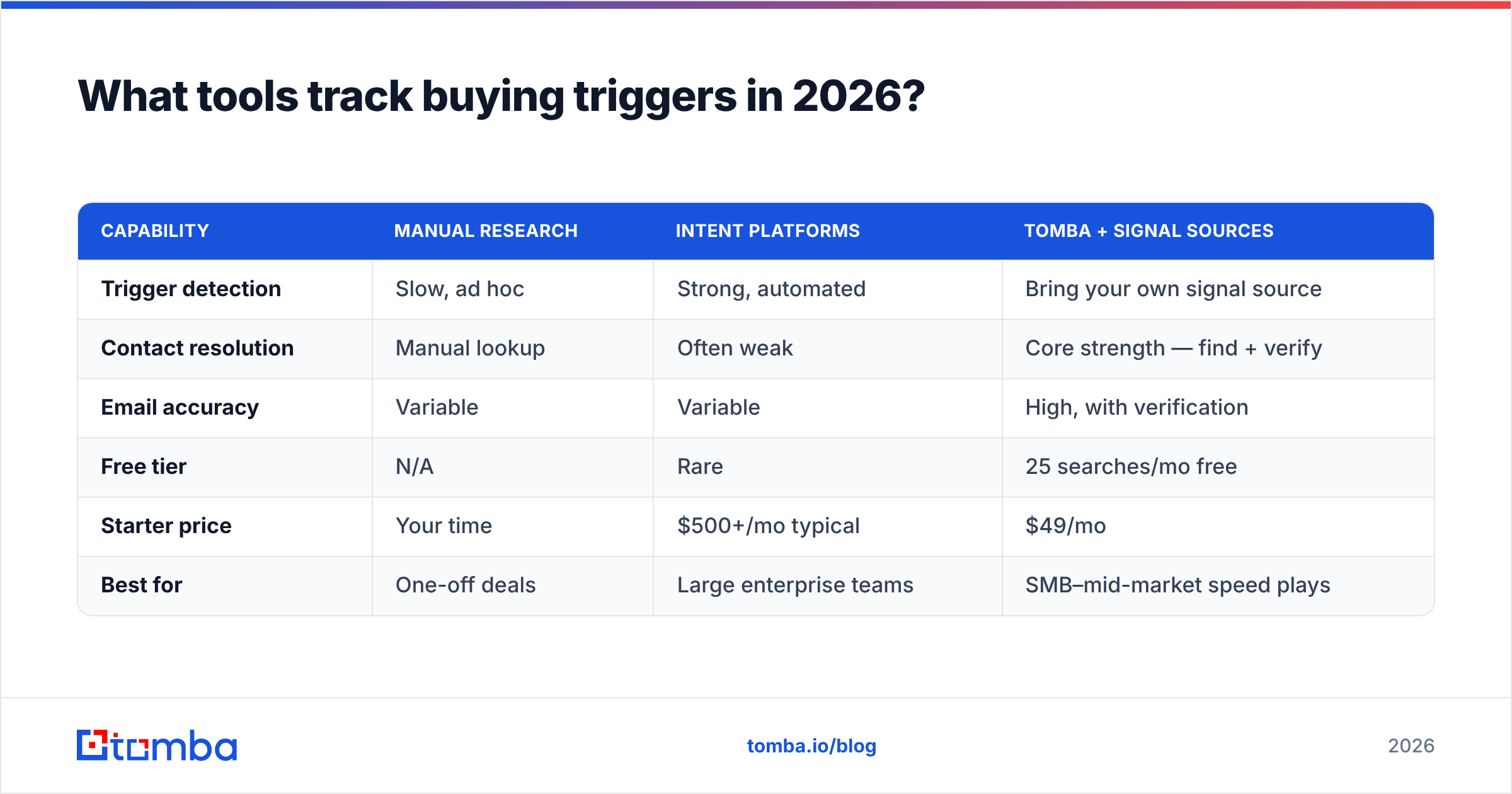
| Capability | Manual research | Intent platforms | Tomba + signal sources |
|---|---|---|---|
| Trigger detection | Slow, ad hoc | Strong, automated | Bring your own signal source |
| Contact resolution | Manual lookup | Often weak | Core strength — find + verify |
| Email accuracy | Variable | Variable | High, with verification |
| Free tier | N/A | Rare | 25 searches/mo free |
| Starter price | Your time | $500+/mo typical | $49/mo |
| Best for | One-off deals | Large enterprise teams | SMB–mid-market speed plays |
The honest read: dedicated intent platforms like those reviewed on G2 are excellent at detecting signals at scale, and if you're an enterprise team with budget, they earn their keep. But they're frequently weak at the unglamorous middle step — turning a triggered account into a verified, deliverable contact. That's the gap that quietly wastes your timing.
That's why a lean, fast stack often wins for SMB and mid-market teams: pair a focused set of free or cheap signal sources (LinkedIn, Crunchbase, job boards, website visitor reveal) with a contact engine that resolves and verifies in seconds. You don't need a six-figure platform to run trigger-based outbound — you need reliable detection plus reliable contact data, and you need them to hand off cleanly.
For pricing on the contact-resolution layer, see the full Tomba pricing breakdown — the free tier is enough to test a trigger workflow before you scale it.
How do you build a trigger-based outbound system?#
Start narrow, prove it works, then widen. A common mistake is trying to track every trigger type on day one. Pick the two or three that map best to why your existing customers bought.
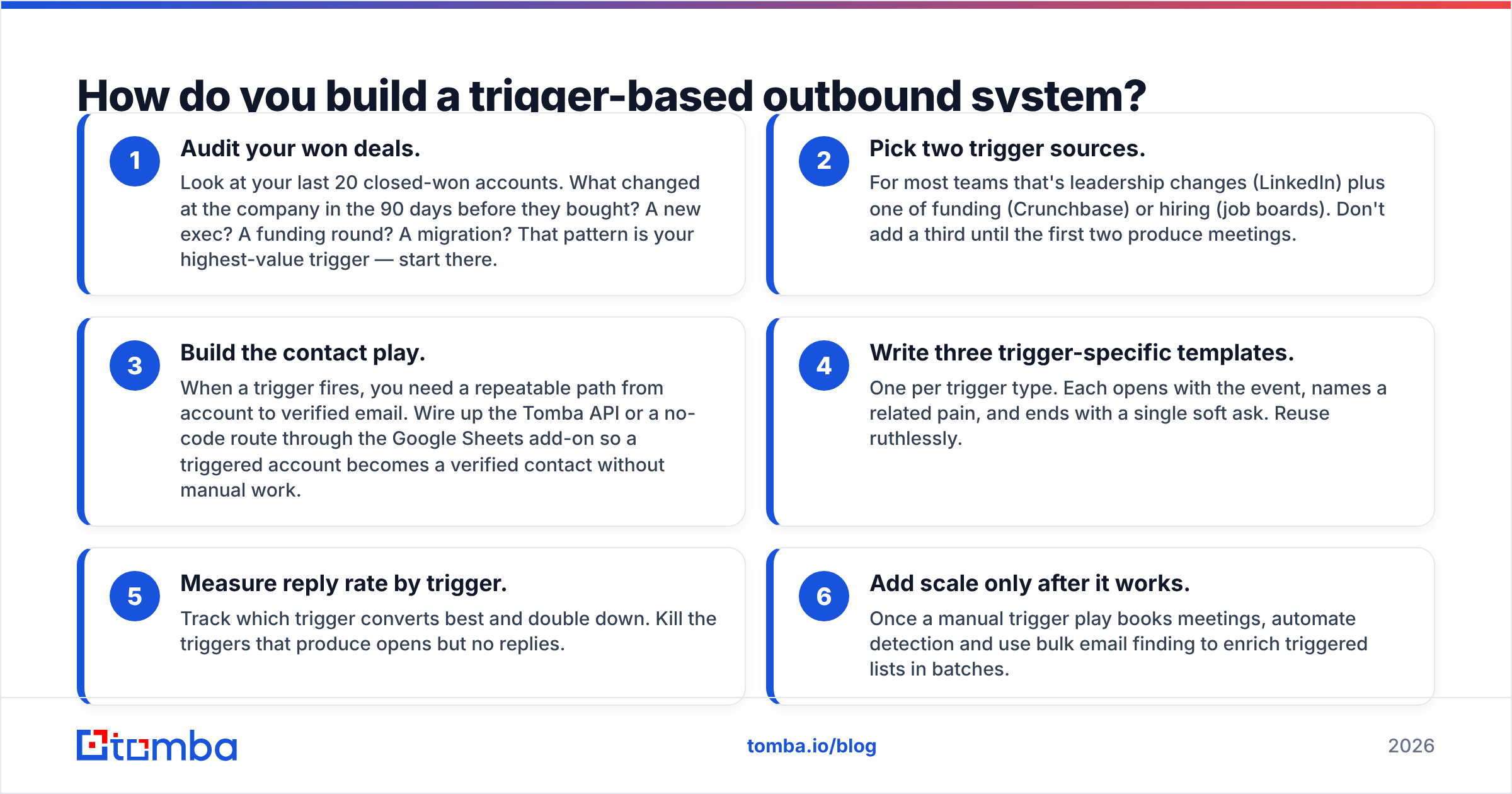
Here's a practical build order:
- Audit your won deals. Look at your last 20 closed-won accounts. What changed at the company in the 90 days before they bought? A new exec? A funding round? A migration? That pattern is your highest-value trigger — start there.
- Pick two trigger sources. For most teams that's leadership changes (LinkedIn) plus one of funding (Crunchbase) or hiring (job boards). Don't add a third until the first two produce meetings.
- Build the contact play. When a trigger fires, you need a repeatable path from account to verified email. Wire up the Tomba API or a no-code route through the Google Sheets add-on so a triggered account becomes a verified contact without manual work.
- Write three trigger-specific templates. One per trigger type. Each opens with the event, names a related pain, and ends with a single soft ask. Reuse ruthlessly.
- Measure reply rate by trigger. Track which trigger converts best and double down. Kill the triggers that produce opens but no replies.
- Add scale only after it works. Once a manual trigger play books meetings, automate detection and use bulk email finding to enrich triggered lists in batches.
The whole point is compounding speed. Every step you remove between "signal appeared" and "email sent" widens your edge over slower competitors chasing the same wave.
How fast does a buying trigger decay?#
Faster than most reps assume — and the decay rate determines your whole cadence.
Website intent signals decay in hours. If someone visits your pricing page three times in a day, reach out the same day or the next morning; by next week the urgency is gone. Leadership changes and funding rounds decay over weeks — useful, but every other vendor is watching the same press release, so being early still matters. Hiring and expansion signals decay slowest, over a month or more, which makes them good for nurture but weak for "drop everything" plays.
The operational takeaway: match your response speed to the trigger's half-life. Build your fastest, most automated path for the fastest-decaying signals, and reserve your slower, more researched outreach for the durable ones. A verified email pulled in seconds is what makes same-day response on a fast trigger actually possible — the reverse email lookup and enrichment tools fill in the rest of the picture once you've made contact.
Frequently asked questions#
What is the difference between a buying trigger and intent data? Intent data is one source of buying triggers — specifically behavioral signals like content consumption or website visits. A buying trigger is the broader category that also includes events like funding, hiring, and leadership changes. Intent data answers "are they researching?"; triggers answer "did something change that makes them more likely to buy?"
How many buying triggers should I track? Start with two or three that match your won-deal patterns. Tracking too many at once produces noise and dilutes the speed advantage. Expand only after a small set reliably books meetings.
Do buying triggers work for SMB targets? Yes, though the trigger mix differs. SMBs show fewer funding and M&A signals but plenty of hiring, tech-stack, and website-intent triggers. A cheap, fast stack works especially well here because deal sizes don't justify enterprise intent platforms.
How quickly should I act on a trigger? Within 48 hours for most triggers, and same-day for website-intent signals. The conversion advantage of a trigger decays quickly, so the bottleneck is usually how fast you can find a verified contact — not how fast you can write the email.
Start running on triggers, not guesses#
The teams winning at outbound in 2026 aren't sending more email — they're sending it at the right moment to the right person. Buying triggers give you the moment. The missing piece is turning that moment into a verified, deliverable contact before the signal goes cold.
That's exactly where the Tomba Email Finder fits: feed it a triggered company and a decision-maker's name, and get back a verified professional email in seconds — with the free tier (25 searches/mo) and a $49/mo Starter plan that let you prove the workflow before you scale it. Pair it with your signal sources, wire up the Tomba API, and your timing advantage stops dying at "who do I email?" Start free, run your first trigger play this week, and let speed do the selling.
// get started
Find, verify and enrich your first contacts today
Start on the free plan with 25 searches a month, then scale when your team is ready.
Free plan · No credit card required · GDPR & CCPA
// about the author