Buzzstream vs Pitchbox 2026: Which Outreach Tool Wins?
Buzzstream vs Pitchbox in 2026: a hands-on breakdown of pricing, CRM depth, automation, and prospecting so you can pick the right outreach platform without overpaying.
Choosing between Buzzstream and Pitchbox usually comes down to one question: do you want an affordable, flexible relationship manager, or a high-throughput outreach machine built for agencies running thousands of touches a month? This guide breaks down where each tool actually wins so you can stop comparing feature lists and pick the one that fits how your team works.
TL;DR — Buzzstream vs Pitchbox at a glance#
- Buzzstream is the better value for small teams, freelancers, and in-house marketers. It is cheaper, easier to learn, and strong as a lightweight outreach CRM.
- Pitchbox is built for agencies and high-volume link builders. Deeper automation, multi-step sequences, and tighter SEO-tool integrations — at a higher price.
- Prospecting is the weak spot for both. Neither tool finds and verifies contact emails reliably; you will still need a dedicated email finder to keep bounce rates low.
- Pricing gap is real: Buzzstream starts around $24/mo; Pitchbox starts near $195/mo (annual). Budget is often the deciding factor.
- Pick by volume: under ~500 outreach emails a month, Buzzstream is plenty. Above that, Pitchbox's automation pays for itself.
What are Buzzstream and Pitchbox?#
Both BuzzStream and Pitchbox are outreach platforms built mainly for link building, digital PR, and blogger relations. Think of them as a CRM that happens to live next to your inbox: they help you find prospects, manage conversations, send personalized emails at scale, and track every reply so nothing slips through the cracks.
The everyday analogy: if cold outreach is like running a restaurant, these tools are your reservation system. They keep track of who you talked to, what you promised, and when to follow up — so you are not scribbling names on napkins. Buzzstream is the cozy neighborhood bistro's booking app; Pitchbox is the enterprise system running a 200-seat operation with three shifts.
Where they differ is philosophy. Buzzstream optimizes for simplicity and relationship tracking. Pitchbox optimizes for throughput and automation. That single distinction drives almost every other difference in pricing, learning curve, and team fit.
Buzzstream vs Pitchbox: the core comparison#
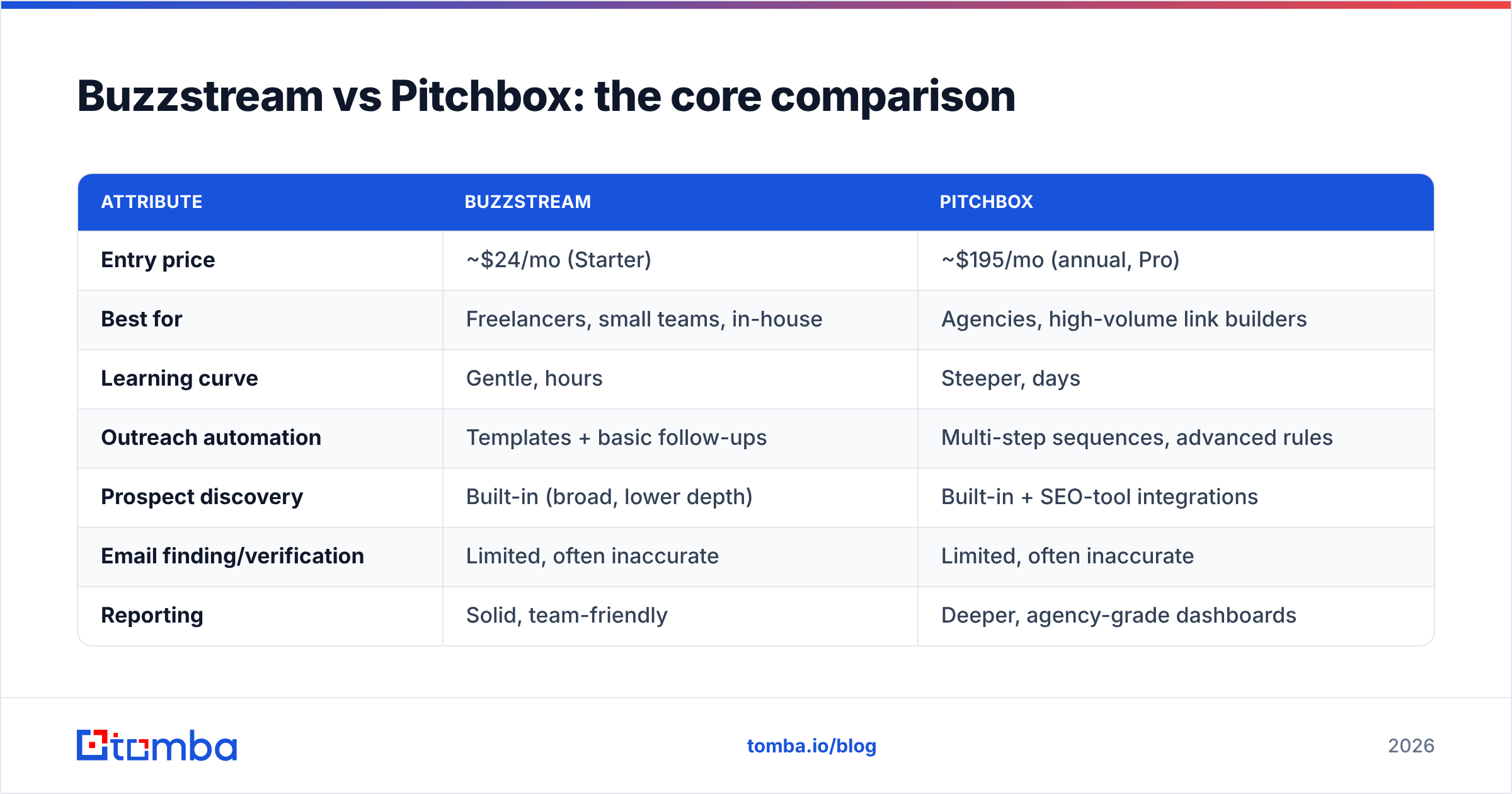
Here is the head-to-head most buyers actually care about. Prices reflect publicly listed 2026 plans and shift with seat count and contact volume, so treat them as directional.
| Attribute | Buzzstream | Pitchbox |
|---|---|---|
| Entry price | ~$24/mo (Starter) | ~$195/mo (annual, Pro) |
| Best for | Freelancers, small teams, in-house | Agencies, high-volume link builders |
| Learning curve | Gentle, hours | Steeper, days |
| Outreach automation | Templates + basic follow-ups | Multi-step sequences, advanced rules |
| Prospect discovery | Built-in (broad, lower depth) | Built-in + SEO-tool integrations |
| Email finding/verification | Limited, often inaccurate | Limited, often inaccurate |
| Reporting | Solid, team-friendly | Deeper, agency-grade dashboards |
| Integrations | Moz, Majestic, Zapier | Moz, Majestic, Ahrefs, SEMrush, more |
| Team/seat scaling | Affordable per seat | Premium per seat |

The pattern is consistent: Buzzstream wins on price and approachability, Pitchbox wins on depth and scale. Neither is "better" in the abstract — the right answer depends on your monthly volume and budget.
Is Buzzstream better than Pitchbox for small teams?#
Yes — for most small teams and solo operators, Buzzstream is the smarter pick. Three reasons drive that.
- Price. Starting near $24/mo, Buzzstream is roughly an eighth of Pitchbox's entry cost. For a freelancer or a two-person marketing team, that gap funds an entire separate tool stack.
- Speed to value. You can build a list, load a template, and start sending in an afternoon. Pitchbox rewards investment but demands it first.
- Relationship focus. Buzzstream's CRM-style contact history is genuinely good. It surfaces past conversations, social profiles, and notes so your outreach feels personal instead of templated.
Where Buzzstream shows its limits is raw scale. Once you are running several campaigns with overlapping sequences and need granular automation rules, the simplicity that made it fast starts to feel like a ceiling. That is exactly the point where teams graduate to Pitchbox — or build their own pipeline around an API.
Is Pitchbox worth the higher price?#
Pitchbox is worth it when outreach volume is your bottleneck, not your budget. Agencies running link-building campaigns for dozens of clients live in Pitchbox for a reason: the automation compounds.
The standout capabilities:
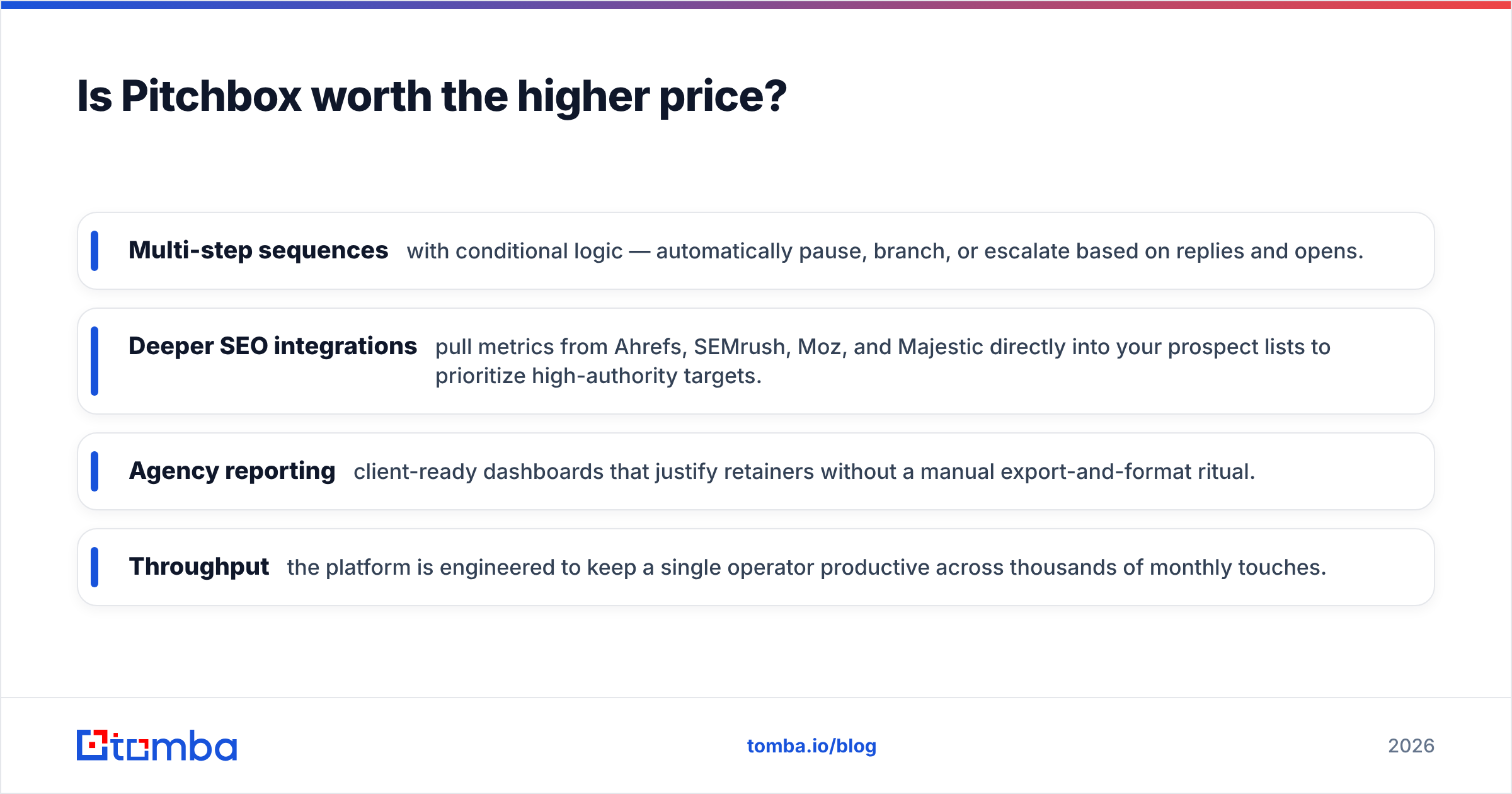
- Multi-step sequences with conditional logic — automatically pause, branch, or escalate based on replies and opens.
- Deeper SEO integrations — pull metrics from Ahrefs, SEMrush, Moz, and Majestic directly into your prospect lists to prioritize high-authority targets.
- Agency reporting — client-ready dashboards that justify retainers without a manual export-and-format ritual.
- Throughput — the platform is engineered to keep a single operator productive across thousands of monthly touches.
The trade-off is obvious: cost and complexity. If your team sends a few hundred emails a month, you will pay for capacity you never use. Pitchbox earns its price at volume — not before it.
What both tools get wrong: prospecting accuracy#
Here is the honest part most comparison posts skip. Neither Buzzstream nor Pitchbox is a reliable email-finding engine. Their built-in discovery features will surface contacts, but the email addresses are frequently guessed patterns, outdated, or unverified — and that quietly wrecks your campaigns.
The damage is downstream. When 15–25% of your outreach list bounces, three things happen:
- Your sender reputation drops, hurting email deliverability for every campaign after it.
- Real prospects never see your message because mailbox providers throttle a sender with high bounce rates.
- Your reporting lies to you — "sent" counts include addresses that never existed.
The fix is to separate discovery from finding and verification. Use Buzzstream or Pitchbox for what they are great at — managing relationships and sequencing outreach — and feed them a clean, verified contact list built with a dedicated tool.
That is where a purpose-built email finder earns its keep. Instead of guessing firstname@domain.com, you find the real address tied to a person and company, then confirm it is deliverable with an email verifier before it ever touches your outreach platform. For link-building at scale, running a target site through domain search returns the editors and contributors worth pitching, and bulk email finder workflows let you process an entire prospect spreadsheet in one pass.
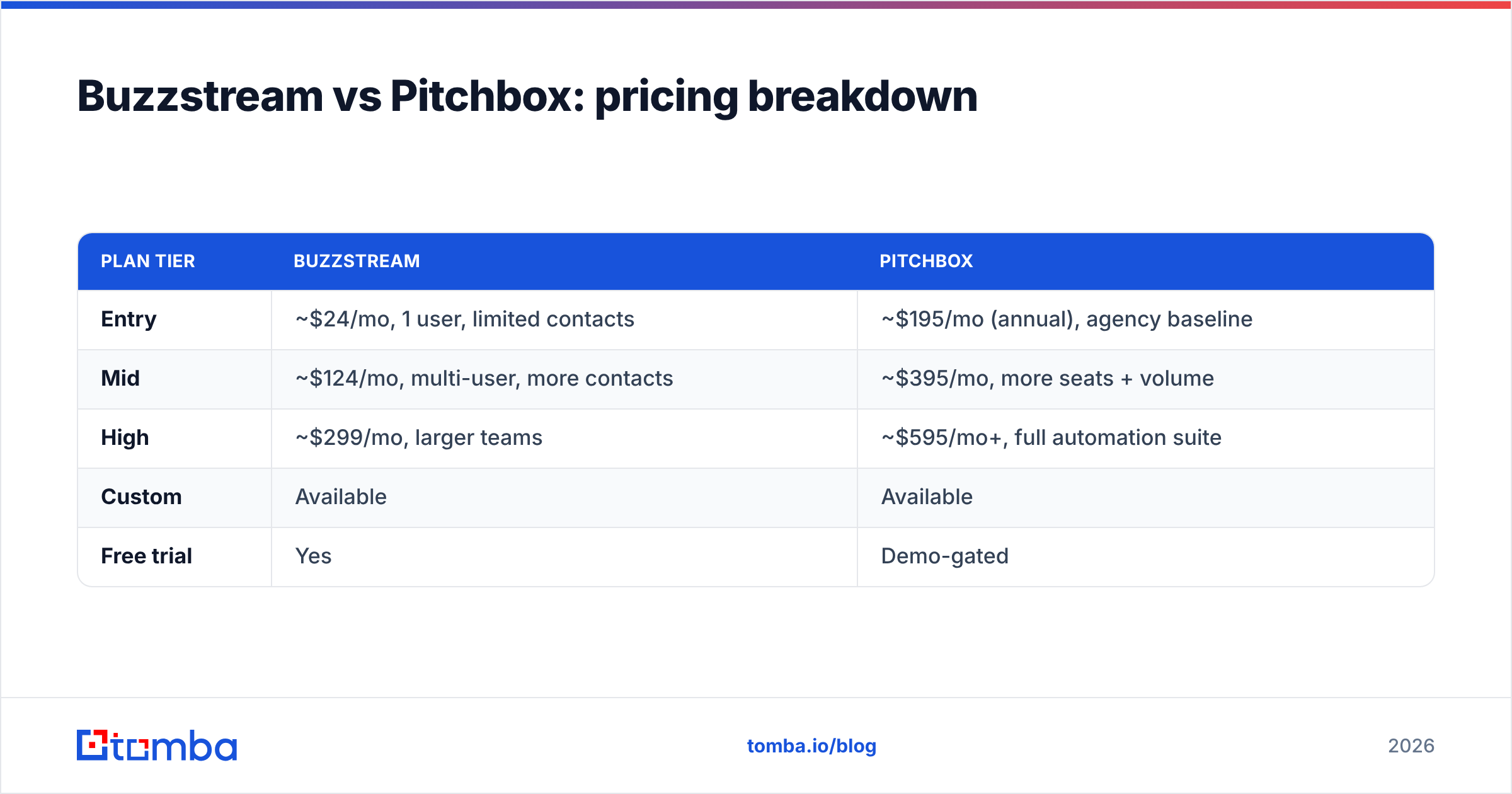
Buzzstream vs Pitchbox: pricing breakdown#
Pricing is where this decision often gets made, so here is a clearer view. Both vendors scale by seats and contact/outreach volume, so your real number depends on usage.
| Plan tier | Buzzstream | Pitchbox |
|---|---|---|
| Entry | ~$24/mo, 1 user, limited contacts | ~$195/mo (annual), agency baseline |
| Mid | ~$124/mo, multi-user, more contacts | ~$395/mo, more seats + volume |
| High | ~$299/mo, larger teams | ~$595/mo+, full automation suite |
| Custom | Available | Available |
| Free trial | Yes | Demo-gated |
The takeaway: Buzzstream's floor is reachable for almost any budget, while Pitchbox's floor assumes you are an agency or a serious in-house team. If you are choosing partly on cost, Buzzstream wins outright. If cost is secondary to throughput, Pitchbox's pricing is defensible.
A note on hidden costs: whichever platform you choose, factor in a verification layer. A bounced campaign costs more than a verification credit — in reputation, deliverability, and wasted sequence steps. You can sanity-check any list cheaply with a free email checker before committing budget to either platform.
Which integrations matter most?#
Both tools integrate with the SEO metrics stack, but Pitchbox goes deeper. If your prioritization depends on live domain authority and traffic data, Pitchbox's broader connections to Ahrefs and SEMrush are a meaningful edge.
- Buzzstream: Moz, Majestic, social profiles, Zapier for everything else.
- Pitchbox: Moz, Majestic, Ahrefs, SEMrush, and richer in-app metric filtering.
For data hygiene, both benefit from an upstream enrichment step. Pushing verified, enriched contacts in — rather than relying on each tool's native discovery — keeps your CRM clean regardless of which platform you land on. Tools like data enrichment APIs and a Chrome extension for one-off lookups fill the gap their native finders leave open. You can review independent feature comparisons on G2 to validate any integration claim before you commit.
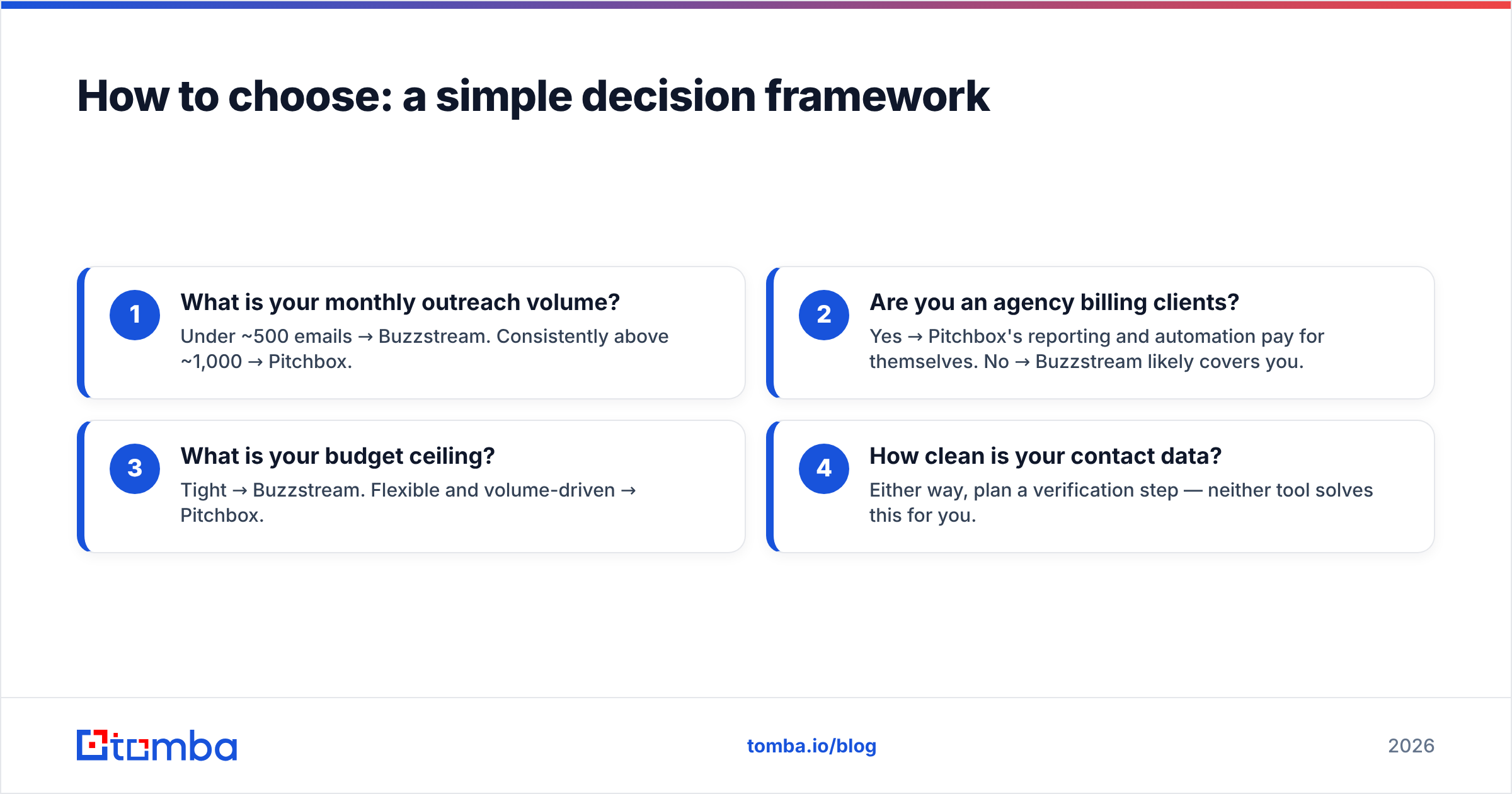
How to choose: a simple decision framework#
Skip the feature-by-feature agonizing. Answer these in order:
- What is your monthly outreach volume? Under ~500 emails → Buzzstream. Consistently above ~1,000 → Pitchbox.
- Are you an agency billing clients? Yes → Pitchbox's reporting and automation pay for themselves. No → Buzzstream likely covers you.
- What is your budget ceiling? Tight → Buzzstream. Flexible and volume-driven → Pitchbox.
- How clean is your contact data? Either way, plan a verification step — neither tool solves this for you.
Most teams overthink the platform and underthink the data feeding it. A cheaper tool with a verified list beats a premium tool sending to guessed addresses every single time.
The bottom line#
Buzzstream is the better choice for small teams, freelancers, and anyone who values affordability and a gentle learning curve. Pitchbox is the better choice for agencies and high-volume link builders who need deep automation and can absorb the price. Both are solid at managing outreach — and both are weak at finding accurate, deliverable contact data.
That last gap is the one that quietly sinks campaigns, and it is the one you can fix today. Before your next outreach push on either platform, build your list with the Tomba Email Finder: find real professional emails by name, company, or domain, verify them so they actually land, and hand a clean list to whichever outreach tool you choose. Start free with 25 searches a month, then scale on a Tomba plan that fits your volume — so your outreach platform spends its time on relationships, not bounces.
// get started
Find, verify and enrich your first contacts today
Start on the free plan with 25 searches a month, then scale when your team is ready.
Free plan · No credit card required · GDPR & CCPA
// about the author