How to Reach C-Level Executives in 2026: A Sales Playbook
C-level buyers ignore 98% of cold outreach. Here's how to find their real contact details, earn a reply, and book the meeting in 2026.
How to Reach C-Level Executives in 2026: A Sales Playbook
Selling to a CEO is not the same job as selling to a manager. The person at the top has less time, more filters, and a sharper nose for anything that wastes either. If your outbound still treats a Chief Revenue Officer like a mid-funnel MQL, you are losing the deal before the first reply.
This is a practical guide to reaching c level executives in 2026 — finding their real contact data, getting past the gatekeeper, and writing the kind of message a busy executive actually answers.
TL;DR#
- C level refers to senior executives whose titles start with "Chief" — CEO, CFO, COO, CMO, CRO, CTO, and the growing list around them. They control budget and final approval.
- The hardest part of executive outreach is not the pitch — it's accurate contact data. Stale lists and guessed emails kill credibility before you say a word.
- Use a verified email finder plus a phone finder to reach the executive directly, not their long-gone predecessor.
- Lead with business outcomes and brevity. Executives buy time back; they do not read paragraphs about your feature set.
- Multithread. The C-suite rarely evaluates alone, so map the chiefs and their direct reports.
What does "C level" actually mean?#
C level (also called the C-suite) is the group of senior executives who hold "Chief" titles and sit at the top of an organization's decision hierarchy. The "C" stands for Chief.
Think of a company as an airliner. The C-suite is the cockpit: a small group with the controls, the instruments, and final authority over where the plane goes. Everyone else is cabin crew or passengers — important, but not flying the aircraft. When you sell to the C level, you are selling to the cockpit.
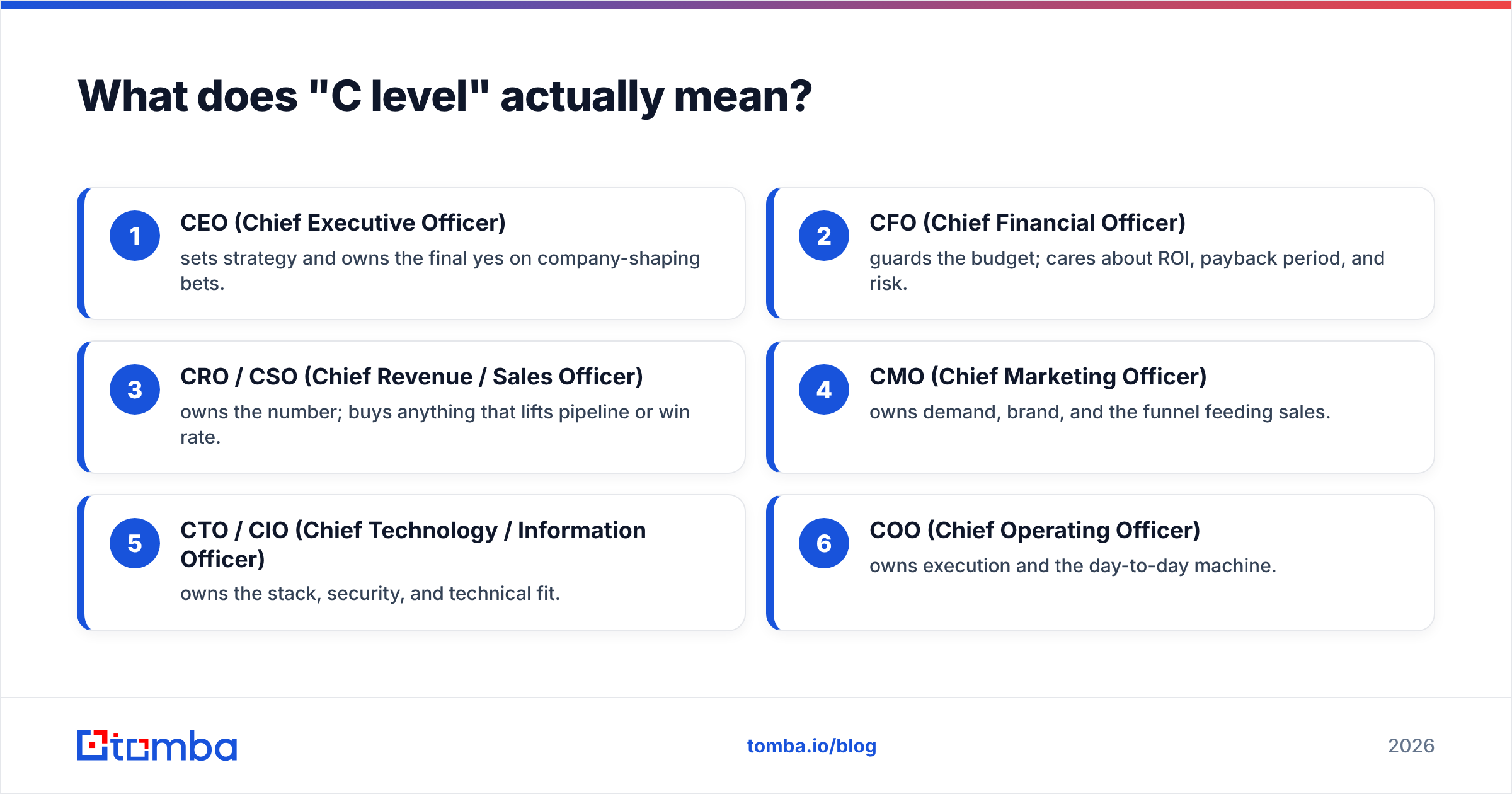
The roles you will target most often in B2B sales:
- CEO (Chief Executive Officer) — sets strategy and owns the final yes on company-shaping bets.
- CFO (Chief Financial Officer) — guards the budget; cares about ROI, payback period, and risk.
- CRO / CSO (Chief Revenue / Sales Officer) — owns the number; buys anything that lifts pipeline or win rate.
- CMO (Chief Marketing Officer) — owns demand, brand, and the funnel feeding sales.
- CTO / CIO (Chief Technology / Information Officer) — owns the stack, security, and technical fit.
- COO (Chief Operating Officer) — owns execution and the day-to-day machine.
The newer arrivals — Chief Data Officer, Chief Customer Officer, Chief AI Officer — matter too, because they often hold net-new budget that hasn't been fought over yet.

Why is selling to the C-suite so hard?#
The short answer: scarcity. An executive's calendar is the most contested resource in the building, and they protect it ruthlessly. Three structural problems make c level outreach harder than any other tier.
Problem one: the gatekeeper. Executive assistants exist partly to filter noise. A generic "quick question for [First Name]" gets deleted or never forwarded.
Problem two: data decay. C-suite turnover is high and constant. According to public market data tracked by firms like Gartner, executive tenure keeps shrinking, which means a contact list built even nine months ago is riddled with people who have moved on. Email a CFO who left last quarter and you've burned the impression instantly.
Problem three: pattern fatigue. Executives see hundreds of pitches. They recognize the templates, the false personalization, and the "I'll keep this brief" messages that run 400 words. You are competing against everyone else's mediocre outreach for the same three seconds of attention.
The fix for all three starts with the same thing: getting the right contact details for the right person, today.
How do you find verified contact data for C-level executives?#
Start with accurate data, because everything downstream depends on it. A brilliant email sent to the wrong address is just a brilliant bounce.
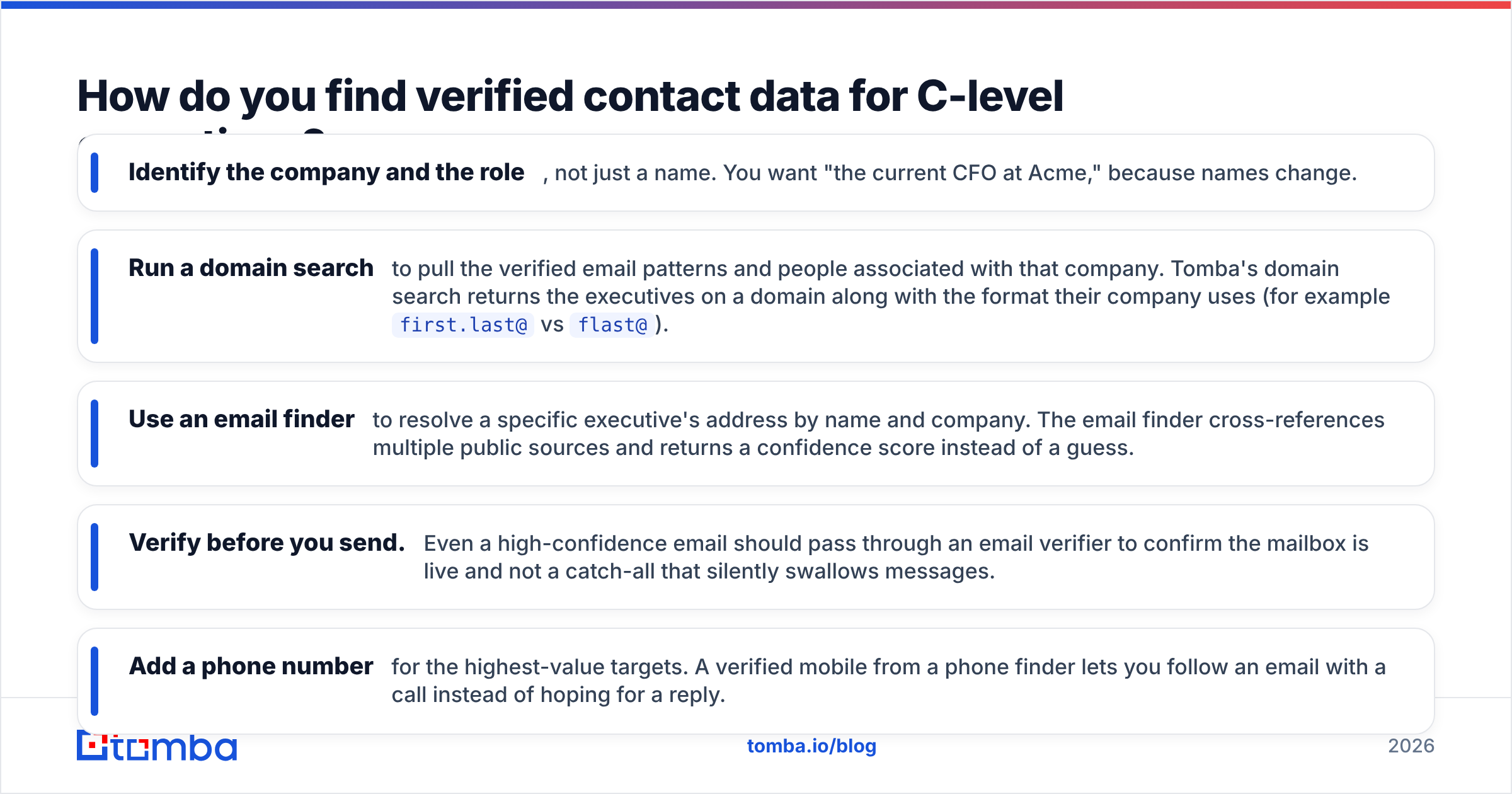
The reliable workflow looks like this:
- Identify the company and the role, not just a name. You want "the current CFO at Acme," because names change.
- Run a domain search to pull the verified email patterns and people associated with that company. Tomba's domain search returns the executives on a domain along with the format their company uses (for example
first.last@vsflast@). - Use an email finder to resolve a specific executive's address by name and company. The email finder cross-references multiple public sources and returns a confidence score instead of a guess.
- Verify before you send. Even a high-confidence email should pass through an email verifier to confirm the mailbox is live and not a catch-all that silently swallows messages.
- Add a phone number for the highest-value targets. A verified mobile from a phone finder lets you follow an email with a call instead of hoping for a reply.
Why does verification matter so much for the C-suite specifically? Because your bounce rate directly damages your sender reputation. Send to dead executive inboxes all day and your domain's deliverability craters — so even your good emails to live prospects start landing in spam. Clean data protects the whole program, not just one message.

Which tools should you use to reach the C level?#
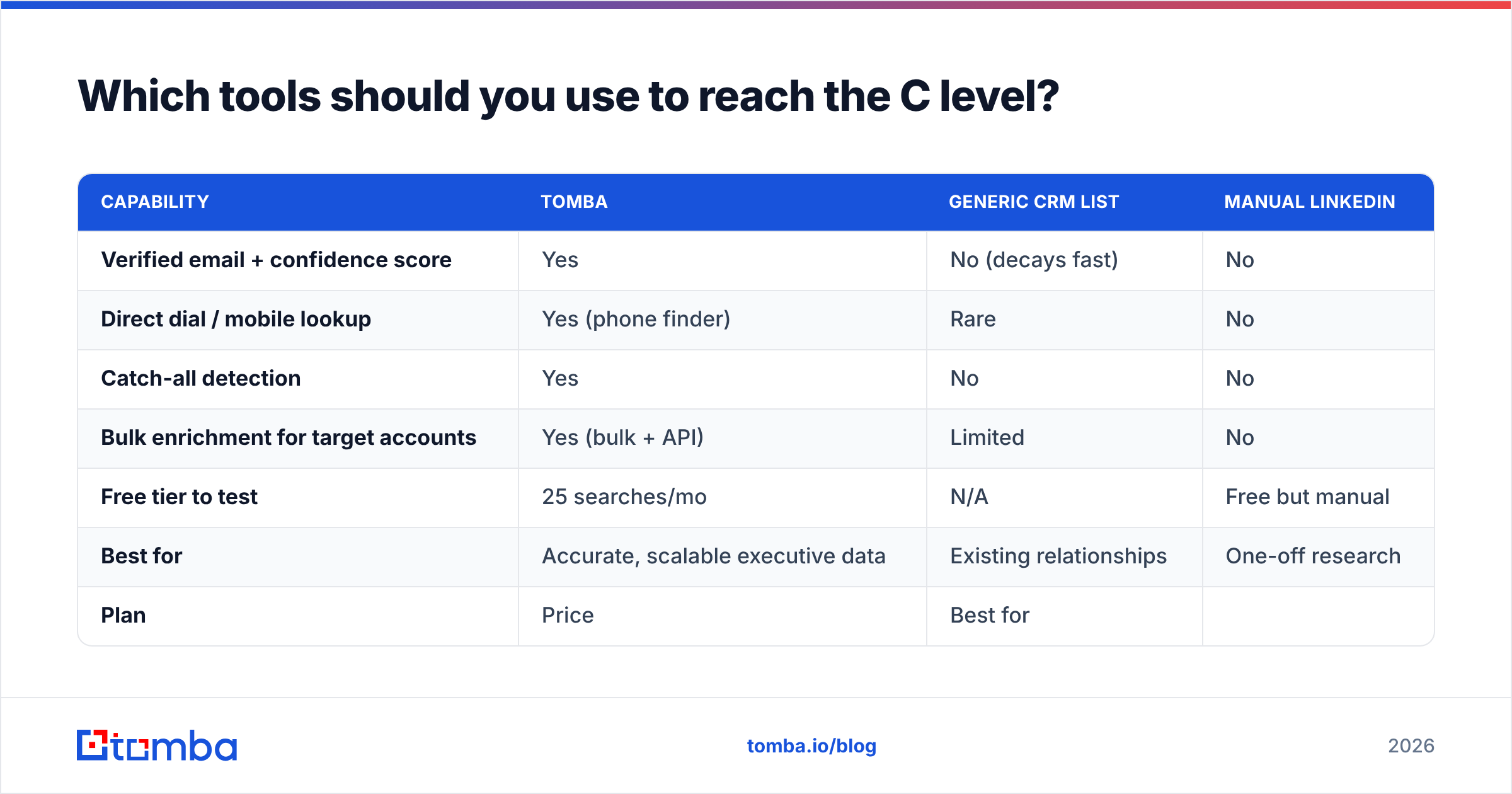
There is no single magic product. You need a small stack that covers data, outreach, and orchestration. Here's how the common options compare for executive-level prospecting.
| Capability | Tomba | Generic CRM list | Manual LinkedIn |
|---|---|---|---|
| Verified email + confidence score | Yes | No (decays fast) | No |
| Direct dial / mobile lookup | Yes (phone finder) | Rare | No |
| Catch-all detection | Yes | No | No |
| Bulk enrichment for target accounts | Yes (bulk + API) | Limited | No |
| Free tier to test | 25 searches/mo | N/A | Free but manual |
| Best for | Accurate, scalable executive data | Existing relationships | One-off research |
The point isn't to replace your CRM or LinkedIn — it's to feed them clean fuel. Pull verified contacts with a dedicated data tool, push them into your sequencer or CRM, then work the relationship. Tomba connects to most stacks through native integrations and a documented email finder API, so the verified data lands where your reps already work.
For teams running account-based plays, the math gets simple. Pick 100 target accounts, map the three-to-five chiefs and senior VPs in each, enrich them in one bulk pass, verify, and you have a clean 400-contact executive list in an afternoon instead of a quarter.
How Tomba pricing fits an executive prospecting program#
You don't need the top plan to run serious C-suite outreach. Most teams start on Starter or Growth and scale credits as their account list grows. Full Tomba pricing is public, but the shape is:
| Plan | Price | Best for |
|---|---|---|
| Free | $0 (25 searches/mo) | Testing data quality |
| Starter | $49/mo | Solo AEs, small ABM lists |
| Growth | $99/mo | Full-time SDR teams |
| Pro | $249/mo | High-volume outbound + API |
| Enterprise | Custom | Large RevOps deployments |
How do you write outreach a C-level executive will actually answer?#
Once the data is right, the message has to earn the reply. Executives reward two things above all: relevance and brevity. Treat every word as if it costs you the meeting.
Five rules that separate replies from deletions:
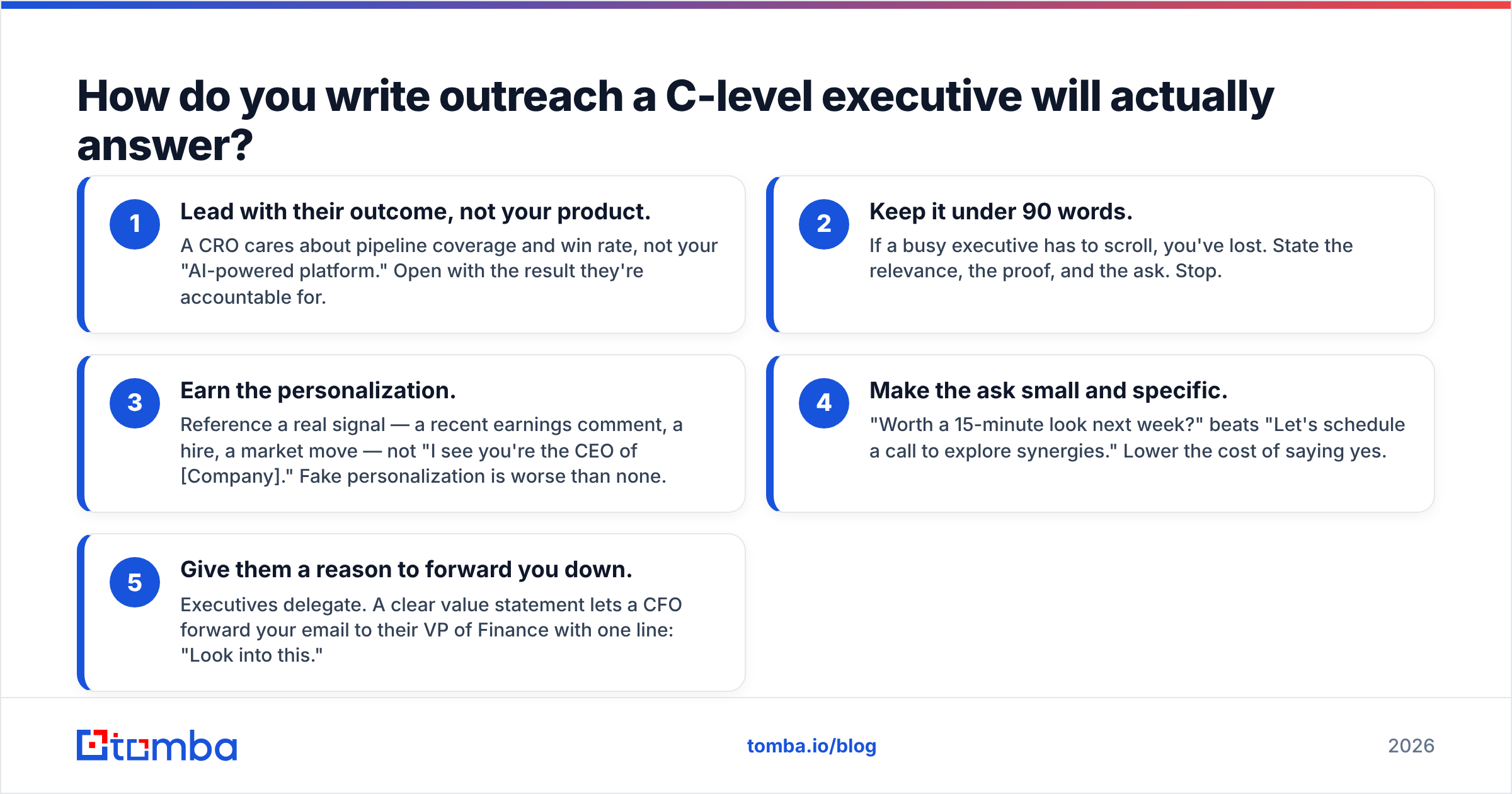
- Lead with their outcome, not your product. A CRO cares about pipeline coverage and win rate, not your "AI-powered platform." Open with the result they're accountable for.
- Keep it under 90 words. If a busy executive has to scroll, you've lost. State the relevance, the proof, and the ask. Stop.
- Earn the personalization. Reference a real signal — a recent earnings comment, a hire, a market move — not "I see you're the CEO of [Company]." Fake personalization is worse than none.
- Make the ask small and specific. "Worth a 15-minute look next week?" beats "Let's schedule a call to explore synergies." Lower the cost of saying yes.
- Give them a reason to forward you down. Executives delegate. A clear value statement lets a CFO forward your email to their VP of Finance with one line: "Look into this."
For inspiration on structure and openers, study proven frameworks rather than reinventing them — resources like the HubSpot sales blog publish data-backed templates you can adapt. And if you're refining lines fast, Tomba's free subject line generator helps you test hooks before they go in front of a CEO.
A note on multithreading: the C-suite rarely buys solo. The CFO signs, but the VP of Finance evaluates and the analyst builds the business case. Map the whole buying committee, not just the chief. Reaching one executive and four of their senior reports — all with verified data — gives you four more paths to the same yes. Track the response rate per role so you learn which seat actually engages.
What about phone and multichannel outreach to executives?#
Email alone is rarely enough at this tier. The executives most worth reaching are the ones most buried in email, which means a single channel gets lost. The teams that book C-suite meetings in 2026 run coordinated sequences across email, phone, and social.
A simple, effective cadence:
- Day 1 — short, outcome-led email to the executive.
- Day 3 — connect on LinkedIn with a one-line, no-pitch note.
- Day 4 — a brief call or voicemail to the verified direct dial.
- Day 7 — a second email that adds a new proof point, not a "just bumping this."
- Day 10 — a soft break-up email that re-states the value and invites a forward.
The phone step is where verified mobile data earns its keep. A phone validator confirms the number is live before your rep dials, so you spend calling time on real connections instead of disconnected lines. Pairing a verified email with a verified dial roughly doubles the chance any single executive engages somewhere in the sequence.
Want a quick credibility check on your own domain before you launch? Run it through an email reputation checker so you know your messages can even reach a CEO's primary inbox in the first place.
Common mistakes when selling to the C-suite#
A few patterns sink otherwise good campaigns:
- Guessing emails. Permutating
first.last@company.comand praying is how you bounce and burn your domain. Always verify. - Pitching features to people who buy outcomes. A CTO cares about risk and fit; a CFO cares about payback. Speak their language.
- Ignoring the gatekeeper instead of respecting them. A warm, specific message to an executive assistant gets forwarded. A pushy one gets blocked forever.
- One-and-done outreach. Executives miss the first email constantly. Persistence with new value, not nagging, wins.
- Stale lists. Re-verify your C-level data every quarter. The people churn faster than any other segment.
Frequently asked questions#
What does C level stand for? The "C" stands for "Chief." C level describes the senior executives whose titles begin with Chief — CEO, CFO, COO, CMO, CRO, CTO, and similar — who hold final authority over strategy and budget.
How do I find a C-level executive's email address? Run a domain search to see the company's verified email pattern and people, use an email finder to resolve the specific person, then verify the result before sending. Guessing the format is the fastest way to bounce.
Is it legal to cold email C-suite executives? Cold B2B outreach is permitted in many regions when you follow the applicable rules (clear identity, opt-out, accurate headers). Check the regulations for your prospect's location, such as CAN-SPAM in the US and GDPR-aligned rules in the EU, and keep your data verified and your list clean.
How often should I update my executive contact list? At least quarterly. C-suite turnover is high, so a list older than a few months will contain people who have already moved on.
Bring the C-suite within reach#
Reaching the C level comes down to one discipline practiced relentlessly: send the right message to the right executive at a verified address, then follow through across channels. The pitch matters, but the data matters first — because the best outreach in the world still fails if it lands in a dead inbox.
Start by building one clean, verified list of the executives in your target accounts. The Tomba Email Finder gives you confidence-scored emails by name, company, or domain, with verification and direct-dial lookup alongside it — and the free tier lets you test the data quality on your real accounts before you commit a dollar. Find the chiefs who own your number, reach them directly, and spend your selling time on conversations instead of bounces.
// get started
Find, verify and enrich your first contacts today
Start on the free plan with 25 searches a month, then scale when your team is ready.
Free plan · No credit card required · GDPR & CCPA
// about the author