How to Reach C-Level Executives in 2026: A B2B Sales Guide
Selling to a C level executive in 2026 means earning 15 minutes of a CEO's day. Here is how to find them, frame the pitch, and book the meeting.
Selling to a CEO is not the same as selling to a manager. A C level executive guards their calendar like a vault, screens out generic pitches in seconds, and only engages with outreach that maps directly to a business outcome they already care about. If your messaging reads like a product brochure, you are out before you start.
This guide breaks down who the C-suite actually is, why reaching them is hard, the channels that still work in 2026, and how to build a verified contact list that gets your foot in the door.
TL;DR#
- A C level executive (CEO, CFO, CTO, CMO, COO, and peers) sits at the top of the org chart and owns budget, strategy, and final-say decisions.
- They respond to outcomes — revenue, risk, cost, time — not features. Lead with their P&L, not your product.
- Email plus phone plus LinkedIn, sequenced together, beats any single channel for C-suite outreach.
- Bad data kills C-level campaigns faster than bad copy. Verify every address before you send.
- Use a B2B email finder and phone finder to source executive contacts directly instead of buying stale lists.
What is a C level executive?#
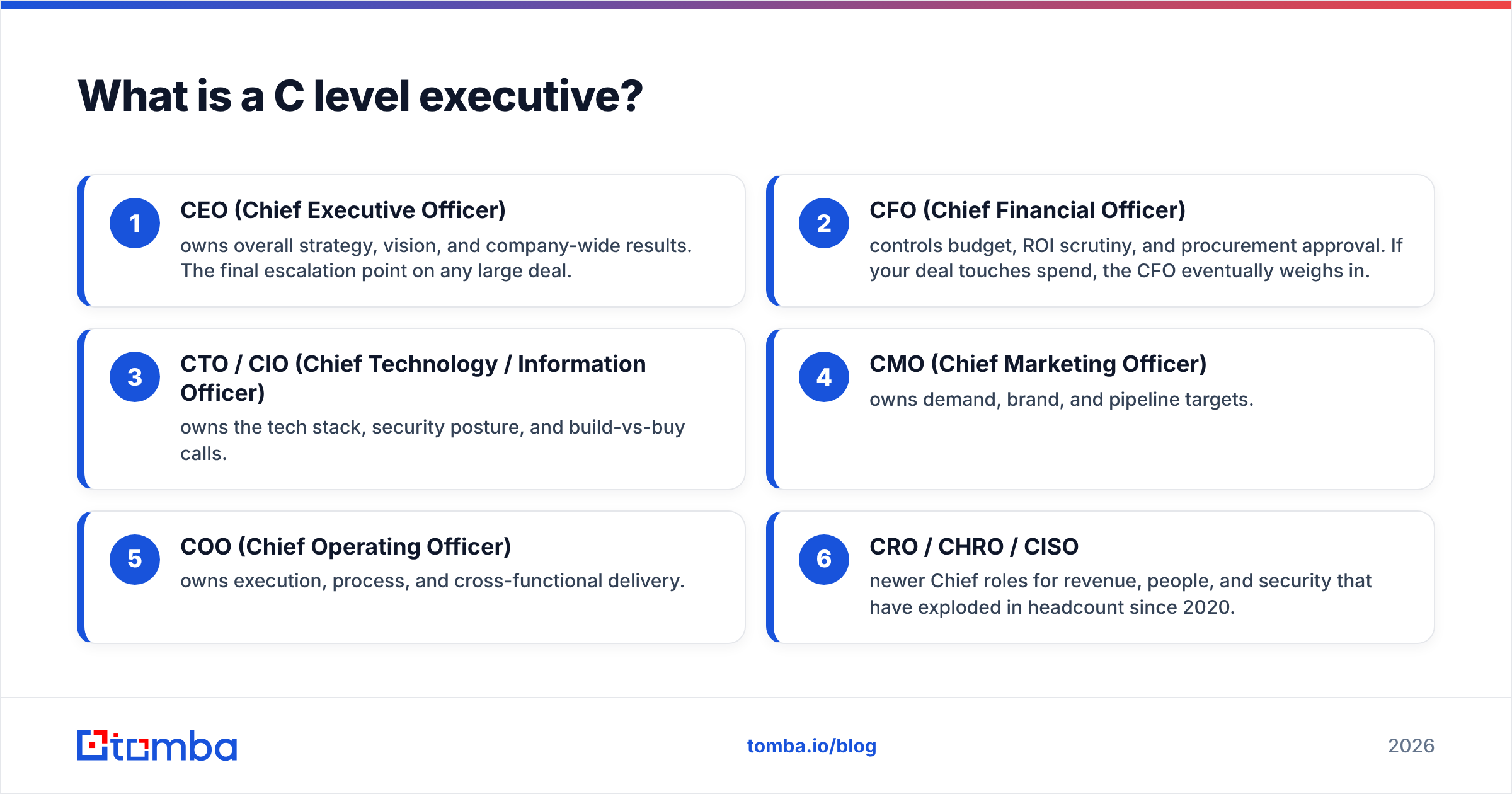
A C level executive is a senior leader whose title starts with "Chief" — the people who carry final accountability for a function or the entire company. The "C" stands for Chief, and these roles form what is commonly called the C-suite.
Here are the roles you will most often target in B2B sales:
- CEO (Chief Executive Officer) — owns overall strategy, vision, and company-wide results. The final escalation point on any large deal.
- CFO (Chief Financial Officer) — controls budget, ROI scrutiny, and procurement approval. If your deal touches spend, the CFO eventually weighs in.
- CTO / CIO (Chief Technology / Information Officer) — owns the tech stack, security posture, and build-vs-buy calls.
- CMO (Chief Marketing Officer) — owns demand, brand, and pipeline targets.
- COO (Chief Operating Officer) — owns execution, process, and cross-functional delivery.
- CRO / CHRO / CISO — newer Chief roles for revenue, people, and security that have exploded in headcount since 2020.
The practical takeaway: every C level executive is measured on a small number of metrics. Your job is to figure out which metric you move, then say so in the first sentence.

Why is it so hard to reach the C-suite?#
Three structural barriers stand between you and a Chief-anything.
The gatekeeper. Executive assistants and chiefs of staff exist to filter noise. A vague request gets deleted; a specific, relevant one gets forwarded. Gatekeepers are not obstacles to trick — they are routers. Give them a reason to route you up.
The attention economy. According to research summarized by HubSpot, decision-makers receive dozens of cold pitches weekly. A C level executive has even less tolerance. You get one line to prove relevance before the thumb hits archive.
The relevance bar. Gartner has documented that B2B buying groups now involve six to ten stakeholders, and executives only engage when a purchase is tied to a strategic priority they already own. If you cannot connect your offer to a board-level goal, you are noise.
None of these barriers fall to volume. They fall to precision — the right person, the right metric, the right moment.
What channels actually work for C-level outreach?#
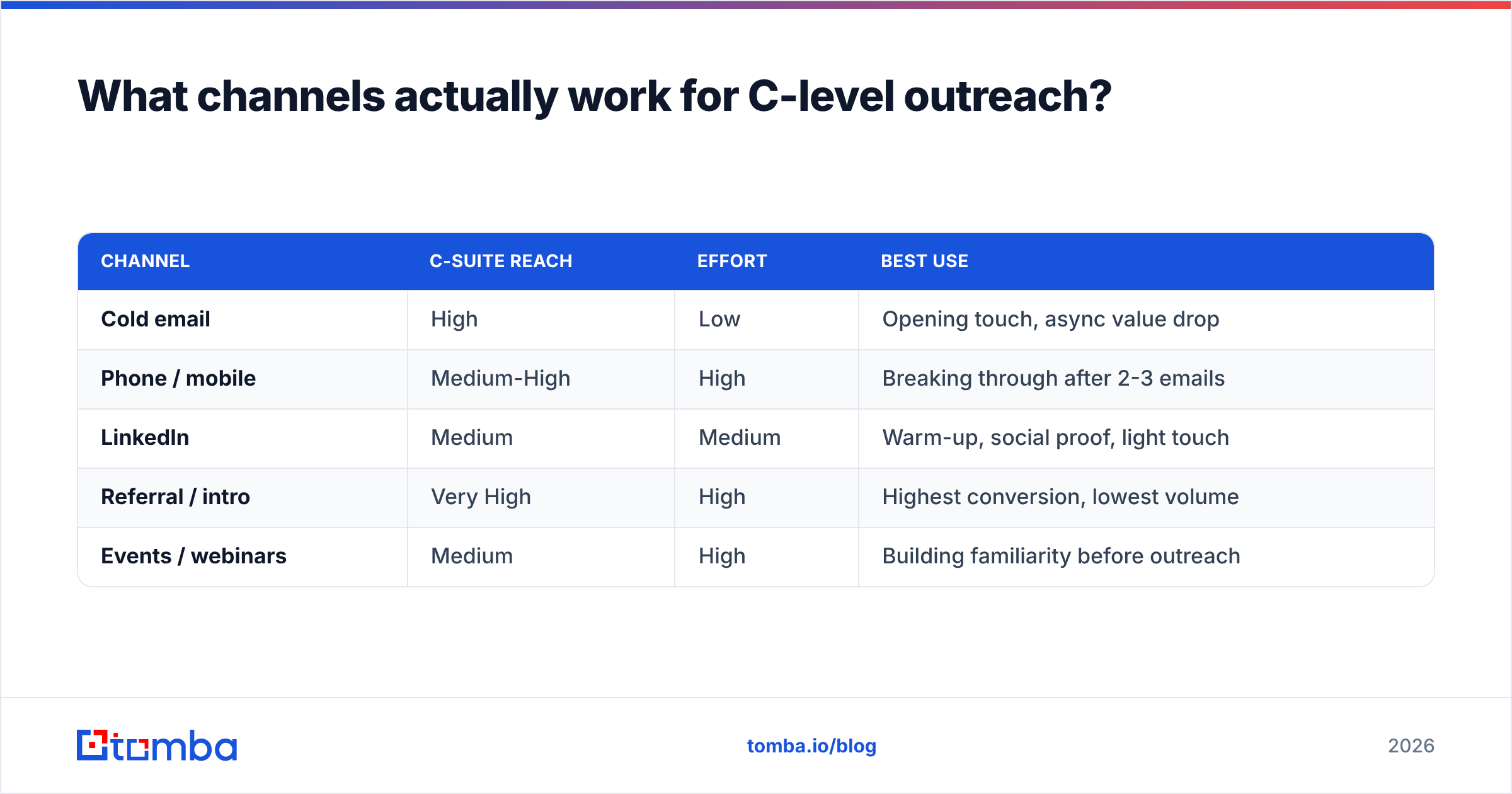
No single channel reliably reaches the C-suite. The teams that book executive meetings run a coordinated sequence across email, phone, and social. Here is how the main channels compare.
| Channel | C-suite reach | Effort | Best use |
|---|---|---|---|
| Cold email | High | Low | Opening touch, async value drop |
| Phone / mobile | Medium-High | High | Breaking through after 2-3 emails |
| Medium | Medium | Warm-up, social proof, light touch | |
| Referral / intro | Very High | High | Highest conversion, lowest volume |
| Events / webinars | Medium | High | Building familiarity before outreach |
A few rules that hold across all of them:
- Email leads. A tight, outcome-first cold email is still the most scalable way to open an executive conversation — if it lands in the inbox and is genuinely relevant.
- Phone breaks ties. When two or three emails go unanswered, a direct mobile dial often gets the reply that email never will. Sourcing accurate B2B phone numbers is what makes this channel viable.
- LinkedIn warms. A thoughtful comment or connection request before your email lands raises reply rates without feeling like a pitch. See our take on LinkedIn outreach for the mechanics.
- Referrals convert. The single highest-conversion path to a C level executive is a warm intro. It does not scale, but it closes.
How do you write a pitch a CEO will actually read?#
Lead with their outcome, name the proof, and ask for a small, specific next step. That is the entire formula.
A C level executive does not care that your platform has "AI-powered analytics." They care that a comparable company cut churn by 18% or freed up two weeks of finance time per quarter. Translate every feature into a number on their scorecard.
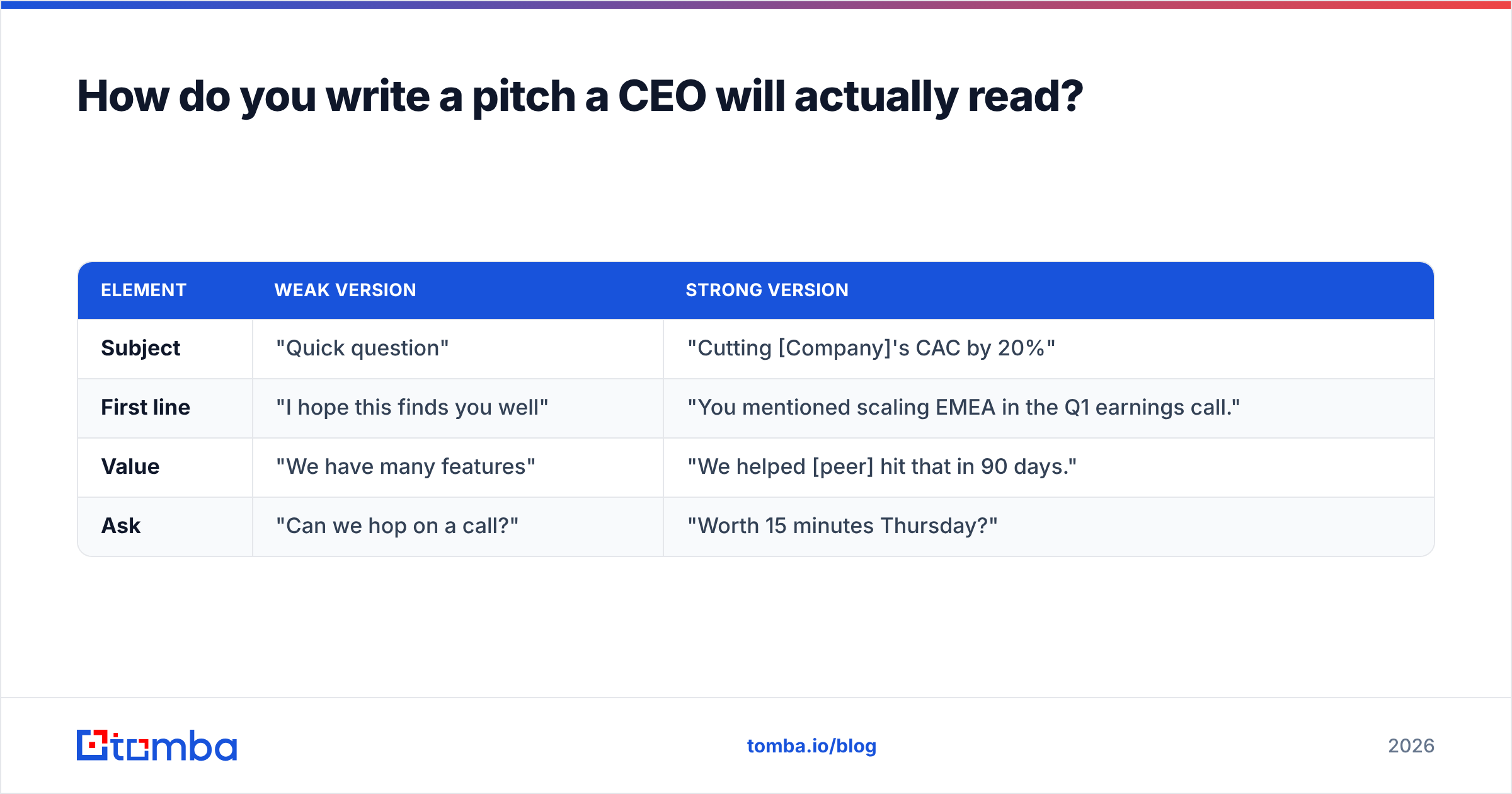
Use this structure for the opening of a C-suite cold email:
| Element | Weak version | Strong version |
|---|---|---|
| Subject | "Quick question" | "Cutting [Company]'s CAC by 20%" |
| First line | "I hope this finds you well" | "You mentioned scaling EMEA in the Q1 earnings call." |
| Value | "We have many features" | "We helped [peer] hit that in 90 days." |
| Ask | "Can we hop on a call?" | "Worth 15 minutes Thursday?" |
Keep the whole thing under 90 words. An executive reads on a phone, between meetings. Brevity signals respect for their time, and respect is what earns the reply. If you want a head start, our cold email templates are built around this outcome-first structure.

How do you find verified C-level contact details?#
You cannot personalize outreach to a C level executive if you are emailing the wrong person — or a real person at a dead address. Data quality is the hidden variable behind every executive campaign that works or fails.
Bought lists are the worst offender. Executive turnover is high, titles change quarterly, and a list compiled six months ago is already decaying. Sending to stale addresses tanks your sender reputation, which then hurts the deliverability of every other email you send. Protect your domain by understanding email deliverability before you scale any sequence.
The reliable workflow looks like this:
- Identify the account and the right Chief. Use domain search to pull the email pattern and known contacts at a target company.
- Find the specific executive. Run the name through an email finder to get their professional address with a confidence score.
- Verify before you send. Pass every address through an email verifier to drop invalids and protect deliverability.
- Add the phone layer. Pull a direct line with a phone finder for the channel that breaks through silence.
- Enrich for context. Use data enrichment to append role, seniority, and company signals so your first line writes itself.
This is where a purpose-built data tool earns its keep. Instead of guessing formats or trusting a year-old CSV, you source the contact, confirm it is live, and move on.
How does Tomba compare to a generic list provider?#
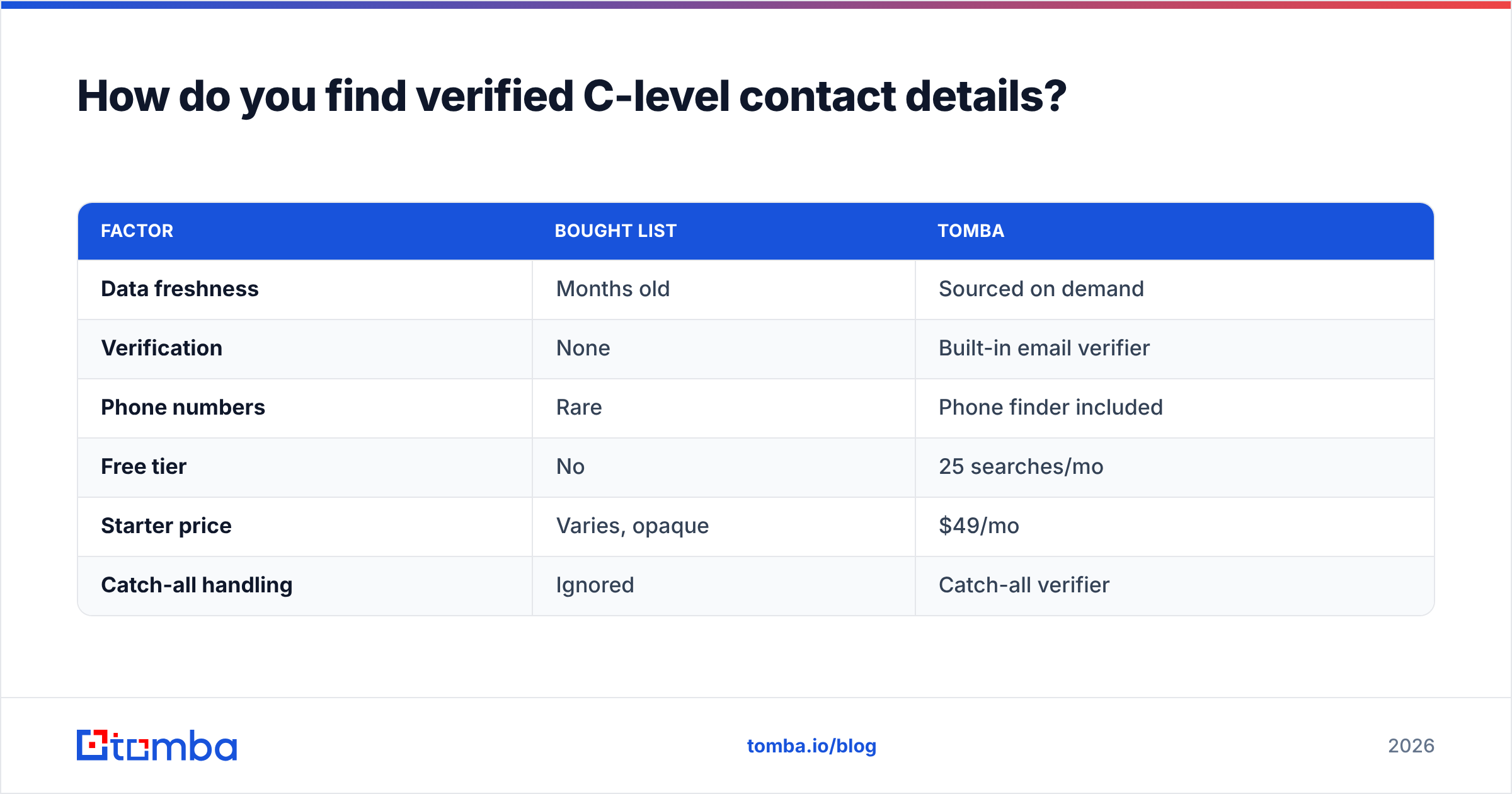
| Factor | Bought list | Tomba |
|---|---|---|
| Data freshness | Months old | Sourced on demand |
| Verification | None | Built-in email verifier |
| Phone numbers | Rare | Phone finder included |
| Free tier | No | 25 searches/mo |
| Starter price | Varies, opaque | $49/mo |
| Catch-all handling | Ignored | Catch-all verifier |
You can review the full Tomba pricing to match a plan to your outreach volume. The Free tier is enough to test a target account list; Growth at $99/mo suits a small SDR team running daily executive sequences.
How many touches does it take to reach a C level executive?#
Plan for a multi-touch sequence over two to three weeks, not a single email. Executives rarely reply to a first touch, and most reps quit before the touch that would have worked.
A practical C-suite cadence:
- Day 1 — LinkedIn connection or a relevant comment (no pitch).
- Day 2 — Cold email, outcome-first, under 90 words.
- Day 5 — Short follow-up adding one new proof point.
- Day 8 — Direct phone call or voicemail referencing the email.
- Day 12 — Breakup email: "Should I close the loop?"
The breakup email consistently pulls replies, because it removes pressure and triggers a quick yes-or-no. Across the whole sequence, keep the metric you move front and center — consistency of message matters more than channel.
One caution: never sacrifice quality for cadence. Five sharp, well-timed touches beat fifteen generic ones, and they protect the sender reputation that keeps you in the inbox.
What mistakes get reps screened out instantly?#
- Pitching features, not outcomes. A CFO does not buy software; they buy a lower cost line or a de-risked audit.
- Wrong title. Emailing a CMO about an infrastructure migration wastes everyone's time. Map the offer to the role.
- Unverified sends. Bouncing off a dead executive address signals spam and burns your domain.
- Walls of text. If it does not fit on a phone screen, it does not get read.
- No specific ask. "Let's connect" is not an ask. "15 minutes Thursday?" is.
Avoid those five and you are already ahead of most outbound aimed at the C-suite.
Putting it together#
Reaching a C level executive in 2026 is a precision game, not a volume game. Know exactly who you are targeting and what metric they own. Lead with their outcome in the first line. Sequence email, phone, and LinkedIn together over a couple of weeks. And above everything, send to verified, current contact data — because the sharpest pitch in the world is worthless at a dead address.
Get the data layer right first and the rest of your executive outreach gets easier. Start with the Tomba Email Finder to source and verify C-suite contacts by name or domain, layer in the phone finder for direct dials, and you will spend your time talking to decision-makers instead of hunting for their addresses. Spin up a free account, test it against your target account list, and book the meetings that actually move your pipeline.
// get started
Find, verify and enrich your first contacts today
Start on the free plan with 25 searches a month, then scale when your team is ready.
Free plan · No credit card required · GDPR & CCPA
// about the author