C Level Hierarchy Explained: The 2026 Executive Org Chart Guide
Who actually sits in the C-suite, what each title controls, and how to map the C level hierarchy so your outbound reaches the real decision-maker in 2026.
TL;DR
- The C level hierarchy is the layer of "Chief" executives (CEO, CFO, CTO, and a dozen more) who own company-wide strategy, budget, and final sign-off.
- The CEO sits at the top; everyone else in the C-suite reports to them, and the board sits above the CEO.
- For B2B sellers, the hierarchy matters because the person with the pain is rarely the person with the budget — you usually need both.
- Modern org charts have exploded past the classic three (CEO/CFO/COO) into role-specific chiefs: CRO, CISO, CHRO, CDO, and more.
- Map the hierarchy first, then find verified contact details so your outreach lands with the right name, not a guessed one.
What is the C level hierarchy?#
The C level hierarchy is the ranked structure of a company's most senior executives — the people whose titles start with "Chief." Think of it like the cockpit of a commercial flight: the captain (CEO) makes the final call, but the first officer, navigator, and engineers each own a system, and the plane only flies when all of them coordinate. "C-suite" is just shorthand for the room those people sit in.
These executives sit above vice presidents, directors, and managers. They set strategy, allocate budget, and answer to the board of directors and shareholders. When a deal is large enough to need executive approval, it climbs this ladder. If you sell anything north of a few thousand dollars a month, knowing who occupies which seat — and who they report to — is the difference between a stalled deal and a signed one.
The hierarchy is not flat. A Chief Marketing Officer and a Chief Financial Officer are peers on paper, but in a budget conversation the CFO usually wins. Understanding those informal power lines is as important as memorizing the titles.
Who sits in the C-suite, and what do they control?#
Here is the core roster you will run into across most mid-market and enterprise companies. Use it as a cheat sheet before any outbound campaign.
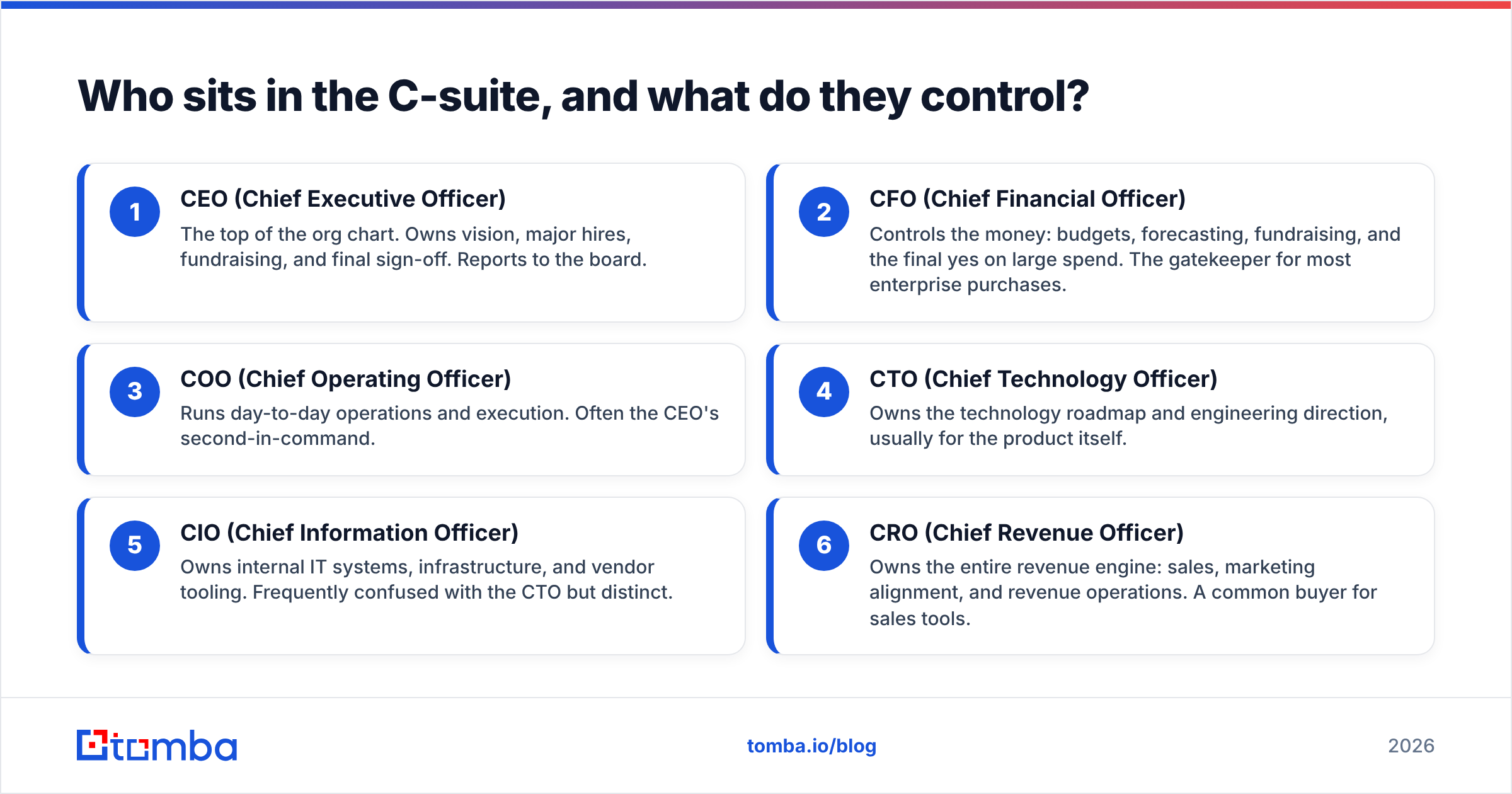
- CEO (Chief Executive Officer) — The top of the org chart. Owns vision, major hires, fundraising, and final sign-off. Reports to the board.
- CFO (Chief Financial Officer) — Controls the money: budgets, forecasting, fundraising, and the final yes on large spend. The gatekeeper for most enterprise purchases.
- COO (Chief Operating Officer) — Runs day-to-day operations and execution. Often the CEO's second-in-command.
- CTO (Chief Technology Officer) — Owns the technology roadmap and engineering direction, usually for the product itself.
- CIO (Chief Information Officer) — Owns internal IT systems, infrastructure, and vendor tooling. Frequently confused with the CTO but distinct.
- CRO (Chief Revenue Officer) — Owns the entire revenue engine: sales, marketing alignment, and revenue operations. A common buyer for sales tools.
Each of these roles has a different trigger. A CFO cares about ROI and risk; a CTO cares about integration and security; a CRO cares about pipeline and quota attainment. Pitch the same feature three different ways, and you triple your hit rate.
What is the difference between the CEO, CFO, and COO?#
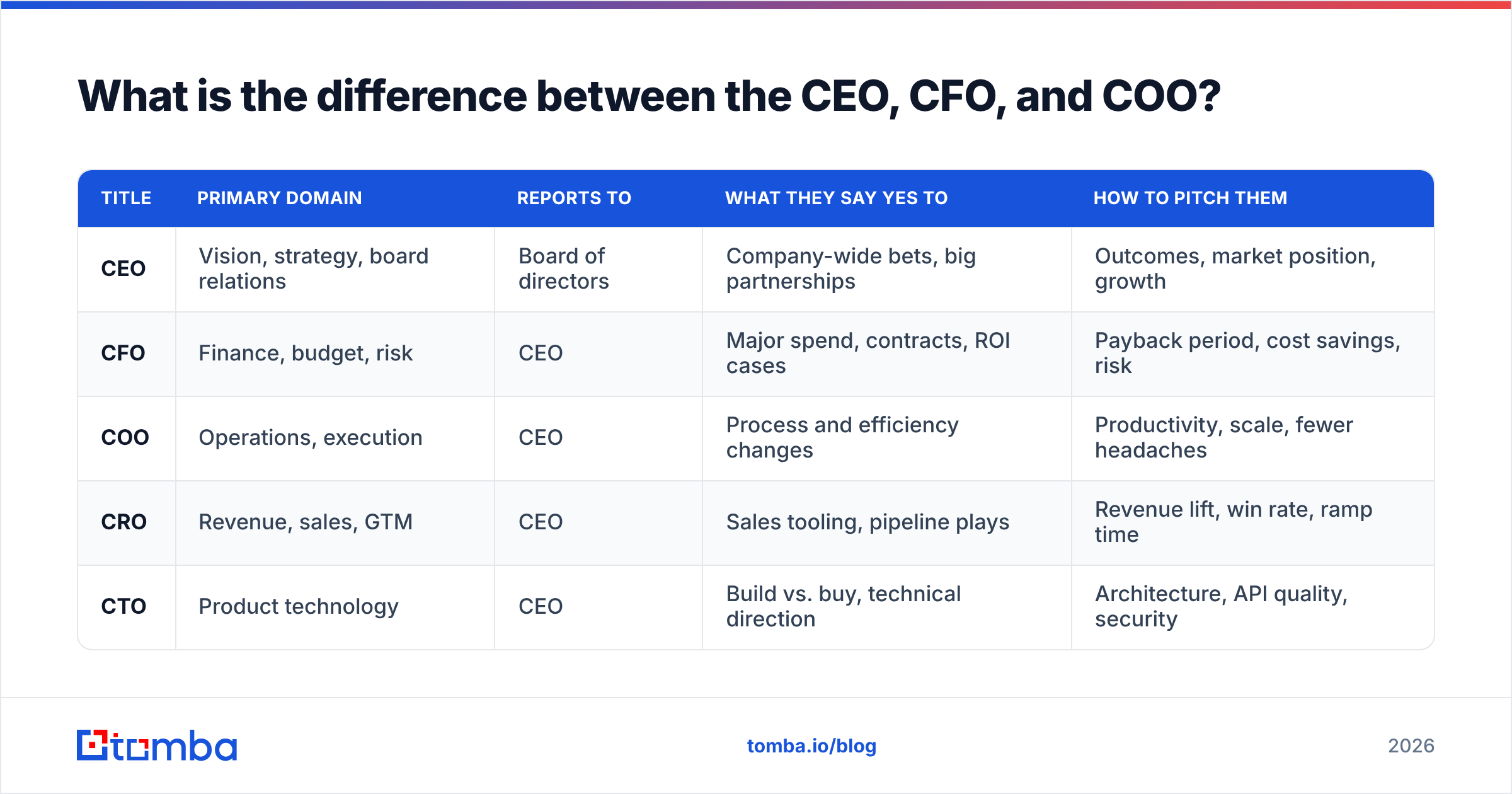
The short version: the CEO decides where the company goes, the COO makes sure it gets there, and the CFO makes sure it can afford the trip.
| Title | Primary domain | Reports to | What they say yes to | How to pitch them |
|---|---|---|---|---|
| CEO | Vision, strategy, board relations | Board of directors | Company-wide bets, big partnerships | Outcomes, market position, growth |
| CFO | Finance, budget, risk | CEO | Major spend, contracts, ROI cases | Payback period, cost savings, risk |
| COO | Operations, execution | CEO | Process and efficiency changes | Productivity, scale, fewer headaches |
| CRO | Revenue, sales, GTM | CEO | Sales tooling, pipeline plays | Revenue lift, win rate, ramp time |
| CTO | Product technology | CEO | Build vs. buy, technical direction | Architecture, API quality, security |
Notice the "reports to" column. Almost everyone reports to the CEO, and the CEO reports to the board. That single fact tells you how escalation works: if a champion three levels down loves your product, the approval still has to climb to whichever C-level owns that budget line. For more on aligning these revenue roles, the concept of revenue operations ties the CRO, CFO, and COO together around one pipeline.
How has the C level hierarchy changed in 2026?#
The C-suite has gotten crowded. A decade ago, most companies ran on the classic trio plus a CTO. In 2026, role specialization has produced a long tail of chiefs, each carved out to own a function that used to live under someone else.
Newer or now-common roles include:
- CISO (Chief Information Security Officer) — Owns cybersecurity and compliance. Critical to reach if you sell anything that touches customer data.
- CHRO / CPO (Chief Human Resources / People Officer) — Owns talent, culture, and increasingly the tools employees use day to day.
- CDO (Chief Data Officer) — Owns data strategy, governance, and analytics.
- CMO (Chief Marketing Officer) — Owns brand, demand generation, and the marketing tech stack.
- CCO (Chief Customer Officer) — Owns the post-sale customer experience and retention.
- CAIO (Chief AI Officer) — A genuinely new seat, owning AI strategy and responsible deployment across the business.
This sprawl is good news and bad news for sellers. Good: there is now a specific executive who owns almost any problem you solve, so your message can be sharper. Bad: org charts are messier than ever, titles overlap, and the person with the title you expect may not hold the budget you assumed. According to industry analysts like Gartner, the rise of the CAIO and CDO reflects how much strategic weight has shifted toward data and AI. That is exactly why a clean, current map of who-does-what beats a year-old contact list.
How do you map the C level hierarchy for outbound sales?#
Mapping the hierarchy is a four-step loop: identify the account, list the relevant chiefs, find their verified contact details, and sequence your outreach from champion to economic buyer.
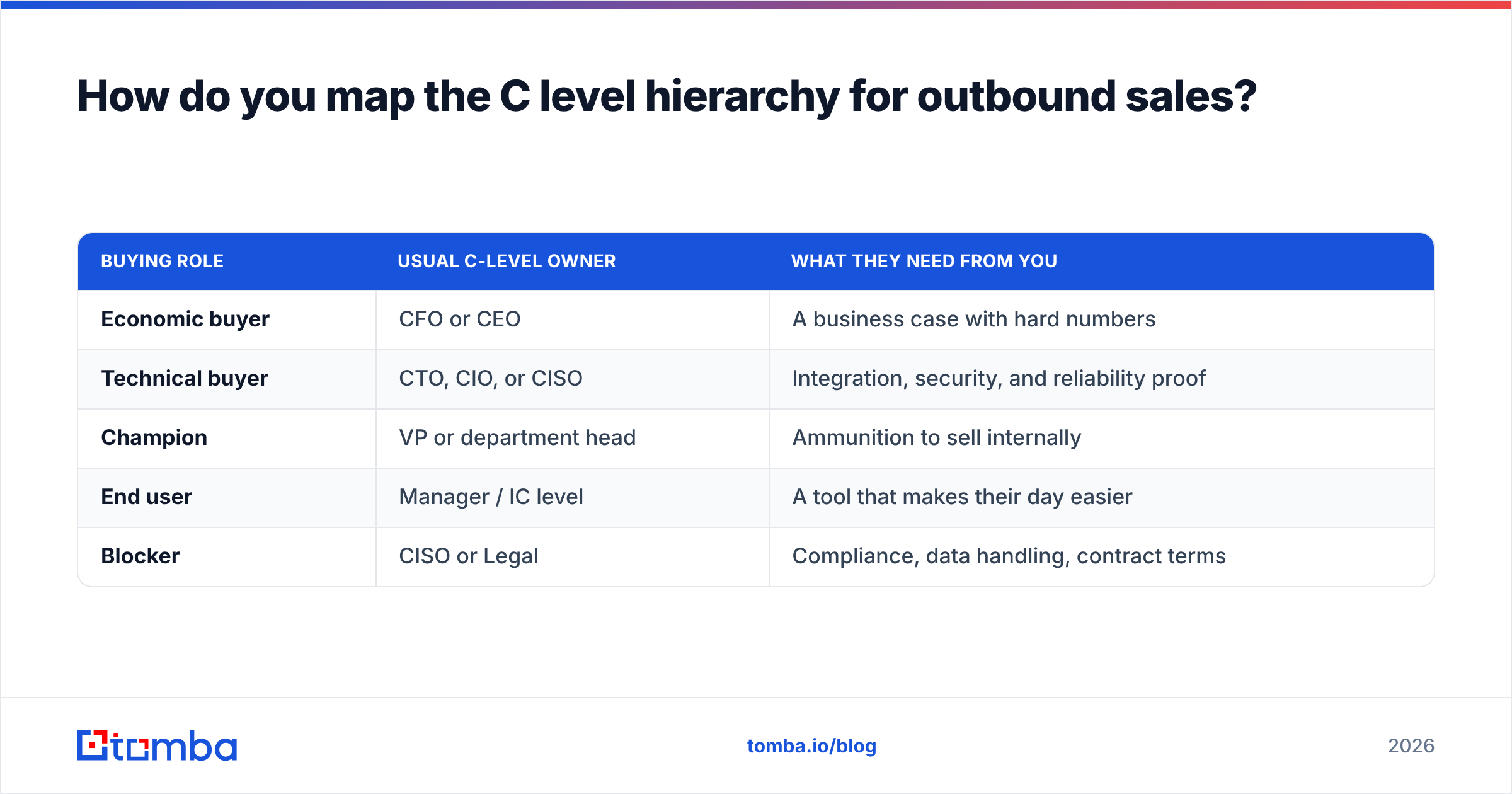
Here is how the roles split across a typical enterprise deal:
| Buying role | Usual C-level owner | What they need from you |
|---|---|---|
| Economic buyer | CFO or CEO | A business case with hard numbers |
| Technical buyer | CTO, CIO, or CISO | Integration, security, and reliability proof |
| Champion | VP or department head | Ammunition to sell internally |
| End user | Manager / IC level | A tool that makes their day easier |
| Blocker | CISO or Legal | Compliance, data handling, contract terms |
Step one is account research: pull the org chart from LinkedIn, the company's leadership page, and press releases. Step two is matching each buying role above to a real human. Step three — the one most reps skip — is getting accurate contact information so your sequence does not bounce or hit the wrong inbox. A title without a verified email is just trivia.
This is where a purpose-built tool earns its keep. Instead of guessing firstname@company.com, run the company through a domain search to surface every public email pattern and named contact at that organization, then confirm each address with an email verifier before you send. The result is a clean, hierarchy-aware list: the right names, mapped to the right roles, with addresses that actually deliver.
Why does the hierarchy matter for win rates?#
Because deals die in the gap between the person who feels the pain and the person who signs the check. Selling to a single contact — even an enthusiastic one — is the most common reason enterprise deals stall.
Picture a Chief Marketing Officer who loves your platform. She has the pain and the authority over her department, but the contract size triggers CFO review. If you have only ever spoken to the CMO, you are now relying on her to sell your value to a finance executive she may not have full access to, using talking points she did not write. Map the hierarchy early, and you can arm her with a CFO-ready business case — or, better, get introduced directly.
Multi-threading across the C level hierarchy consistently lifts win rate because it removes single points of failure. If your champion leaves, gets reorganized, or goes quiet, the deal survives because you built relationships with their peers and their boss. Research from sales platforms like HubSpot repeatedly shows that deals with multiple engaged stakeholders close at meaningfully higher rates than single-threaded ones.
The practical takeaway: never run a six-figure pursuit through one contact. Identify at least the economic buyer, the technical buyer, and a champion, then build a contact plan for each.
What tools help you reach the C-suite?#
You need two things to work the hierarchy efficiently: a map of who sits where, and a reliable way to contact them. Free org charts give you the first; they almost never give you the second.
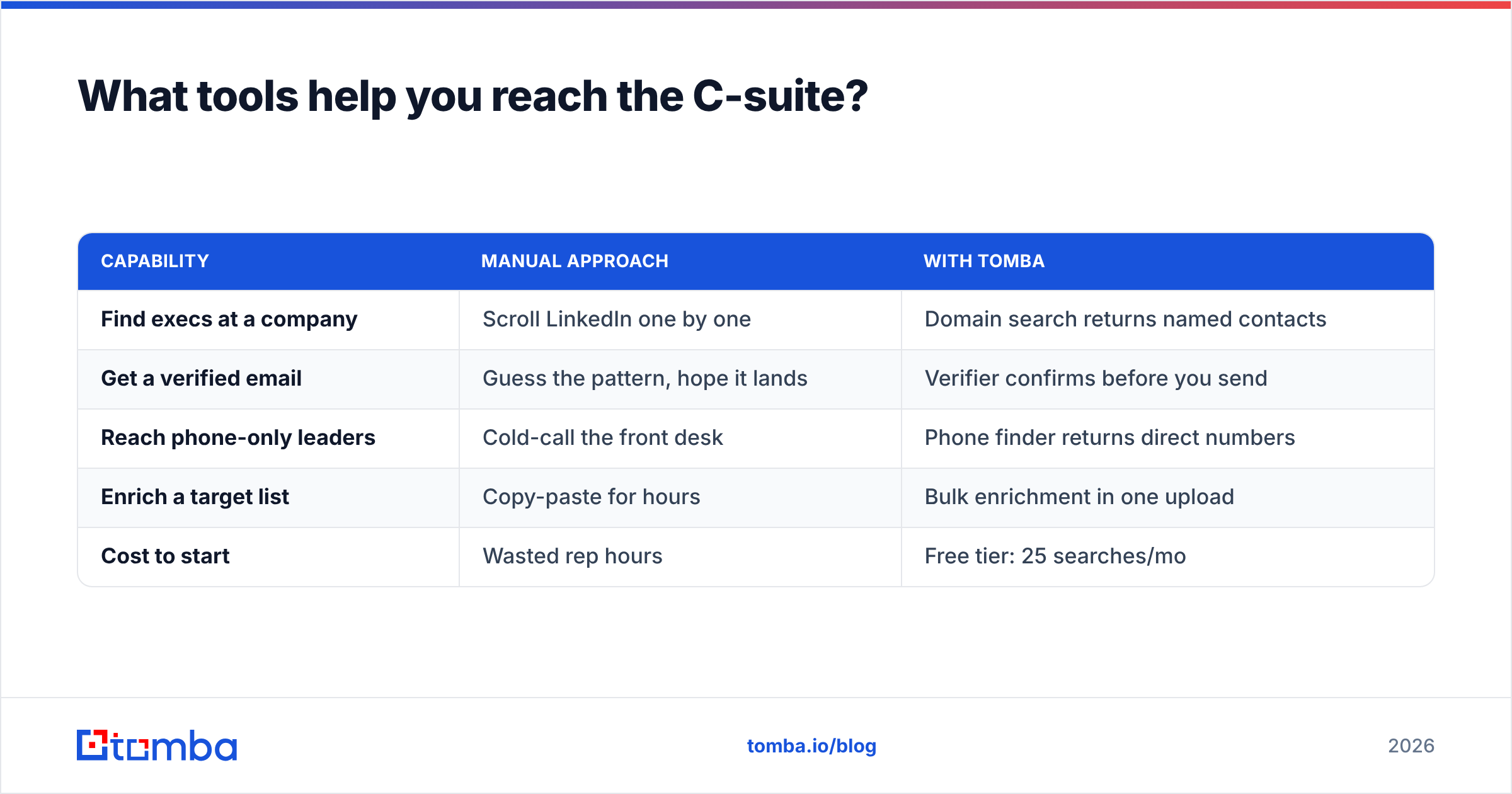
A modern prospecting stack closes that gap. Use a LinkedIn finder to convert a profile you found while mapping the org into a verified work email. For phone-first outreach to senior leaders who ignore email, a phone finder surfaces direct B2B numbers. And when you are working a whole target account list, the bulk email finder lets you enrich hundreds of executives at once instead of one tab at a time.
| Capability | Manual approach | With Tomba |
|---|---|---|
| Find execs at a company | Scroll LinkedIn one by one | Domain search returns named contacts |
| Get a verified email | Guess the pattern, hope it lands | Verifier confirms before you send |
| Reach phone-only leaders | Cold-call the front desk | Phone finder returns direct numbers |
| Enrich a target list | Copy-paste for hours | Bulk enrichment in one upload |
| Cost to start | Wasted rep hours | Free tier: 25 searches/mo |
Pricing scales with volume rather than per-seat games. The Tomba pricing ladder runs from a Free tier at 25 searches a month, to Starter at $49/mo, Growth at $99/mo, and Pro at $249/mo, with custom Enterprise plans for teams running large account-based programs. That means you can map and verify a single strategic account on the free tier before committing budget.
How do you avoid common C-suite outreach mistakes?#
Three mistakes sink most executive outreach: wrong title, wrong email, and wrong message.
- Wrong title — Pitching the CTO on an internal-IT tool that the CIO actually owns. Fix it by learning the CTO-vs-CIO and CRO-vs-CMO distinctions above before you write a word.
- Wrong email — Sending to a guessed address that bounces, hurting your sender reputation. Always verify; a bounce to a C-level domain can poison deliverability for the whole account.
- Wrong message — Sending a CFO the same feature list you sent the end user. Translate features into the metric each chief is measured on: payback for the CFO, ramp time for the CRO, breach risk for the CISO.
Get those three right and your reply rate from senior leaders climbs without sending a single extra email. The hierarchy is not bureaucracy to route around — it is a map of exactly what each person cares about and what they can approve.
Map the hierarchy, then reach the right name#
The C level hierarchy is your shortcut to the shortest path to yes. Learn the titles, learn who reports to whom, and match every buying role to a real, verified human before you launch a sequence. The teams that win enterprise deals in 2026 are the ones who treat the org chart as a sales asset, not an afterthought.
Ready to turn an org chart into a contact list that actually delivers? Start with the Tomba Email Finder — search by domain, name, or company to surface verified executive emails, then verify and enrich them in the same workflow. Map the C-suite, reach the real decision-maker, and stop losing deals to a guessed address. Run your first target account free, no card required.
Ready to find emails that actually work?
Join 150,000+ professionals who stopped guessing and started sending. Free credits on signup — no credit card required.
Get the Tomba newsletter
Practical outbound tactics and product updates — once every two weeks.
About the author