C-Level vs C-Suite: Key Differences & Titles (2026)
"C-level" or "C-suite"? They're related but not identical. Here's exactly what each term means, who sits in the room, and how to reach them in 2026.
C-Level vs C-Suite: What the Terms Really Mean in 2026
If you sell to executives, you've typed both phrases into the same email and wondered if they mean the same thing. Short answer: they're tightly related, but they aren't interchangeable. Getting the distinction right makes you sound like an insider instead of a vendor reading off a script.
TL;DR#
- "C-level" describes any individual executive whose title starts with "Chief" — CEO, CFO, CTO, CMO, and so on. It's a seniority label for a person.
- "C-suite" is the collective group of those C-level leaders, plus the metaphorical room (and budget) where they make company-wide decisions.
- Every C-suite member is C-level, but "C-level" can also describe one person in isolation; "C-suite" almost always means the team.
- The modern C-suite has expanded well beyond the classic three — CISO, CRO, CPO, and CDO are now common.
- To actually sell to them, you need accurate names, verified emails, and direct phone numbers — guesswork kills executive outreach faster than a bad subject line.
Is "C-Level" the Same as "C-Suite"?#
No — and the difference is about scope. C-level is an adjective for a person's rank. C-suite is a noun for the group.
Think of it like a basketball analogy. "Starter" describes one player's status (C-level). "The starting five" describes the unit that takes the court together (C-suite). You'd say "she's a starter," but you'd say "the starting five decided the game plan." Same logic applies here: "He's a C-level hire" versus "The decision went to the C-suite."
Technically, both terms trace back to the word "Chief." Any title in the pattern Chief ___ Officer qualifies the holder as C-level. When you gather those people into one decision-making body — the executives who report to the CEO and the board — you get the C-suite.
Here's the practical takeaway for outreach: use "C-level" when you're describing a target persona ("we sell to C-level finance leaders"), and use "C-suite" when you're describing the buying committee ("the deal needs C-suite sign-off").

Who Sits in the C-Suite?#
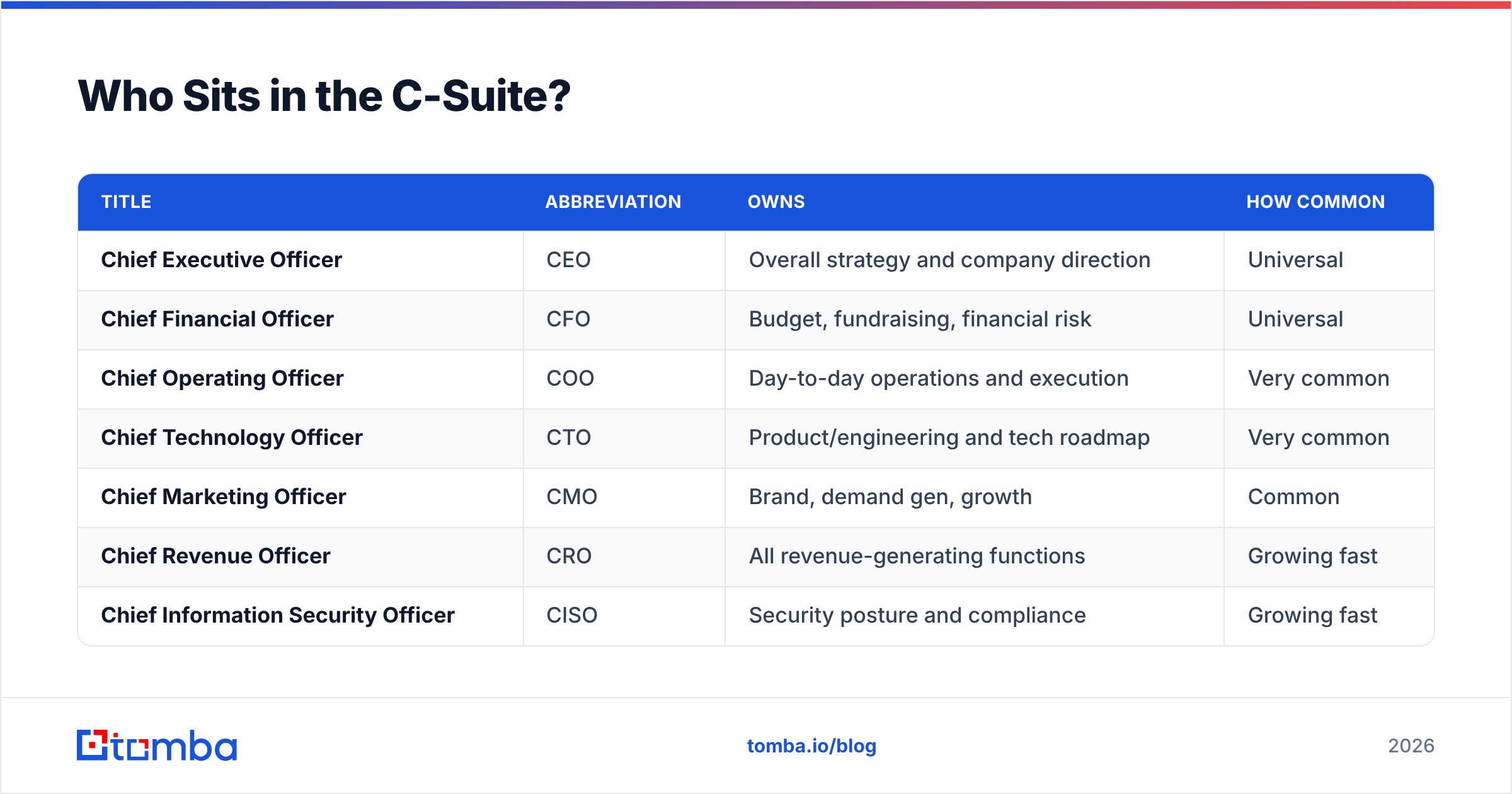
The C-suite isn't a fixed roster. It grows as companies add specialized leadership. Below are the roles you'll encounter most often, grouped by how established they are.
| Title | Abbreviation | Owns | How common |
|---|---|---|---|
| Chief Executive Officer | CEO | Overall strategy and company direction | Universal |
| Chief Financial Officer | CFO | Budget, fundraising, financial risk | Universal |
| Chief Operating Officer | COO | Day-to-day operations and execution | Very common |
| Chief Technology Officer | CTO | Product/engineering and tech roadmap | Very common |
| Chief Marketing Officer | CMO | Brand, demand gen, growth | Common |
| Chief Revenue Officer | CRO | All revenue-generating functions | Growing fast |
| Chief Information Security Officer | CISO | Security posture and compliance | Growing fast |
| Chief Product Officer | CPO | Product vision and lifecycle | Growing |
| Chief Data Officer | CDO | Data strategy and governance | Emerging |
The classic trio — CEO, CFO, COO — anchors almost every org. After that, the suite reflects what a company values. A SaaS startup leans technical (CTO, CPO). A regulated enterprise adds a CISO and a Chief Compliance Officer. A scale-up obsessed with growth promotes a CRO to unify sales, marketing, and customer success. For a deeper vocabulary refresher, the Wikipedia entry on corporate titles is a solid neutral reference.
What Does Each C-Level Role Actually Care About?#
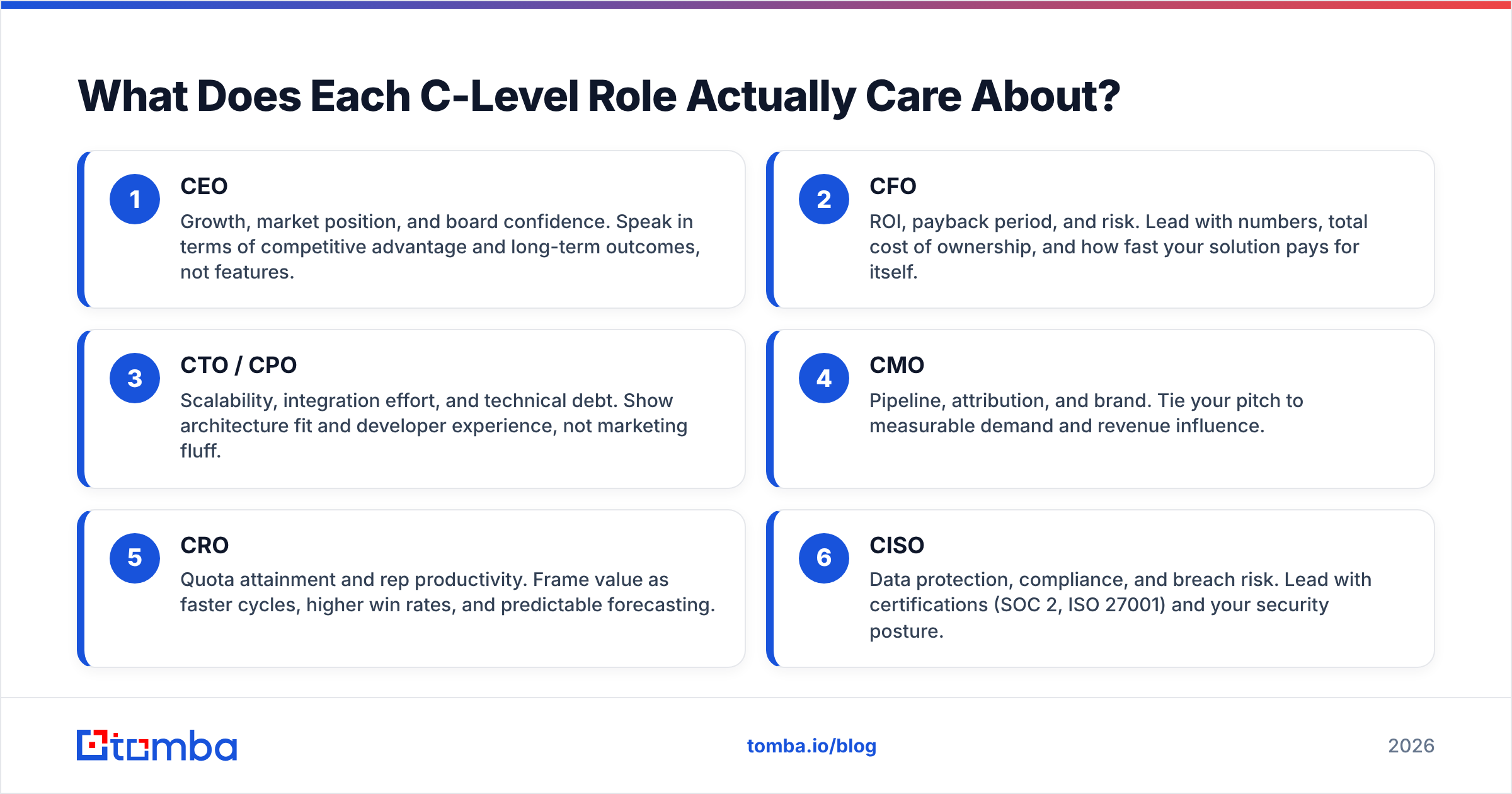
Knowing the title is step one. Knowing what keeps each executive up at night is what earns a reply. Here's a quick map of priorities you can use to tailor messaging:
- CEO — Growth, market position, and board confidence. Speak in terms of competitive advantage and long-term outcomes, not features.
- CFO — ROI, payback period, and risk. Lead with numbers, total cost of ownership, and how fast your solution pays for itself.
- CTO / CPO — Scalability, integration effort, and technical debt. Show architecture fit and developer experience, not marketing fluff.
- CMO — Pipeline, attribution, and brand. Tie your pitch to measurable demand and revenue influence.
- CRO — Quota attainment and rep productivity. Frame value as faster cycles, higher win rates, and predictable forecasting.
- CISO — Data protection, compliance, and breach risk. Lead with certifications (SOC 2, ISO 27001) and your security posture.
This is the structured "altitude" check most reps skip. A message that lands with a CTO will bore a CFO and alarm a CISO. Segment first, write second.
Why Does the C-Level vs C-Suite Distinction Matter for Sales?#
Because the words signal whether you understand the buying process. Executive deals rarely close on a single yes. According to research summarized by Gartner, the typical B2B buying group involves six to ten decision-makers — and large deals almost always escalate to the C-suite for final approval.
That means two things for your outreach:
- You target C-level individuals. Each persona gets a tailored message based on what that chief cares about.
- You sell to the C-suite collectively. Your champion has to defend the purchase to a room of peers, so you arm them with the business case the whole suite will accept.
Reps who blur the two end up sending a CFO a CTO's pitch, or treating one signature as the whole committee. Precision in language tends to track precision in strategy.
How Do You Find and Reach C-Suite Executives?#
This is where most outbound stalls. You can know exactly which CRO you want to reach and still have no way to contact them. Executives guard their inboxes, screen unknown numbers, and almost never list a direct line publicly.
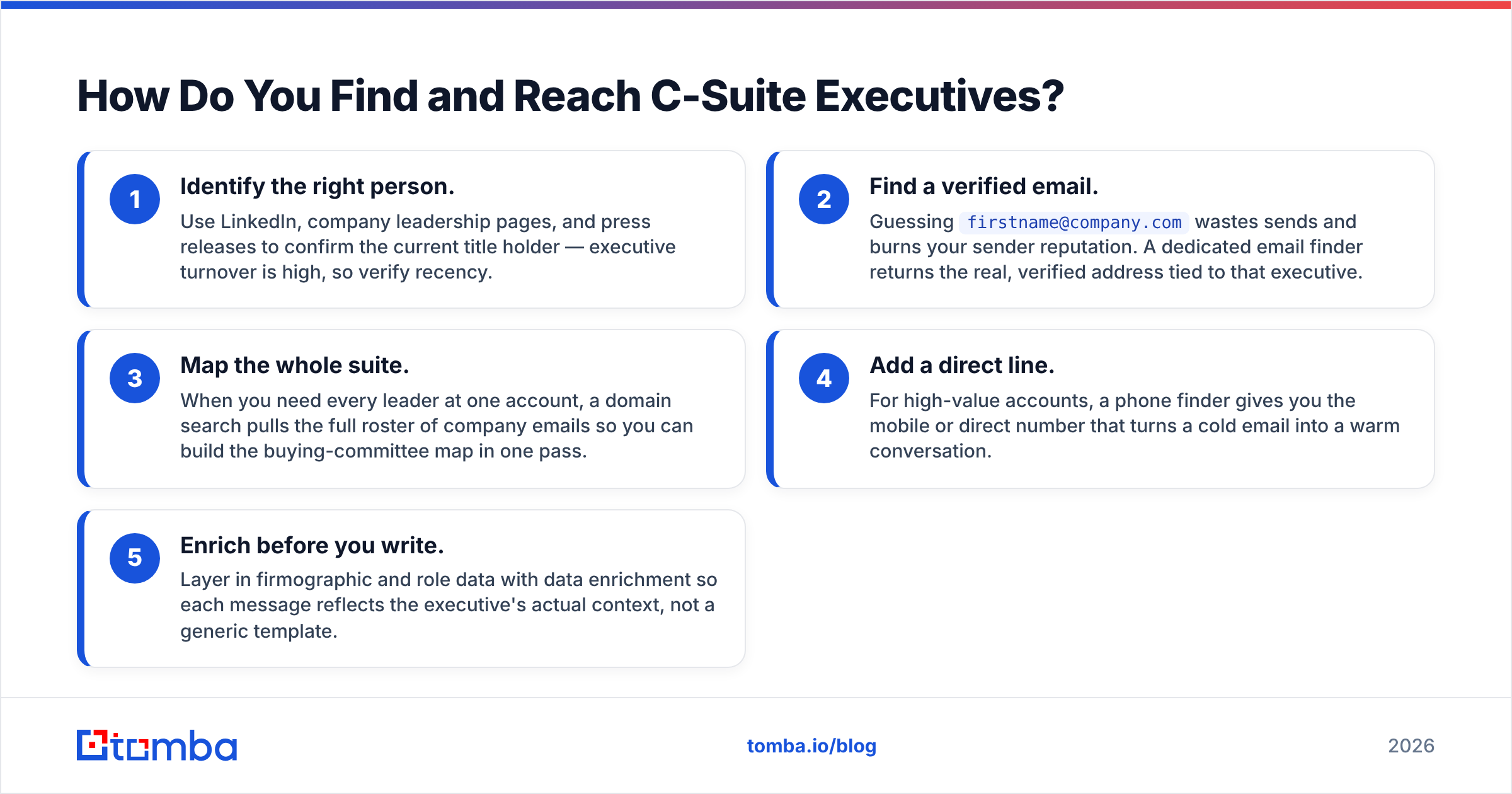
A reliable workflow looks like this:
- Identify the right person. Use LinkedIn, company leadership pages, and press releases to confirm the current title holder — executive turnover is high, so verify recency.
- Find a verified email. Guessing
firstname@company.comwastes sends and burns your sender reputation. A dedicated email finder returns the real, verified address tied to that executive. - Map the whole suite. When you need every leader at one account, a domain search pulls the full roster of company emails so you can build the buying-committee map in one pass.
- Add a direct line. For high-value accounts, a phone finder gives you the mobile or direct number that turns a cold email into a warm conversation.
- Enrich before you write. Layer in firmographic and role data with data enrichment so each message reflects the executive's actual context, not a generic template.

The point isn't to spray the entire C-suite with identical notes. It's to reach the right C-level individuals with verified contact data, then equip your internal champion to carry the deal across the rest of the suite.
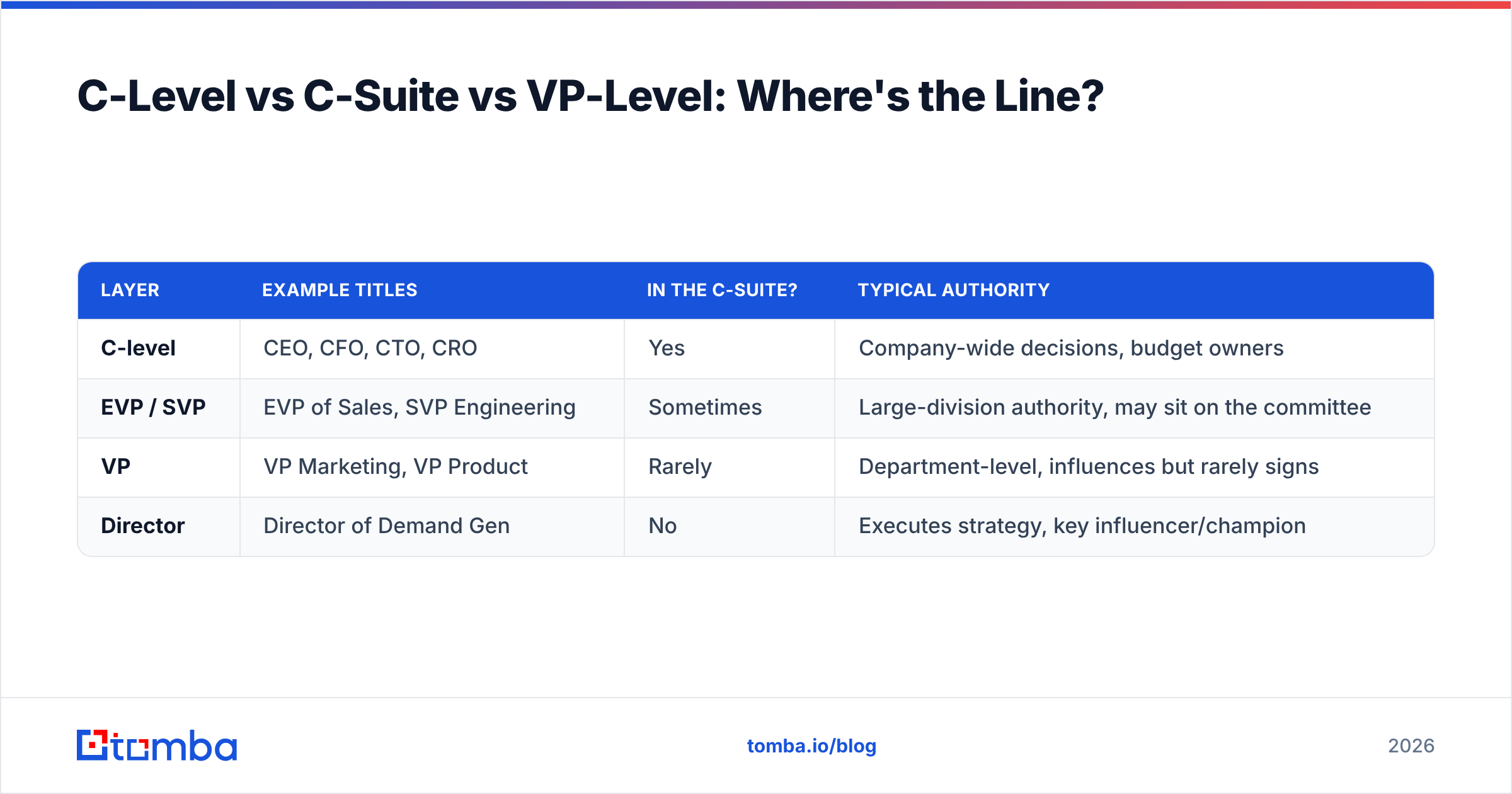
C-Level vs C-Suite vs VP-Level: Where's the Line?#
A frequent point of confusion: is a VP part of the C-suite? Usually not. The line sits at the "Chief" title and direct CEO reporting.
| Layer | Example titles | In the C-suite? | Typical authority |
|---|---|---|---|
| C-level | CEO, CFO, CTO, CRO | Yes | Company-wide decisions, budget owners |
| EVP / SVP | EVP of Sales, SVP Engineering | Sometimes | Large-division authority, may sit on the committee |
| VP | VP Marketing, VP Product | Rarely | Department-level, influences but rarely signs |
| Director | Director of Demand Gen | No | Executes strategy, key influencer/champion |
For sales, directors and VPs are often your champions — the people who feel the pain and push internally — while the C-suite holds the economic authority. Don't ignore the lower tiers; they frequently open the door to the executives above them. HubSpot's guide to the B2B buying committee breaks these dynamics down well if you want to build a full account map.
How Has the C-Suite Changed by 2026?#
The biggest shift is specialization. A decade ago, "the C-suite" meant three or four people. Today it's a wider, more fluid group shaped by three forces:
- Security and data moved to the top table. CISOs and CDOs now own budget and board attention because breaches and AI governance are existential risks, not IT footnotes.
- Revenue got consolidated. The CRO role merged sales, marketing, and success under one number, changing who you pitch when you sell go-to-market software.
- Titles fragmented. Chief AI Officer, Chief Sustainability Officer, and Chief Customer Officer appear in more orgs every year, each with a distinct mandate and budget.
For prospecting, this means your target list goes stale faster than ever. The CISO you identified last quarter may have a new title — or a new employer — this quarter. Treating contact data as a one-time pull is the fastest way to email people who left. Refresh and re-verify on a cadence.
Quick Reference: Saying It Right#
To keep the terminology straight in your own copy:
- "We help C-level executives cut reporting time." ✅ (describing the persona)
- "The proposal is with the C-suite for approval." ✅ (describing the group)
- "He's a C-suite." ❌ — one person isn't a suite; say "He's a C-level executive."
- "Our champion is selling up to the C-level." ✅ (the layer above her)
Small distinction, big credibility difference when an executive reads your message.
Start Reaching the Right Executives#
Knowing the difference between c level or c suite is the easy part. The hard part is getting accurate, verified contact data for the specific leaders who control the budget — and keeping that data current as titles shift.
That's exactly what Tomba's Email Finder is built for. Drop in a name and company, or search an entire domain, and get verified executive emails you can actually send to — no guessing, no bounces, no torched sender reputation. Pair it with phone lookup and enrichment to build a complete picture of every C-suite decision-maker on your target accounts. Start on the free tier (25 searches a month), and when you're ready to scale your executive outreach, the Starter plan runs $49/mo — see full Tomba pricing for the details. Find the right chief, reach the whole suite, and stop letting bad data decide your deals.
Ready to find emails that actually work?
Join 150,000+ professionals who stopped guessing and started sending. Free credits on signup — no credit card required.
Get the Tomba newsletter
Practical outbound tactics and product updates — once every two weeks.
About the author