C-Level Positions in 2026: Roles, Duties & Org Chart
From CEO to CISO, here's what every C-level position actually does in 2026 — plus how sales teams find and reach the executives who sign off on deals.
TL;DR
- C-level positions are the senior executives whose titles start with "Chief" — the people who own strategy, budget, and final sign-off across a company.
- The core five are CEO, CFO, COO, CTO, and CMO, but the modern C-suite has expanded to include CISO, CRO, CHRO, CPO, and more.
- Each role controls a different budget and cares about a different metric — knowing which is the difference between a deal and a deleted email.
- The hard part of selling to executives isn't writing the pitch; it's getting the right name and a verified email address in front of the right person.
- Use a domain search to map a company's leadership, then verify before you send so your message actually lands.
What are C-level positions?#
C-level positions are the highest-ranking executive jobs in a company, named for the word "Chief" that opens each title. When someone says "the C-suite," they mean this group — the CEO, CFO, COO, and the growing roster of specialist chiefs who report directly to the board or the CEO.
Think of a company as an airline. The board owns the airline and decides where it should fly. The C-suite is the cockpit crew: the captain (CEO) makes the final call, but the first officer handling fuel and money (CFO), the engineer watching the systems (CTO), and the crew chief running daily operations (COO) all have hands on the controls. Everyone below them is cabin crew and ground staff executing the flight plan.
The defining trait of a C-level position isn't seniority alone — plenty of VPs are senior. It's scope and authority: a chief owns an entire function, sets its strategy, controls its budget, and answers for its results to the board. That's why they matter so much in B2B sales. When you reach a C-level executive, you're talking to someone who can actually say yes without asking three other people first.
Why do C-level positions matter for B2B sales?#
Because budget and final authority live in the C-suite. A 2025 round of Gartner buying research has consistently shown that the typical B2B purchase now involves a buying group of six to ten stakeholders — and the people who break ties and unlock funds are almost always C-level.
Reaching them changes three things at once:
- Deal velocity — a champion three levels down has to sell internally for weeks. A CFO who likes your numbers can compress that to a single meeting.
- Deal size — executives buy outcomes, not features, so conversations naturally move toward bigger, multi-year commitments.
- Win rate — when the economic buyer is engaged early, your win rate climbs because you're no longer hostage to a single low-level contact who might leave or go quiet.
The catch: executives are the hardest people to reach. Their inboxes are guarded, their direct lines are unlisted, and generic info@ addresses go nowhere. That's the real bottleneck — not the message, but the contact data behind it.
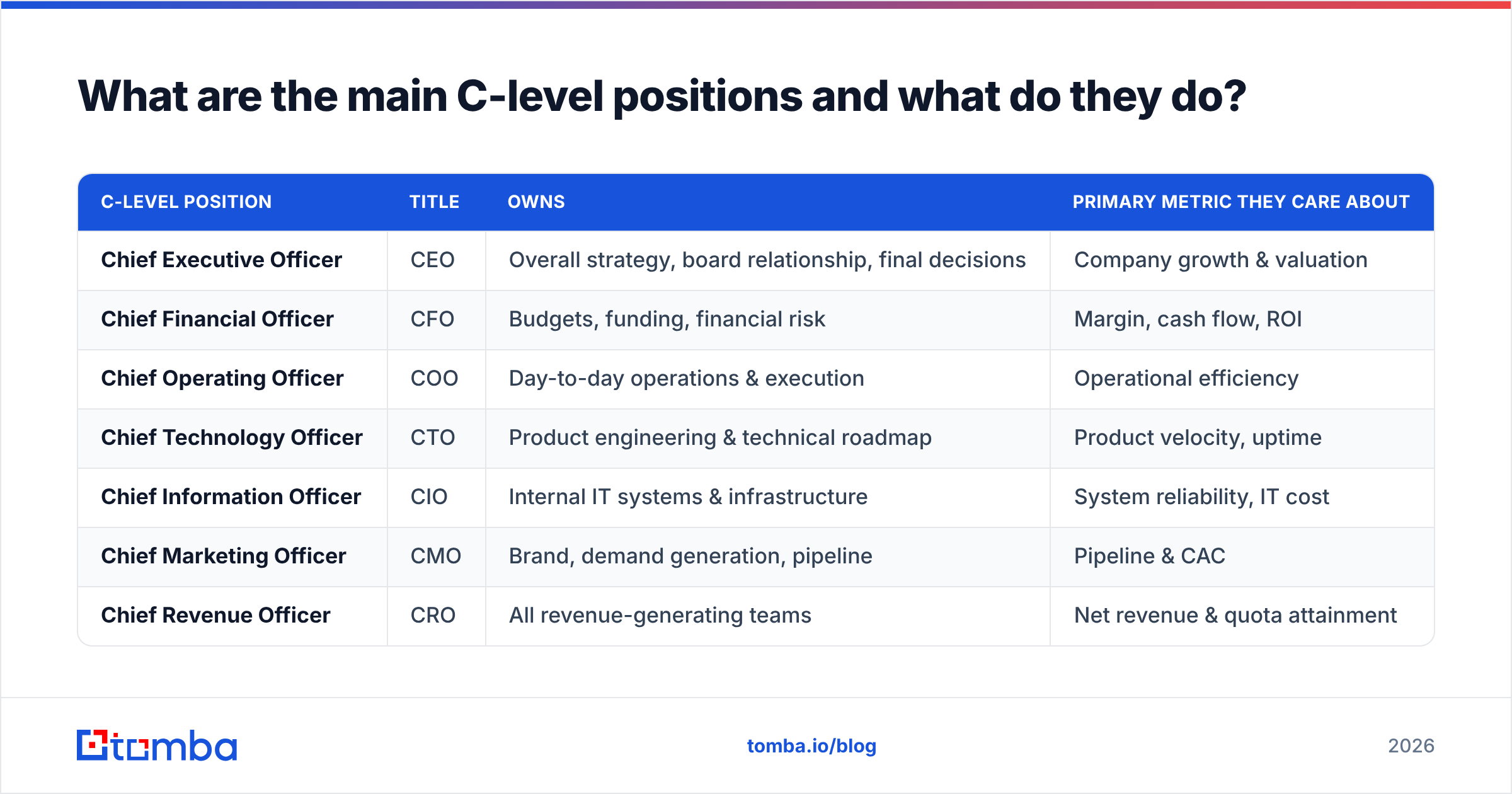
What are the main C-level positions and what do they do?#
Here's the modern C-suite, broken down by what each chief owns and the metric that keeps them up at night. Use this as a prospecting cheat sheet: match your value proposition to the metric the executive is measured on.
| C-Level Position | Title | Owns | Primary metric they care about |
|---|---|---|---|
| Chief Executive Officer | CEO | Overall strategy, board relationship, final decisions | Company growth & valuation |
| Chief Financial Officer | CFO | Budgets, funding, financial risk | Margin, cash flow, ROI |
| Chief Operating Officer | COO | Day-to-day operations & execution | Operational efficiency |
| Chief Technology Officer | CTO | Product engineering & technical roadmap | Product velocity, uptime |
| Chief Information Officer | CIO | Internal IT systems & infrastructure | System reliability, IT cost |
| Chief Marketing Officer | CMO | Brand, demand generation, pipeline | Pipeline & CAC |
| Chief Revenue Officer | CRO | All revenue-generating teams | Net revenue & quota attainment |
| Chief Information Security Officer | CISO | Security posture & compliance | Risk reduction, breach prevention |
| Chief Human Resources Officer | CHRO | Talent, culture, retention | Retention & headcount efficiency |
| Chief Product Officer | CPO | Product vision & roadmap | Adoption & retention |
A few notes on how this maps to outreach:
- Selling security software? Your buyer is the CISO, and your message should lead with risk, not features.
- Selling a sales or marketing platform? The CRO or CMO owns the budget; the CFO signs off on the spend.
- Selling infrastructure or dev tooling? The CTO cares about velocity, the CIO cares about reliability — same company, two different pitches.
How is the C-suite organized — who reports to whom?#
The CEO sits at the top and reports to the board of directors. Everyone else in the C-suite typically reports to the CEO, with two common exceptions: the CFO sometimes reports partly to the board's audit committee, and in some structures the CISO reports to the CIO rather than directly to the CEO.
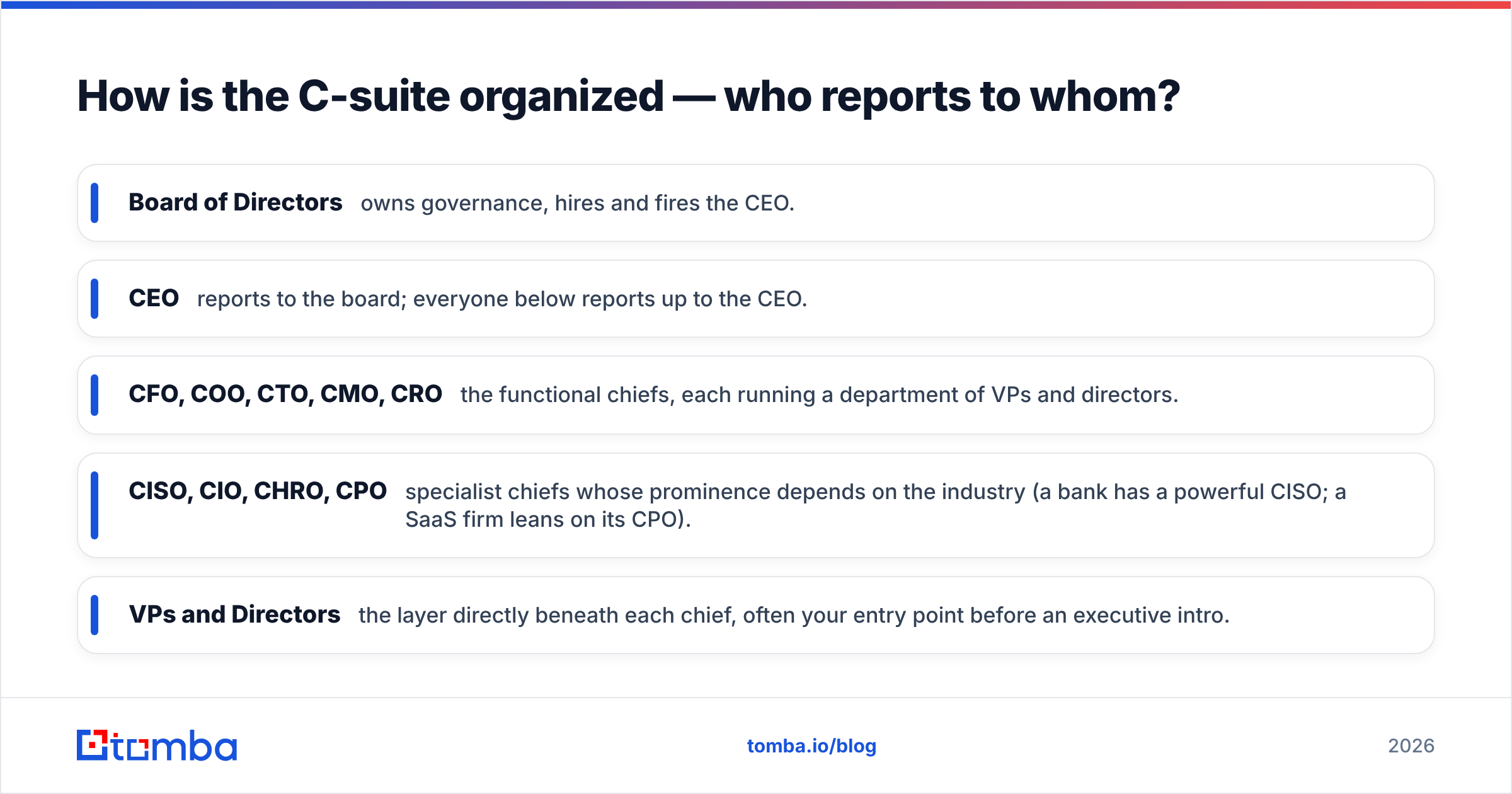
Here's the simplified chain of command in most mid-to-large companies:
- Board of Directors — owns governance, hires and fires the CEO.
- CEO — reports to the board; everyone below reports up to the CEO.
- CFO, COO, CTO, CMO, CRO — the functional chiefs, each running a department of VPs and directors.
- CISO, CIO, CHRO, CPO — specialist chiefs whose prominence depends on the industry (a bank has a powerful CISO; a SaaS firm leans on its CPO).
- VPs and Directors — the layer directly beneath each chief, often your entry point before an executive intro.
The practical takeaway for sales: you rarely email a CEO cold and win. You map the suite, find the chief who owns your problem, and often enter through their VP. To do that, you need an accurate org map — which is exactly where a tool that returns every email on a domain earns its keep.
How do C-level titles differ by company size?#
The same title means very different things depending on company size, and missing that nuance is how reps embarrass themselves.
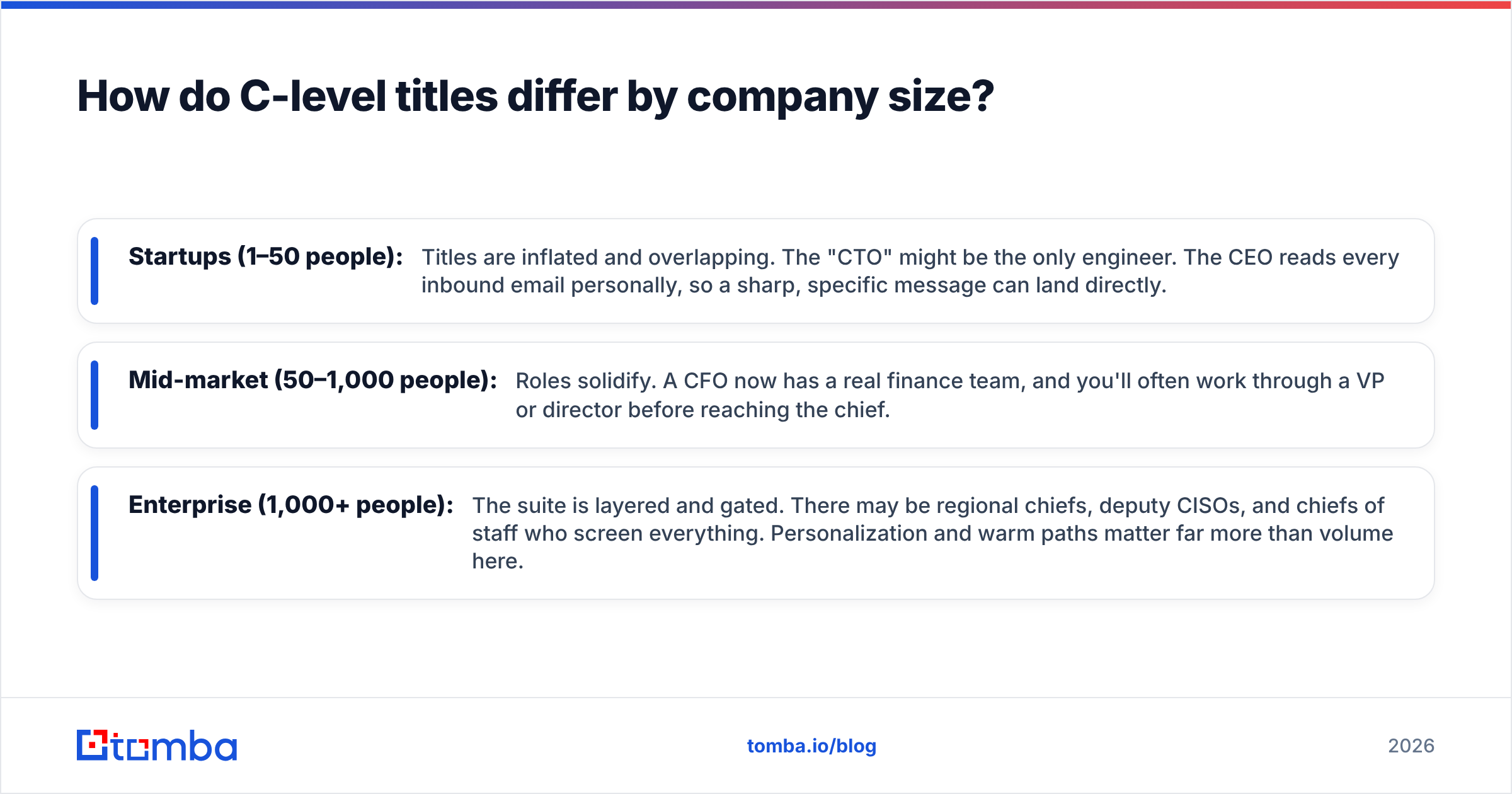
- Startups (1–50 people): Titles are inflated and overlapping. The "CTO" might be the only engineer. The CEO reads every inbound email personally, so a sharp, specific message can land directly.
- Mid-market (50–1,000 people): Roles solidify. A CFO now has a real finance team, and you'll often work through a VP or director before reaching the chief.
- Enterprise (1,000+ people): The suite is layered and gated. There may be regional chiefs, deputy CISOs, and chiefs of staff who screen everything. Personalization and warm paths matter far more than volume here.
This is why a static contact list goes stale fast. Executives move, titles change, and companies reorg constantly. Enriching and re-verifying your data — rather than trusting a download from two years ago — keeps your targeting honest. Tomba's data enrichment and email verifier exist for exactly this drift problem.

How do you find and reach C-level executives?#
Finding the right executive is a four-step workflow, and each step has a tool that does the heavy lifting. The pattern matters more than any single trick: identify the role, find the person, get a verified email, then personalize.
- Identify the role. Use the org map above to decide which chief owns your problem. Don't default to the CEO — the CFO or CRO is often a faster yes.
- Find the person. Pull the company's leadership from its website, LinkedIn, or a domain search that returns named contacts and their roles for any domain.
- Get a verified email. Guessing
firstname@company.comburns your sender reputation when it bounces. Run names through an email finder and confirm each address before it enters your sequence. - Reach out with relevance. Lead with the metric that executive is measured on. A CFO wants ROI math in the first line; a CISO wants risk reduction.
For multi-channel plays, pairing email with a verified direct line works well — a phone finder gives you a second touchpoint when inboxes go quiet. The goal is never volume for its own sake; it's getting the right verified contact for each named executive so your effort isn't wasted on dead addresses.
Build vs. buy: how teams source executive contacts#
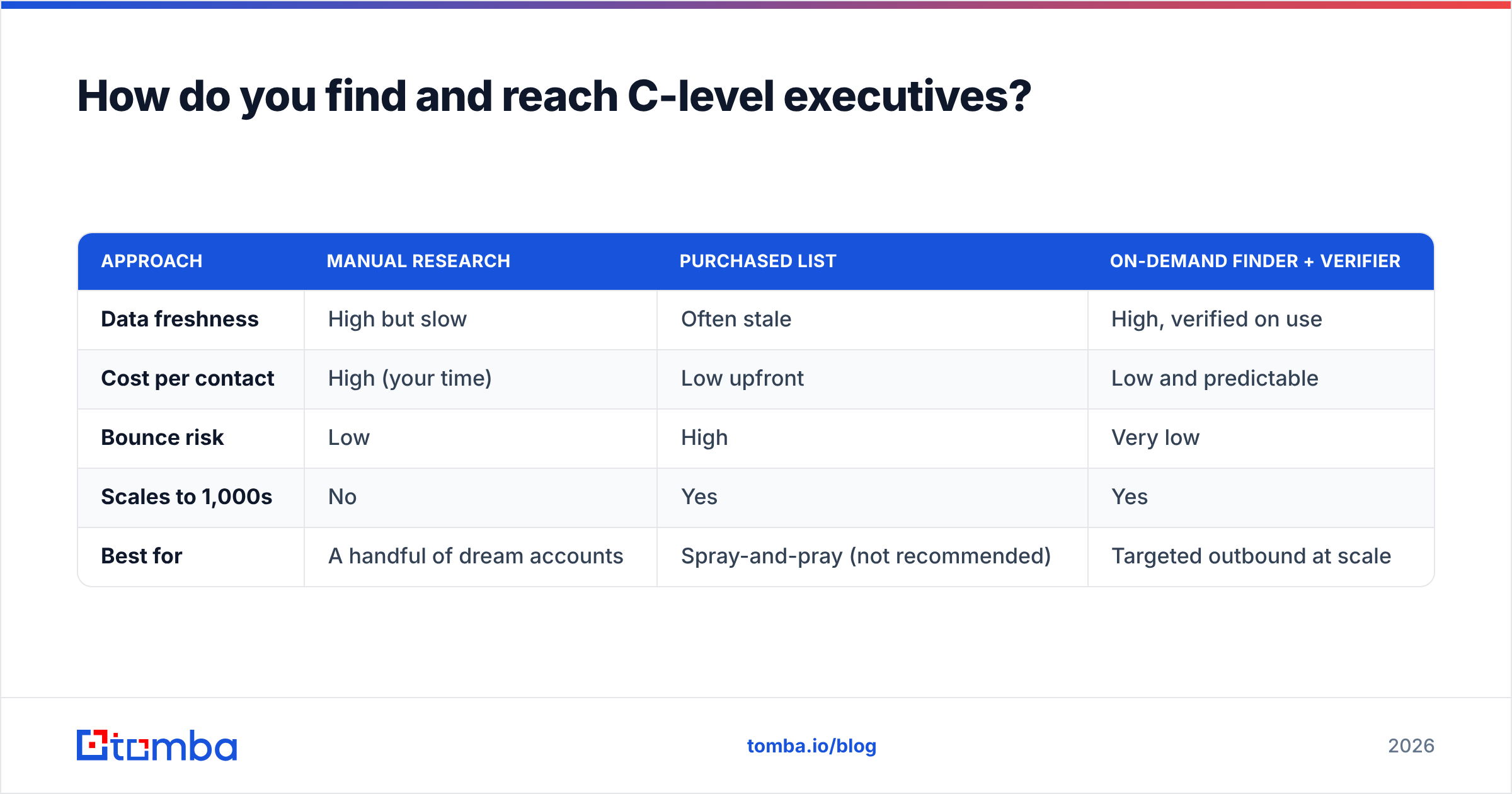
| Approach | Manual research | Purchased list | On-demand finder + verifier |
|---|---|---|---|
| Data freshness | High but slow | Often stale | High, verified on use |
| Cost per contact | High (your time) | Low upfront | Low and predictable |
| Bounce risk | Low | High | Very low |
| Scales to 1,000s | No | Yes | Yes |
| Best for | A handful of dream accounts | Spray-and-pray (not recommended) | Targeted outbound at scale |
The third column is where most modern outbound teams land: the freshness of manual research with the scale of a list, minus the bounce risk. Compared with bolt-on databases inside larger platforms, a focused finder-and-verifier stack — like Tomba's — tends to be both cheaper and more accurate per verified contact. You can check the full Tomba pricing to see how the free and paid tiers map to your volume.
What new C-level positions are emerging in 2026?#
The C-suite keeps expanding as new functions become board-level priorities. A few titles that have moved from "nice to have" to mainstream:
- Chief AI Officer (CAIO): Owns AI strategy, governance, and adoption. As companies operationalize AI, this role is splitting off from the CTO. According to coverage from outlets like Salesforce and major analysts, AI ownership at the executive level is now a common board mandate.
- Chief Customer Officer (CCO): Unifies success, support, and retention under one revenue-protecting chief.
- Chief Data Officer (CDO): Owns data as an asset — governance, quality, and monetization — distinct from IT.
- Chief Sustainability Officer (CSO): Owns ESG strategy and reporting, increasingly tied to regulatory and investor pressure.
For sellers, every new chief is a new potential buyer with a fresh budget and an unmet need. The teams that win are the ones who spot these roles early and reach them before the category gets crowded. That, again, comes back to data: you can't sell to a Chief AI Officer you didn't know existed at an account you haven't mapped.
How do you keep executive contact data accurate?#
Treat executive data as perishable, not permanent. The single biggest mistake in C-suite outreach is trusting a list that's months old. Executives change jobs constantly — the average tenure of a CMO, for example, is famously short, often cited around three years per industry surveys on sites like HubSpot.
A simple maintenance rhythm keeps you clean:
- Re-verify before every send. An address that worked last quarter may bounce today. Verification at send time protects your sender reputation.
- Enrich on a schedule. Refresh titles and companies for your top accounts monthly so you're never pitching a CFO who left in January.
- De-duplicate and standardize. Merge records and normalize formats so the same executive doesn't sit in your CRM three times under three titles.
Do this and your outbound stops fighting itself. Clean data means more inboxes reached, fewer spam complaints, and a list that actually reflects who runs each account today.
Final takeaway#
C-level positions are the decision-makers who control budget and final sign-off — and reaching the right one, with a verified email, is the highest-leverage move in B2B sales. Map the suite, match your pitch to the metric each chief owns, and never send to an address you haven't checked.
When you're ready to turn that strategy into a pipeline, start with the Tomba Email Finder. Drop in a company domain, get the named executives and their verified professional emails in seconds, and spend your time selling to chiefs instead of guessing at their addresses. The free tier gives you 25 searches a month to test it on your top accounts — no reason to keep guessing.
Ready to find emails that actually work?
Join 150,000+ professionals who stopped guessing and started sending. Free credits on signup — no credit card required.
Get the Tomba newsletter
Practical outbound tactics and product updates — once every two weeks.
About the author