C-Level Sales in 2026: How to Reach and Close Executives
C-level sales is won or lost before the first call. Here's how to research, reach, and close executive buyers in 2026 — with frameworks, data, and a step-by-step playbook.
TL;DR
- C-level sales means selling to executives (CEO, CFO, CRO, CIO, CMO) who buy outcomes, not features — they fund initiatives, they don't compare checkboxes.
- The deal is usually decided in the research phase: you need the right contact, the right business trigger, and a one-line thesis on why their number is at risk.
- Reaching the C-suite is a contact-data problem first and a messaging problem second. Bad data is why most "executive outreach" never lands in the right inbox.
- Multithread early. Executives delegate, so a champion below them often runs the evaluation while the C-level holds the budget.
- Below: a research-to-close playbook, a channel comparison table, and the metrics that actually predict C-level win rates.
What is C-level sales?#
C-level sales is the practice of selling to the senior-most executives in an organization — the people whose titles start with "Chief." Think of it like pitching to the owner of a restaurant instead of the line cook. The cook cares whether the new knife is sharp; the owner only cares whether tonight's covers go up and food cost goes down. C-suite buyers behave the same way: they buy revenue, risk reduction, margin, or speed — never features.
That single distinction reshapes everything. A feature-led demo that wins over a manager will bore a CFO in ninety seconds. Executives operate on a portfolio of bets, and your deal is competing for attention against a reorg, an acquisition, and a board meeting next Tuesday. According to Gartner, the typical B2B buying group now includes six to ten decision-makers, and the higher you sell, the more those stakeholders fragment across functions.
So C-level sales is less "convince one person" and more "give one busy person a reason to sponsor a change and the cover to delegate the evaluation." Get that framing wrong and you'll spend months talking to people who can say no but never yes.
Why is selling to the C-suite different?#
Three structural differences separate C-level sales from mid-market or SMB motions.
- Time is the scarcest currency. A VP might give you 30 minutes out of curiosity. A CEO gives you eight minutes because someone they trust said it was worth it. Every word has to earn the next one.
- They think in outcomes and dollars, not workflows. "Saves your reps two hours a week" is a manager pitch. "Recovers $1.4M in pipeline that's currently leaking from bad contact data" is a C-level pitch.
- They buy through other people. Executives rarely run the hands-on evaluation. They appoint a champion, set a deadline, and check in. Your job is to arm that champion so well that the upward sell happens without you in the room.
)
This is also why "more activity" is the wrong lever in C-level sales. Blasting 500 generic emails at executives doesn't scale — it gets you blocked, marked as spam, and remembered for the wrong reasons. Precision beats volume by an order of magnitude at this level. One sharply researched message to the right CFO outperforms a hundred templated ones.
How do you research a C-level buyer before reaching out?#
Start with the number that keeps them up at night, then work backward to your product. Executives respond to relevance, and relevance comes from doing homework no competitor bothered to do.
A repeatable pre-outreach research checklist:
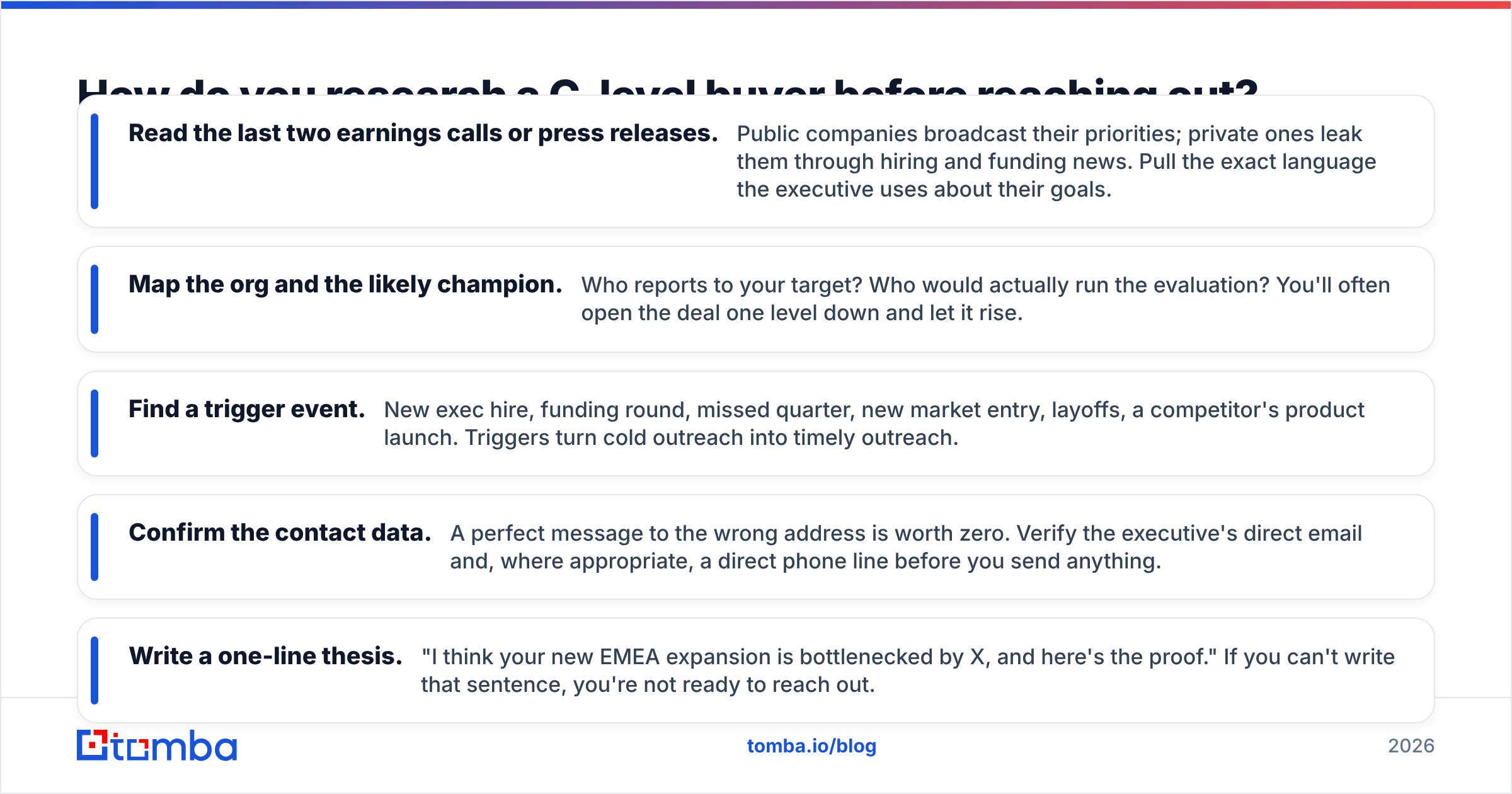
- Read the last two earnings calls or press releases. Public companies broadcast their priorities; private ones leak them through hiring and funding news. Pull the exact language the executive uses about their goals.
- Map the org and the likely champion. Who reports to your target? Who would actually run the evaluation? You'll often open the deal one level down and let it rise.
- Find a trigger event. New exec hire, funding round, missed quarter, new market entry, layoffs, a competitor's product launch. Triggers turn cold outreach into timely outreach.
- Confirm the contact data. A perfect message to the wrong address is worth zero. Verify the executive's direct email and, where appropriate, a direct phone line before you send anything.
- Write a one-line thesis. "I think your new EMEA expansion is bottlenecked by X, and here's the proof." If you can't write that sentence, you're not ready to reach out.
That fourth step is where most outreach quietly dies. Executive email addresses are guarded, frequently changed, and rarely listed publicly. Using a reliable email finder to locate and verify the right address — and a phone finder for direct dials — removes the single biggest point of failure in C-level prospecting. Pair that with data enrichment so every record carries title, seniority, and company context before your first touch.
Which channels work best for reaching executives?#
No single channel wins C-level sales. The executives who ignore email answer a referral; the ones who never pick up the phone reply to a sharp LinkedIn note. The winning move is a coordinated sequence across channels, anchored to verified contact data.
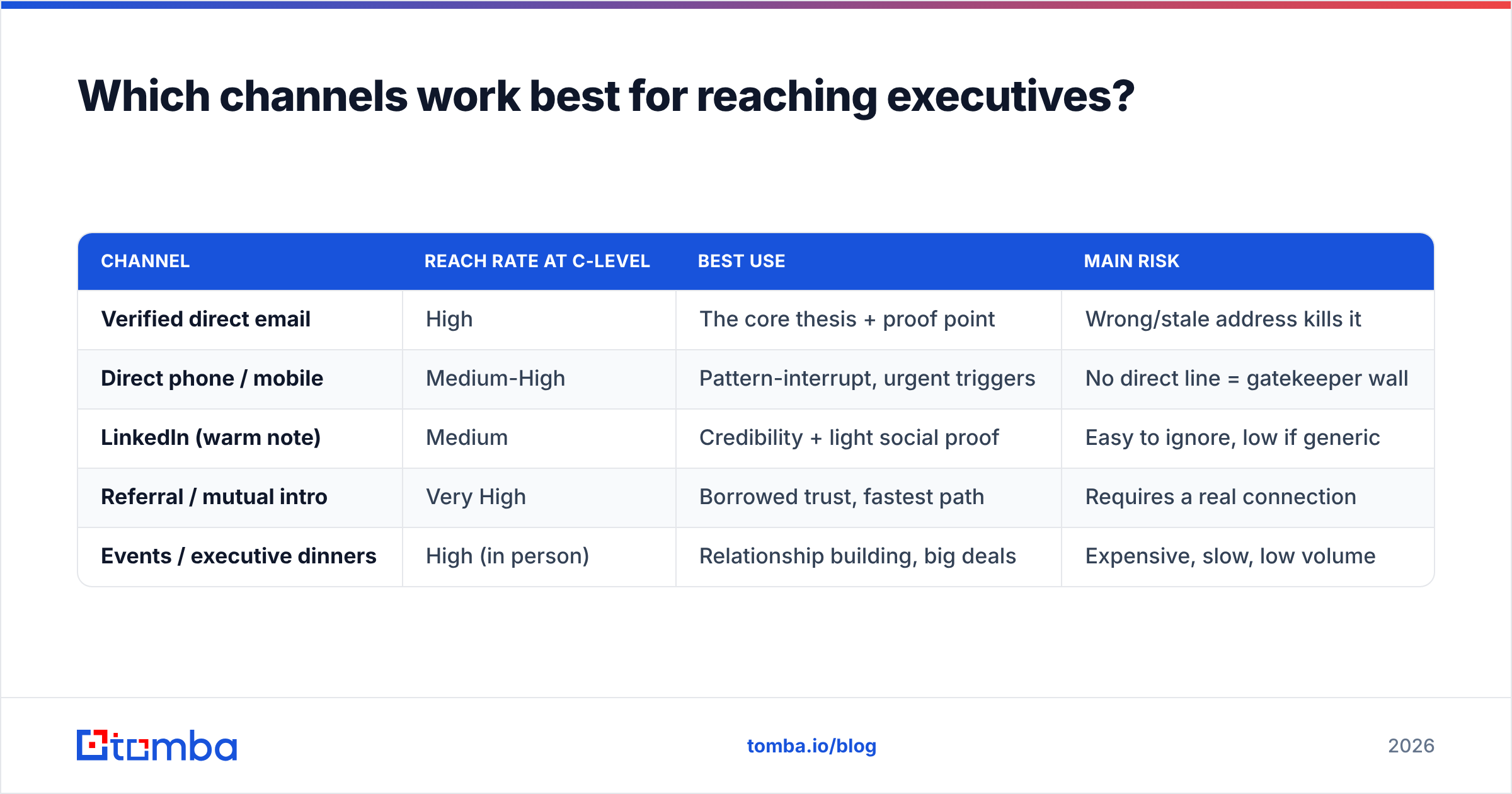
Here's how the main channels compare for reaching the C-suite specifically:
| Channel | Reach rate at C-level | Best use | Main risk |
|---|---|---|---|
| Verified direct email | High | The core thesis + proof point | Wrong/stale address kills it |
| Direct phone / mobile | Medium-High | Pattern-interrupt, urgent triggers | No direct line = gatekeeper wall |
| LinkedIn (warm note) | Medium | Credibility + light social proof | Easy to ignore, low if generic |
| Referral / mutual intro | Very High | Borrowed trust, fastest path | Requires a real connection |
| Events / executive dinners | High (in person) | Relationship building, big deals | Expensive, slow, low volume |
The pattern is consistent: channels that carry trust or precision win, and channels that rely on volume lose. A LinkedIn finder that ties a profile to a verified business email lets you run email and social in lockstep instead of guessing. The goal isn't to pick one channel — it's to hit the same executive across two or three with one coherent message, so the third touch feels familiar instead of cold.
)
What should a C-level outreach message actually say?#
Lead with their problem, prove you understand it, and make the ask absurdly small. Executives don't read; they scan. Your message has roughly one sentence to earn the second.
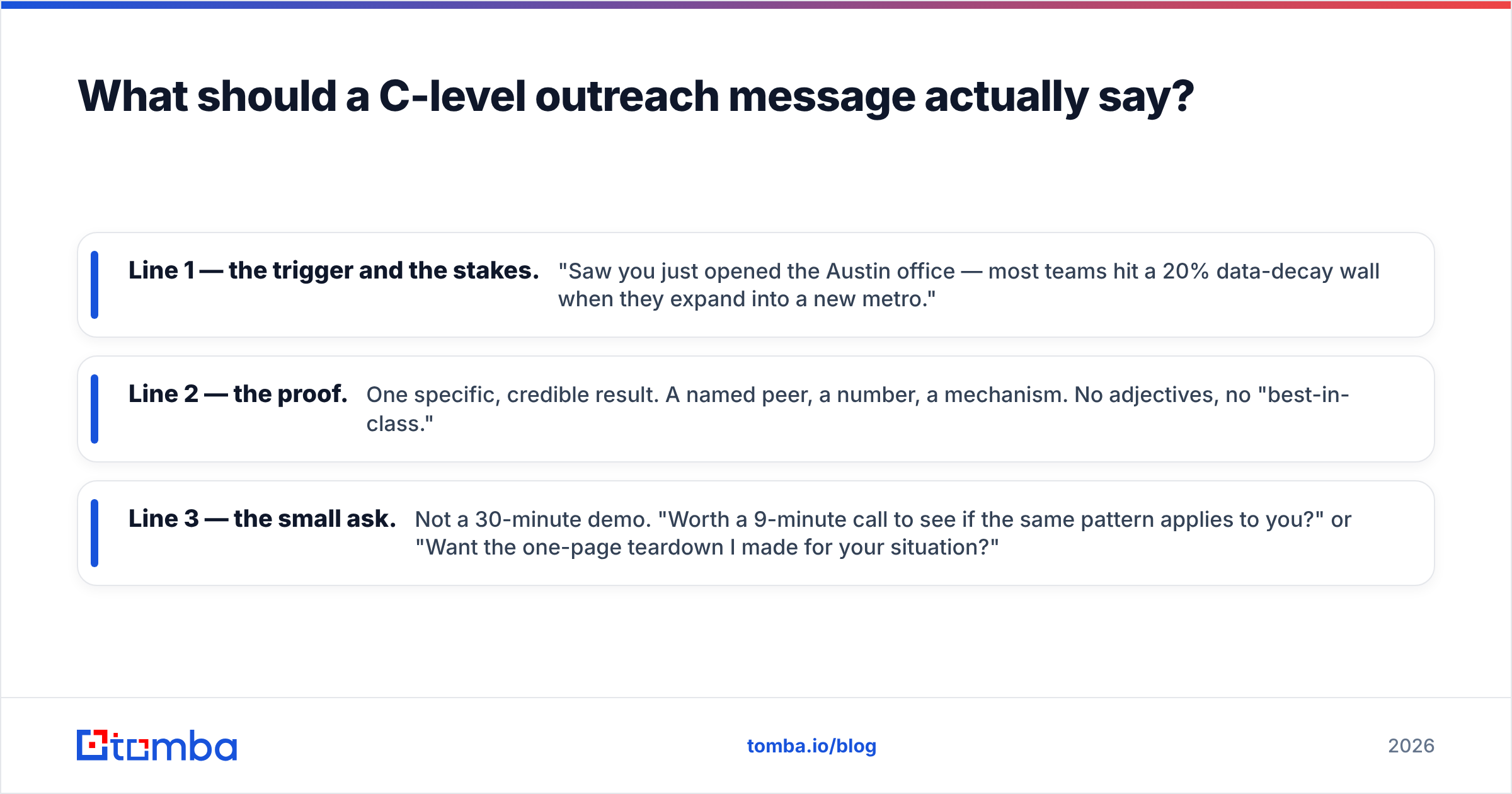
A structure that works:
- Line 1 — the trigger and the stakes. "Saw you just opened the Austin office — most teams hit a 20% data-decay wall when they expand into a new metro."
- Line 2 — the proof. One specific, credible result. A named peer, a number, a mechanism. No adjectives, no "best-in-class."
- Line 3 — the small ask. Not a 30-minute demo. "Worth a 9-minute call to see if the same pattern applies to you?" or "Want the one-page teardown I made for your situation?"
What to cut: your company history, your funding, your feature list, the word "synergy," and any sentence that could be sent to a hundred other people. If the message would still make sense with the recipient's name swapped out, it's not C-level outreach — it's spam with a first name.
One more rule: respect the email deliverability basics. Even a brilliant message fails if it lands in spam. Verify addresses before sending, keep volume sane from a warmed domain, and don't burn your sender reputation blasting unverified lists at executives. The fastest way to get locked out of the C-suite is to get flagged once.
How do you handle gatekeepers and multithreading?#
Treat gatekeepers as routers, not obstacles, and never put all your weight on a single contact. Executive assistants control calendars, but they also know exactly who owns a problem. Being honest and specific — "I'm trying to reach whoever owns supply-chain risk, is that Dana or someone on her team?" — gets you routed faster than any clever workaround.
Multithreading is the real insurance policy in C-level sales. Because the executive delegates, you want two or three relationships inside the account:
- The economic buyer (the C-level) who holds the budget and the urgency.
- The champion (often a director or VP) who runs the evaluation and sells internally when you're not there.
- The technical/financial validator who has to bless the decision and can quietly kill it.
If you only know the executive, the deal stalls every time they get pulled into a board prep. If you only know the champion, the deal dies when budget season hits and there's no executive sponsor. You need both, which means you need accurate contact data for a buying group — not a single hero contact. Tools that support bulk lead generation and a clean B2B database make mapping and reaching a full buying committee practical instead of a manual slog.
What metrics actually predict C-level win rates?#
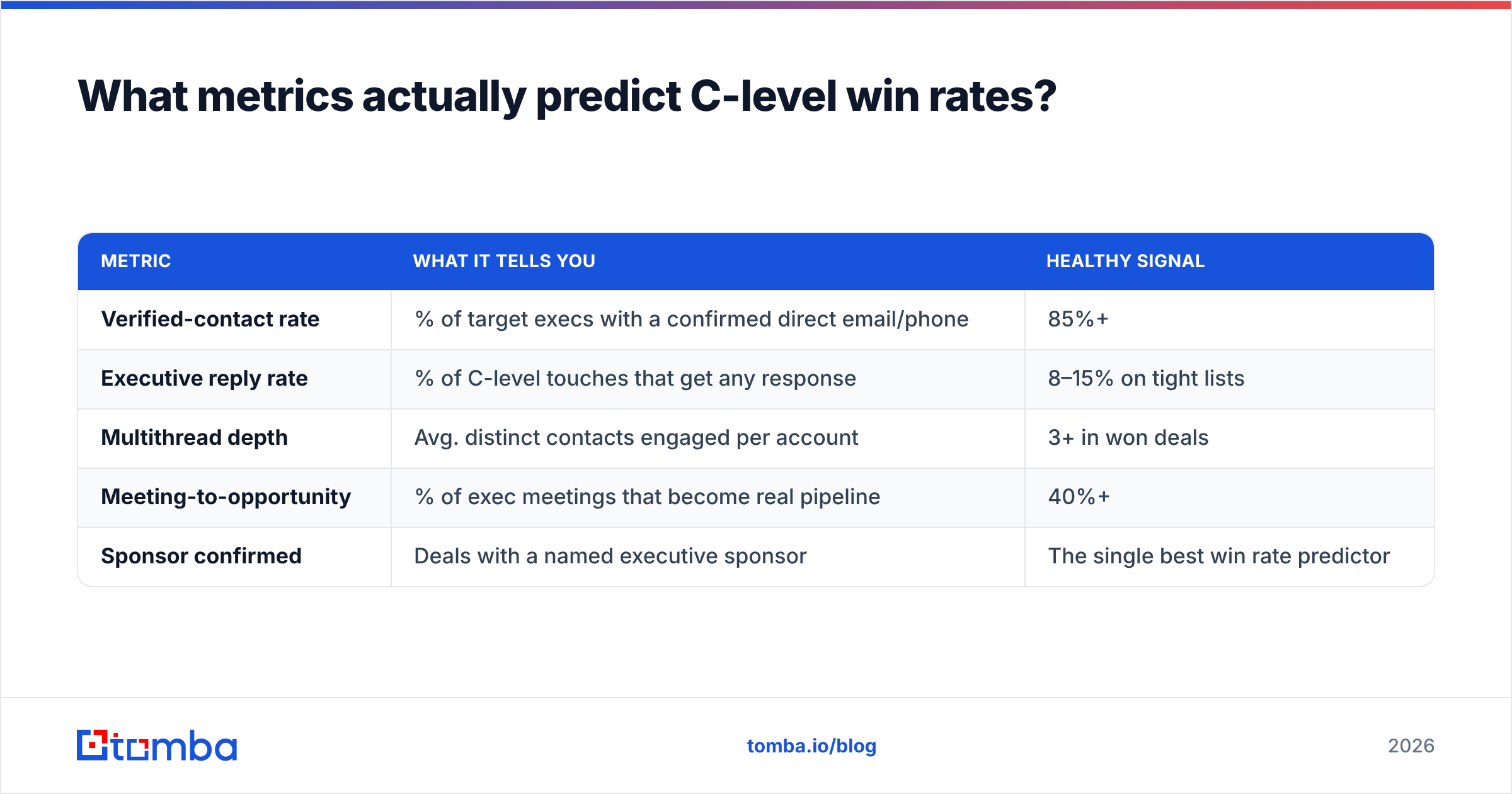
Stop counting activity and start counting access. In SMB sales, dials and emails sent correlate with results. In C-level sales they don't — you can send a thousand emails and never reach a buyer. The metrics that matter measure quality of access and progression.
| Metric | What it tells you | Healthy signal |
|---|---|---|
| Verified-contact rate | % of target execs with a confirmed direct email/phone | 85%+ |
| Executive reply rate | % of C-level touches that get any response | 8–15% on tight lists |
| Multithread depth | Avg. distinct contacts engaged per account | 3+ in won deals |
| Meeting-to-opportunity | % of exec meetings that become real pipeline | 40%+ |
| Sponsor confirmed | Deals with a named executive sponsor | The single best win rate predictor |
Notice that two of the five are pure data-quality metrics. That's not an accident. Verified-contact rate sits upstream of everything else — if you can't reliably reach the right executives, no amount of messaging skill recovers the funnel. Research from HubSpot consistently shows that data decay and bad contact information are among the top reasons outbound sequences underperform, and the effect compounds at the executive level where addresses change with every promotion and reorg.
A simple C-level sales playbook you can run this quarter#
Putting it together, here's a 30-day loop you can actually execute:
- Pick 25 dream accounts. Quality over quantity — you'll go deep, not wide.
- Map each buying group. Identify the economic buyer, likely champion, and validator for all 25.
- Verify every contact. Run the list through an email verifier and confirm direct phone lines. Aim for that 85%+ verified rate before sending a single message.
- Find a trigger per account. No trigger, no touch — park it and revisit when one appears.
- Write 25 thesis lines. One sentence each on why their number is at risk. If you can't, you don't understand the account yet.
- Run a 3-channel, 3-touch sequence. Email, phone, LinkedIn — same thesis, different framing, spaced over two weeks.
- Multithread on every reply. The moment one contact engages, bring in a second. Never let a deal ride on one relationship.
- Measure access, not activity. Track verified-contact rate, exec reply rate, and sponsor-confirmed deals weekly.
Run that loop, and the difference shows up fast: fewer, better conversations with people who can actually fund a decision.
The bottom line on C-level sales#
C-level sales rewards precision and punishes volume. The reps who win at this level aren't sending more — they're researching deeper, reaching the exact right person, and arriving with a thesis the executive can't ignore. Everything downstream depends on the upstream basics: knowing who to reach and being able to actually reach them.
That's where your data foundation decides the outcome before the conversation even starts. If your team is spending hours hunting for executive emails, guessing at formats, or watching sequences die against bad addresses, fix the input first. Start with the Tomba Email Finder to locate and verify the direct emails of the C-suite contacts you're targeting — then layer in phone and enrichment so every executive touch lands where it should. The free tier gives you 25 searches a month to test it on your top accounts; the Tomba pricing scales from $49/mo when you're ready to run the full playbook across your pipeline. Precision in, executives out.
// get started
Find, verify and enrich your first contacts today
Start on the free plan with 25 searches a month, then scale when your team is ready.
Free plan · No credit card required · GDPR & CCPA
// about the author