C Level Titles in 2026: The Complete Executive Org Chart Guide
A plain-English breakdown of every C level title in 2026 — what each chief officer owns, who reports to whom, and how to reach them in B2B sales.

C Level Titles in 2026: The Complete Executive Org Chart Guide
If you sell to, report to, or want to join the executive team, you need to know exactly what each C level title means in 2026 — because the list has grown well past CEO, CFO, and CTO.
TL;DR
- "C level titles" are the senior-most executive roles in a company, all starting with Chief and ending in Officer (the "C" and the "O" in the C-suite).
- The classic four are CEO, CFO, COO, and CTO, but modern orgs now add CRO, CMO, CISO, CPO, CHRO, CDO, and more.
- Each title maps to a budget, a domain, and a buying decision — knowing which is which is the difference between a relevant pitch and a deleted email.
- Bigger companies have more C-level roles; startups often stack three or four functions onto one person.
- To reach the C-suite reliably you need accurate contact data — guessing email formats wastes sends and burns your sender reputation.
What are C level titles?#
C level titles are the top executive positions in an organization, each prefixed with "Chief" and the person's domain, and suffixed with "Officer." The "C" stands for Chief; the term "C-suite" simply describes this group collectively, the way "the cabinet" describes a government's senior ministers.
Think of a company as an airline. The board of directors decides where the airline should fly (strategy and oversight). The C-suite is the cockpit crew that actually flies the plane — each officer responsible for a different system: the captain (CEO), the money systems (CFO), daily operations (COO), and the technology that keeps everything in the air (CTO). Everyone below them are the cabin and ground crews executing the plan.
C-level executives share three traits regardless of the specific title:
- They own a P&L or a company-wide function. A VP runs a team; a chief officer runs a discipline across the entire business.
- They report to the CEO or the board, not to another manager.
- They hold real budget authority — they can approve, veto, or champion a purchase without escalating.
That last point is why C level titles matter so much in B2B sales. According to Gartner, the typical B2B buying group now involves six to ten decision-makers, and the C-suite member is usually the one who signs. Get the title wrong and your message lands with someone who literally cannot say yes.
What are the most common C level titles?#
The "core four" anchor almost every org chart, and most other C-suite roles branched off from them over the past two decades. Here is the foundational set, with the one-line job each one actually owns:
- CEO — Chief Executive Officer. The final decision-maker; owns vision, strategy, and overall performance. Everyone else ultimately reports up to this person.
- CFO — Chief Financial Officer. Owns the money: budgeting, reporting, fundraising, and financial risk. The gatekeeper for most large purchases.
- COO — Chief Operating Officer. Runs day-to-day operations so the CEO can focus on strategy. Often the internal "how do we execute this" leader.
- CTO — Chief Technology Officer. Owns the product technology and engineering direction — what gets built and how.
- CMO — Chief Marketing Officer. Owns brand, demand generation, and the market narrative.
- CRO — Chief Revenue Officer. Owns all revenue-generating functions (sales, often marketing and customer success) under one number.

Wait — ignore that placeholder; here is the meme that actually belongs:
The exact mix depends on the company. A SaaS startup may collapse the CRO, CMO, and COO roles into one "head of go-to-market." A 50,000-person enterprise might have all six plus another dozen specialized chiefs.
What is the full list of C level titles in 2026?#
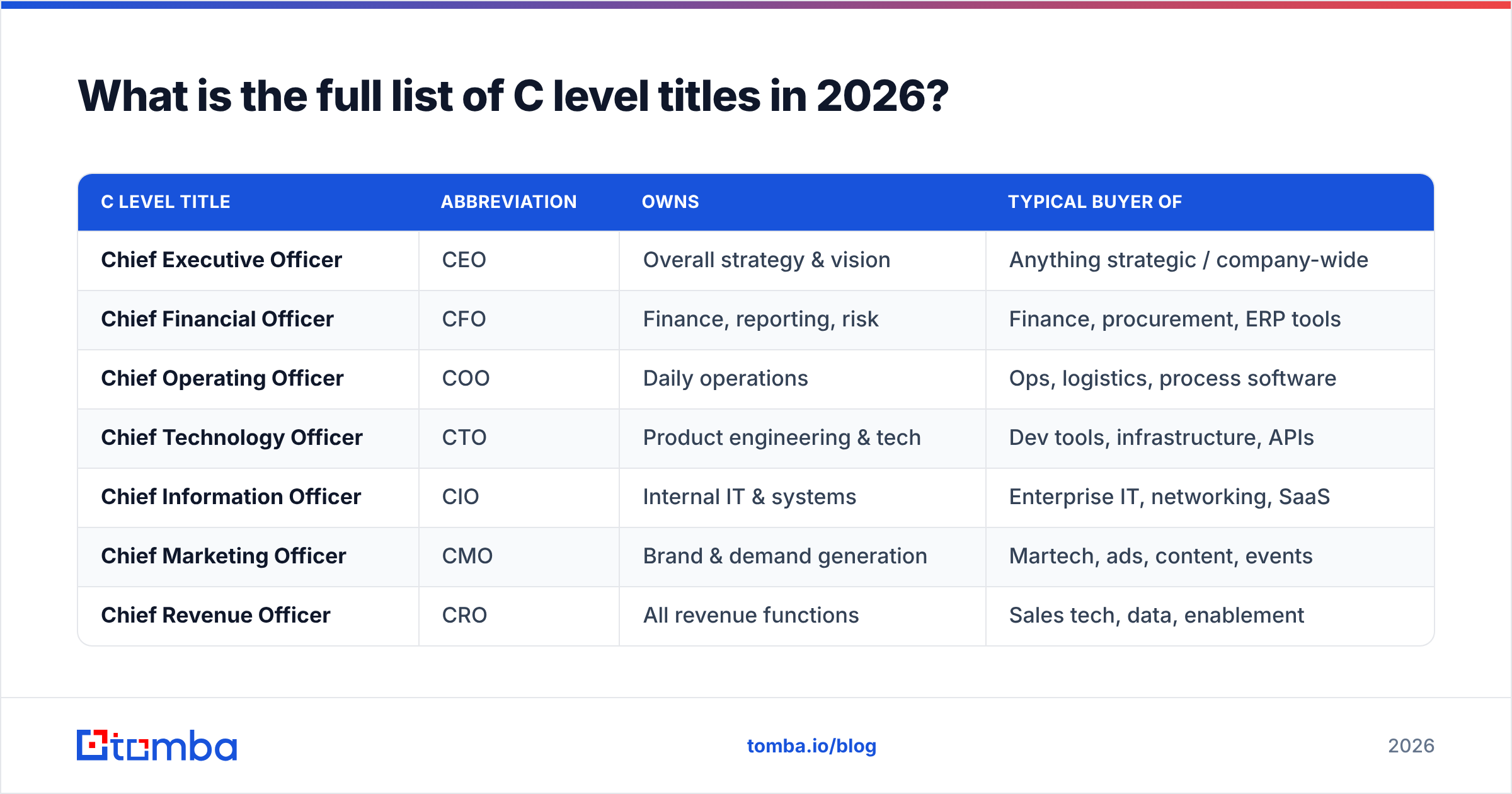
The C-suite has expanded as new disciplines became board-level concerns — security, data, privacy, and customer experience all earned their own chief in the last decade. Here is a fuller reference table you can use when qualifying or routing a contact.
| C level title | Abbreviation | Owns | Typical buyer of |
|---|---|---|---|
| Chief Executive Officer | CEO | Overall strategy & vision | Anything strategic / company-wide |
| Chief Financial Officer | CFO | Finance, reporting, risk | Finance, procurement, ERP tools |
| Chief Operating Officer | COO | Daily operations | Ops, logistics, process software |
| Chief Technology Officer | CTO | Product engineering & tech | Dev tools, infrastructure, APIs |
| Chief Information Officer | CIO | Internal IT & systems | Enterprise IT, networking, SaaS |
| Chief Marketing Officer | CMO | Brand & demand generation | Martech, ads, content, events |
| Chief Revenue Officer | CRO | All revenue functions | Sales tech, data, enablement |
| Chief Information Security Officer | CISO | Security & compliance | Security, identity, audit tools |
| Chief Product Officer | CPO | Product roadmap & UX | Analytics, research, design tools |
| Chief Human Resources Officer | CHRO | People, talent, culture | HRIS, recruiting, L&D platforms |
| Chief Data Officer | CDO | Data strategy & governance | Data platforms, BI, warehouses |
| Chief Customer Officer | CCO | Customer success & retention | CS platforms, support, community |
A few notes that trip people up:
- CTO vs CIO. The CTO usually owns the technology you sell to customers; the CIO owns the technology your own employees use internally. In smaller firms one person wears both hats.
- CRO vs CMO vs VP Sales. The CRO is the unifier — when a company hires one, it usually means sales, marketing, and success now share a single revenue target. If you sell sales automation or data, the CRO is often your economic buyer.
- CISO's rising authority. As breaches became board-level events, the CISO moved from "reports to the CIO" to "reports to the CEO" at many enterprises. For a deeper history of how these titles evolved, Wikipedia's corporate title entry is a solid neutral reference.
How do C level titles differ from VP and director titles?#
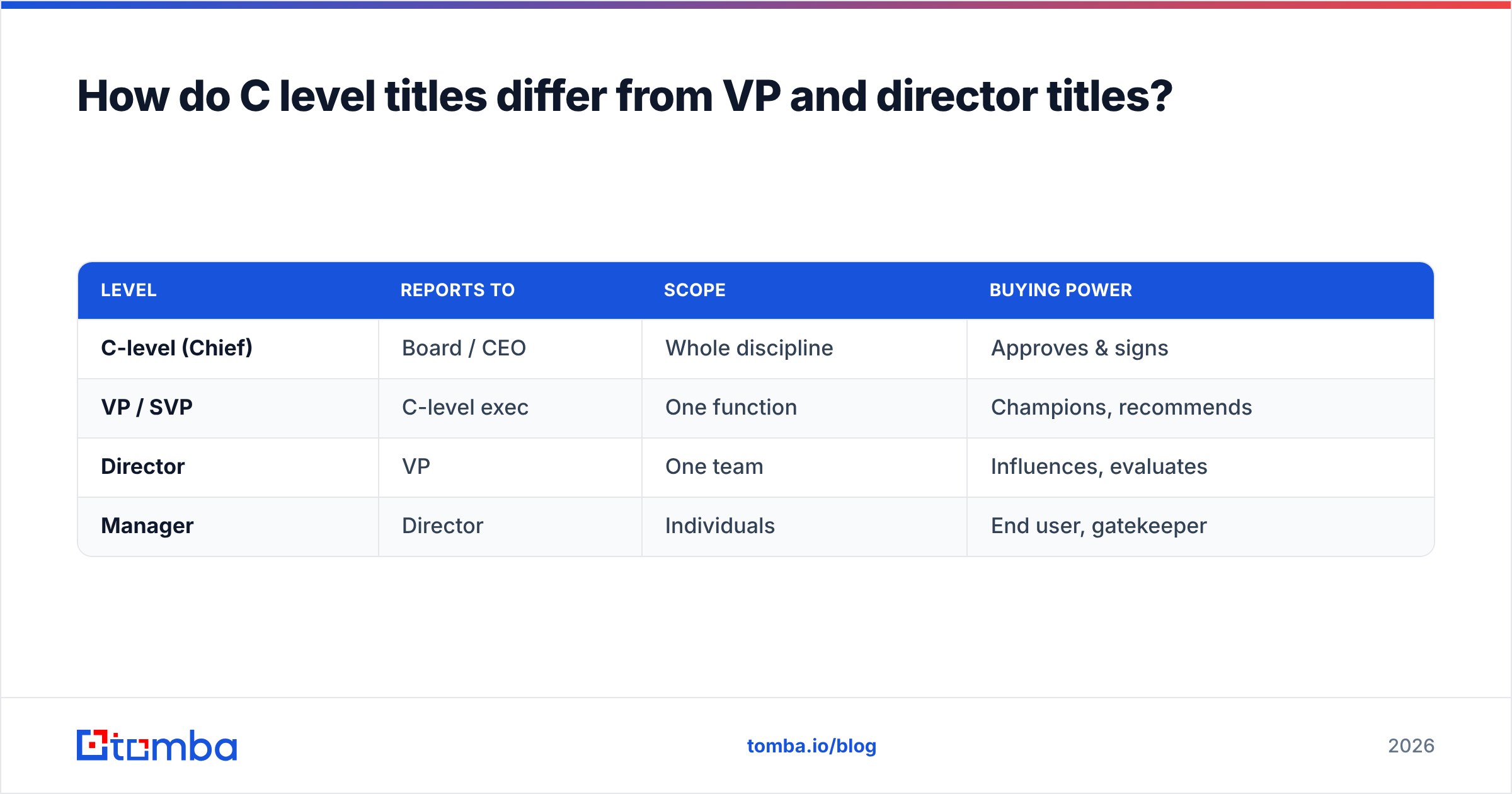
The difference is scope and accountability, not just seniority. A C-level executive owns an entire discipline and answers to the board; a VP owns a function within that discipline; a director owns a team within that function.
Picture a hospital. The CMO (Chief Medical Officer) sets standards for all patient care across the building. A VP of Surgery runs the surgical department. A director of nursing manages one floor's nurses. All three are "leaders," but only one is accountable for the whole institution's outcomes.
| Level | Reports to | Scope | Buying power |
|---|---|---|---|
| C-level (Chief) | Board / CEO | Whole discipline | Approves & signs |
| VP / SVP | C-level exec | One function | Champions, recommends |
| Director | VP | One team | Influences, evaluates |
| Manager | Director | Individuals | End user, gatekeeper |
For prospecting, this hierarchy is your routing map. The director often becomes your champion — the person who feels the pain daily and builds the internal case. The VP recommends. The C-level exec decides. Sending a "let's hop on a quick call" cold email to a CEO when your real champion is a director frequently fails; the title is too senior for the message. HubSpot's research on the modern B2B buying committee consistently shows that mapping the right message to the right title beats blasting the most senior name you can find.
Which C level titles are emerging in 2026?#
New chiefs appear whenever a topic becomes too strategic to delegate. The fastest-growing C level titles right now reflect AI, data, and customer obsession:
- CAIO — Chief AI Officer. Owns the company's AI strategy, governance, and adoption. Practically nonexistent five years ago, now common in large enterprises.
- CDO — Chief Digital Officer (distinct from Chief Data Officer, confusingly same abbreviation). Leads digital transformation across products and operations.
- CSO — Chief Sustainability Officer. Owns ESG commitments and reporting, increasingly tied to regulatory and investor pressure.
- CXO — Chief Experience Officer. Unifies the end-to-end customer journey across marketing, product, and support.
- CPO — Chief People Officer. A rebrand of CHRO emphasizing culture and employee experience over administrative HR.

The lesson for sellers: don't assume a title doesn't exist just because it didn't last year. When you run a LinkedIn finder search or pull an org chart, expect to see chiefs you've never heard of — and treat each one as a clue about what that company is prioritizing this year.
How do you actually reach C level executives?#
You reach the C-suite with accurate contact data, a relevant message tied to their specific domain, and persistence across channels. The title tells you what they care about; the data tells you where to send it.
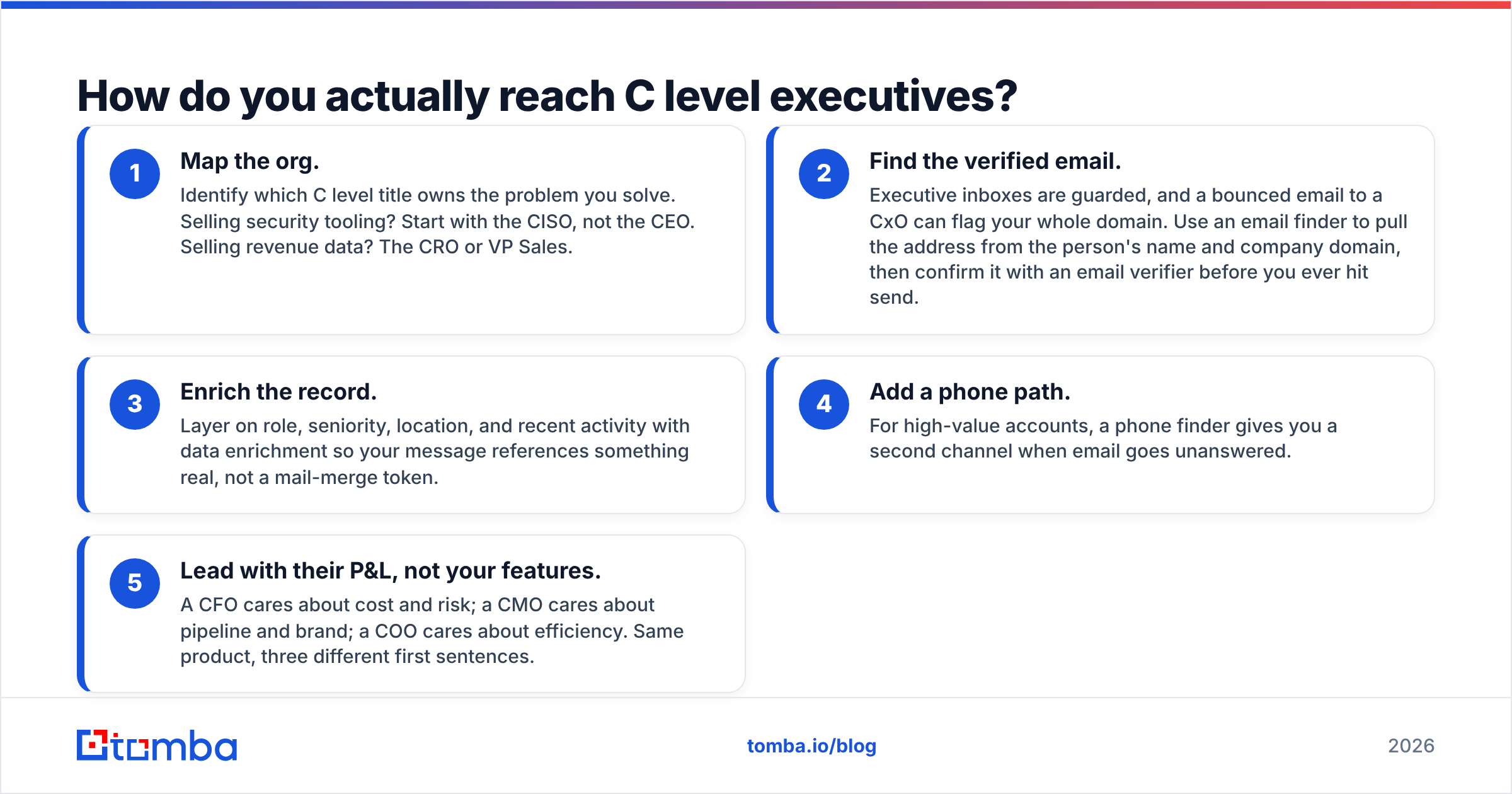
Here is the practical workflow most outbound teams use:
- Map the org. Identify which C level title owns the problem you solve. Selling security tooling? Start with the CISO, not the CEO. Selling revenue data? The CRO or VP Sales.
- Find the verified email. Executive inboxes are guarded, and a bounced email to a CxO can flag your whole domain. Use an email finder to pull the address from the person's name and company domain, then confirm it with an email verifier before you ever hit send.
- Enrich the record. Layer on role, seniority, location, and recent activity with data enrichment so your message references something real, not a mail-merge token.
- Add a phone path. For high-value accounts, a phone finder gives you a second channel when email goes unanswered.
- Lead with their P&L, not your features. A CFO cares about cost and risk; a CMO cares about pipeline and brand; a COO cares about efficiency. Same product, three different first sentences.
The most common failure mode is data, not messaging. Teams write a sharp email to the right title and then send it to a guessed address like firstname@company.com that bounces. According to vendor benchmarks aggregated on G2, invalid-email rates above a few percent measurably hurt deliverability. Verified data is the unglamorous foundation that makes every other step work.
How many C level titles should a company have?#
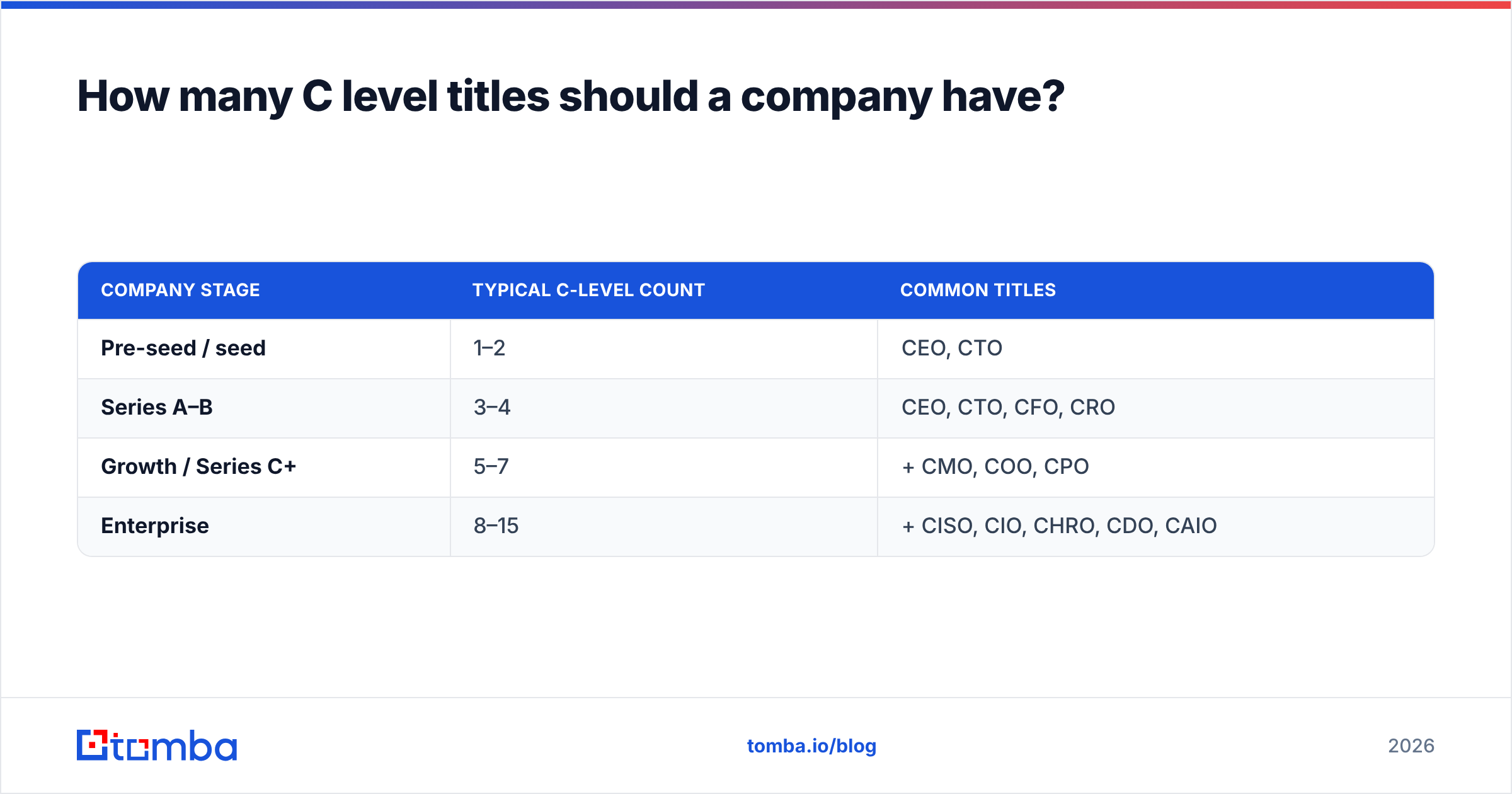
As few as the business genuinely needs — title inflation is real and signals little about actual scale. A 12-person startup with eight "Chief" titles is usually a red flag, not a sign of depth. A useful rule of thumb by company stage:
| Company stage | Typical C-level count | Common titles |
|---|---|---|
| Pre-seed / seed | 1–2 | CEO, CTO |
| Series A–B | 3–4 | CEO, CTO, CFO, CRO |
| Growth / Series C+ | 5–7 | + CMO, COO, CPO |
| Enterprise | 8–15 | + CISO, CIO, CHRO, CDO, CAIO |
For prospecting, the count itself is a signal. If you find a company that just hired its first CRO or CISO, that's a buying trigger — a new chief almost always brings new budget and a mandate to buy tools that prove their early impact. Pulling a domain search across the company's leadership page is one of the fastest ways to spot these fresh hires before your competitors do.
Frequently asked questions about C level titles#
What does the "C" in C level stand for? Chief. Every C-suite title follows the pattern Chief + [Domain] + Officer, such as Chief Financial Officer.
Is a President a C level title? Not technically — "President" doesn't follow the Chief/Officer format, though in many companies the President holds C-level authority and may also be the COO or CEO.
Who is the most senior C level executive? The CEO, who reports to the board of directors and to whom the other chiefs report.
Do startups need C level titles? Functionally yes, formally no. Early teams often use "co-founder" or "head of" until the role's scope justifies a chief title.
Which C level executive controls the budget? The CFO controls overall budget and approves spend, but each chief typically owns a discretionary budget for their own domain.
Reach the right chief with the right data#
Knowing C level titles is only half the job — the other half is getting your message into the right executive inbox without bouncing. Tomba Email Finder turns a name and a company domain into a verified, ready-to-send email address, so your sharp, title-specific pitch actually reaches the CRO, CISO, or CFO you researched. Pair it with built-in verification, enrichment, and phone lookup, and you have a clean path from "I know who decides" to "I'm in their inbox."
Start free with 25 searches a month, then scale on the Starter plan at $49/mo as your pipeline grows — see full Tomba pricing for every tier. Map the org, find the email, verify it, and spend your energy on the message instead of guessing the address.
Ready to find emails that actually work?
Join 150,000+ professionals who stopped guessing and started sending. Free credits on signup — no credit card required.
Get the Tomba newsletter
Practical outbound tactics and product updates — once every two weeks.
About the author