Call Follow Up Email: A 2026 Guide to Winning More Deals
Most deals stall in the silence after a sales call. Here is a 2026 playbook for call follow up timing, templates, and the tools that make it automatic.
You had a great call. The prospect was nodding, asking questions, even floating timelines. Then you hung up, got pulled into the next meeting, and three days later the thread is dead. The call did not fail. The call follow up did.
This guide breaks down exactly how to follow up after a sales call in 2026 — the timing, the structure, the templates, and the automation that keeps a single rep on top of dozens of open conversations at once.
TL;DR#
- Send your first call follow up within 24 hours — response rates drop sharply after that window.
- Lead with their words, not yours. Recap the prospect's goals and objections before pitching anything.
- Always include one clear next step (a calendar link, a deliverable, a decision) — never end on "let me know."
- Sequence, don't single-shot. Plan 3–5 touches across email, phone, and LinkedIn over two to three weeks.
- Automate the busywork — logging, reminders, and contact data — so you spend your energy on the message, not the admin.
What is a call follow up, and why does it decide the deal?#
A call follow up is any message — email, call, or social touch — you send after a sales conversation to keep momentum and move the buyer to the next stage. Think of it like watering a plant the day after you plant the seed. The seed (the call) does nothing on its own; consistent follow-through is what makes it grow.
Here is the uncomfortable math. Buyers talk to multiple vendors, sit through internal reviews, and forget 80% of a conversation within a day. Your follow up is what survives that decay. According to HubSpot's sales research, a large share of deals require five or more touches to close, yet most reps stop after one or two. The gap between those two numbers is where quota goes to die.
A strong call follow up does three jobs at once:
- Confirms shared understanding — you restate what was agreed so nobody re-litigates it later.
- Reduces buyer effort — you hand over next steps, resources, and answers so they do not have to chase you.
- Creates a deadline — you replace open-ended "we'll be in touch" energy with a specific date and action.
Miss any of those and the conversation quietly cools.
)
When should you send a call follow up?#
Conclusion first: send the first follow up the same day, ideally within a few hours, and never later than 24 hours. Recall is freshest then, and speed signals that you are organized and serious.
After that first touch, spacing matters more than frequency. Bunch your messages too tightly and you look desperate; space them too far apart and you get forgotten. A reliable cadence for a typical B2B deal looks like this:
- Touch 1 — within 24 hours: recap email with next steps and any promised materials.
- Touch 2 — day 3: value-add (a relevant case study, a quick answer to an open objection).
- Touch 3 — day 5–6: a short nudge on a different channel (LinkedIn or a quick call).
- Touch 4 — day 9–10: a pattern-interrupt or "should I close your file?" message.
- Touch 5 — day 14+: a break-up email that leaves the door open.
The right number of touches depends on deal size. A $200/month SaaS deal might close on touch two; a six-figure enterprise contract might need a dozen touches across several stakeholders. The principle holds: plan the sequence before you need it so you are never improvising at 5pm on a Friday.
What does a great call follow up email look like?#
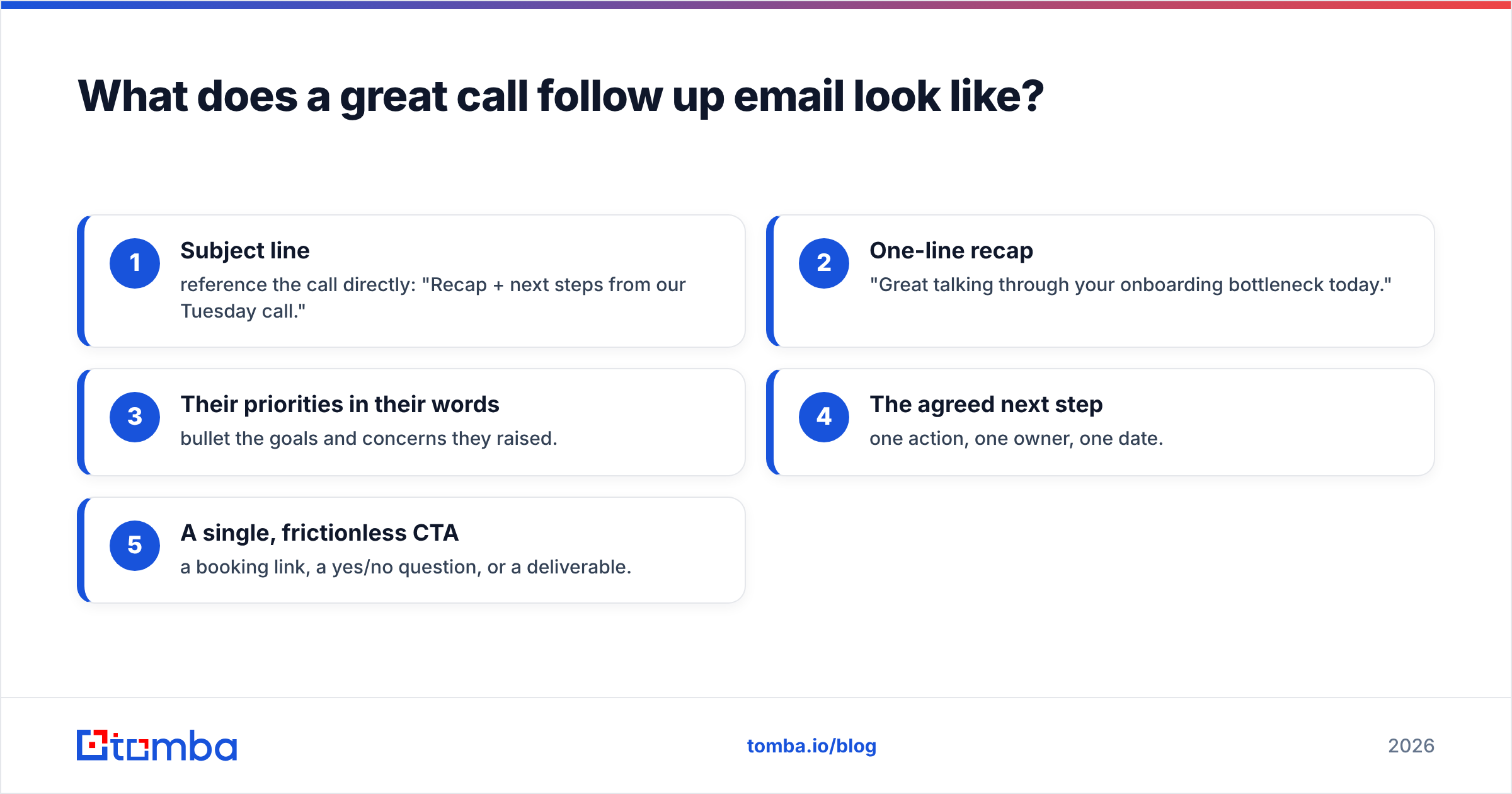
The best follow ups are short, specific, and built around the buyer — not a wall of text about your product. Use this five-part skeleton:
- Subject line — reference the call directly: "Recap + next steps from our Tuesday call."
- One-line recap — "Great talking through your onboarding bottleneck today."
- Their priorities in their words — bullet the goals and concerns they raised.
- The agreed next step — one action, one owner, one date.
- A single, frictionless CTA — a booking link, a yes/no question, or a deliverable.
You can sharpen each line with a subject line generator and pressure-test the body for spammy phrasing before you hit send. If you want a head start on the wording, a library of cold email templates gives you proven structures to adapt rather than writing from a blank page.
Here is a recap template you can lift today:
Subject: Recap + next steps from our call
Hi {{First name}},
Thanks for the time today. To make sure I captured it right, here's what I heard matters most to you:
- Cutting manual data entry for your SDR team
- Getting cleaner contact data into {{CRM}}
- A rollout that doesn't disrupt Q3
Next step: I'll send a tailored ROI breakdown by Thursday, and we'll reconnect Monday at 10am ({{calendar link}}) to review it with {{stakeholder}}.
Anything I missed? Reply and I'll adjust.
Notice it never says "just following up" or "circling back." Those phrases add words without adding a reason to reply.
Email, phone, or LinkedIn — which channel wins?#
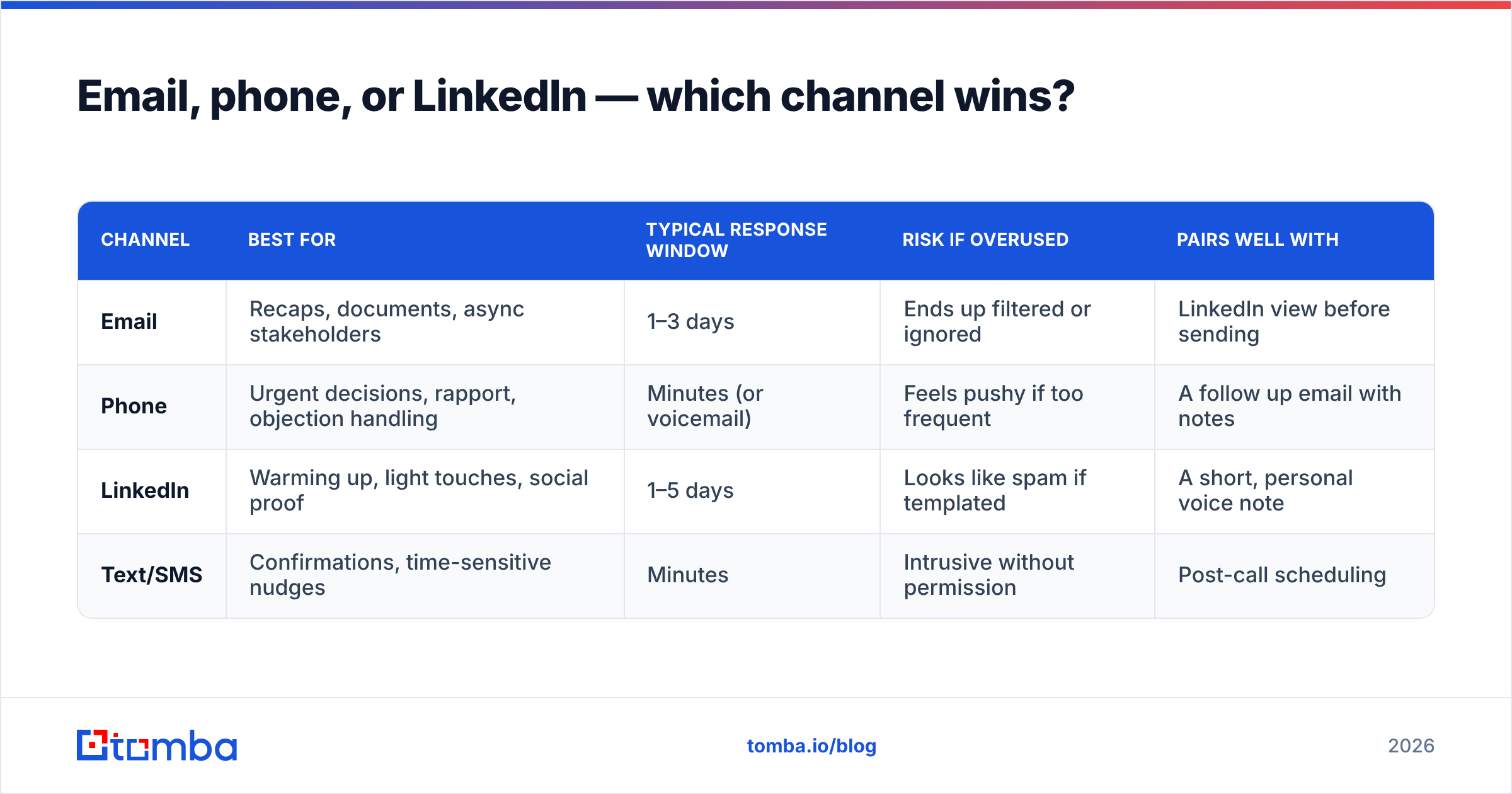
None of them wins alone. The reps who book the most second meetings work the channels together, because each one reaches the buyer in a different context. The table below compares them so you can build a deliberate multi-channel cadence instead of hammering one inbox.
| Channel | Best for | Typical response window | Risk if overused | Pairs well with |
|---|---|---|---|---|
| Recaps, documents, async stakeholders | 1–3 days | Ends up filtered or ignored | LinkedIn view before sending | |
| Phone | Urgent decisions, rapport, objection handling | Minutes (or voicemail) | Feels pushy if too frequent | A follow up email with notes |
| Warming up, light touches, social proof | 1–5 days | Looks like spam if templated | A short, personal voice note | |
| Text/SMS | Confirmations, time-sensitive nudges | Minutes | Intrusive without permission | Post-call scheduling |
A practical rhythm: email the recap, connect on LinkedIn the next day, and reserve the phone for moments that genuinely need a live decision. To work the phone channel at all, you need accurate direct dials — a phone finder pulls verified B2B numbers so your "quick call" does not dead-end at a disconnected line.
How do you write a follow up that gets replies, not silence?#
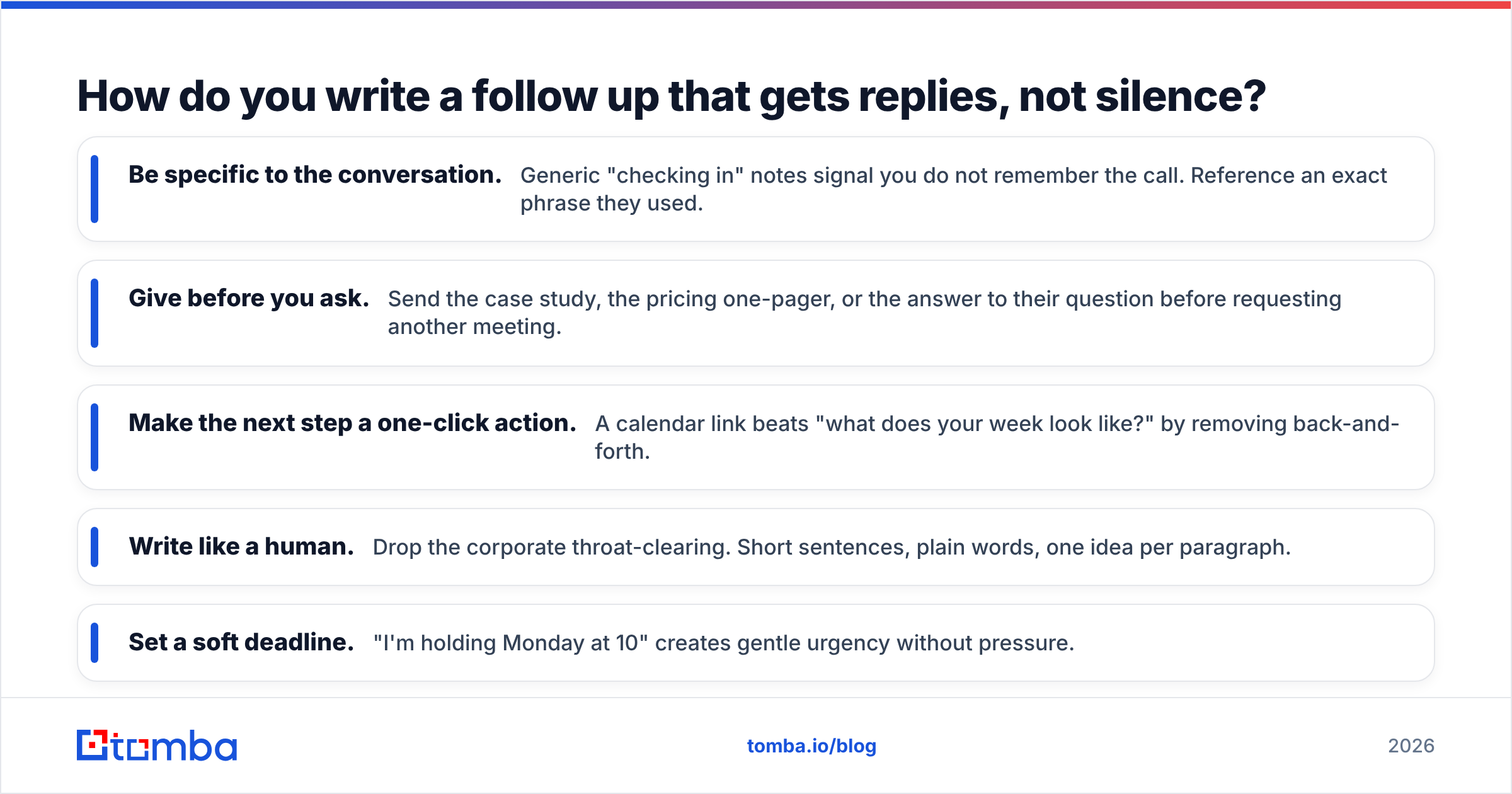
The difference between a follow up that converts and one that gets ignored usually comes down to five habits.
- Be specific to the conversation. Generic "checking in" notes signal you do not remember the call. Reference an exact phrase they used.
- Give before you ask. Send the case study, the pricing one-pager, or the answer to their question before requesting another meeting.
- Make the next step a one-click action. A calendar link beats "what does your week look like?" by removing back-and-forth.
- Write like a human. Drop the corporate throat-clearing. Short sentences, plain words, one idea per paragraph.
- Set a soft deadline. "I'm holding Monday at 10" creates gentle urgency without pressure.
Tracking your email response rate across these variables tells you which habits actually move the needle for your market. What works for a 30-day SaaS cycle will not match a nine-month enterprise procurement slog, so measure rather than assume.
)
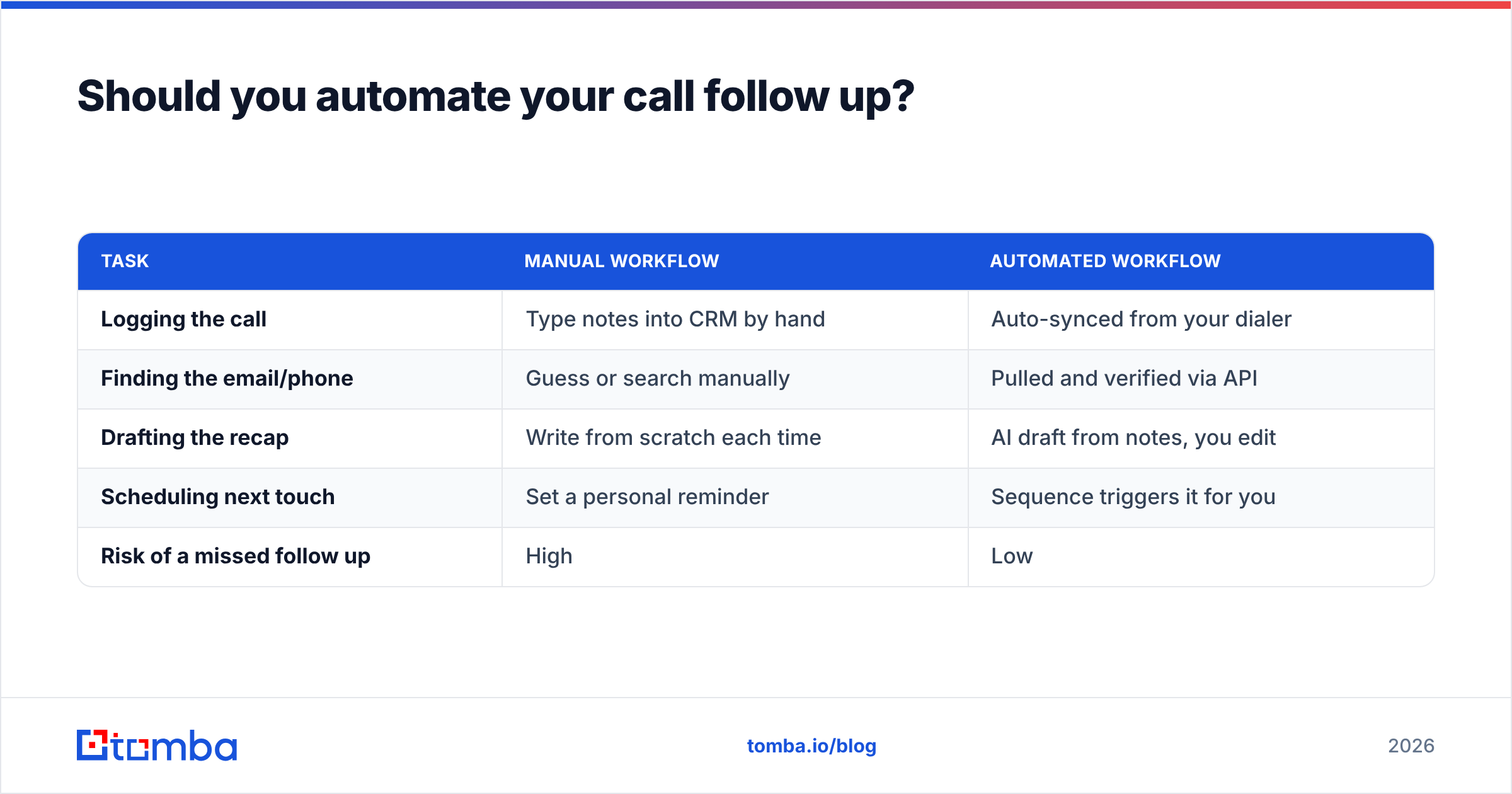
Should you automate your call follow up?#
Yes — automate the mechanics, keep the message human. The goal is not to blast identical emails to everyone. It is to eliminate the reasons follow ups slip: you forgot, you ran out of time, or the contact data was wrong.
Three layers are worth automating:
- Reminders and sequencing. Let your CRM or sequencing tool queue the next touch so nothing falls through the cracks. Connecting Tomba to your stack through a HubSpot integration or Salesforce integration keeps every call logged and every follow up scheduled automatically.
- Contact data. A follow up to the wrong address or a stale number is wasted effort. Enriching records with a reliable email finder and verifying them before send protects your sender reputation and your time.
- First-draft copy. AI can draft the recap from your call notes in seconds, leaving you to personalize the parts that matter.
Compare the manual approach against an automated one:
| Task | Manual workflow | Automated workflow |
|---|---|---|
| Logging the call | Type notes into CRM by hand | Auto-synced from your dialer |
| Finding the email/phone | Guess or search manually | Pulled and verified via API |
| Drafting the recap | Write from scratch each time | AI draft from notes, you edit |
| Scheduling next touch | Set a personal reminder | Sequence triggers it for you |
| Risk of a missed follow up | High | Low |
The automated column does not make you less personal. It frees the 20 minutes per deal you used to spend on admin so you can spend it on the one paragraph that actually wins the reply. Tools like Gong handle the call-intelligence side, while a data platform handles the contact accuracy side — and the two complement each other.
What mistakes kill a call follow up?#
Even disciplined reps lose deals to a handful of avoidable errors.
- Waiting too long. Every day of silence erodes recall and lets a competitor get there first.
- Making it about you. "I wanted to share more about our features" centers your agenda, not their problem.
- No clear ask. "Let me know your thoughts" puts the work on the buyer. Hand them a decision instead.
- Identical mass sends. Buyers can smell a mail-merge. One specific detail beats ten generic compliments.
- Giving up at touch two. The deals are in the follow-through most reps never reach.
- Bad data. Bounced emails and wrong numbers quietly sink your sequence and your domain reputation.
Fixing the last point is the cheapest win available. Reviewing where your contact data comes from and verifying it up front means your perfectly written follow up actually lands in front of a human.
How do you scale follow ups across a whole pipeline?#
One rep can hold maybe a dozen conversations in their head. A full pipeline has hundreds. Scaling without dropping the ball comes down to systematizing what you already do well on your best deals.
Build a repeatable playbook: a named cadence per deal type, templates for each touch, and clear triggers for when to escalate to a call or loop in a manager. Connect your prospecting data, your CRM, and your sequencing tool so a closed call automatically spawns the next follow up with the right contact details attached. When the system handles the routing, every rep on the team follows up like your best rep — consistently, on time, with accurate data.
That consistency compounds. A team that reliably reaches touch five instead of stopping at touch two does not just close a few more deals; it changes the whole pipeline's conversion math.
Put your call follow up on autopilot#
A great call is only the opening move. The deals go to whoever follows up faster, sharper, and more consistently — and that is a system you can build, not a talent you are born with.
Start by fixing the foundation: accurate contact data so every follow up reaches the right person on the right channel. Tomba's Email Finder gives you verified professional emails by name, company, or domain, so your recap email never bounces and your follow up sequence stays alive. Pair it with the phone finder for direct dials, plug it into your CRM, and let the busywork run itself. You write the message that wins the deal; let Tomba make sure it gets delivered. Check the Tomba pricing — including a free tier with 25 searches a month — and turn your next great call into a closed one.
// get started
Find, verify and enrich your first contacts today
Start on the free plan with 25 searches a month, then scale when your team is ready.
Free plan · No credit card required · GDPR & CCPA
// about the author