Candidate Sourcing in 2026: Strategies, Tools & Tactics
Candidate sourcing is the proactive hunt for talent before a role even opens. Here's the 2026 playbook: channels, tools, outreach, and the metrics that prove it works.
TL;DR
- Candidate sourcing is the proactive work of finding and contacting potential hires before you need them — the opposite of waiting on inbound applications.
- The 2026 stack is multi-channel: LinkedIn, GitHub, niche communities, referrals, and your own ATS — stitched together by reliable contact data.
- The single biggest bottleneck is reaching people. A verified email beats an InMail you'll never get a reply to.
- Measure sourcing like a pipeline: response rate, qualified-conversation rate, and time-to-first-interview, not raw profile counts.
- Tools like Tomba Email Finder turn a name and company into a deliverable email so your outreach actually lands.
What is candidate sourcing?#
Candidate sourcing is the proactive process of identifying, researching, and contacting people who could fill a role — usually before they have applied, and often before the role is even posted. Think of it like a chef building relationships with farmers months before a dinner service, instead of sprinting to the market the morning of. The recruiter who sources well never starts from zero.
That is the core distinction worth internalizing: recruiting is reactive, sourcing is proactive. Recruiting processes the people who raise their hand. Sourcing goes and finds the people who never will — the senior engineer who is happily employed, the designer who does not check job boards, the sales leader three referrals away from your network.
Sourcing breaks into a few repeatable moves:
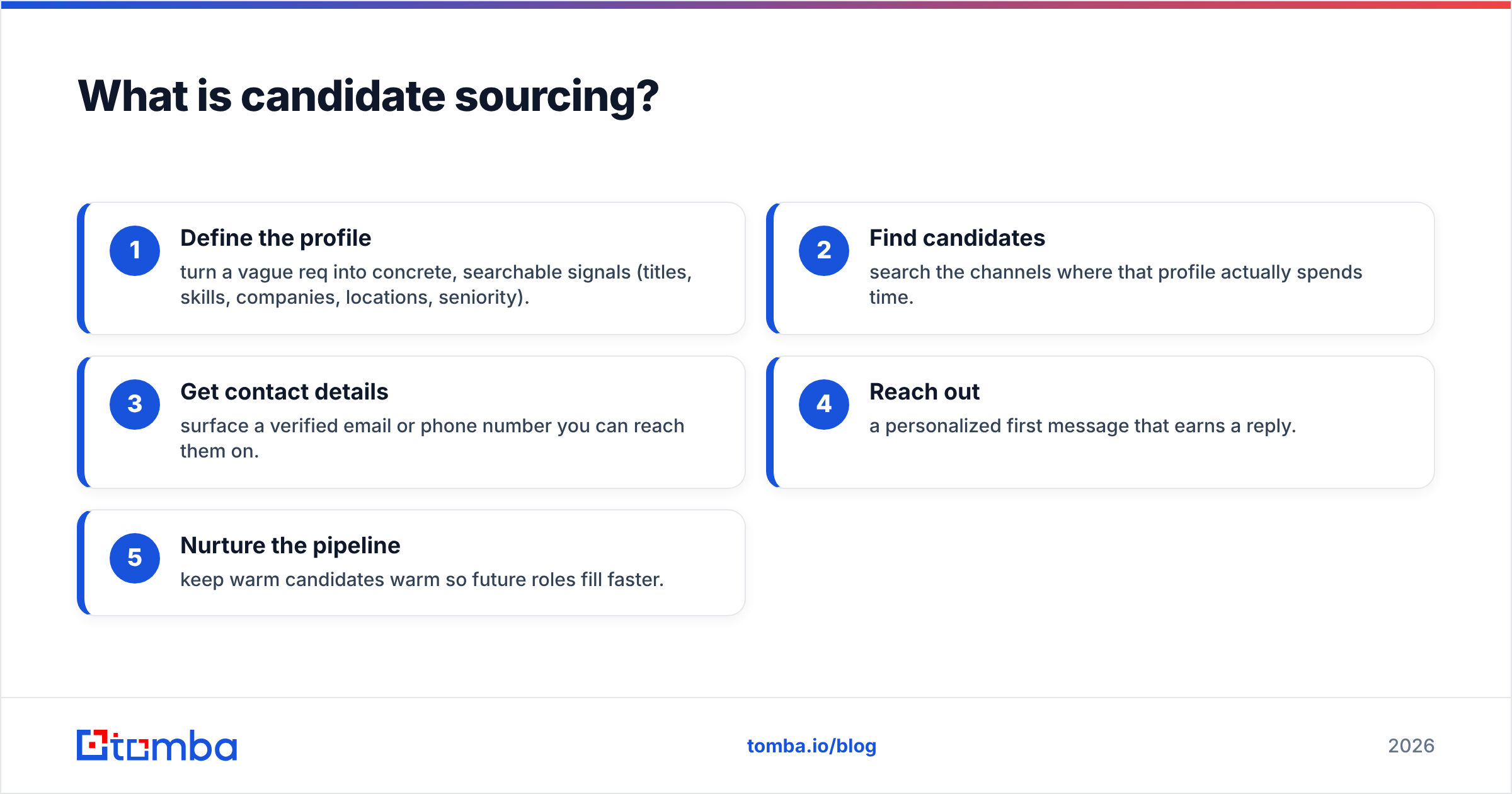
- Define the profile — turn a vague req into concrete, searchable signals (titles, skills, companies, locations, seniority).
- Find candidates — search the channels where that profile actually spends time.
- Get contact details — surface a verified email or phone number you can reach them on.
- Reach out — a personalized first message that earns a reply.
- Nurture the pipeline — keep warm candidates warm so future roles fill faster.
Most teams are decent at step 2 and terrible at steps 3 and 4. That is where good candidates quietly leak out of the funnel.
Why does candidate sourcing matter in 2026?#
Because the best people are not applying. Roughly 70% of the global workforce is made up of passive talent — employed, not actively searching, and invisible to your careers page. If your hiring depends entirely on inbound, you are fishing in the smallest pond available.
Sourcing also compounds. A sourced pipeline you nurtured last quarter is the reason a role fills in two weeks instead of two months. That speed has a dollar value: every extra week a seat sits empty is lost output, overworked teammates, and a hiring manager who starts cutting corners.
)
There is also a quality argument. When you source, you set the bar — you go after exactly the profile you defined. When you wait on applications, the applicant pool sets the bar for you. Proactive sourcing is how you hire above your weight class.
What are the best candidate sourcing channels?#
No single channel covers every role. A backend engineer lives on GitHub; a brand designer lives on Dribbble and LinkedIn; a regional sales rep lives in their CRM-shaped corner of LinkedIn and at industry events. The skill is matching channel to profile, then layering channels so one source's blind spot is another's strength.
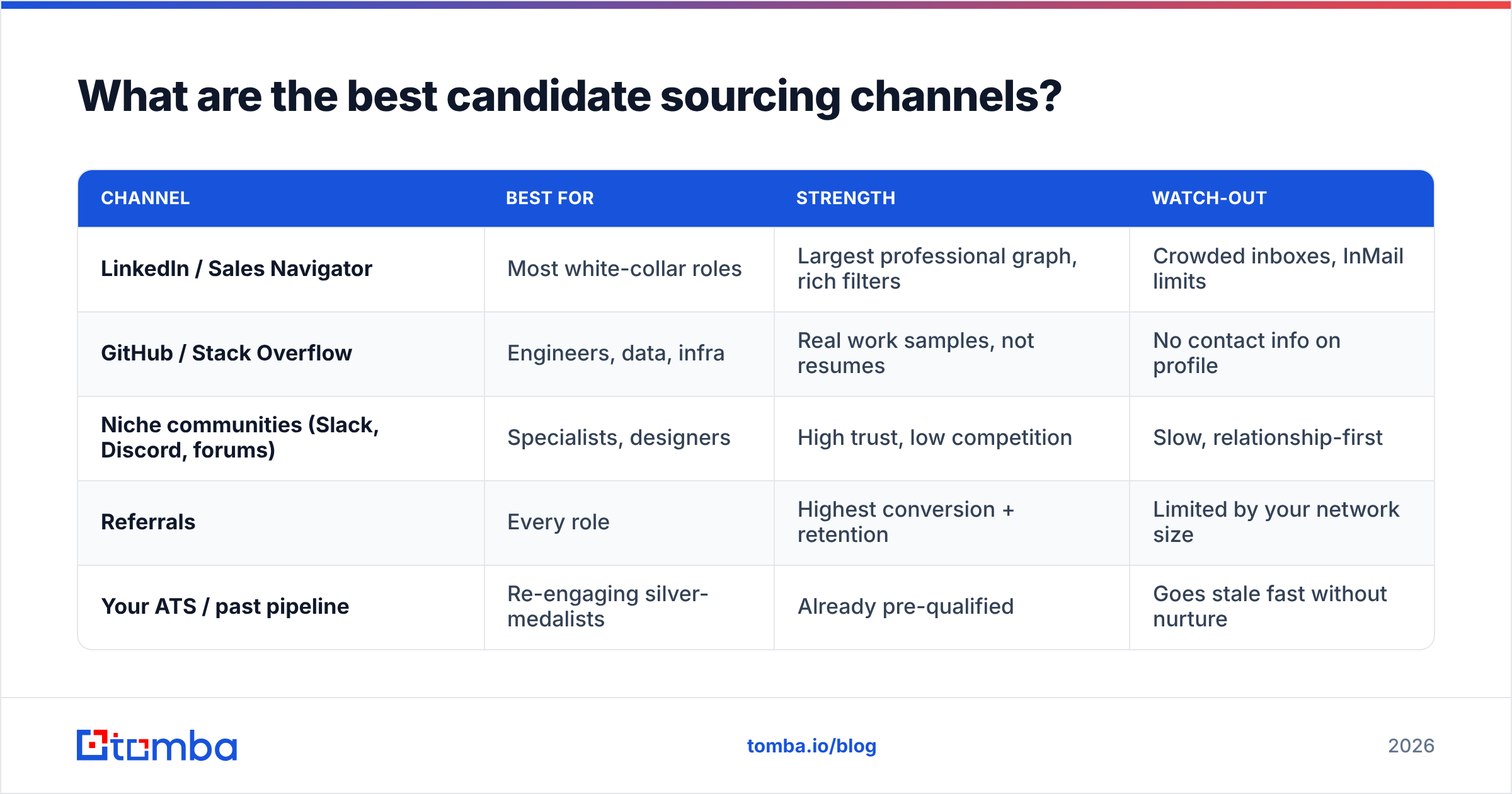
| Channel | Best for | Strength | Watch-out |
|---|---|---|---|
| LinkedIn / Sales Navigator | Most white-collar roles | Largest professional graph, rich filters | Crowded inboxes, InMail limits |
| GitHub / Stack Overflow | Engineers, data, infra | Real work samples, not resumes | No contact info on profile |
| Niche communities (Slack, Discord, forums) | Specialists, designers | High trust, low competition | Slow, relationship-first |
| Referrals | Every role | Highest conversion + retention | Limited by your network size |
| Your ATS / past pipeline | Re-engaging silver-medalists | Already pre-qualified | Goes stale fast without nurture |
The pattern that wins in 2026 is multi-channel sourcing with a single contact layer underneath it. You discover someone on GitHub, confirm their role on LinkedIn, then need one thing to actually talk to them: a way to reach their inbox. That is the connective tissue most sourcing strategies forget to build.
How do you find a candidate's contact information?#
You bridge the gap between "I found their profile" and "I can email them." A LinkedIn profile is a dead end without an outreach channel, and InMail credits run out fast — so the reliable move is to find a verified professional email.
Here is the practical workflow:
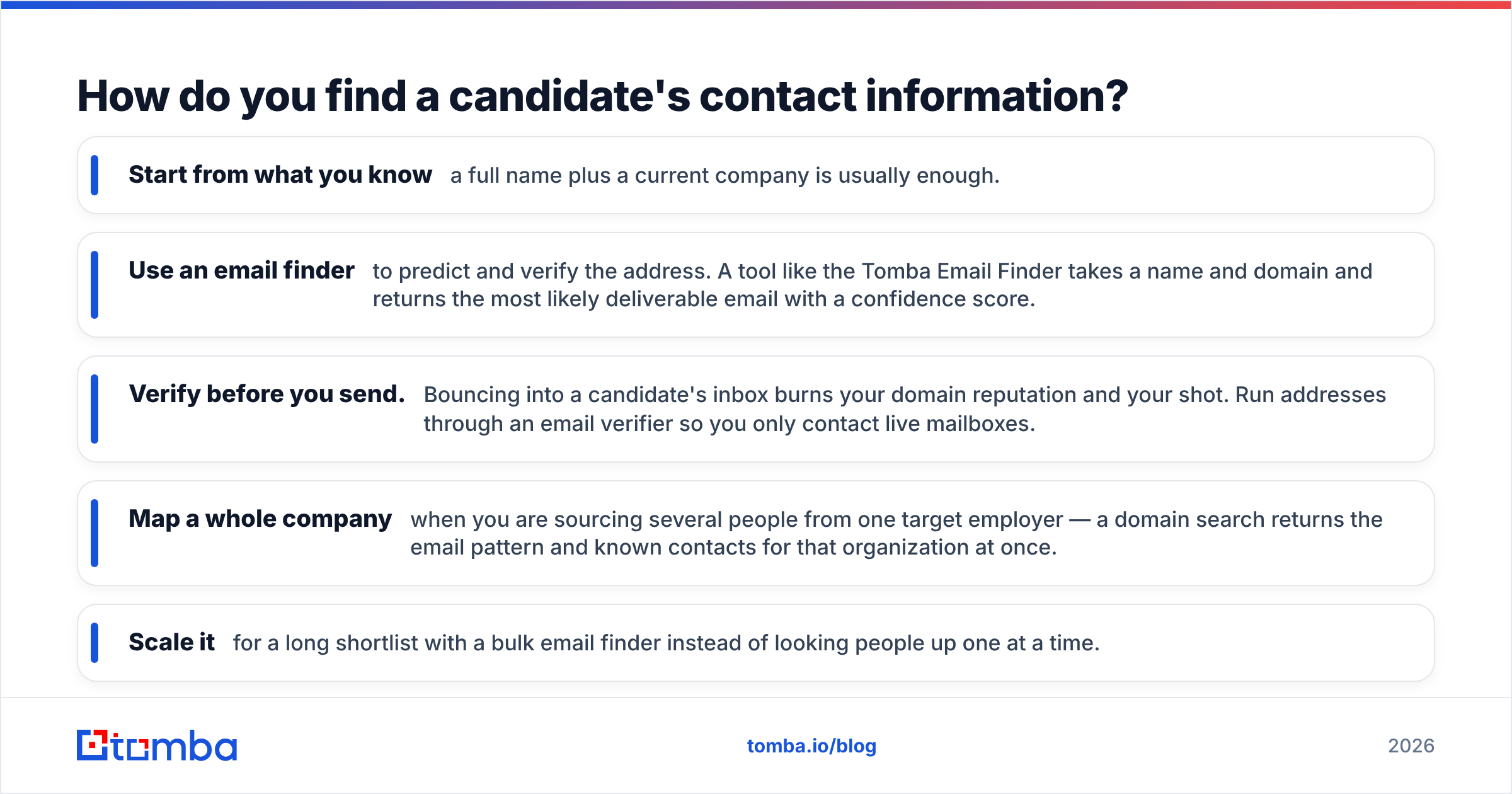
- Start from what you know — a full name plus a current company is usually enough.
- Use an email finder to predict and verify the address. A tool like the Tomba Email Finder takes a name and domain and returns the most likely deliverable email with a confidence score.
- Verify before you send. Bouncing into a candidate's inbox burns your domain reputation and your shot. Run addresses through an email verifier so you only contact live mailboxes.
- Map a whole company when you are sourcing several people from one target employer — a domain search returns the email pattern and known contacts for that organization at once.
- Scale it for a long shortlist with a bulk email finder instead of looking people up one at a time.
The reason this matters: deliverability is the hidden tax on every sourcing effort. You can find a hundred perfect candidates, but if half your emails bounce or land in spam, your pipeline is a leaky bucket. Verified data is the patch.
Which candidate sourcing tools should you use?#
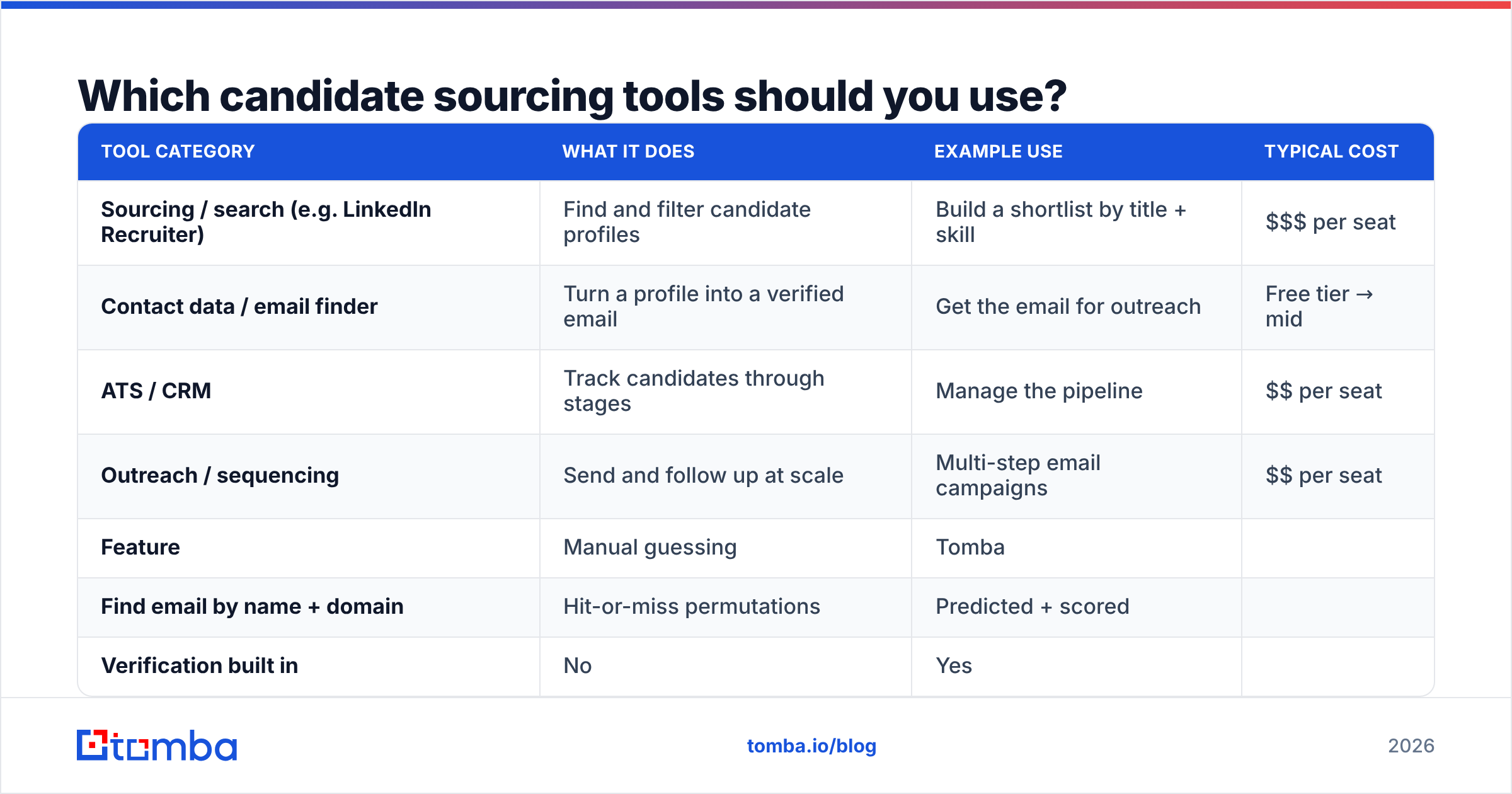
Your stack should cover four jobs: discover, enrich, reach, and track. You do not need one tool per job — many overlap — but you do need each job covered. Here is how the common categories compare.
| Tool category | What it does | Example use | Typical cost |
|---|---|---|---|
| Sourcing / search (e.g. LinkedIn Recruiter) | Find and filter candidate profiles | Build a shortlist by title + skill | $$$ per seat |
| Contact data / email finder | Turn a profile into a verified email | Get the email for outreach | Free tier → mid |
| ATS / CRM | Track candidates through stages | Manage the pipeline | $$ per seat |
| Outreach / sequencing | Send and follow up at scale | Multi-step email campaigns | $$ per seat |
For the contact-data layer specifically, here is how Tomba lines up against the way most teams operate today:
| Feature | Manual guessing | Tomba |
|---|---|---|
| Find email by name + domain | Hit-or-miss permutations | Predicted + scored |
| Verification built in | No | Yes |
| Free tier | N/A | 25 searches/mo |
| Starter price | N/A | $49/mo |
| Bulk + API | No | Yes |
Tomba's free tier (25 searches/month) is enough to test the workflow on a real role before committing; the Starter plan at $49/mo opens up volume for an active desk. If you live in spreadsheets, the Google Sheets add-on and Chrome extension keep sourcing inside the tools you already use, and the Tomba API wires contact lookup directly into a custom sourcing pipeline.
)
A note on honesty: no email finder hits 100% on every contact, and anyone claiming otherwise is selling you something. What you want is high coverage on the profiles you care about, a confidence score so you know what you're sending, and verification so you don't torch your sender reputation. Check independent reviews on G2 before you standardize on anything.
How do you write candidate outreach that gets replies?#
You make it short, specific, and obviously not a blast. Passive candidates get pinged constantly; the recruiter who clearly did ten seconds of homework wins. Generic outreach is the fastest way to train great candidates to ignore you.
The anatomy of a message that lands:
- A subject line that reads like a human wrote it — reference their work, not "Exciting opportunity!!" If you want to pressure-test options, a subject line tester helps before you send.
- A specific opener — name the repo, the talk, the project, the company. Prove you are not mail-merging.
- One clear reason this role fits them — not a job description dump.
- A low-friction ask — "Open to a 15-minute chat next week?" beats "Apply here."
- A short, polite follow-up — most replies come from message two or three. Persistence, not pestering.
Keep the whole thing under 120 words. If a candidate has to scroll, you have already lost. And track your response rate by template so you double down on what works instead of guessing.
How do you measure candidate sourcing success?#
You measure the pipeline, not the activity. "I sourced 200 profiles" is a vanity number; "I generated 9 qualified conversations and 3 first-round interviews" is a result. Track the funnel from contact to conversation so you can see exactly where candidates drop.
The metrics that actually drive decisions:
- Response rate — replies ÷ messages sent. The fastest read on message and targeting quality.
- Qualified-conversation rate — real conversations ÷ responses. Tells you if you're sourcing the right people.
- Email deliverability — bounce rate and inbox placement. A spike here means your data or domain needs attention; the deliverability fundamentals are worth a refresher.
- Time-to-first-interview — how fast sourcing converts into hiring-manager time.
- Pipeline coverage — warm candidates per open and upcoming role.
When response rates sag, the cause is almost always one of three things: wrong targeting, weak messaging, or bad contact data sending you into spam. The first two you fix with editing; the third you fix with verification.
Common candidate sourcing mistakes to avoid#
- Sourcing only when a role opens. Pipelines built under deadline pressure are shallow. Source continuously.
- Relying on a single channel. LinkedIn-only sourcing misses every candidate who isn't active there — often your best ones.
- Skipping verification. Unverified blasts bounce, hurt your domain, and silently kill deliverability.
- Generic outreach at scale. Volume without personalization just teaches good candidates to filter you out.
- No nurture. A silver-medalist from this quarter is a fast hire next quarter — if you stayed in touch.
- Measuring activity, not outcomes. Profiles viewed is noise; qualified conversations is signal.
Frequently asked questions#
What is the difference between sourcing and recruiting? Sourcing is the proactive front end — finding and contacting passive candidates before they apply. Recruiting is the broader process that includes screening, interviewing, and closing. Sourcing feeds recruiting.
Is candidate sourcing only for technical roles? No. Engineers get the most attention because they rarely apply, but sourcing works for sales, design, marketing, executive, and operations roles — anywhere the best people aren't actively job-hunting.
How many candidates should I source per role? It depends on conversion, but a healthy desk often works a shortlist of 30–60 well-matched profiles per role to land 3–5 strong interviews, assuming solid response and deliverability rates.
Do I need expensive tools to start? No. You can begin with free LinkedIn search and a free email-finder tier (Tomba offers 25 searches/month) to prove the workflow before investing in paid seats.
Start sourcing with reliable contact data#
Great sourcing lives or dies on whether your outreach reaches a real inbox. You can have the perfect shortlist and the sharpest message, and none of it matters if the email bounces. That's the gap the Tomba Email Finder closes: feed it a candidate's name and company, get back a verified, deliverable email with a confidence score, and send outreach that actually lands. Start free with 25 searches a month, confirm it works on a live role, and scale up from there — your pipeline will thank you. Find candidates, reach them, and keep the bucket from leaking.
// get started
Find, verify and enrich your first contacts today
Start on the free plan with 25 searches a month, then scale when your team is ready.
Free plan · No credit card required · GDPR & CCPA
// about the author