Challenger Sales Questions: 25 Examples to Use in 2026
The best Challenger reps don't interrogate buyers — they reframe them. Here are 25 challenger sales questions that teach, tailor, and take control of the deal.
TL;DR
- Challenger sales questions exist to do three jobs: teach the buyer something new, tailor the message to their world, and take control of the conversation — not to fill a discovery checklist.
- The best questions reframe the buyer's understanding of their own problem before you ever mention your product.
- Weak "pain-funnel" questions ("What keeps you up at night?") are forgettable; reframe questions ("What if the metric you're optimizing is the wrong one?") are not.
- You can only tailor when you've researched the account first — role, tech stack, recent moves, and the right person to reach.
- Below: 25 ready-to-use challenger sales questions sorted by stage, plus a comparison of Challenger vs. other question frameworks.
What are challenger sales questions?#
Challenger sales questions are deliberately provocative discovery questions designed to reframe how a buyer sees their problem, based on the Challenger Sale methodology from Matthew Dixon and Brent Adamson's research at CEB (now Gartner). Instead of asking buyers to describe pain you already know about, you ask questions that expose a problem they haven't fully recognized yet.
Think of it like a good doctor. A weak doctor asks, "So, what's bothering you today?" and writes down whatever you say. A great doctor asks, "You mentioned afternoon headaches — how's your screen time and your water intake?" and reframes a symptom you'd dismissed into the actual diagnosis. Challenger questions are the second kind: they lead, they teach, and they make the buyer think "I hadn't looked at it that way."
The methodology breaks every strong rep behavior into three moves, and your questions should map to them:
- Teach — Questions that surface a problem or cost the buyer is underestimating.
- Tailor — Questions that connect that insight to their specific role, industry, and metrics.
- Take control — Questions that drive toward decision, timeline, and money without flinching.
A generic discovery script asks about budget and timeline first. A Challenger script earns the right to ask about budget by first changing what the buyer believes is at stake.
Why do most discovery questions fail?#
Most discovery questions fail because they ask the buyer to be the expert on their own problem. That sounds respectful, but it's a trap. If the buyer already understood the full cost of their problem and the best way to solve it, they'd have solved it. Your questions exist to close that gap.
The classic failure mode is the "pain funnel" interrogation — fifteen open-ended questions that feel, to the buyer, like a deposition. Gartner's own research found that buyers who experienced a "supplier helped me see a new perspective" interaction were dramatically more likely to make a high-quality, low-regret purchase. Questions that merely extract information don't create that feeling. Questions that deliver information disguised as a question do.
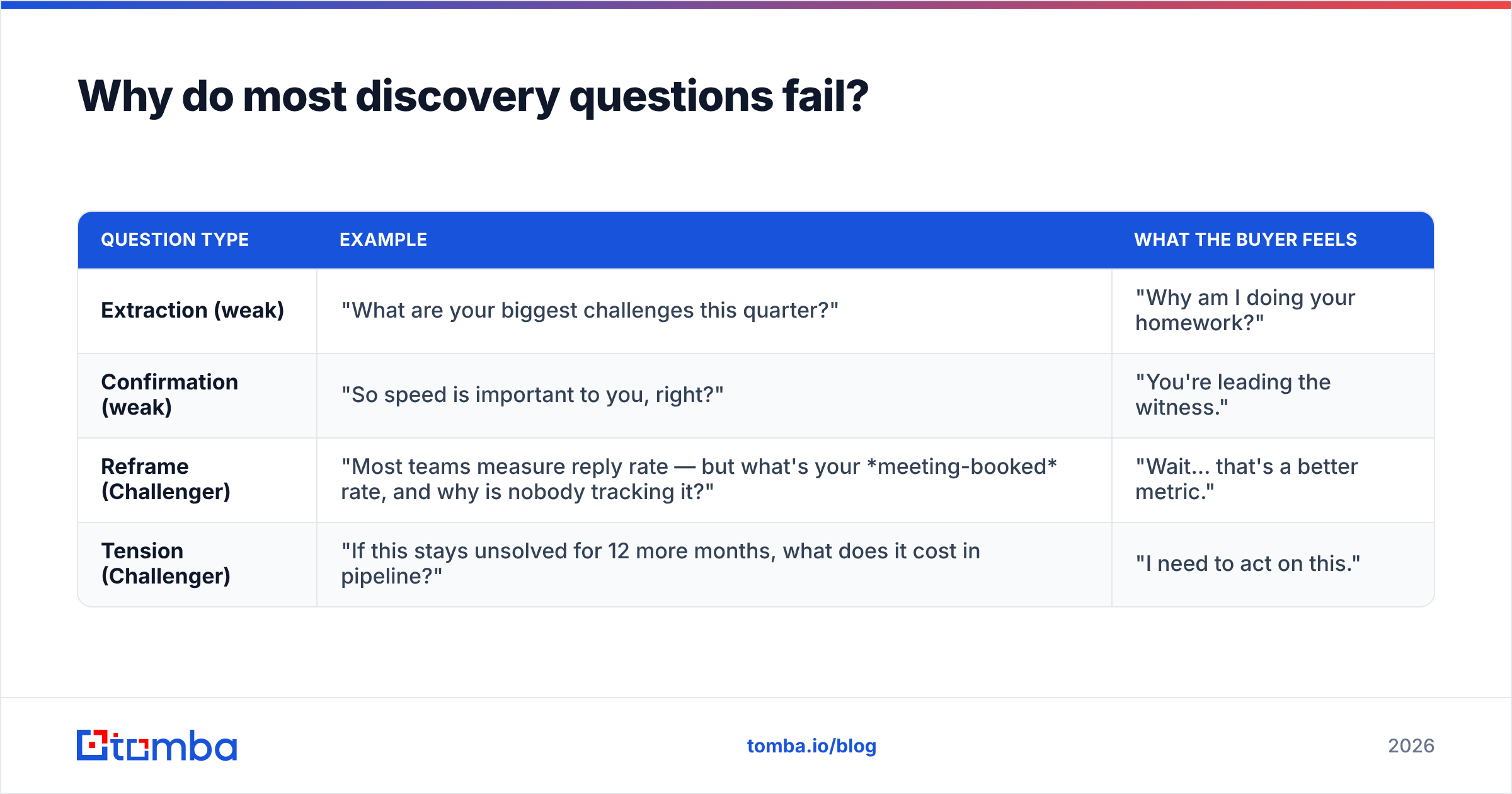
Here's the difference in practice:
| Question type | Example | What the buyer feels |
|---|---|---|
| Extraction (weak) | "What are your biggest challenges this quarter?" | "Why am I doing your homework?" |
| Confirmation (weak) | "So speed is important to you, right?" | "You're leading the witness." |
| Reframe (Challenger) | "Most teams measure reply rate — but what's your meeting-booked rate, and why is nobody tracking it?" | "Wait… that's a better metric." |
| Tension (Challenger) | "If this stays unsolved for 12 more months, what does it cost in pipeline?" | "I need to act on this." |
The reframe and tension questions do real work. They shift the buyer's mental model and create the productive discomfort that motivates change.
What are 25 challenger sales questions by stage?#
Use these as raw material, not a script. Adapt the nouns to the buyer's world — that's the "tailor" step, and it's the difference between sounding insightful and sounding like a sales robot.
Teach: reframe the problem (questions 1–9)#
- "Most teams in your position assume the bottleneck is X — what if it's actually Y?"
- "When you look at your funnel, are you optimizing the metric that drives revenue, or the one that's easiest to report?"
- "What's the hidden cost of the workaround your team built to avoid fixing this?"
- "If I told you peers your size are seeing a 30% gap here, where would you guess that gap is hiding?"
- "You've framed this as a tooling problem — what makes you sure it isn't a data problem underneath?"
- "What would have to be true for this issue to not be costing you deals right now?"
- "Which of your current metrics would look worse if you measured it honestly?"
- "When was the last time someone challenged how your team defines a 'qualified' lead?"
- "If your best competitor solved this tomorrow, what advantage would they take from you?"
Tailor: connect the insight to their world (questions 10–17)#
- "For a VP of Sales specifically, which of these costs lands on your number versus marketing's?"
- "Given your tech stack, where does this problem create the most manual cleanup?"
- "You just expanded into a new region — how does that change the urgency here?"
- "Who on your team feels this pain first, and who feels it loudest in the QBR?"
- "How does this look different for your enterprise segment versus SMB?"
- "What does your CFO need to see before this becomes a funded priority?"
- "Of the three problems we've surfaced, which one shows up in your board deck?"
- "How is this measured in your comp plan — because that usually tells me where the real pressure is."
Take control: drive the decision (questions 18–25)#
- "If we agreed this is worth solving, what's stopping us from starting this quarter?"
- "Who else has to nod before this moves — and should they be in the next conversation?"
- "What's your honest read: is this a 'fix now' or a 'someday' problem for you?"
- "If the numbers hold up in a pilot, what would the rollout actually look like?"
- "What's the cost of waiting one more quarter, stated in dollars?"
- "When you've bought tools like this before, where did the process get stuck — and how do we avoid that?"
- "What would make this an easy 'yes' for you, and what would make it an easy 'no'?"
- "Assuming we clear your concerns, are you the person who signs, or do we need to build the case for someone else?"
Notice how the "take control" questions name money and decision-makers directly. Challenger reps are comfortable with constructive tension; they don't soften every question into mush. For more on the conversion side of this, our breakdown of response rate benchmarks shows why precise, provocative outreach beats high-volume generic messaging.
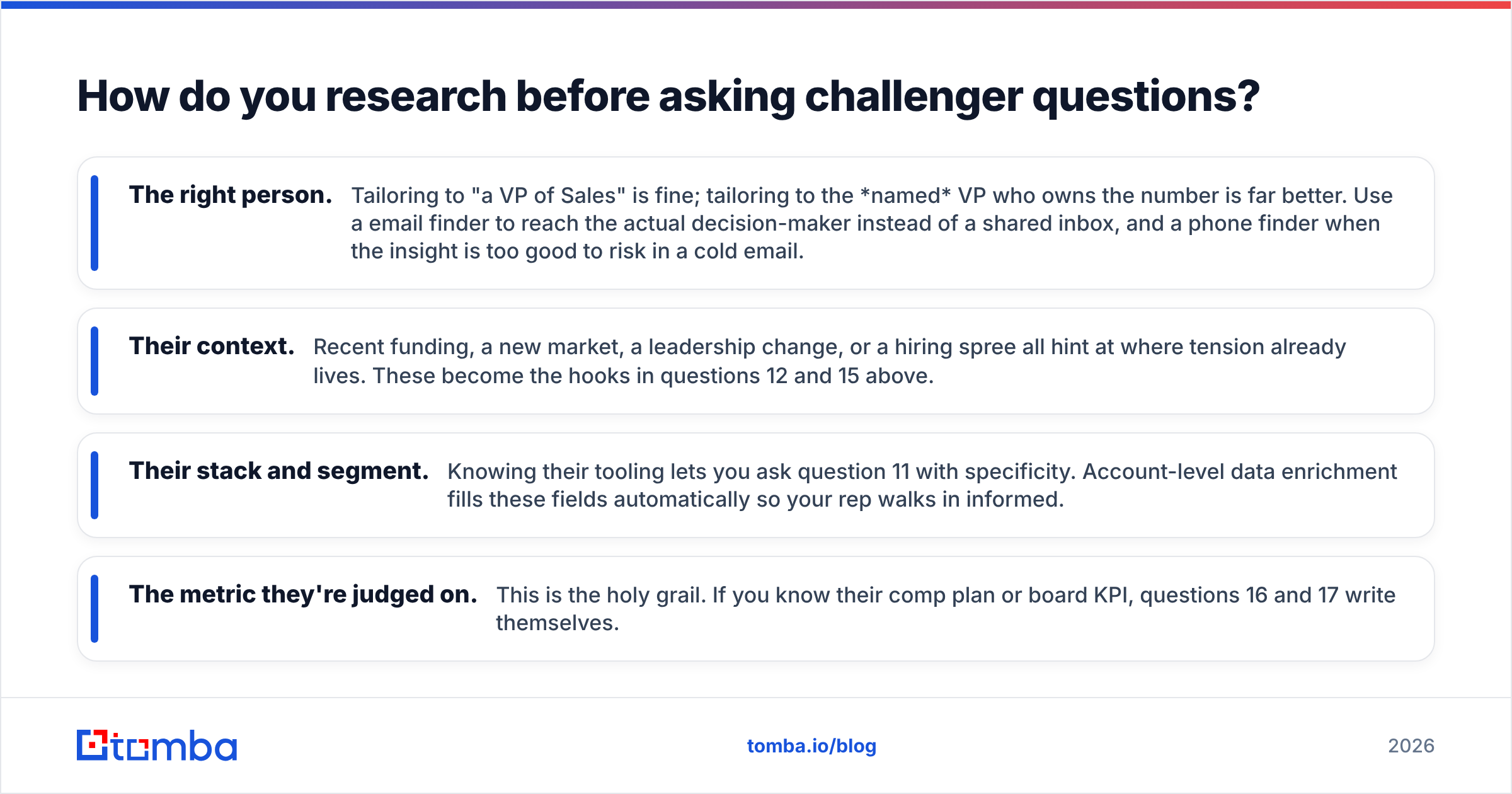
How do you research before asking challenger questions?#
You can't tailor what you don't know — so the tailoring step starts before the call, with research. A reframe question only works if it's aimed at the buyer's actual situation. Aim it at a generic persona and it sounds like a horoscope.
Before you write a single question, gather four things:
- The right person. Tailoring to "a VP of Sales" is fine; tailoring to the named VP who owns the number is far better. Use a email finder to reach the actual decision-maker instead of a shared inbox, and a phone finder when the insight is too good to risk in a cold email.
- Their context. Recent funding, a new market, a leadership change, or a hiring spree all hint at where tension already lives. These become the hooks in questions 12 and 15 above.
- Their stack and segment. Knowing their tooling lets you ask question 11 with specificity. Account-level data enrichment fills these fields automatically so your rep walks in informed.
- The metric they're judged on. This is the holy grail. If you know their comp plan or board KPI, questions 16 and 17 write themselves.
The point isn't to weaponize trivia. It's that a reframe lands ten times harder when it's wrapped in a detail only an insider would know. "Most teams underinvest here" is a shrug. "You just opened a London office and I'd bet your EMEA reply rates are half your US numbers — here's why" is a meeting.
Challenger vs. SPIN vs. Sandler: which question framework wins?#
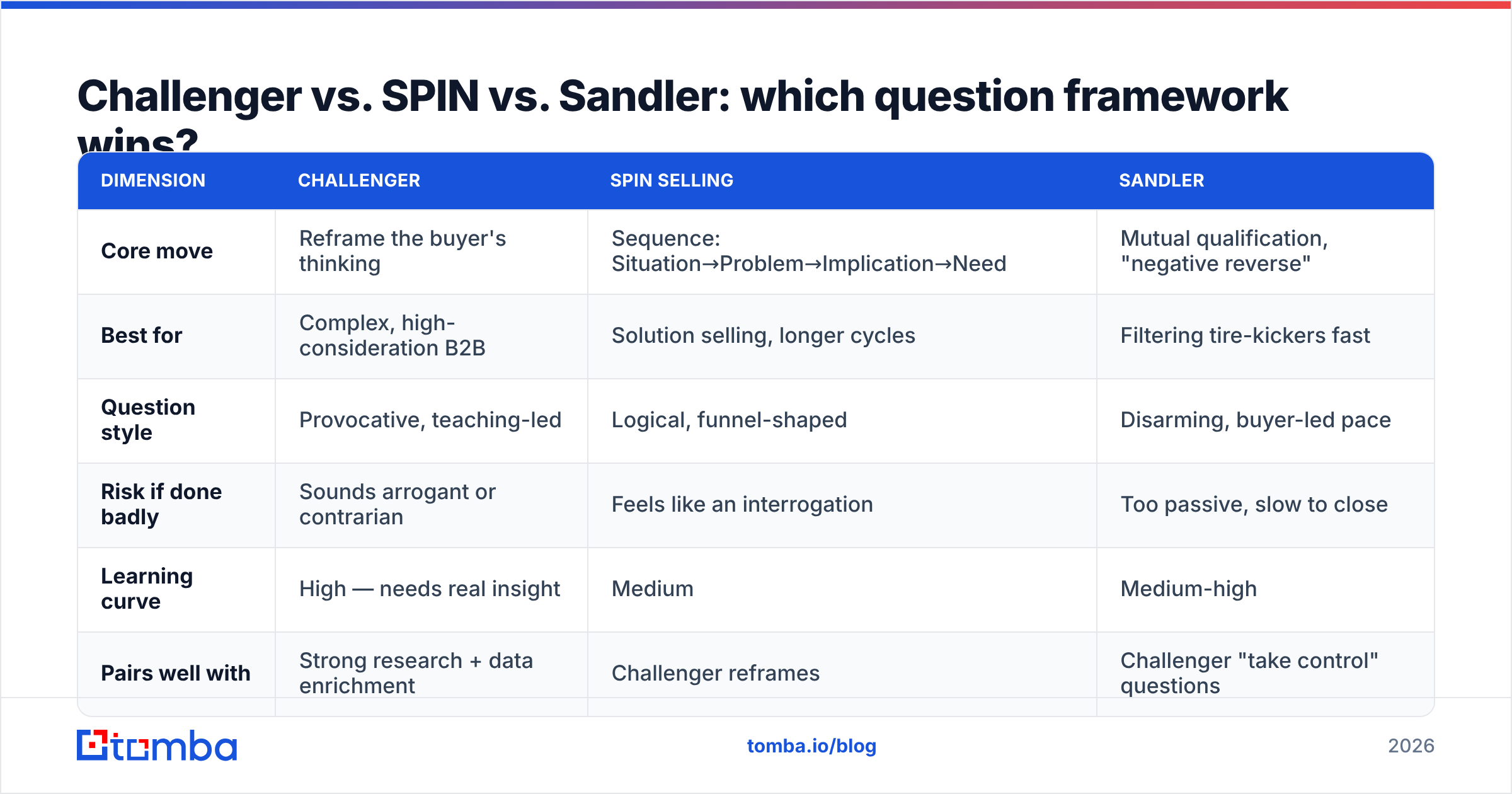
No single framework "wins" — they solve different problems, and strong reps borrow from all three. Challenger excels at complex B2B deals where the buyer's understanding is the obstacle. SPIN is a cleaner discovery scaffold. Sandler is strongest at qualifying out bad fits early.
| Dimension | Challenger | SPIN Selling | Sandler |
|---|---|---|---|
| Core move | Reframe the buyer's thinking | Sequence: Situation→Problem→Implication→Need | Mutual qualification, "negative reverse" |
| Best for | Complex, high-consideration B2B | Solution selling, longer cycles | Filtering tire-kickers fast |
| Question style | Provocative, teaching-led | Logical, funnel-shaped | Disarming, buyer-led pace |
| Risk if done badly | Sounds arrogant or contrarian | Feels like an interrogation | Too passive, slow to close |
| Learning curve | High — needs real insight | Medium | Medium-high |
| Pairs well with | Strong research + data enrichment | Challenger reframes | Challenger "take control" questions |
The practical answer for 2026: use SPIN's structure, Challenger's reframes, and Sandler's discipline about walking away. If you want the deeper background, the original framework is well summarized on Wikipedia's Challenger Sale entry, and vendor-neutral reviews on G2 show how teams blend methodologies in real CRMs. HubSpot's sales blog (hubspot.com) also keeps a running library of discovery-question templates worth raiding.
How do you avoid sounding arrogant with challenger questions?#
The single biggest failure of Challenger reps is mistaking contrarian for insightful. A reframe that's just "you're wrong" creates defensiveness, not tension. The fix is three guardrails:
- Lead with data, not opinion. "Teams your size lose ~30% here" beats "I think you're doing this wrong." Cite a peer benchmark, not your gut.
- Validate before you reframe. "You're right that speed matters — and here's the part most teams miss." The "and" keeps you on the buyer's side.
- Ask, don't assert. End the teach on a question mark. "What if the metric is the problem?" invites collaboration; "Your metric is the problem" invites a fight.
Tension should feel like a colleague pointing at a whiteboard, not a debate opponent scoring points. The moment a buyer feels managed, the insight dies.
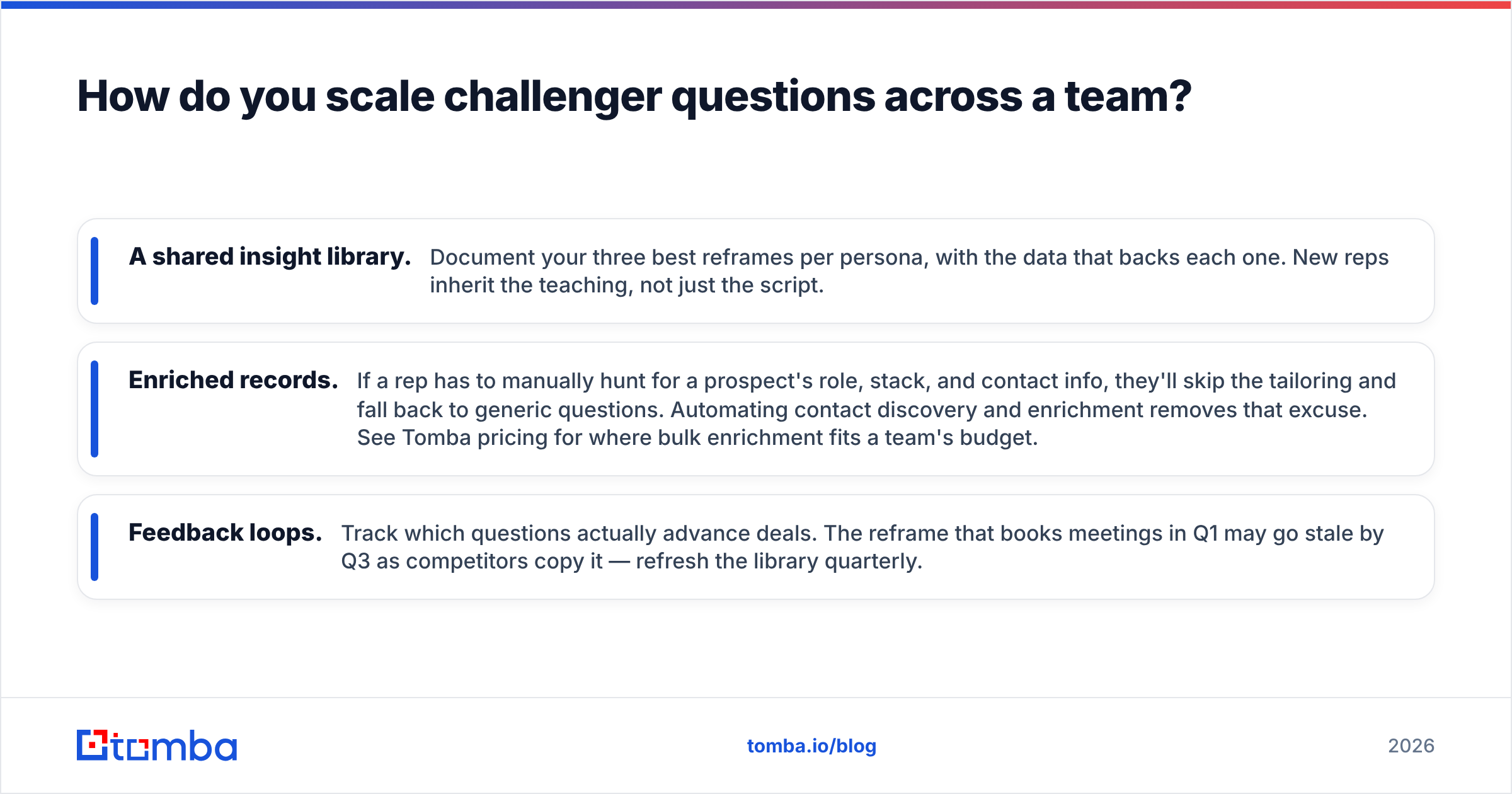
How do you scale challenger questions across a team?#
Reframes don't scale by memo — they scale by building research into the workflow so every rep walks into every call already tailored. The insight is the same; the personalization is what has to be repeatable.
That means three things operationally:
- A shared insight library. Document your three best reframes per persona, with the data that backs each one. New reps inherit the teaching, not just the script.
- Enriched records. If a rep has to manually hunt for a prospect's role, stack, and contact info, they'll skip the tailoring and fall back to generic questions. Automating contact discovery and enrichment removes that excuse. See Tomba pricing for where bulk enrichment fits a team's budget.
- Feedback loops. Track which questions actually advance deals. The reframe that books meetings in Q1 may go stale by Q3 as competitors copy it — refresh the library quarterly.
A Challenger motion is only as good as the data feeding it. Reps who reach the wrong contact, or who reach the right one with a generic message, never get to use their best question.
Ready to tailor every question to the right buyer?#
Great challenger sales questions die in a shared inbox. The reframe that would have changed a buyer's mind never lands because the email went to info@ instead of the VP who owns the number. Fix the input and the questions get sharper automatically.
Tomba's Email Finder gets your insight to the actual decision-maker — verified, with the role and company context you need to tailor the question before you hit send. Start on the free tier (25 searches a month), then scale to Starter at $49/mo once your Challenger motion is converting. Research first, reframe second, and let the data do the tailoring so your reps can focus on the one thing software can't fake: a question that makes the buyer think differently.
// get started
Find, verify and enrich your first contacts today
Start on the free plan with 25 searches a month, then scale when your team is ready.
Free plan · No credit card required · GDPR & CCPA
// about the author