ChatGPT for B2B Sales in 2026: A Practical Playbook
ChatGPT can write your prospecting emails, summarize calls, and qualify leads — but only if you feed it real data and the right prompts. Here's the 2026 playbook.
TL;DR
- ChatGPT is a force multiplier for B2B sellers — research, email drafts, call summaries, objection handling — but it is not a data source. It hallucinates names, titles, and emails.
- The winning pattern in 2026 is real data in, ChatGPT out: pull verified contacts and firmographics from a provider, then let the model personalize and scale.
- Use it for the repeatable 80% (first drafts, list cleanup, CRM notes) and keep humans on the 20% that closes (discovery, negotiation, pricing).
- The biggest risk is generic output. Specific prompts plus specific data beat clever prompts every time.
- Below: copy-paste prompts, a workflow table, the limits nobody mentions, and how to wire it to a verified contact pipeline.
What does ChatGPT actually do for B2B sales?#
Think of ChatGPT as the world's fastest junior sales assistant: it never sleeps, it drafts in seconds, and it will confidently make things up if you let it. The value is in delegation, not magic. You hand it the boring, repeatable language work, and you keep the judgment.
In a typical B2B motion, that means four jobs:
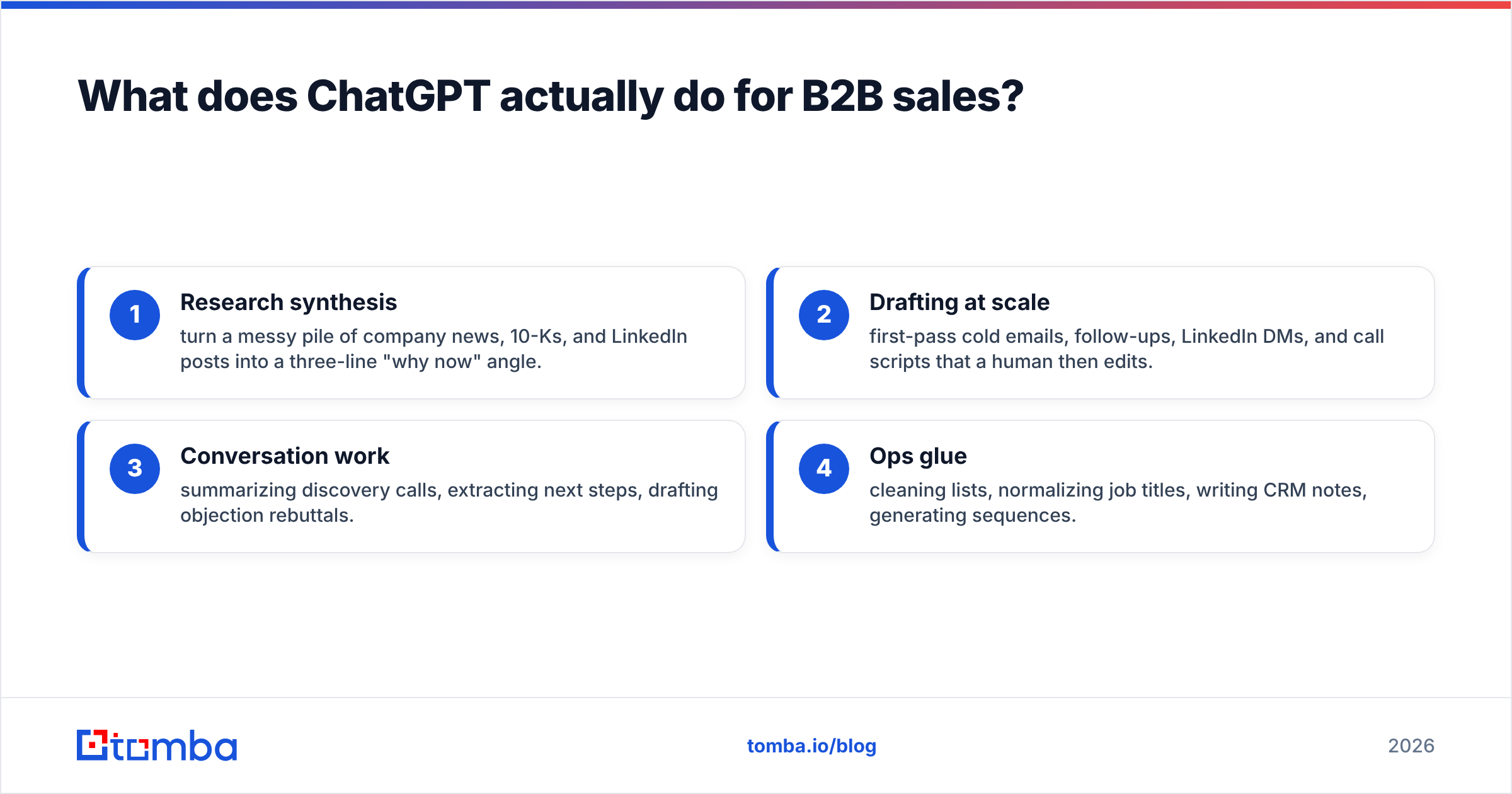
- Research synthesis — turn a messy pile of company news, 10-Ks, and LinkedIn posts into a three-line "why now" angle.
- Drafting at scale — first-pass cold emails, follow-ups, LinkedIn DMs, and call scripts that a human then edits.
- Conversation work — summarizing discovery calls, extracting next steps, drafting objection rebuttals.
- Ops glue — cleaning lists, normalizing job titles, writing CRM notes, generating sequences.
What it does not do well is know who to contact. ChatGPT has no live database of decision-makers and no idea whether j.smith@acme.com bounces. That gap is exactly where your data layer comes in — more on that below.
Is ChatGPT good enough to replace SDRs?#
No — and anyone selling you that is selling you churned pipeline. ChatGPT replaces tasks, not roles. The math is simple: the model collapses the time cost of writing, but the scarce resource in B2B is relevance, and relevance comes from data and human context the model doesn't have.
Here's the honest division of labor:
- Great fit for AI: first drafts, summarization, reformatting, brainstorming subject lines, translating tone, generating variants for A/B tests.
- Human-required: reading buying signals in a live call, multi-threading a complex deal, pricing concessions, knowing when to walk away.
- Shared: account research (AI drafts, human verifies), sequence design (AI generates, human approves).
A seller using sales automation plus ChatGPT can run the volume of three, but only if the inputs are clean. Garbage contacts in, polite garbage out — at scale.
How do you write prompts that don't sound like a robot?#
The difference between a reply-getting email and obvious AI spam is specificity of input. Generic prompt ("write a cold email to a CTO") yields generic output. Loaded prompt (real trigger, real pain, real proof) yields something a human would actually send.
A reliable prompt skeleton:
Role: You are an SDR selling [product] to [persona].
Context: The prospect is [name], [title] at [company].
Recent trigger: [specific event — funding, hire, launch, post].
Their likely pain: [one sentence].
Our proof: [one customer result with a number].
Task: Write a 75-word cold email. No buzzwords. One CTA: a 15-min call.
Constraints: Conversational, 5th-grade reading level, no "I hope this finds you well".
Notice every bracket is a fact you must supply. The model is the writer; you are the researcher. This is why the teams getting results pair ChatGPT with a contact and enrichment layer that fills those brackets automatically. Pull the title and company from a domain search, grab the trigger from news, and the prompt writes itself.
For subject lines and tone testing, you can also lean on purpose-built helpers like a subject line generator before you ever open ChatGPT, then let the model expand the winners into full copy.
What does a real ChatGPT B2B sales workflow look like?#
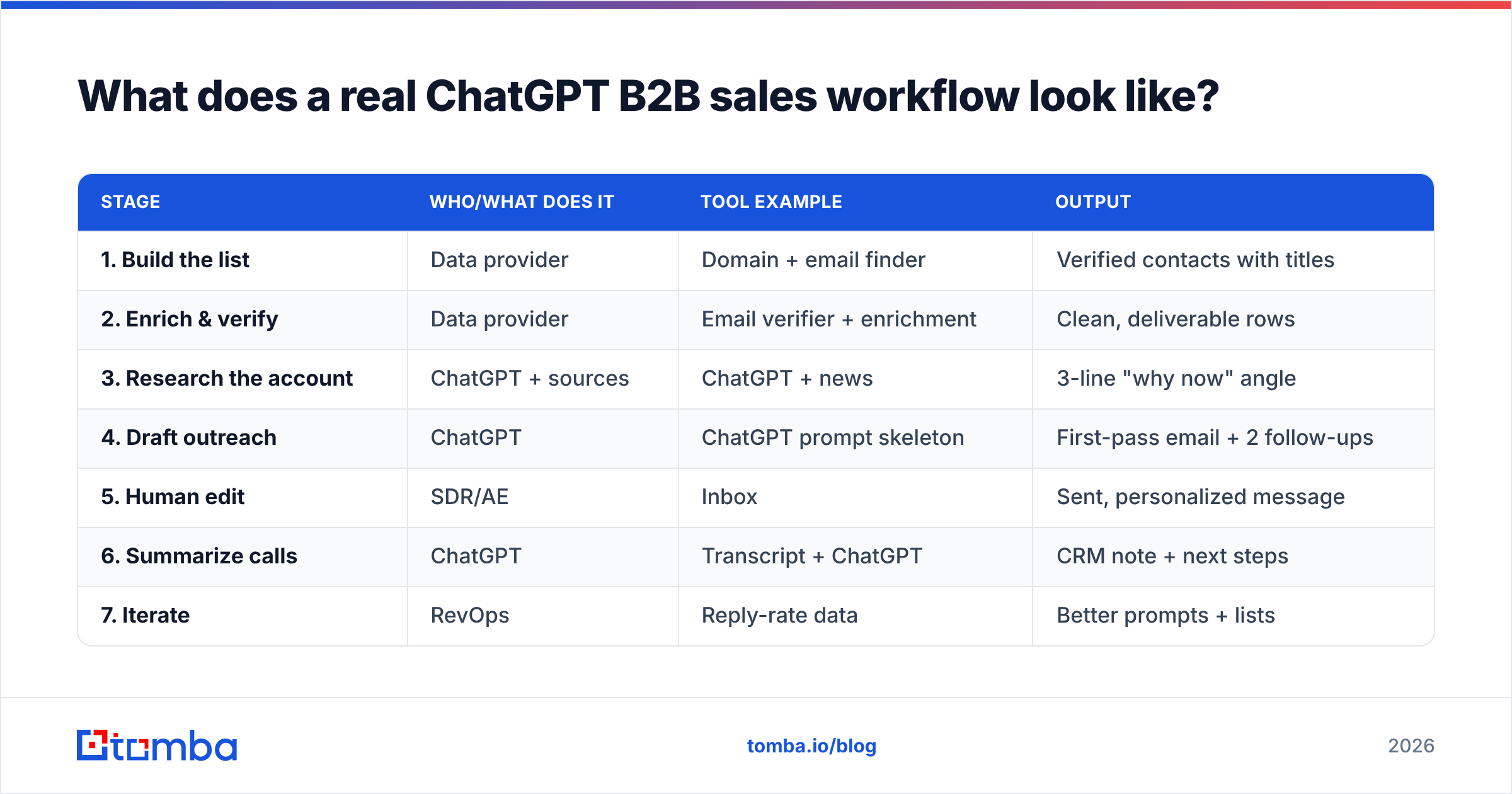
Below is the end-to-end loop most high-performing teams run in 2026. The pattern: data tools do retrieval and verification, ChatGPT does language, humans do judgment.
| Stage | Who/what does it | Tool example | Output |
|---|---|---|---|
| 1. Build the list | Data provider | Domain + email finder | Verified contacts with titles |
| 2. Enrich & verify | Data provider | Email verifier + enrichment | Clean, deliverable rows |
| 3. Research the account | ChatGPT + sources | ChatGPT + news | 3-line "why now" angle |
| 4. Draft outreach | ChatGPT | ChatGPT prompt skeleton | First-pass email + 2 follow-ups |
| 5. Human edit | SDR/AE | Inbox | Sent, personalized message |
| 6. Summarize calls | ChatGPT | Transcript + ChatGPT | CRM note + next steps |
| 7. Iterate | RevOps | Reply-rate data | Better prompts + lists |
The leverage point is stage 1 and 2. If your contacts are wrong, every downstream ChatGPT step amplifies the error. That's why a verified email finder sits at the front of the line — it decides whether your beautifully written email reaches a human or a bounce.
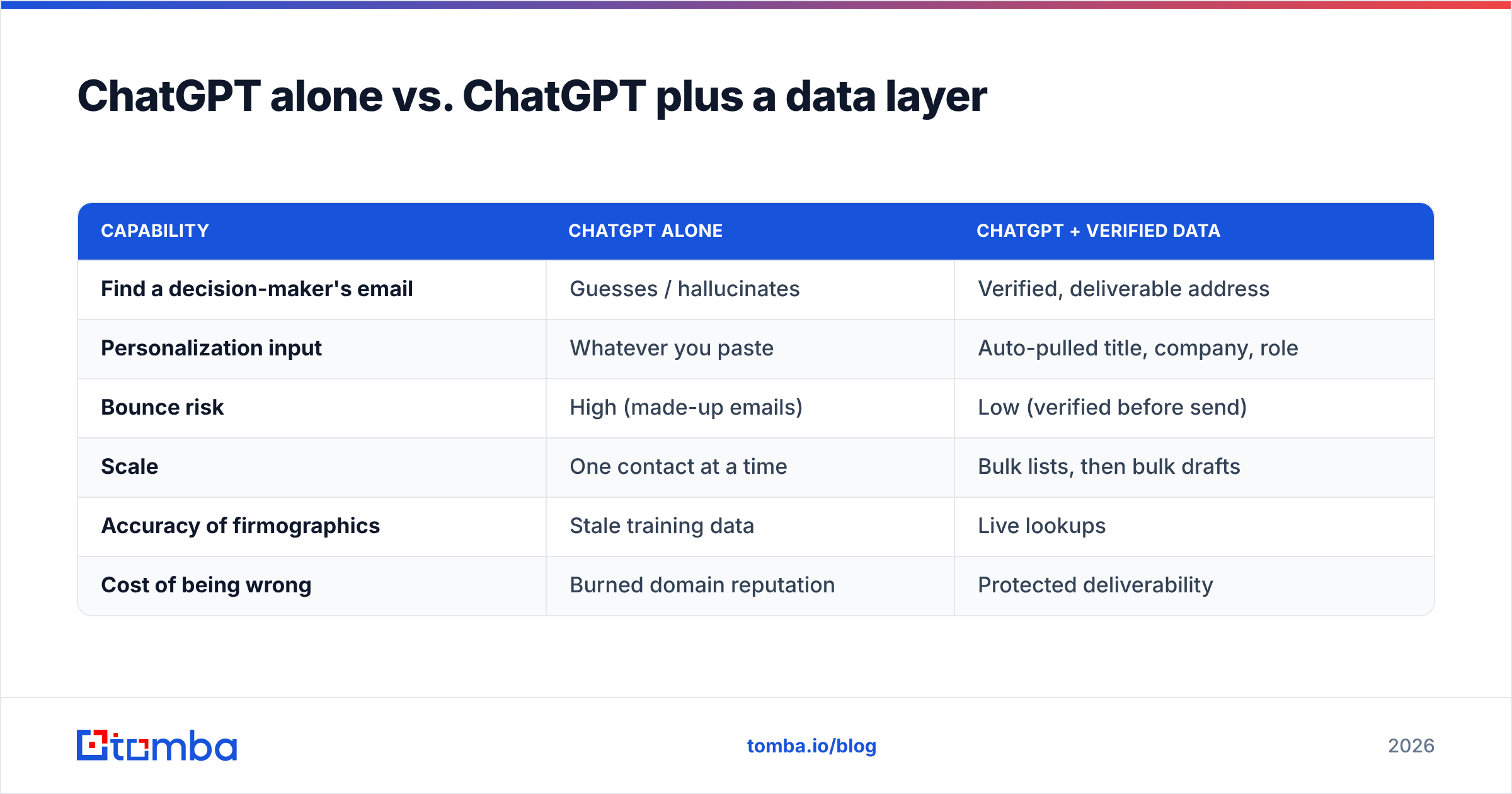
ChatGPT alone vs. ChatGPT plus a data layer#
This is the comparison that actually matters for pipeline. ChatGPT by itself is a writing tool; combined with verified data, it becomes a prospecting engine.
| Capability | ChatGPT alone | ChatGPT + verified data |
|---|---|---|
| Find a decision-maker's email | Guesses / hallucinates | Verified, deliverable address |
| Personalization input | Whatever you paste | Auto-pulled title, company, role |
| Bounce risk | High (made-up emails) | Low (verified before send) |
| Scale | One contact at a time | Bulk lists, then bulk drafts |
| Accuracy of firmographics | Stale training data | Live lookups |
| Cost of being wrong | Burned domain reputation | Protected deliverability |
The takeaway: never let ChatGPT invent contact details. Use it to write, and use a dedicated tool to know. If your team sends from a shared domain, an unverified list is a fast way to wreck sender reputation — clean data is non-negotiable.

What are the limits and risks nobody mentions?#
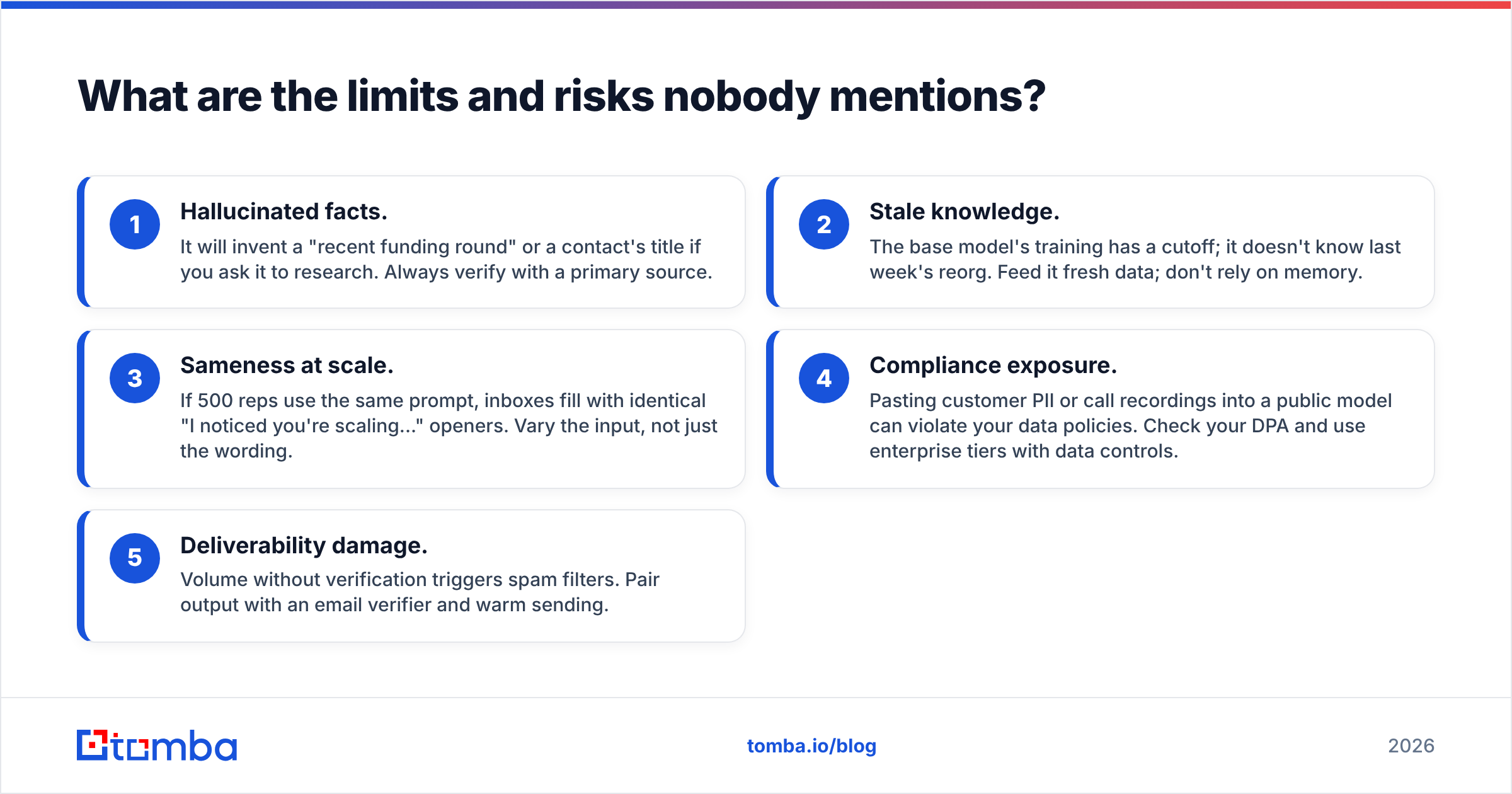
ChatGPT is powerful, but treating it as an oracle gets reps in trouble. Watch these five failure modes:
- Hallucinated facts. It will invent a "recent funding round" or a contact's title if you ask it to research. Always verify with a primary source.
- Stale knowledge. The base model's training has a cutoff; it doesn't know last week's reorg. Feed it fresh data; don't rely on memory.
- Sameness at scale. If 500 reps use the same prompt, inboxes fill with identical "I noticed you're scaling..." openers. Vary the input, not just the wording.
- Compliance exposure. Pasting customer PII or call recordings into a public model can violate your data policies. Check your DPA and use enterprise tiers with data controls.
- Deliverability damage. Volume without verification triggers spam filters. Pair output with an email verifier and warm sending.
According to industry analysts at Gartner, the value of generative AI in sales comes from augmenting sellers, not automating them end to end — a useful reality check when a vendor promises "fully autonomous AI SDRs."
Which ChatGPT prompts give the best B2B sales ROI?#
Steal these. Each assumes you paste in real, verified data first.
- Account research: "Here are 5 recent items about [company]: [paste]. Summarize the single most relevant business priority for a [your product] pitch in 2 sentences, then suggest one outreach angle."
- Cold email: use the skeleton above. Generate three variants at different tones (direct, curious, peer-to-peer).
- Follow-up that isn't 'just bumping this': "Write a 40-word follow-up that adds one new insight, references [specific detail], and asks a different question than my first email."
- Objection handling: "The prospect said: '[objection]'. Draft three rebuttals — one with a customer proof point, one reframing the cost, one asking a diagnostic question."
- Call summary: "Here's a transcript: [paste]. Extract: decision criteria, stakeholders mentioned, objections, agreed next steps, and a 2-line CRM note."
- List cleanup: "Normalize these job titles into [VP, Director, Manager, IC] and flag any that aren't a buyer for [product]."
For repeatable plays, store winners as templates. A cold email AI helper or a saved email templates library keeps your best prompts and structures one click away instead of buried in a doc.
How do you measure if ChatGPT is actually helping?#
Don't measure "emails sent." Measure outcomes and time saved. Track these before and after you roll out AI assistance:
- Reply rate and positive reply rate (the only vanity-proof signal of relevance) — see why response rate beats open rate.
- Meetings booked per rep per week.
- Hours spent on admin (research, note-taking, list building) — this is where AI saves the most.
- Bounce rate — should drop if you added verification, not rise.
- Pipeline created, attributed back to AI-assisted sequences.
If reply rates fall after adopting ChatGPT, you have a sameness problem: too many reps, same prompt, same data. The fix is upstream — richer, more specific inputs per account, not a cleverer prompt.
Where does verified data fit into the AI sales stack?#
At the very front. A B2B AI stack in 2026 looks like a relay race: a B2B database and finder tools hand verified contacts to ChatGPT, ChatGPT hands drafts to the rep, and the rep hands a clean message to the prospect. Drop the baton at stage one and the whole race is lost.
The non-negotiables for the data layer:
- Coverage — can it find the buyer at the account you care about?
- Accuracy — verified, not guessed; low bounce rate.
- Integration — does it push into your CRM, Google Sheets, or workflow via API so ChatGPT prompts auto-fill?
- Compliance — transparent data sources and consent handling.
Independent reviews on sites like G2 are a sane place to sanity-check accuracy claims before you commit budget — vendor benchmarks are marketing; peer reviews are closer to truth.
Closing: pair the prompt with the pipeline#
ChatGPT is the easiest 10x your sales team will get this year — but only on the language layer. It cannot tell you who to email, and it will happily invent contacts that bounce and burn your domain. The teams winning with AI in 2026 treat the model as the writer and a verified data source as the source of truth.
Start at the front of the relay. Use Tomba's Email Finder to build verified, deliverable contact lists by name, company, or domain, then feed those clean rows into your ChatGPT prompts so every draft lands in a real inbox. It's free to try for 25 searches a month, scales with affordable Tomba pricing, and plugs straight into your stack. Get the data right, and ChatGPT will handle the rest.
// get started
Find, verify and enrich your first contacts today
Start on the free plan with 25 searches a month, then scale when your team is ready.
Free plan · No credit card required · GDPR & CCPA
// about the author