Choosing Targets for Cold Outreach: A 2026 Playbook
Stop spraying generic lists. This 2026 playbook shows how to define an ICP, score accounts, and build a tight target list that actually books meetings.
Most cold outreach fails before the first email is ever written. Not because of a weak subject line or a clumsy CTA, but because the list was wrong. You can write the best sequence of your life and still get a 0.4% reply rate if you sent it to people who were never going to care.
This guide is about the part of outbound nobody screenshots for LinkedIn: choosing who to contact. Get the targeting right and average copy still books meetings. Get it wrong and great copy still dies in the archive folder.
TL;DR#
- Targeting beats copy. A tight, well-researched list with mediocre messaging outperforms a brilliant sequence sent to a bad list almost every time.
- Define a real ICP first — firmographics, technographics, and trigger events — then layer the buying-committee personas on top.
- Score accounts, don't just collect them. A simple fit-plus-intent score keeps your reps on the 20% of accounts that drive 80% of pipeline.
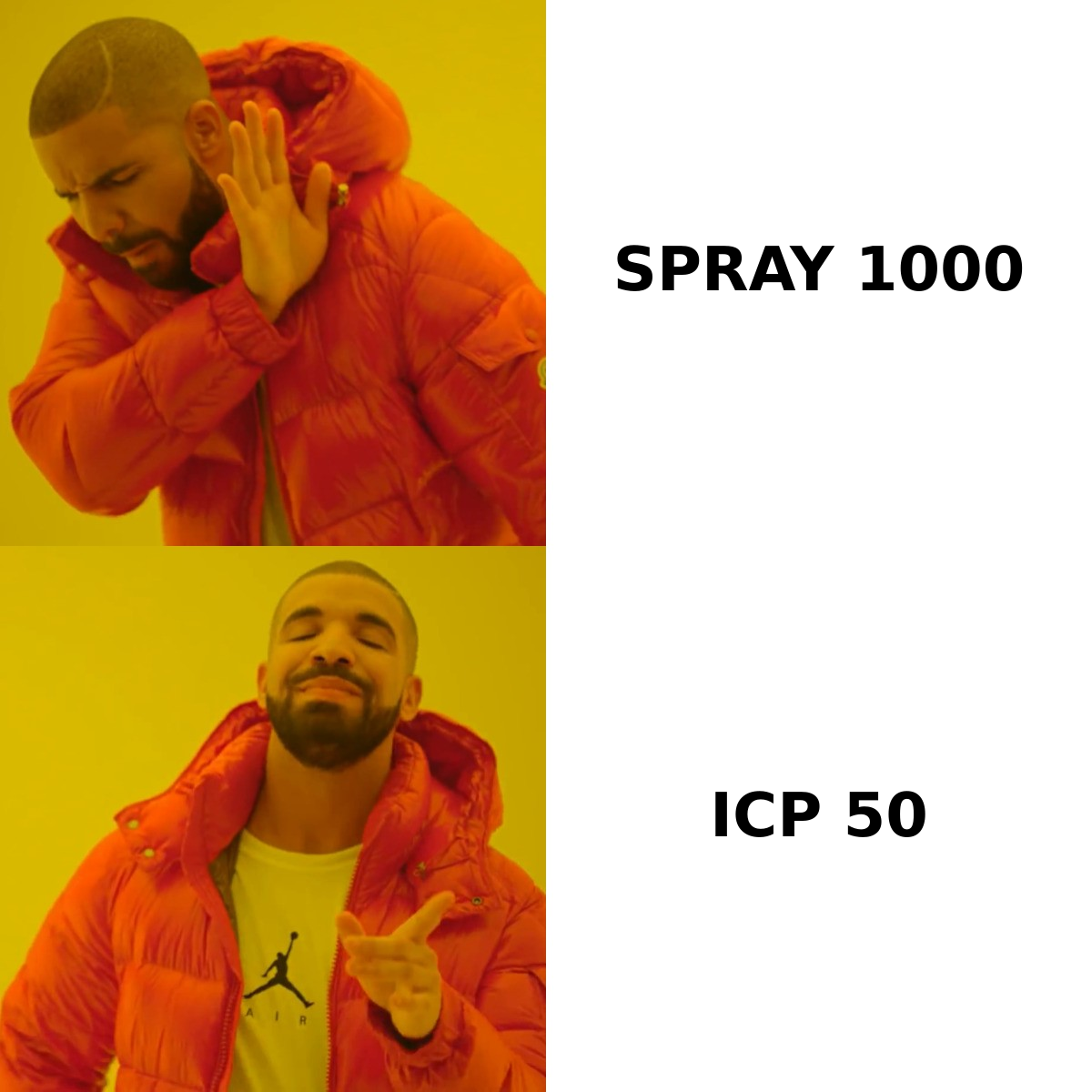
- List size is a trap. 50 deeply-researched accounts beat 5,000 scraped rows for reply rate, deliverability, and sanity.
- Verify and enrich before you send so your bounce rate stays low and your domain reputation survives.
Why does choosing targets for cold outreach matter more than copy?#
Here is the uncomfortable math. If your list is 80% bad-fit, no amount of personalization recovers it — those people will not buy regardless of what you say. Targeting is multiplicative: it sets the ceiling on every other variable in your campaign.
Think of it like fishing. Copy, subject lines, and follow-up cadence are your bait and technique. Your target list is which lake you fish in. The best lure in the world catches nothing in an empty pond. Reps obsess over the lure and ignore the lake.
There is also a deliverability cost. Bad lists are full of stale, role-based, and invalid addresses. High bounce rates tank your sender reputation, which means even your good prospects stop seeing your emails. Choosing targets carefully is partly a copywriting decision and partly an infrastructure decision.
What is an Ideal Customer Profile (ICP), and how do you build one?#
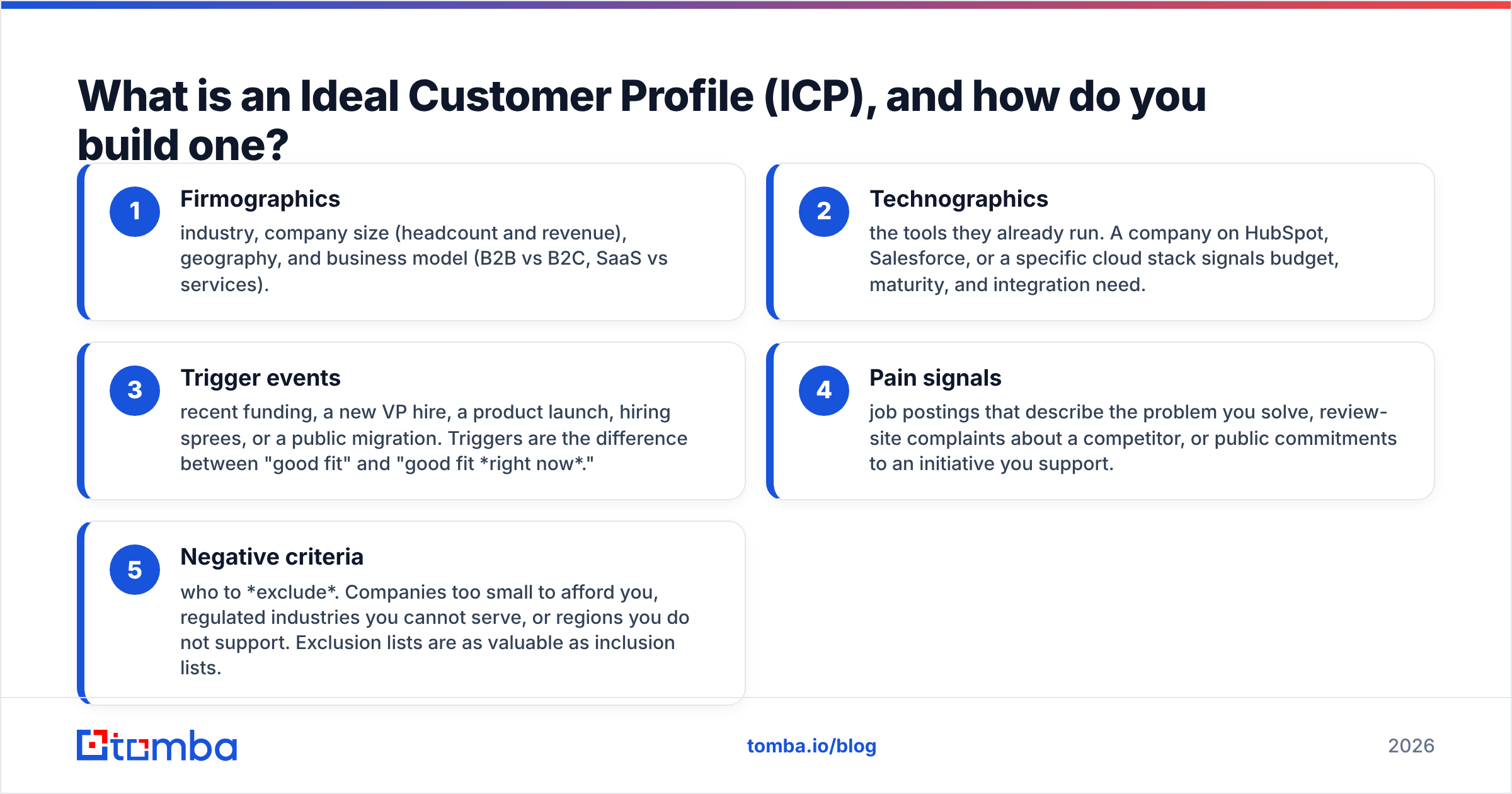
Your ICP is a description of the companies most likely to become high-value, low-churn customers. It is not a persona (that is the individual), and it is not your total addressable market (that is everyone who could theoretically buy). It is the sweet spot in between.
Build it from evidence, not vibes. Pull your last 20–50 closed-won deals and look for what they share:
- Firmographics — industry, company size (headcount and revenue), geography, and business model (B2B vs B2C, SaaS vs services).
- Technographics — the tools they already run. A company on HubSpot, Salesforce, or a specific cloud stack signals budget, maturity, and integration need.
- Trigger events — recent funding, a new VP hire, a product launch, hiring sprees, or a public migration. Triggers are the difference between "good fit" and "good fit right now."
- Pain signals — job postings that describe the problem you solve, review-site complaints about a competitor, or public commitments to an initiative you support.
- Negative criteria — who to exclude. Companies too small to afford you, regulated industries you cannot serve, or regions you do not support. Exclusion lists are as valuable as inclusion lists.
Write the ICP down as a one-page filter that anyone on the team can apply. If two reps would build different lists from the same definition, the definition is too vague.
What does a good vs. bad target list actually look like?#
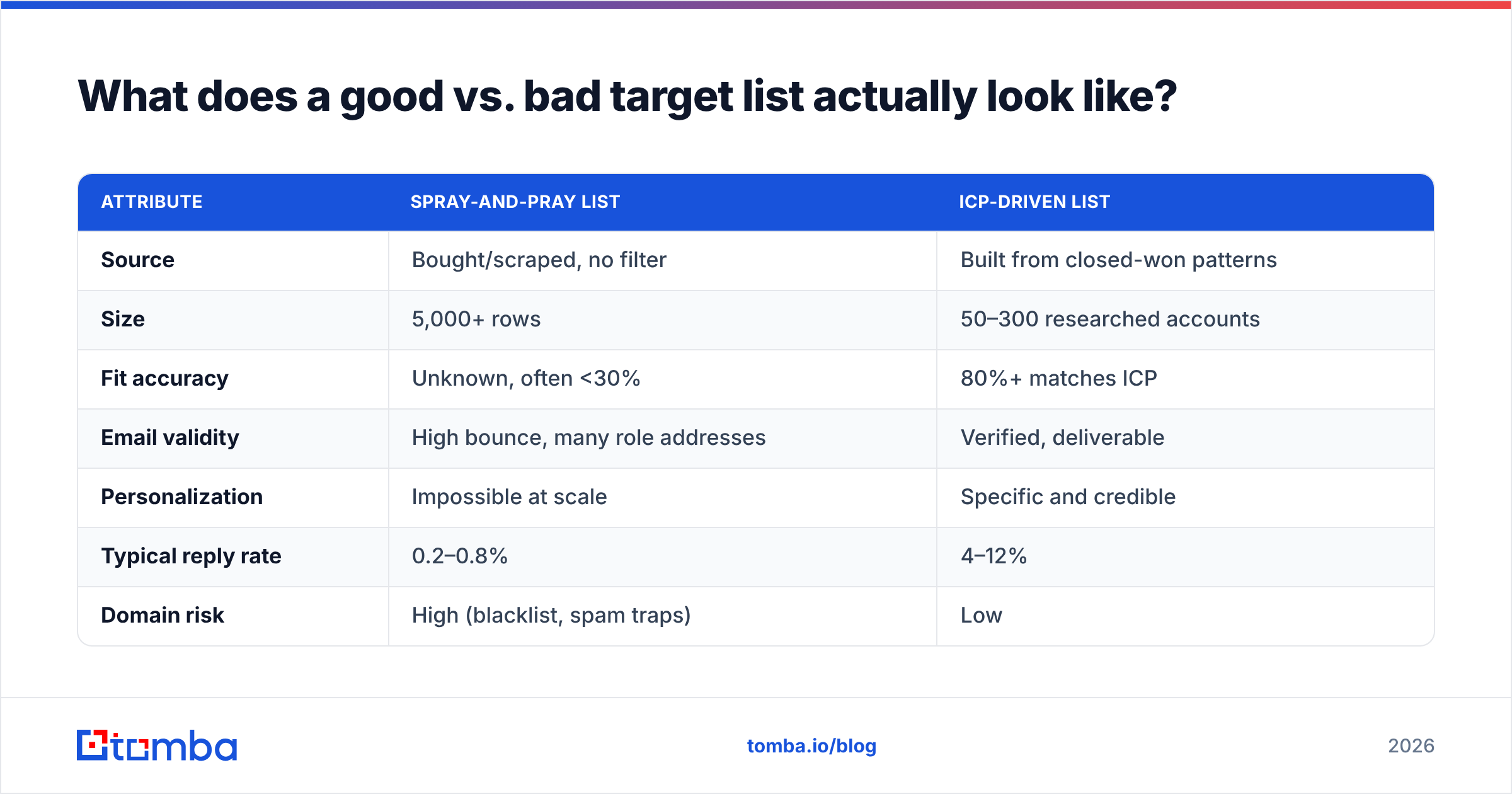
The contrast is stark once you put it side by side. Quality is not a soft metric here — it shows up directly in bounce rate, reply rate, and the number of meetings booked per hundred contacts.
| Attribute | Spray-and-pray list | ICP-driven list |
|---|---|---|
| Source | Bought/scraped, no filter | Built from closed-won patterns |
| Size | 5,000+ rows | 50–300 researched accounts |
| Fit accuracy | Unknown, often <30% | 80%+ matches ICP |
| Email validity | High bounce, many role addresses | Verified, deliverable |
| Personalization | Impossible at scale | Specific and credible |
| Typical reply rate | 0.2–0.8% | 4–12% |
| Domain risk | High (blacklist, spam traps) | Low |
The bad list feels productive because the number is big. But reply rate is the metric that pays rent, and reply rate collapses when fit drops. Choosing targets for cold outreach is mostly an exercise in saying no to volume.
How do you score and prioritize target accounts?#
Once you have a pool that matches the ICP, you still need an order to work them in. Not all good-fit accounts are equal — some are ready to buy now, some in six months. A lightweight scoring model keeps reps focused on the top of the list.
Score each account on two axes and multiply:
- Fit (1–5): How closely does it match your ICP? Size, industry, and tech stack all feed this.
- Intent (1–5): Are there active trigger events? Funding, hiring, a competitor switch, or web-visit signals all raise intent.
An account at Fit 5 / Intent 5 goes to the top of the queue today. A Fit 5 / Intent 1 goes into a nurture track. A Fit 2 / Intent 5 is a distraction — high noise, low payoff — and should usually be dropped. This is also where marketing qualified lead signals from your site can feed straight into the intent score.
The point is not mathematical precision. It is forcing a ranking so your best hour of the day goes to the best ten accounts, not whatever happens to be at the top of a CSV.
Who inside the account should you actually contact?#
Choosing the company is half the job. Choosing the human is the other half. Modern B2B deals involve a buying committee, and Gartner's research consistently shows six to ten people weigh in on a typical purchase. Pick the wrong contact and your message gets ignored or, worse, never forwarded.
Map three roles for every target account:
- Champion — the person who feels the pain daily and would benefit most. Usually a manager or senior individual contributor. Start here; they are most likely to reply.
- Economic buyer — controls the budget. Often a director or VP. They care about outcomes and ROI, not features.
- Blocker / influencer — security, legal, ops, or a skeptical peer who can kill the deal. Worth knowing about even if you do not email them first.
A practical rule: open with the champion, reference the economic buyer's priorities in your message, and let the champion sell internally. Cold-emailing the CEO of a 2,000-person company about a frontline tool almost never works — it is the classic targeting mistake of confusing "senior" with "right."
How do you find and verify contact data for your targets?#
A perfect target list is useless if the email addresses bounce. Once you know which companies and roles you want, you need accurate, deliverable contact data — and you need it verified before it touches your sending domain.
This is the workflow that keeps lists clean:
- Find by company. Use a domain search to pull every known email pattern and contact at a target company, then filter to the roles you mapped above.
- Find by person. When you already have a name and company, an email finder returns the most likely professional address and a confidence score.
- Verify before sending. Run every address through an email verifier to catch invalid, role-based, and risky catch-all addresses. This is the single biggest lever on bounce rate.
- Enrich for personalization. Layer in data enrichment — title, seniority, location, and company attributes — so your scoring and your copy both have something real to work with.
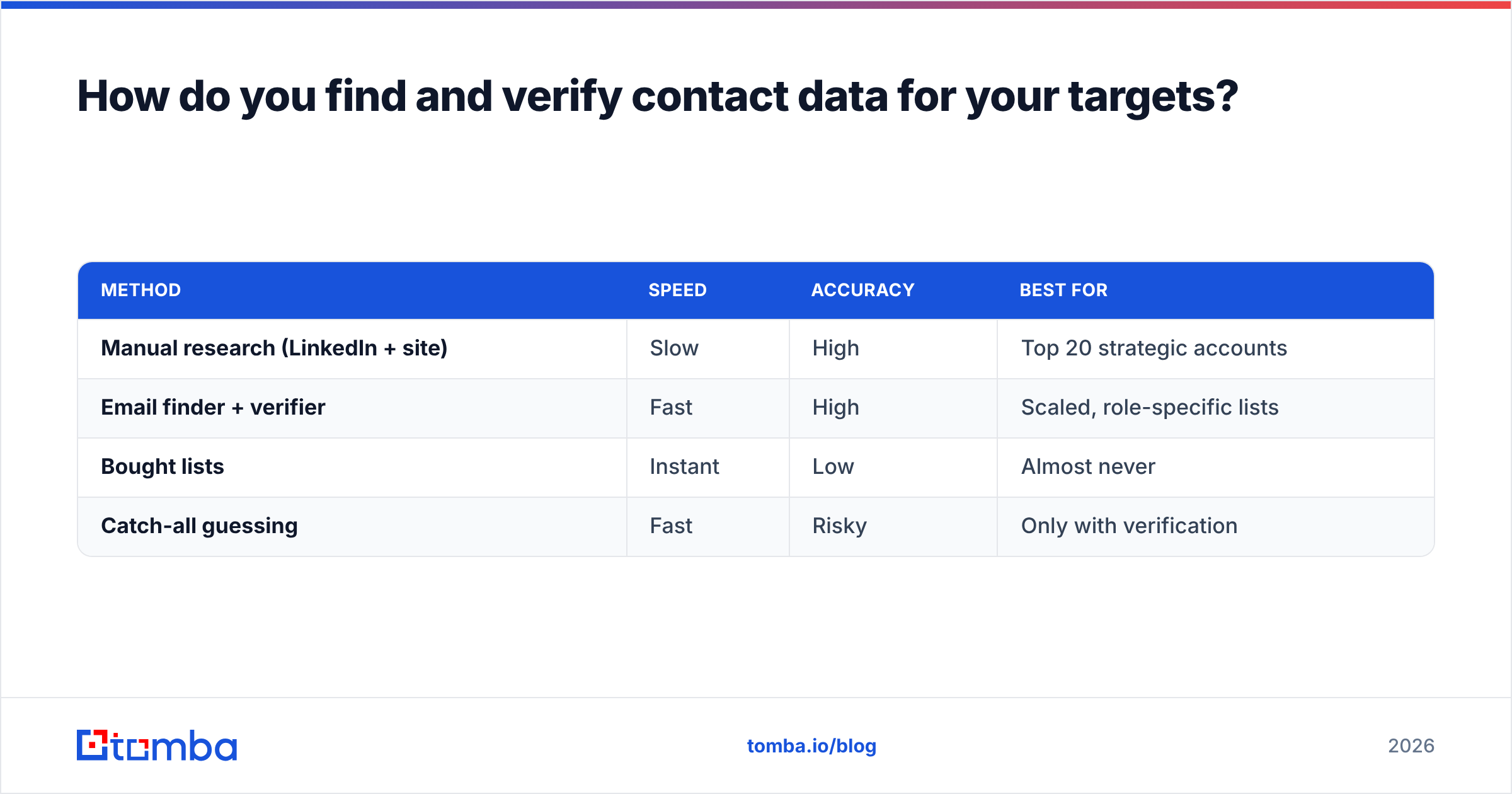
Compare the common sourcing approaches and the trade-offs become obvious:
| Method | Speed | Accuracy | Best for |
|---|---|---|---|
| Manual research (LinkedIn + site) | Slow | High | Top 20 strategic accounts |
| Email finder + verifier | Fast | High | Scaled, role-specific lists |
| Bought lists | Instant | Low | Almost never |
| Catch-all guessing | Fast | Risky | Only with verification |
The middle row is where most teams should live: tooling that scales the find-and-verify step without sacrificing the fit discipline you built into the ICP. If you run outreach in volume, a bulk email finder lets you process a vetted account list in one pass rather than one row at a time.
How big should your target list be?#
Smaller than you think. The instinct to maximize list size comes from treating outreach as a numbers game, but it is a relevance game with a numbers floor.
A useful starting point for a single rep:
- Tier 1 (strategic): 20–30 accounts, fully researched, hyper-personalized, multi-channel.
- Tier 2 (scaled): 100–300 accounts, role-targeted, lightly personalized with enrichment variables.
- Tier 3 (volume): only if Tiers 1 and 2 are exhausted and deliverability is healthy.
If your reply rate is below 2%, the answer is almost never "send more." It is "send better" — tighten the ICP, improve the contact mapping, or clean the data. Adding volume to a broken list just multiplies the damage to your domain. Many teams that report being "blacklisted" simply scaled a bad list faster.
G2's category data makes the same point at the tooling level: the platforms that win on satisfaction are the ones that improve list quality, not the ones that promise the biggest raw database.
What are the most common targeting mistakes in 2026?#
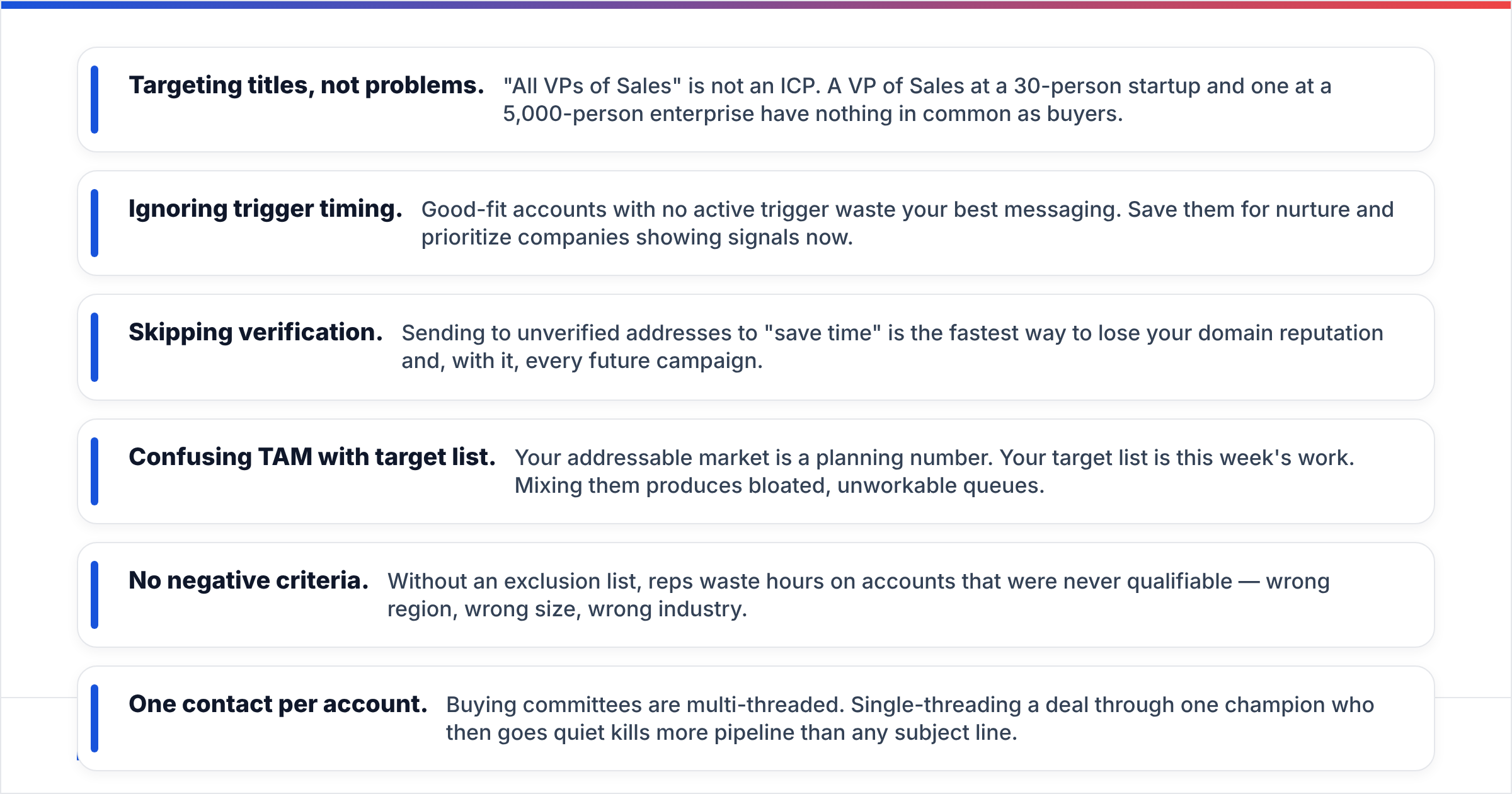
Even disciplined teams fall into a handful of repeatable traps. Watch for these:
- Targeting titles, not problems. "All VPs of Sales" is not an ICP. A VP of Sales at a 30-person startup and one at a 5,000-person enterprise have nothing in common as buyers.
- Ignoring trigger timing. Good-fit accounts with no active trigger waste your best messaging. Save them for nurture and prioritize companies showing signals now.
- Skipping verification. Sending to unverified addresses to "save time" is the fastest way to lose your domain reputation and, with it, every future campaign.
- Confusing TAM with target list. Your addressable market is a planning number. Your target list is this week's work. Mixing them produces bloated, unworkable queues.
- No negative criteria. Without an exclusion list, reps waste hours on accounts that were never qualifiable — wrong region, wrong size, wrong industry.
- One contact per account. Buying committees are multi-threaded. Single-threading a deal through one champion who then goes quiet kills more pipeline than any subject line.
Fixing these is mostly about discipline, not new tools. The teams that win at outbound treat their target list as a living asset — pruned weekly, re-scored as triggers change, and never padded just to hit an activity quota.
Putting it together: a repeatable targeting workflow#
Here is the end-to-end loop you can run every week:
- Refresh the ICP against your latest closed-won and closed-lost deals.
- Pull a candidate pool of accounts matching firmographics and technographics.
- Score each on fit and intent; keep the top tier, nurture the rest.
- Map the buying committee — champion, economic buyer, blocker — per account.
- Find and verify contact data for the mapped roles.
- Enrich for personalization variables.
- Send, measure reply rate, and feed the results back into step one.
That feedback loop is what separates teams that improve from teams that just stay busy. Every campaign teaches you something about your ICP if you let it.
Start with a list that actually converts#
The highest-leverage hour in outbound is not spent writing — it is spent choosing. A tight, verified, well-scored list will out-earn a clever sequence on a bad list every single time.
When you are ready to turn your ICP into a real, deliverable target list, start with the Tomba Email Finder. Find the right people at your right-fit accounts, verify before you send, and enrich every record so your messaging lands with someone who actually has the problem you solve. You can test it on the free tier (25 searches/month) and scale up through the Starter plan at $49/mo once your targeting is dialed in. Choose better, send less, book more.
// get started
Find, verify and enrich your first contacts today
Start on the free plan with 25 searches a month, then scale when your team is ready.
Free plan · No credit card required · GDPR & CCPA
// about the author