Client Objection Handling in 2026: A Practical B2B Playbook
Objections are buying signals, not rejections. Here's a framework-driven approach to client objection handling that turns pushback into closed deals in 2026.
TL;DR
- Objections are not rejections — they are requests for more information, and 60%+ of lost deals stall on an unhandled objection, not a hard "no."
- The strongest client objection handling follows a repeatable loop: listen, acknowledge, clarify, respond, confirm — improvising is what kills win rates.
- Most objections fall into five buckets: price, timing, authority, need, and trust. Each has a different best-fit response pattern.
- Prevention beats rebuttal: clean data, the right contact, and tight qualification kill half your objections before they're spoken.
- A method like LAARC or the Sandler reversal works far better than a clever one-liner — and reps who use a framework close 20-30% more of their stalled deals.
Why does client objection handling decide your win rate?#
Because the deal is usually won or lost in the gap between "I'm not sure" and your next sentence. Objection handling is the skill of staying calm, curious, and useful in that gap instead of getting defensive.
Think of an objection like a customer at a restaurant sending a dish back. They're not leaving — they're still at the table, still hungry, still willing to pay. They just told you exactly what's wrong. A weak server argues. A great server asks one clarifying question, fixes the plate, and turns a complaint into a bigger tip. Sales works the same way: the prospect who objects is still engaged. The prospect who says "looks great, I'll think about it" and ghosts you is the one you actually lost.
The data backs this up. Most B2B deals that go dark don't die on price — they die because a real concern went unaddressed and the rep never surfaced it. Reps who treat objections as the most valuable part of the conversation consistently post higher win rates and shorter cycles. Reps who treat them as attacks talk past the concern and lose.
)
What are the main types of client objections?#
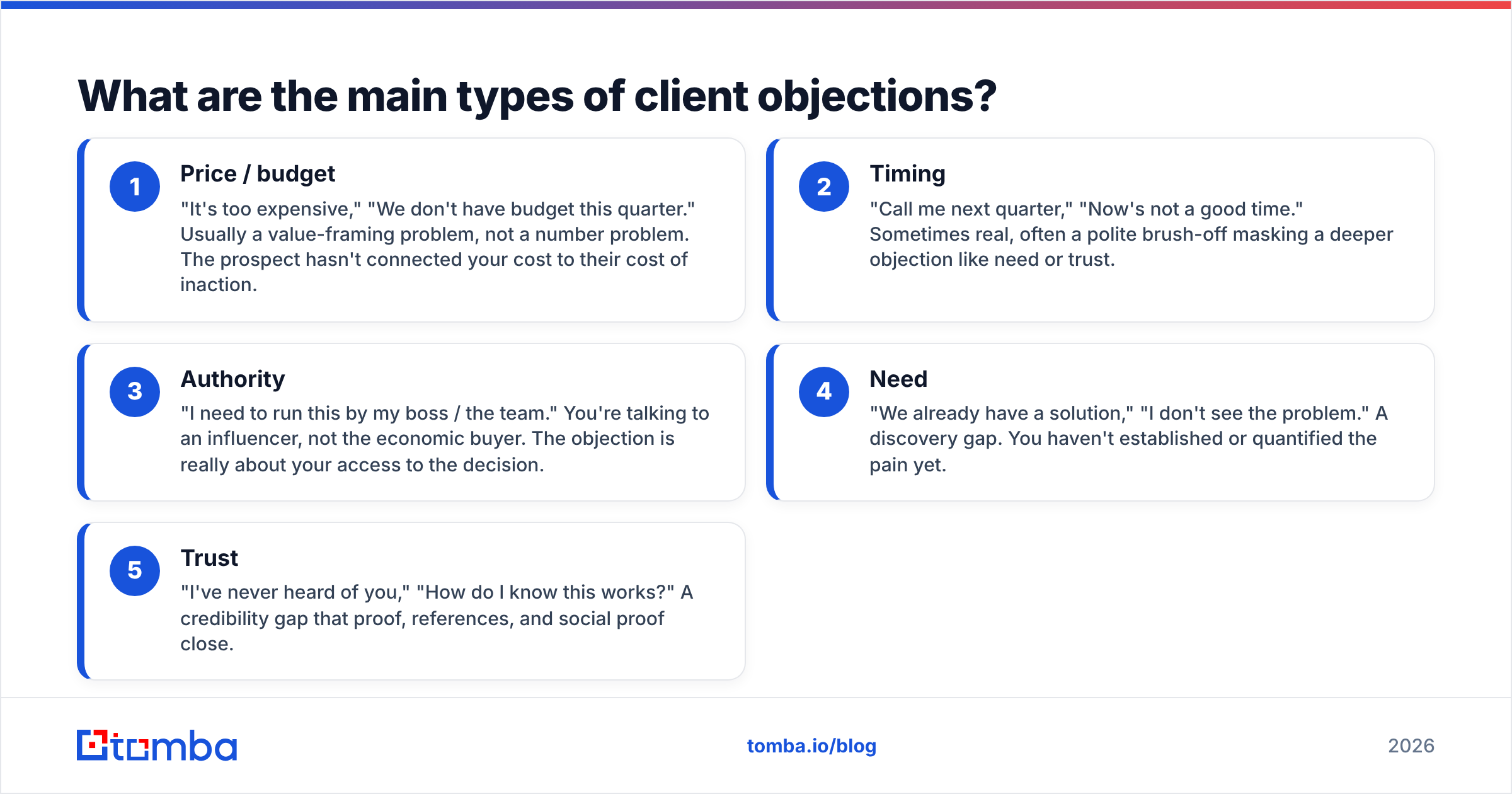
There are five core categories, and naming the category is half the battle. Once you know which bucket an objection lives in, you know which play to run.
- Price / budget — "It's too expensive," "We don't have budget this quarter." Usually a value-framing problem, not a number problem. The prospect hasn't connected your cost to their cost of inaction.
- Timing — "Call me next quarter," "Now's not a good time." Sometimes real, often a polite brush-off masking a deeper objection like need or trust.
- Authority — "I need to run this by my boss / the team." You're talking to an influencer, not the economic buyer. The objection is really about your access to the decision.
- Need — "We already have a solution," "I don't see the problem." A discovery gap. You haven't established or quantified the pain yet.
- Trust — "I've never heard of you," "How do I know this works?" A credibility gap that proof, references, and social proof close.
Notice that three of these five (timing, authority, need) are frequently smokescreens — surface statements covering a different real objection. That's why the clarify step matters so much. You can't handle an objection you've misdiagnosed.
What's the best framework for handling objections?#
The best framework is the one your whole team can run under pressure — but LAARC is the most reliable starting point. It stands for Listen, Acknowledge, Assess, Respond, Confirm, and it works because it forces you to slow down before you answer.
Here's the loop in practice:
- Listen — let them finish completely. Don't interrupt to defend. Silence after they stop talking often pulls out the real objection.
- Acknowledge — "That's a fair concern" or "I hear that a lot from finance teams." This lowers the temperature and signals you're on their side.
- Assess (clarify) — ask a question. "When you say it's expensive, is it the total number, or the way it's structured?" This is where smokescreens collapse.
- Respond — answer the actual objection you uncovered, with proof, not adjectives.
- Confirm — "Does that address it, or is there something else holding you back?" This stops the objection from reappearing at the close.
Compare the leading methods so you can pick the one that fits your motion:
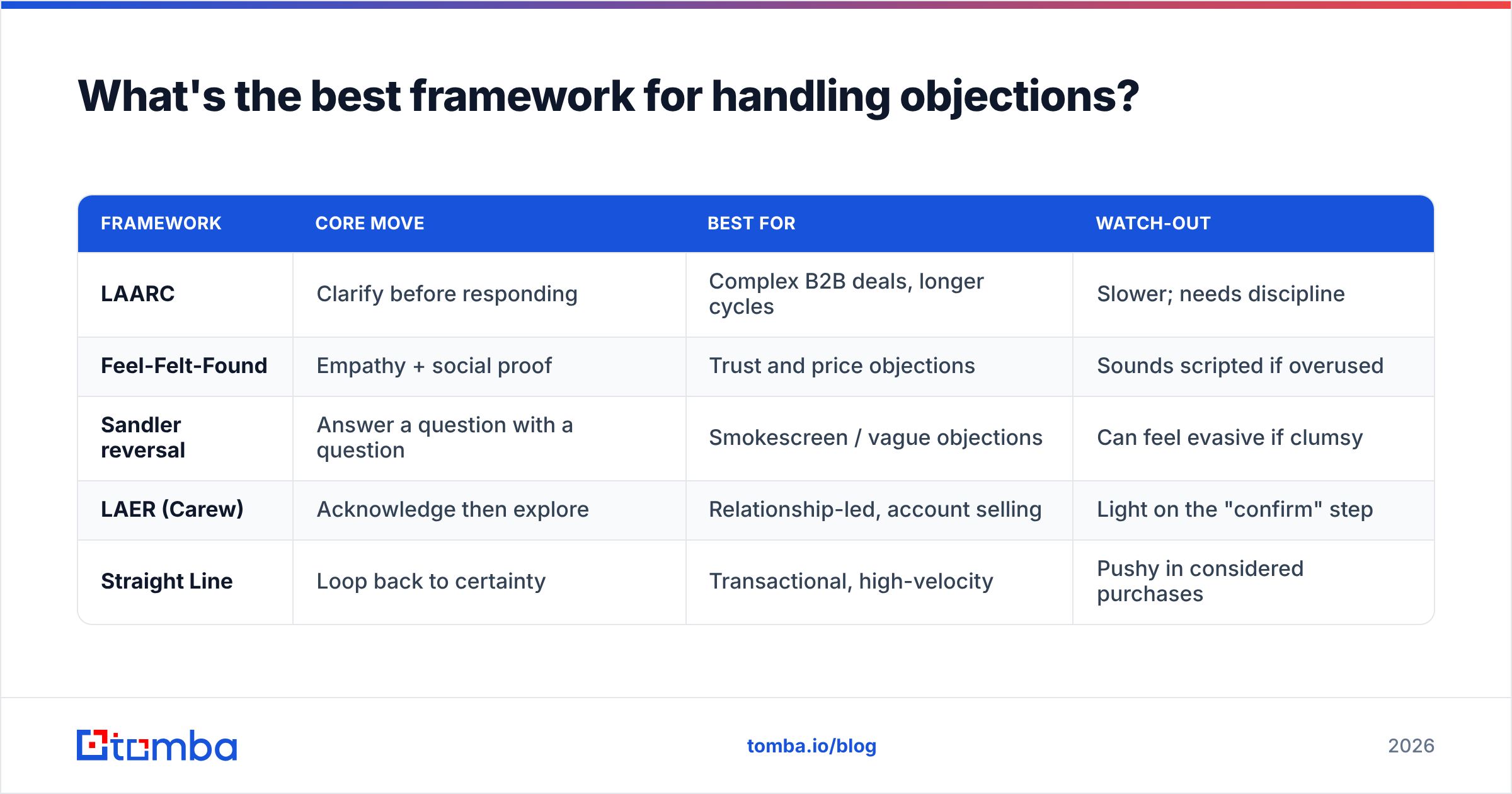
| Framework | Core move | Best for | Watch-out |
|---|---|---|---|
| LAARC | Clarify before responding | Complex B2B deals, longer cycles | Slower; needs discipline |
| Feel-Felt-Found | Empathy + social proof | Trust and price objections | Sounds scripted if overused |
| Sandler reversal | Answer a question with a question | Smokescreen / vague objections | Can feel evasive if clumsy |
| LAER (Carew) | Acknowledge then explore | Relationship-led, account selling | Light on the "confirm" step |
| Straight Line | Loop back to certainty | Transactional, high-velocity | Pushy in considered purchases |
There's no single winner. High-velocity SMB teams lean Straight Line or Feel-Felt-Found; enterprise teams with six-figure deals almost always run LAARC or LAER because the clarify-and-confirm steps protect a long, multi-stakeholder cycle. HubSpot's research on sales objection handling is a solid neutral reference if you want to benchmark your scripts.
How do you handle the price objection specifically?#
Reframe cost as cost-of-inaction, then anchor against the problem instead of the budget line.
When a prospect says "it's too expensive," the worst response is to discount immediately — you just taught them that your price is fake and your first number was a lie. Instead:
- Clarify the real number. "Too expensive compared to what?" Often they're comparing you to doing nothing, not to a competitor.
- Quantify the pain. If bad-fit leads cost their team 10 hours a week, your tool that saves 8 of those hours pays for itself before the invoice clears.
- Isolate the objection. "If price weren't a factor, is this the right solution for you?" If yes, it's a budget conversation. If no, price was a smokescreen for need.
- Offer structure, not just a smaller number. Annual billing, a phased rollout, or starting on a lower tier (a $49/mo starter plan that proves ROI before the $99/mo upgrade) keeps the value intact.
The point is to move the conversation from "your price" to "their problem." A number only feels expensive in a vacuum.
How do you stop objections before they happen?#
Prevent them upstream with better qualification and cleaner data — the cheapest objection to handle is the one never raised.
A huge share of objections trace back to talking to the wrong person or leading with the wrong context. If you're pitching a manager who can't sign, you'll always hit the authority objection. If your contact data is stale, you'll burn your opener apologizing for getting their role wrong. Prevention looks like this:
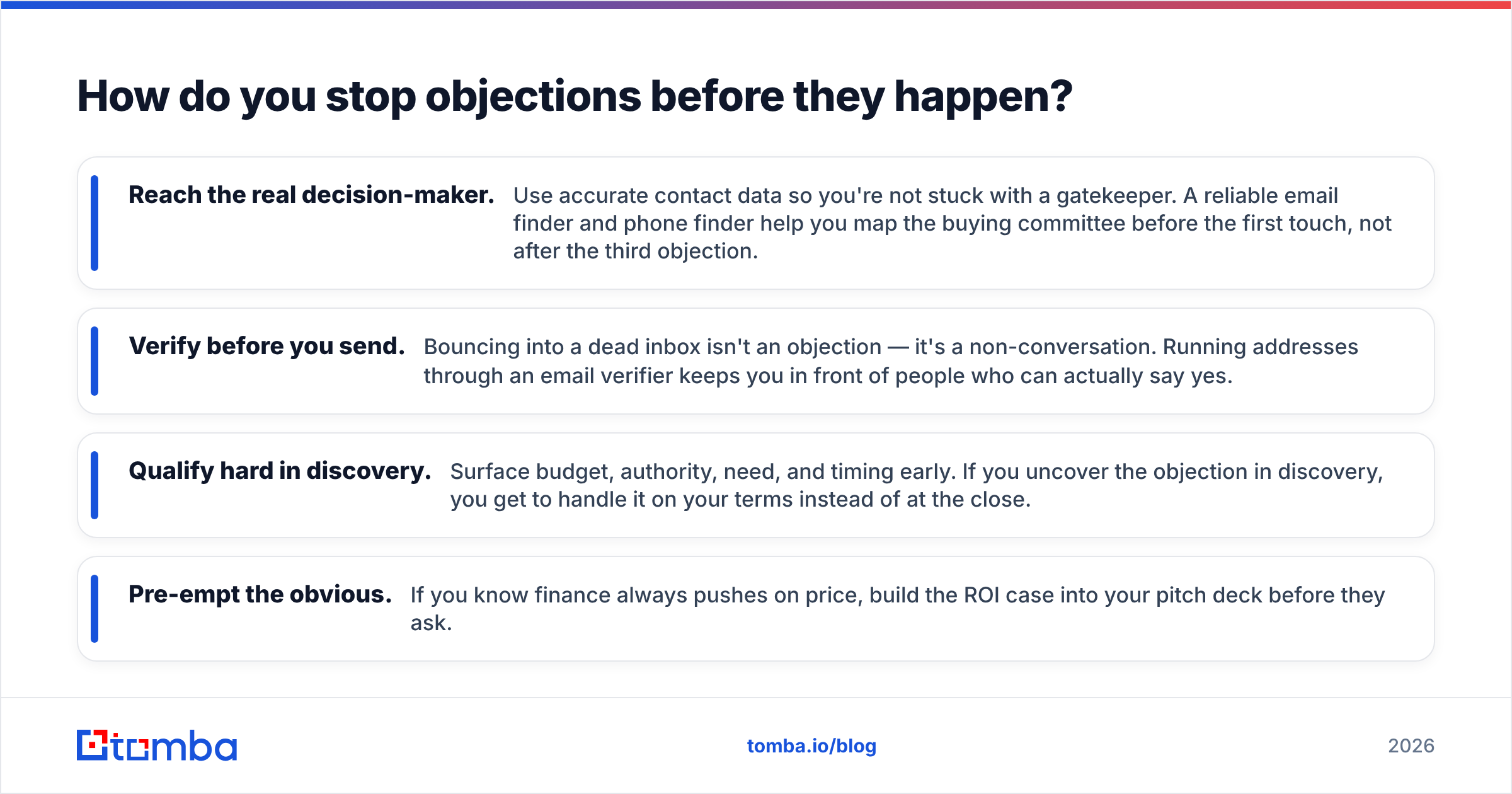
- Reach the real decision-maker. Use accurate contact data so you're not stuck with a gatekeeper. A reliable email finder and phone finder help you map the buying committee before the first touch, not after the third objection.
- Verify before you send. Bouncing into a dead inbox isn't an objection — it's a non-conversation. Running addresses through an email verifier keeps you in front of people who can actually say yes.
- Qualify hard in discovery. Surface budget, authority, need, and timing early. If you uncover the objection in discovery, you get to handle it on your terms instead of at the close.
- Pre-empt the obvious. If you know finance always pushes on price, build the ROI case into your pitch deck before they ask.
)
Better targeting is the most under-rated objection-handling skill. When your response rate climbs because you're emailing the right, verified contacts, you spend far less time fighting "why are you contacting me?" and far more time fighting winnable objections about value.
What about timing and authority objections?#
Treat "not now" and "I have to ask my boss" as access problems, not endings.
Timing. When someone says "call me in Q3," resist the calendar reflex. Ask, "What changes in Q3 that makes this easier?" If they have a real answer (budget cycle, a contract ending), it's legitimate — book a firm next step and a reason to talk. If they go vague, you've found a smokescreen, usually hiding a need or trust objection you can address now. Never let "later" be undefined; an undefined later is a no.
Authority. "I need to check with my team" is an opportunity, not a wall. The move is to multi-thread: "Makes sense — who else should be in the room, and what will they want to know?" Then arm your champion with a one-pager so they can sell internally without you. The deals that die here are the ones where the rep hands a single contact a complex decision and disappears. Map the committee early; tools that enrich a company's org structure and let you find the right stakeholders turn a single-threaded deal into a defensible one. Salesforce's own State of Sales reporting consistently shows multi-threaded deals close at materially higher rates.
How do you build trust objections into wins?#
Close the credibility gap with proof the prospect can verify themselves, not claims they have to take on faith.
Trust objections — "I've never heard of you," "How do I know your data is accurate?" — are actually the easiest to handle because they have concrete answers:
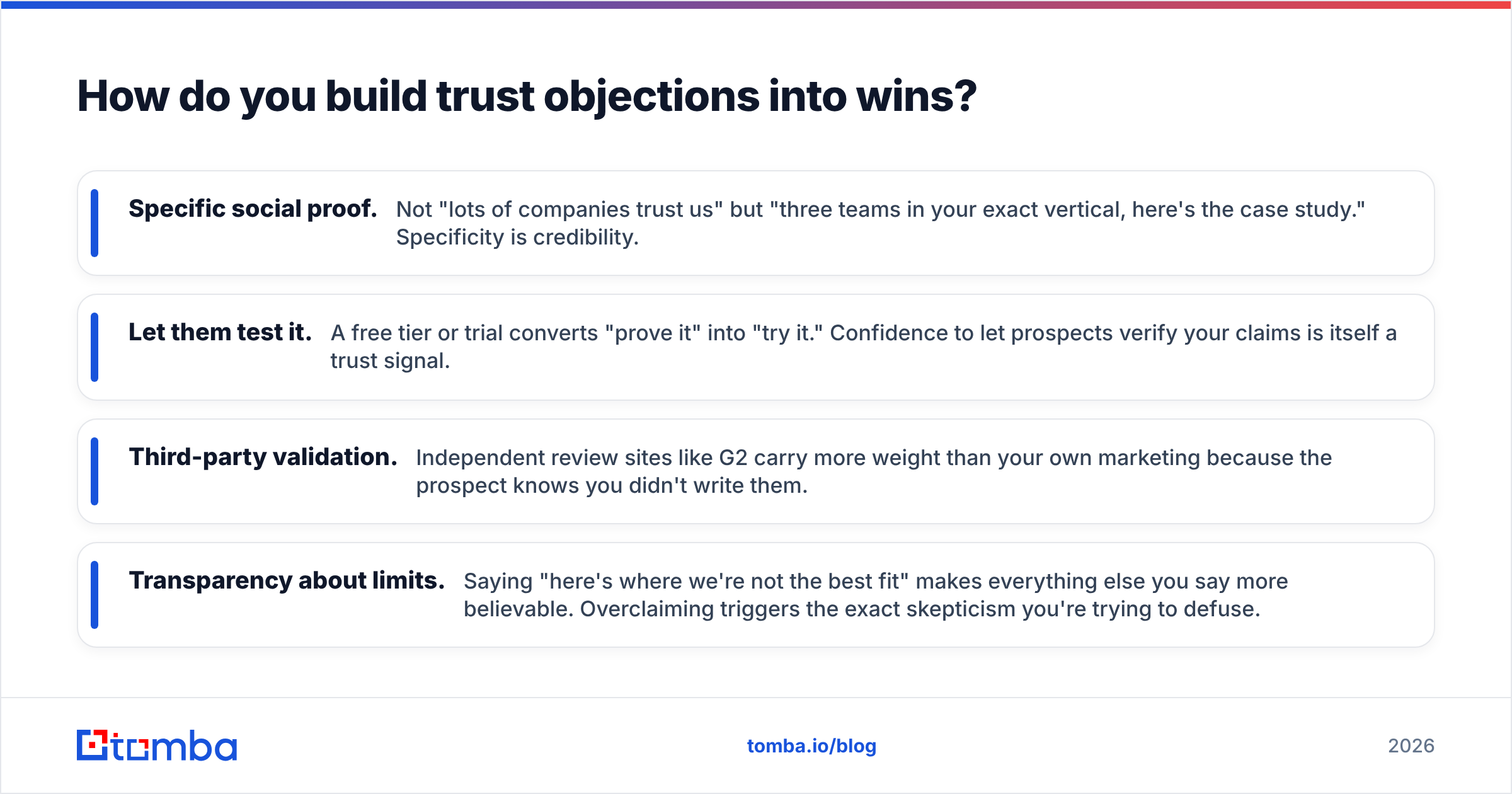
- Specific social proof. Not "lots of companies trust us" but "three teams in your exact vertical, here's the case study." Specificity is credibility.
- Let them test it. A free tier or trial converts "prove it" into "try it." Confidence to let prospects verify your claims is itself a trust signal.
- Third-party validation. Independent review sites like G2 carry more weight than your own marketing because the prospect knows you didn't write them.
- Transparency about limits. Saying "here's where we're not the best fit" makes everything else you say more believable. Overclaiming triggers the exact skepticism you're trying to defuse.
When the objection is specifically about data quality or accuracy, point to how the work is actually done — sourcing, verification, and refresh cadence. Being able to explain where your data comes from and showing real verification beats any adjective. The same logic applies to your own prospecting: trustworthy outreach starts with trustworthy data, which is why a clean B2B database and documented data sources matter as much to your credibility as your pitch.
What are the most common objection-handling mistakes?#
The mistakes are almost always about ego and speed, not knowledge.
- Answering too fast. Responding before you understand the real objection means you confidently solve the wrong problem.
- Getting defensive. The moment you argue, you've made it a contest. Nobody buys from someone they just lost an argument to.
- Discounting reflexively. A fast discount trains the buyer to push harder and signals your price was never real.
- Talking too much. After you respond, stop. The next person to speak often reveals the real concern. Silence is a tool.
- Skipping the confirm step. If you don't ask "does that fully address it?", the objection goes underground and resurfaces as a stalled deal three weeks later.
- One-and-done data. Running outreach on a stale list manufactures objections — wrong name, wrong role, wrong company. Keeping your CRM enriched and current removes a whole class of self-inflicted pushback.
The common thread: great objection handling is mostly listening, diagnosing, and confirming. The actual "rebuttal" is the smallest part. If you're spending your prep time memorizing clever comebacks instead of clarifying questions, you're optimizing the wrong skill.
How do you practice and scale objection handling across a team?#
Make it a system, not a talent — document the top objections, script the clarify questions, and drill them.
The best sales orgs maintain a living objection library: the 15-20 objections that account for 90% of deals, each with the category, the best clarifying question, the proof point, and the confirm line. New reps ramp faster because they're not reinventing responses on every call. Run weekly role-play where one rep objects as aggressively as possible and the other practices the loop — the discomfort of practice is far cheaper than the discomfort of a lost deal.
Pair that with measurement. Track which objections appear at which stage and which responses actually move deals forward. Over time you'll see that better front-end targeting — reaching verified, in-market, decision-level contacts — quietly shrinks your objection volume. You can't out-rebuttal a fundamentally mistargeted pipeline, and you shouldn't try. Fix the inputs, and the objections you're left with are the good kind: real buyers with real questions you can actually answer.
Where does the right data fit into all of this?#
Every framework above assumes one thing: you're talking to the right person, at a real address, at a company with a real problem. Get that wrong and you're not handling objections — you're handling the consequences of bad targeting.
That's the cheapest leverage in your whole process. Start by reaching the actual decision-makers with verified contact details using the Tomba Email Finder — find professional email addresses by domain, name, or company, verify them before you send, and walk into every conversation already talking to someone who can say yes. Spin up a free account (25 searches a month, no card), confirm the lift in your reply rates, and check the full Tomba pricing when you're ready to scale. Handle fewer junk objections, and you'll have far more energy for the ones worth winning.
// get started
Find, verify and enrich your first contacts today
Start on the free plan with 25 searches a month, then scale when your team is ready.
Free plan · No credit card required · GDPR & CCPA
// about the author