Client Persona in 2026: Build B2B Buyer Profiles That Convert
A client persona turns vague targeting into a repeatable revenue engine. Here's how to research, build, and operationalize B2B buyer profiles in 2026.
TL;DR
- A client persona is a research-based profile of the specific person who buys from you — their role, goals, pains, buying triggers, and objections — not a demographic cartoon.
- Personas built on real data outperform "gut feel" targeting on reply rate, win rate, and cycle length, because every message maps to a known job-to-be-done.
- The strongest personas combine qualitative interviews, CRM win/loss data, and firmographic enrichment — then get stored where reps actually work.
- Build 2–4 personas max; more than that and your team stops using them.
- Pair each persona with accurate contact data so the profile turns into pipeline, not a slide deck that gathers dust.
If you have ever written a cold email that felt generic the second you hit send, the problem usually is not your copy. It is that you do not actually know who you are writing to. A client persona fixes that. It is the difference between throwing darts in the dark and aiming at a target you can describe in your sleep.
This guide walks through what a client persona is, how it differs from related terms you have probably heard, how to build one with real research, and how to operationalize it so it drives revenue instead of decorating a Notion page.
What is a client persona?#
A client persona is a semi-fictional, evidence-based representation of your ideal buyer. Think of it like a dossier a detective builds before an interview: you walk in already knowing the person's motivations, what keeps them up at night, and what would make them say yes.
A complete B2B client persona answers five questions:
- Who are they? Job title, seniority, team size, who they report to, and what their day actually looks like.
- What do they want? The business outcome they are measured on — pipeline, retention, cost reduction, compliance.
- What hurts? The specific friction stopping them from hitting that outcome today.
- What triggers a purchase? The event — a new hire, a funding round, a missed quota — that turns a passive reader into an active buyer.
- What stops them from buying? Budget authority, competing priorities, switching costs, and the objections you will hear on every call.
Notice that none of those five questions is "what is their favorite coffee." Fictional color (the classic "Marketing Mary, age 34, loves yoga") is the part of persona work most teams overdo and the part buyers care about least. Concrete, decision-relevant detail beats personality fluff every time.

Client persona vs buyer persona vs ICP: what's the difference?#
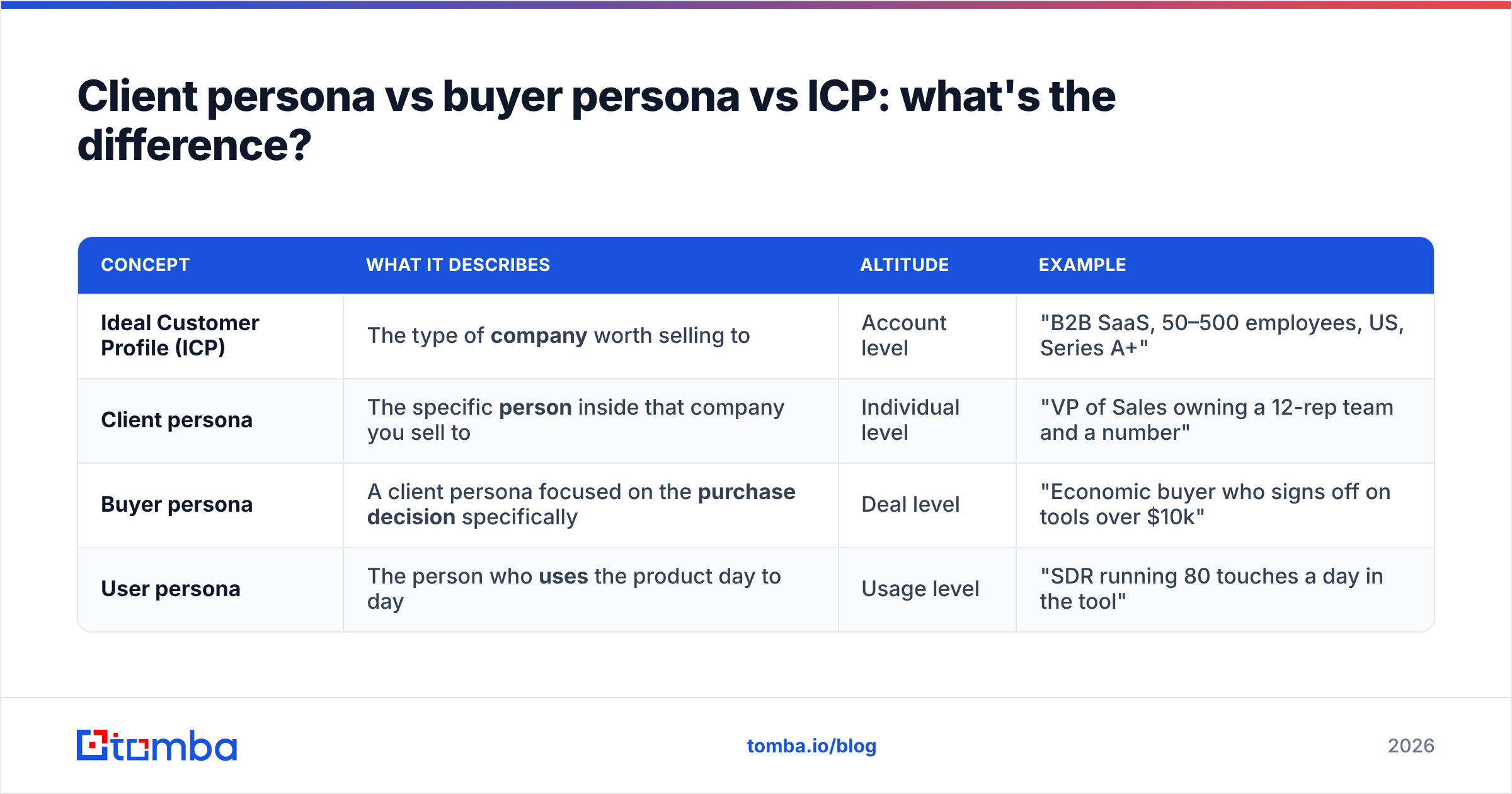
These three terms get used interchangeably, and that sloppiness causes real targeting mistakes. They operate at different altitudes.
| Concept | What it describes | Altitude | Example |
|---|---|---|---|
| Ideal Customer Profile (ICP) | The type of company worth selling to | Account level | "B2B SaaS, 50–500 employees, US, Series A+" |
| Client persona | The specific person inside that company you sell to | Individual level | "VP of Sales owning a 12-rep team and a number" |
| Buyer persona | A client persona focused on the purchase decision specifically | Deal level | "Economic buyer who signs off on tools over $10k" |
| User persona | The person who uses the product day to day | Usage level | "SDR running 80 touches a day in the tool" |
The practical takeaway: your ICP tells you which doors to knock on. Your client persona tells you who answers the door and what to say. In a typical B2B deal you will sell to several personas at once — the user who feels the pain, the buyer who controls the budget, and the executive who cares about the outcome. Mapping all three is how you avoid the classic failure of selling a great product to someone who cannot actually say yes.
If you want a deeper primer on the surrounding terminology, our B2B glossary breaks down adjacent concepts like marketing qualified lead and how they feed your persona work.
Why does a client persona matter for revenue?#
Because every downstream activity inherits its quality from the persona. Get the persona wrong and you scale the wrong message to the wrong people faster.
A sharp client persona improves four metrics directly:
- Reply rate. Messages tied to a known pain get read. Generic blasts get archived.
- Win rate. When you understand the buyer's objections before the call, you handle them instead of getting surprised. (For context on benchmarks, see win rate.)
- Sales cycle length. Reps stop educating the wrong audience and spend time with people who can actually buy.
- Customer retention. Selling to people who genuinely fit means fewer churned accounts that should never have closed.
HubSpot's research on buyer personas has consistently found that companies using documented personas see stronger alignment between marketing and sales — and that alignment is where pipeline efficiency comes from. The cost of skipping persona work is not zero; it is just hidden inside your low reply rates and bloated CAC.
How do you research a client persona?#
Conclusion first: never invent a persona from a conference room. Build it from three evidence streams, then triangulate.
1. Talk to real customers and lost deals#
Interview 5–10 current customers who fit your ICP and 3–5 deals you lost. You are listening for the language they use, the trigger that started their search, and the alternatives they considered. Customers describe their pain in words your marketing never would — and those exact words become your highest-converting copy.
2. Mine your CRM and win/loss data#
Your closed-won deals are a goldmine. Pull the common attributes of accounts that closed fast and stayed: industry, team size, role of the champion, the trigger event. Then do the same for closed-lost. The gap between the two patterns is your persona's boundary.
3. Enrich with firmographic and contact data#
Qualitative interviews tell you the "why." Data enrichment tells you the "how many and where." This is where you turn a hunch into a list you can act on. Using a tool for data enrichment, you append firmographics, technographics, and verified contact details to the accounts that match your emerging persona — so the profile is backed by a reachable audience, not a vibe.
A quick reality check most teams skip: a persona is only as useful as your ability to reach it. If your persona is "Head of RevOps at a 200-person SaaS company" but you cannot find those people's contact details, you have written fiction. Connecting persona definition to a real B2B database keeps the exercise honest.
What does a B2B client persona template look like?#
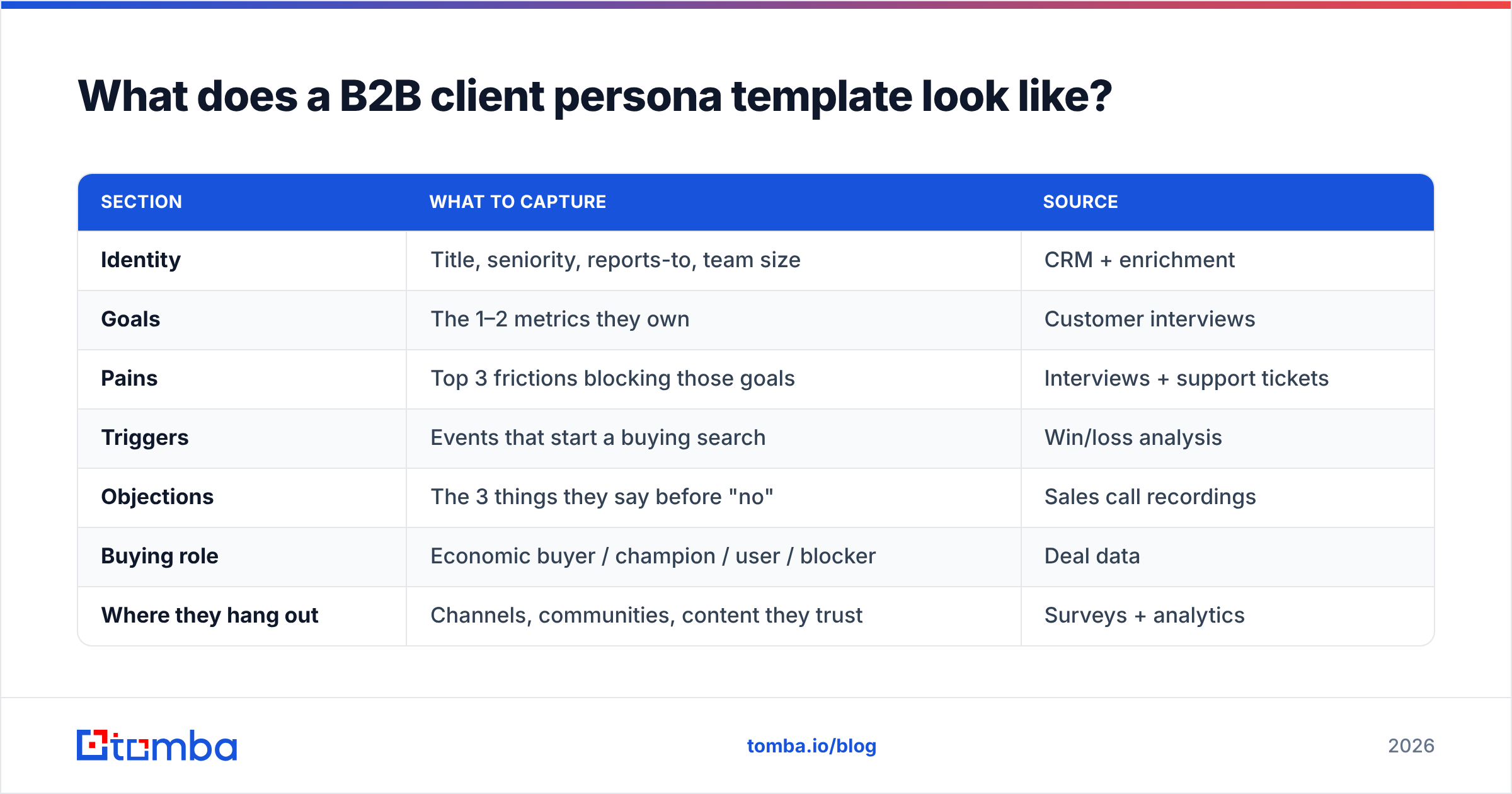
Use this structure. Keep it to one page per persona — anything longer and reps will not read it.
| Section | What to capture | Source |
|---|---|---|
| Identity | Title, seniority, reports-to, team size | CRM + enrichment |
| Goals | The 1–2 metrics they own | Customer interviews |
| Pains | Top 3 frictions blocking those goals | Interviews + support tickets |
| Triggers | Events that start a buying search | Win/loss analysis |
| Objections | The 3 things they say before "no" | Sales call recordings |
| Buying role | Economic buyer / champion / user / blocker | Deal data |
| Where they hang out | Channels, communities, content they trust | Surveys + analytics |
| Watering-hole phrases | Exact words they use for the problem | Interview transcripts |
Fill every cell with evidence, not assumption. If a cell is empty, that is a research gap to close — not a box to make something up in.
How many client personas should you have?#
Two to four. Full stop.
Teams love to proliferate personas because it feels thorough. In practice, a rep juggling eight personas defaults to none of them. The goal is not a complete taxonomy of every human who might buy; it is a small set of profiles distinct enough to change how you sell. If two personas would receive the same email and the same demo, they are one persona.
A useful test: if you cannot name a different value proposition, a different trigger, and a different objection for each persona, you have over-segmented. Merge them.

How do you turn a client persona into pipeline?#
A persona stored in a slide deck generates exactly zero revenue. Operationalizing it means three moves.
1. Map personas to a target account list. Use your ICP to build the account list, then use the persona to identify the right contacts inside each account. This is where contact discovery does the heavy lifting — finding the VP of Sales, not just any email at the company. A domain search lets you pull every relevant contact at a target company and filter to the roles your persona describes.
2. Build persona-specific messaging. Each persona gets its own sequence: subject lines built from their trigger, body copy built from their pain, and a CTA matched to their buying role. The economic buyer hears ROI; the user hears time saved.
3. Push personas into the tools reps live in. Tag every contact in your CRM with its persona. When a lead comes in, the rep instantly knows which script applies. Surfacing the persona inside your CRM workflow — not in a separate doc — is the single biggest driver of whether personas actually get used.
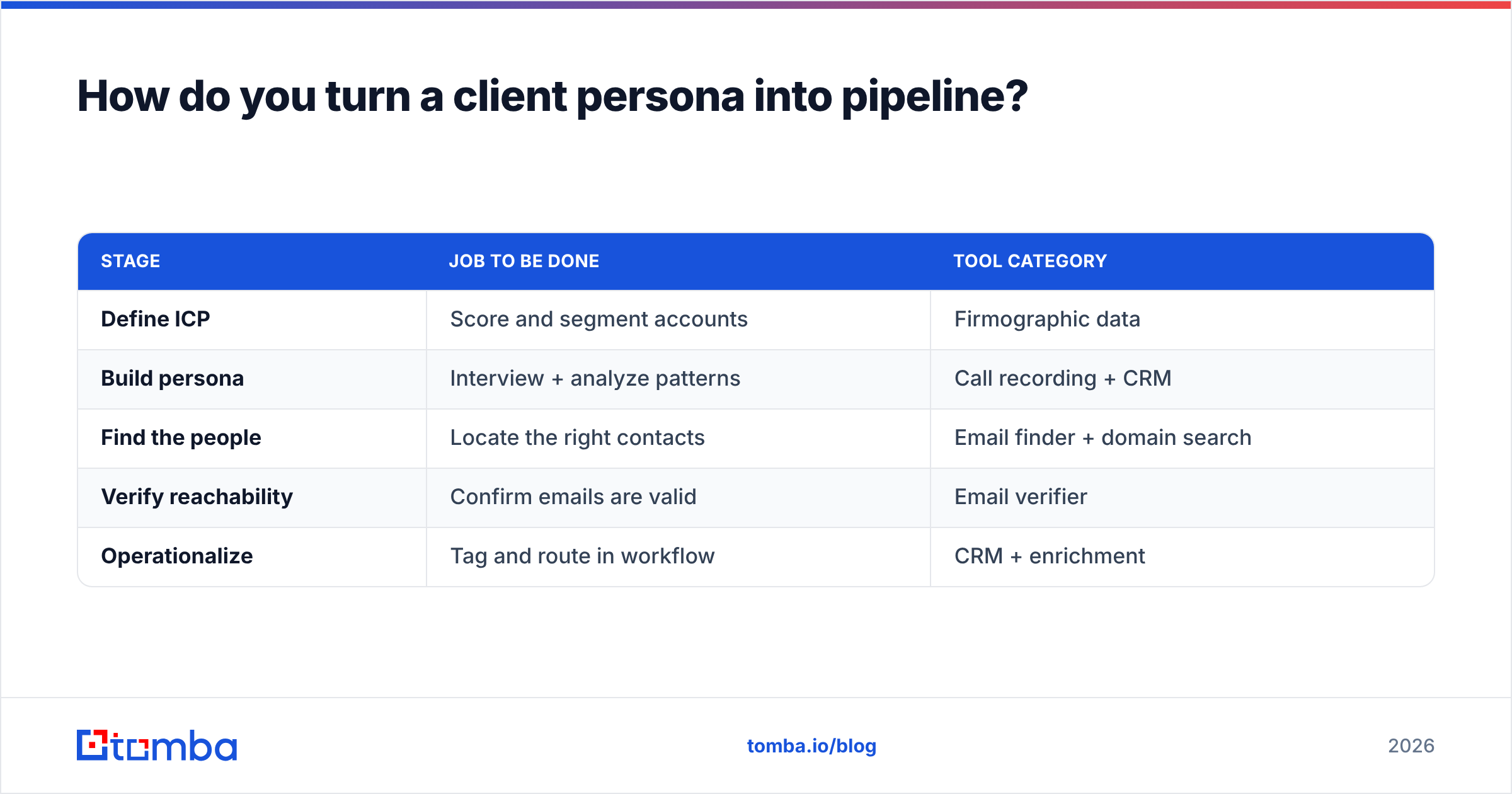
Tooling: what helps at each stage?#
| Stage | Job to be done | Tool category |
|---|---|---|
| Define ICP | Score and segment accounts | Firmographic data |
| Build persona | Interview + analyze patterns | Call recording + CRM |
| Find the people | Locate the right contacts | Email finder + domain search |
| Verify reachability | Confirm emails are valid | Email verifier |
| Operationalize | Tag and route in workflow | CRM + enrichment |
The chain only works if the contact data is accurate. You can have a perfect persona and still burn your sender reputation bouncing emails to addresses that no longer exist. Running discovered contacts through verification before you send is non-negotiable — it protects deliverability and keeps your persona-driven sequences landing in the inbox.
What are common client persona mistakes?#
- Fictional fluff over decision data. Nobody buys because of a stock photo and a fake name. Cut the personality trivia; keep the buying logic.
- Building once and never updating. Markets shift. Re-validate personas at least annually, and faster if your win rate drops.
- Confusing the user with the buyer. The person who loves your product often is not the person who pays for it. Map both.
- No contact data behind it. A persona you cannot reach is a wish. Tie it to real, verified contacts.
- Too many personas. Over-segmentation kills adoption. Stay at 2–4.
- Ignoring lost deals. Your losses define your persona's edges as clearly as your wins.
For broader context on how leaders structure go-to-market motions around personas, both Gartner and HubSpot publish frameworks worth reviewing — and peer reviews on G2 can validate which tooling other teams actually rely on.
How often should you refresh a client persona?#
Treat it like a living document with a quarterly pulse and an annual deep clean. Every quarter, skim recent closed-won and closed-lost deals for any drift in titles, triggers, or objections. Once a year, re-run customer interviews from scratch. The fastest signal that a persona is stale: your best-performing message starts underperforming for no obvious reason. That usually means the audience moved, not that the copy broke.
Frequently asked questions#
Is a client persona the same as a buyer persona? Nearly. "Client persona" is the broader profile of who you serve; "buyer persona" zooms in on the person who makes the purchase decision. In most B2B deals you need both, plus the user persona.
Can I have one persona for the whole company? Only if you sell to one type of person. Most B2B companies sell to a buying committee, so you need a small set — typically the user, the champion, and the economic buyer.
Do I need software to build personas? You can start in a doc. But to turn personas into pipeline you need contact discovery and enrichment, because the persona is useless until you can reach the real people it describes.
Turn your client persona into pipeline with Tomba#
A client persona is only worth the revenue it produces — and revenue starts the moment you can actually reach the people you have profiled. Once you know the exact role, seniority, and company that fit your persona, the Tomba Email Finder lets you find their verified professional email addresses by name, company, or domain, so your persona-driven sequences land in real inboxes instead of bouncing. Pair it with domain search and verification, check the Tomba pricing plans (a free tier with 25 searches a month, Starter at $49/mo, Growth at $99/mo, and Pro at $249/mo), and connect your sharpest persona to a reachable audience today. Build the profile, find the people, close the deal.
// get started
Find, verify and enrich your first contacts today
Start on the free plan with 25 searches a month, then scale when your team is ready.
Free plan · No credit card required · GDPR & CCPA
// about the author