Client Profile in 2026: Build an ICP That Actually Converts
A client profile is the single highest-leverage asset in B2B prospecting. Here is how to build one in 2026 with real firmographic, technographic, and intent data.
You can have the best cold email copy on earth and still lose, because copy is downstream of targeting. A precise client profile is what decides whether your outreach lands in front of someone who has the problem you solve, or someone who deletes it on sight. This guide shows you how to build one in 2026 — with real data, not a persona deck that dies in a Notion doc.
TL;DR#
- A client profile (often called an Ideal Customer Profile, or ICP) is a data-backed description of the accounts and people most likely to buy, stay, and refer.
- Build it from closed-won data first, then layer firmographic, technographic, and intent signals — not from a brainstorm.
- The four-layer model (firmographic, technographic, behavioral, human) is what separates a usable profile from a vibe.
- Operationalize it: turn the profile into a target account list, find verified contacts, and score every inbound lead against it.
- Refresh it every quarter. A 2024 client profile is already wrong in 2026.
What is a client profile?#
A client profile is a structured, evidence-based definition of the customer your business serves best — the accounts where your product creates the most value, closes fastest, and churns least. It answers three questions at once: which companies to target, who inside them to talk to, and why they buy.
Two terms get tangled here, so let's separate them:
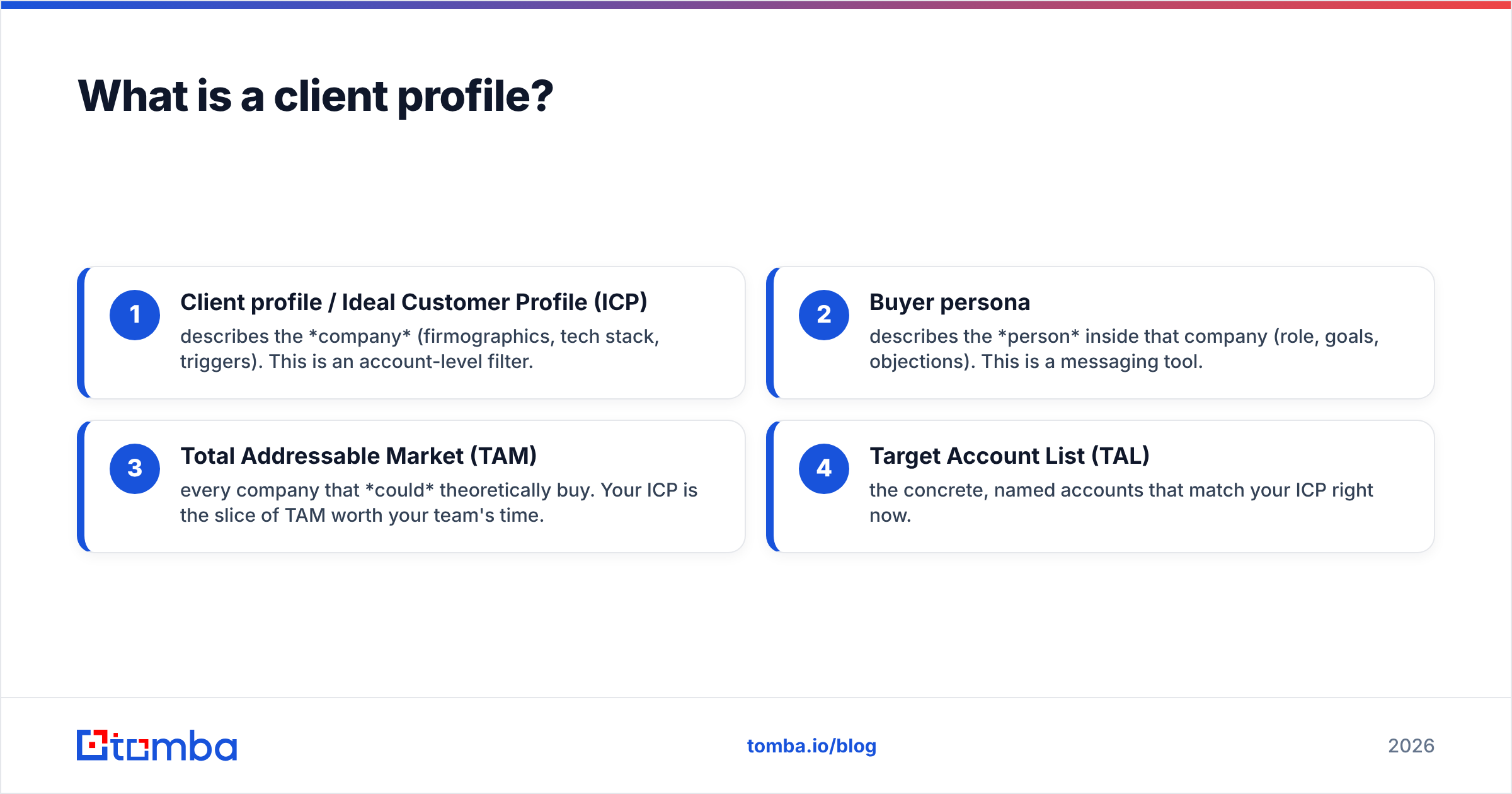
- Client profile / Ideal Customer Profile (ICP) — describes the company (firmographics, tech stack, triggers). This is an account-level filter.
- Buyer persona — describes the person inside that company (role, goals, objections). This is a messaging tool.
- Total Addressable Market (TAM) — every company that could theoretically buy. Your ICP is the slice of TAM worth your team's time.
- Target Account List (TAL) — the concrete, named accounts that match your ICP right now.
Most teams confuse the ICP with the persona and end up with a document that's half firmographics and half feelings. Keep them distinct. According to HubSpot's research on buyer personas, the personas layer on top of the account profile — they don't replace it.
Why does a client profile matter in 2026?#
Because attention is the scarcest resource in B2B, and spraying generic outreach now actively damages your sender reputation. A tight client profile compounds across the entire funnel:
- Higher reply rates. Relevance is the single biggest lever on cold email response — bigger than subject lines or send time.
- Shorter sales cycles. Prospects who match your profile already feel the pain; you're not educating them from zero.
- Lower CAC. You stop paying — in credits, in rep hours, in domain reputation — to reach people who will never buy.
- Better retention. Customers who match your profile get more value, so they renew. Off-profile customers churn and tank your NRR.
Gartner's go-to-market research has repeatedly shown that B2B buying is now a committee sport with 6–10 stakeholders. A client profile that names the account and the buying group is the only way to orchestrate that.
What are the components of a strong client profile?#
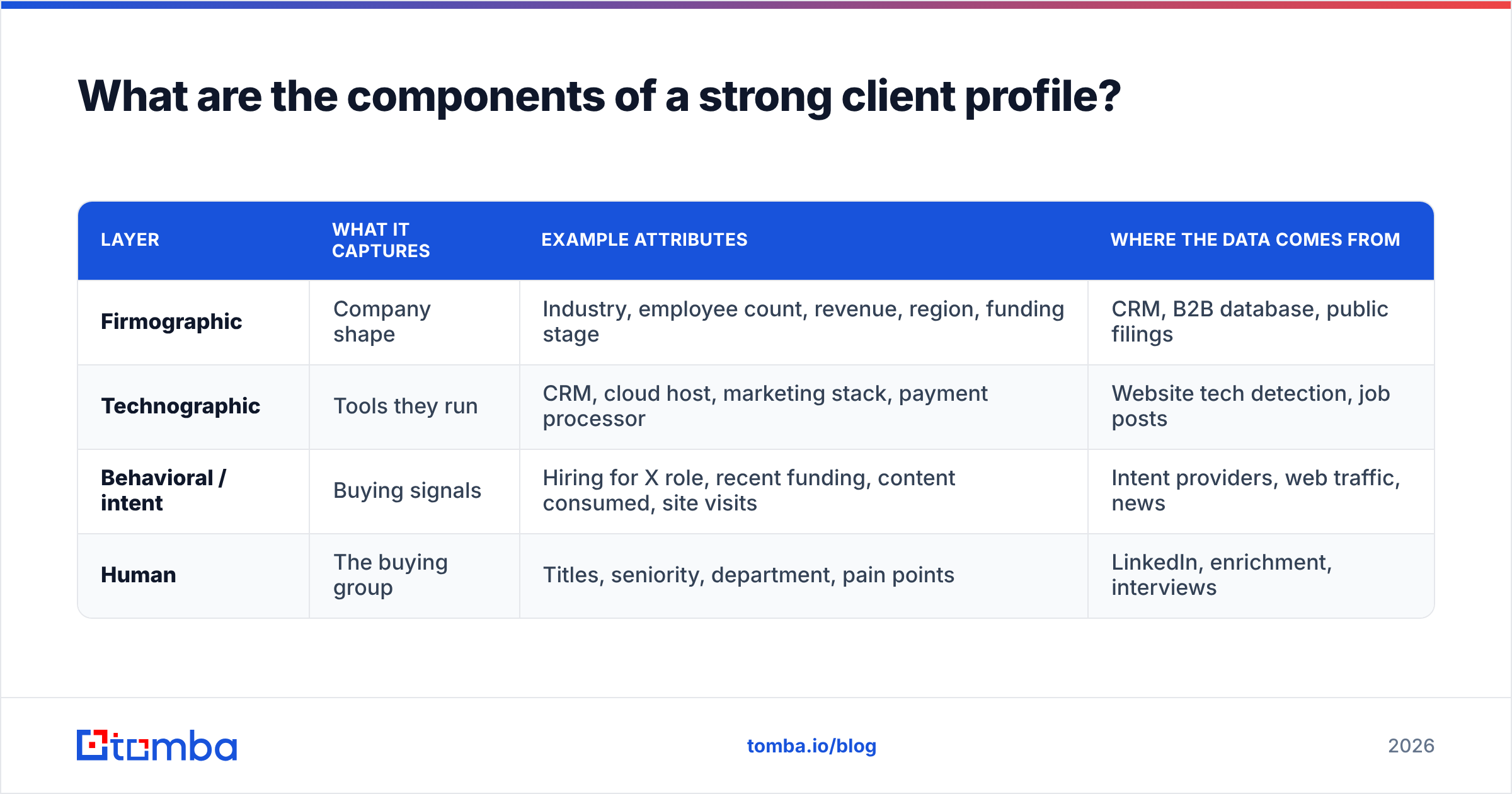
Build your profile in four layers. Skip any layer and you'll either target the wrong companies or the right companies with the wrong message.
| Layer | What it captures | Example attributes | Where the data comes from |
|---|---|---|---|
| Firmographic | Company shape | Industry, employee count, revenue, region, funding stage | CRM, B2B database, public filings |
| Technographic | Tools they run | CRM, cloud host, marketing stack, payment processor | Website tech detection, job posts |
| Behavioral / intent | Buying signals | Hiring for X role, recent funding, content consumed, site visits | Intent providers, web traffic, news |
| Human | The buying group | Titles, seniority, department, pain points | LinkedIn, enrichment, interviews |
Firmographic layer#
This is the foundation: the externally observable shape of a company. In 2026, get specific. "SaaS companies" is not a profile. "Series A–B vertical SaaS companies, 50–200 employees, in North America, with a dedicated RevOps function" is.
Technographic layer#
The tools a company runs reveal whether they're even able to use your product. If you integrate with Salesforce, a HubSpot-only shop is a worse fit regardless of size. Technographics also surface displacement plays — companies on a competitor you can beat.
Behavioral and intent layer#
This is the timing layer. A perfect-fit account that has no active need is a slow deal. Funding rounds, leadership changes, hiring sprees, and product launches are the triggers that move an account from "fits" to "fits and is ready." You can detect some of this with website visitor reveal on your own traffic.
Human layer#
Finally, who do you actually talk to? Map the buying group — economic buyer, champion, technical evaluator, blocker. Each gets a different message. This is where the client profile hands off to your persona work and your sequences.
How do you build a client profile step by step?#
Here's the process that produces a profile you can actually act on, not a poster.
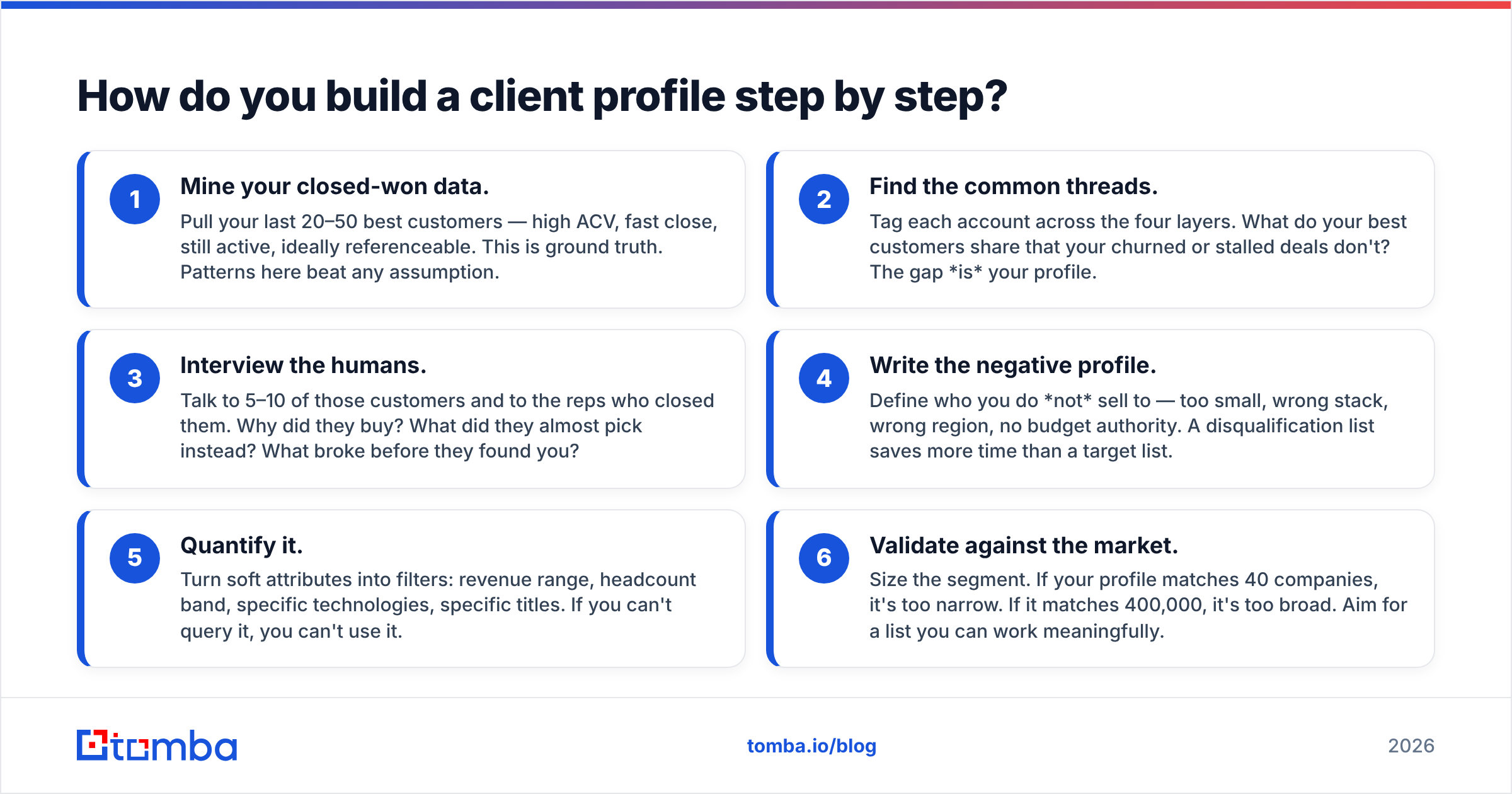
- Mine your closed-won data. Pull your last 20–50 best customers — high ACV, fast close, still active, ideally referenceable. This is ground truth. Patterns here beat any assumption.
- Find the common threads. Tag each account across the four layers. What do your best customers share that your churned or stalled deals don't? The gap is your profile.
- Interview the humans. Talk to 5–10 of those customers and to the reps who closed them. Why did they buy? What did they almost pick instead? What broke before they found you?
- Write the negative profile. Define who you do not sell to — too small, wrong stack, wrong region, no budget authority. A disqualification list saves more time than a target list.
- Quantify it. Turn soft attributes into filters: revenue range, headcount band, specific technologies, specific titles. If you can't query it, you can't use it.
- Validate against the market. Size the segment. If your profile matches 40 companies, it's too narrow. If it matches 400,000, it's too broad. Aim for a list you can work meaningfully.
How do you turn a client profile into a pipeline?#
A profile is worthless until it produces conversations. Operationalize it in three moves.
Move 1 — Build the target account list. Translate your firmographic and technographic filters into a query against a B2B database and export the matching companies. This is your TAL: named accounts, not abstract criteria.
Move 2 — Find the right people and their contact info. For each account, identify the buying-group titles from your human layer, then get verified contact details. This is the step where most teams leak: they have great accounts and no reliable way to reach the decision-makers. An email finder resolves names-plus-domains into verified work emails, and data enrichment fills in the firmographic and role fields you're missing so your scoring stays accurate.
Move 3 — Score every lead against the profile. Inbound leads and partial-fit accounts should be ranked, not treated equally. A simple model — points for each matching layer, negative points for disqualifiers — tells reps where to spend the first hour of their day. Tie it to your definition of a marketing qualified lead so marketing and sales agree on what "good" means.
What tools help you build and run a client profile?#
You need three capabilities: data to define the profile, contact-finding to act on it, and a system of record to score against it. Here's how common approaches stack up.
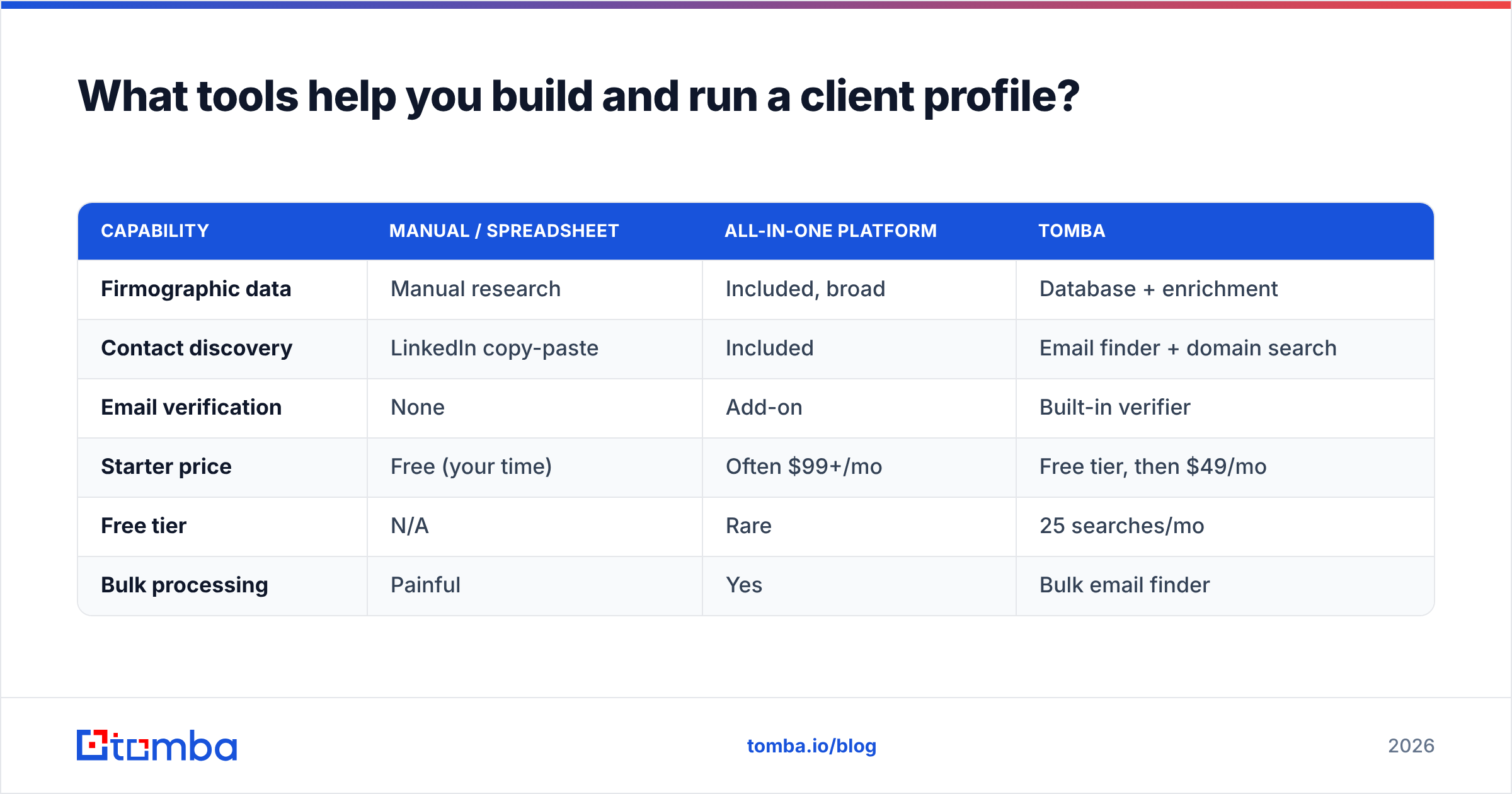
| Capability | Manual / spreadsheet | All-in-one platform | Tomba |
|---|---|---|---|
| Firmographic data | Manual research | Included, broad | Database + enrichment |
| Contact discovery | LinkedIn copy-paste | Included | Email finder + domain search |
| Email verification | None | Add-on | Built-in verifier |
| Starter price | Free (your time) | Often $99+/mo | Free tier, then $49/mo |
| Free tier | N/A | Rare | 25 searches/mo |
| Bulk processing | Painful | Yes | Bulk email finder |
The point isn't that one tool does everything. It's that your profile generates a list, the list needs verified contacts, and verified contacts need to land in your CRM clean. If you're comparing vendors, G2's lead intelligence category is a reasonable neutral starting point for reviews.
You can keep costs predictable here — Tomba's pricing starts free at 25 searches per month and moves to $49/mo on Starter, which is enough to validate a TAL before you commit to an enterprise seat.
What mistakes kill a client profile?#
- Building it from opinion. If your profile didn't start with closed-won data, it's a wish list. Start with what actually bought.
- Making it too broad. "Mid-market companies in the US" is not actionable. Specificity is the entire value.
- Ignoring the negative profile. Knowing who to reject is as valuable as knowing who to chase, and far cheaper to act on.
- Letting it go stale. Your product, market, and best customers shift. A profile you wrote in 2024 is targeting a market that no longer exists in 2026.
- Never operationalizing it. A profile that lives in a slide and never becomes a target list or a lead score is theater. Wire it into your daily workflow or don't bother.
- Skipping verification. Targeting the right person with a bounced email achieves nothing. Verify before you send to protect deliverability.
How often should you update your client profile?#
Review it quarterly, rebuild it annually. Every quarter, re-mine your most recent closed-won and churned accounts and check whether the patterns still hold. When you launch a new product, enter a new region, or move upmarket, treat that as a trigger for a full rebuild — those changes alter who your best customer is.
A good cadence: a 30-minute quarterly check against fresh win/loss data, plus a deeper rebuild whenever your ACV or sales motion shifts by more than a small margin. The teams that win in 2026 treat the client profile as a living model, not a founding document.
Frequently asked questions#
Is a client profile the same as a buyer persona? No. A client profile (ICP) describes the company you target; a buyer persona describes the person inside it. You need both — the profile filters accounts, the persona shapes the message.
How many client profiles should I have? Start with one. Add a second only when you have clear evidence of a distinct, high-performing segment with different firmographics or buying behavior. More than three usually means yours are too narrow.
Can I build a client profile without a lot of data? Yes — start with your best 10–20 customers and rep interviews, then layer in external firmographic and technographic data as you scale. Some signal beats none, and you sharpen it every quarter.
What's the fastest way to act on a finished profile? Convert it into a target account list, then use an email finder and verifier to pull verified contacts for the buying-group titles you defined. That turns a definition into outreach-ready pipeline in hours, not weeks.
Turn your client profile into verified pipeline#
A client profile only pays off when it becomes a list of real people you can reach. Once you've defined your firmographic, technographic, and human layers, point the Tomba Email Finder at your target accounts to pull verified, deliverability-safe work emails for the exact decision-makers in your buying group — then enrich and score them so your reps spend their time only on accounts that fit. Start free with 25 searches a month, and upgrade to Starter at $49/mo when your target list outgrows it.
// get started
Find, verify and enrich your first contacts today
Start on the free plan with 25 searches a month, then scale when your team is ready.
Free plan · No credit card required · GDPR & CCPA
// about the author