B2B Competitive Intelligence Tools: The 2026 Buyer's Guide
Competitive intelligence turns scattered rumors about rivals into a repeatable sales advantage. Here's how to build a program and pick the right tools in 2026.
TL;DR
- Competitive intelligence (CI) is the disciplined practice of collecting, analyzing, and distributing information about your rivals, your market, and your buyers so sales teams can win more deals.
- The payoff is concrete: higher win rates against named competitors, faster objection handling, and pricing that holds firm because reps know exactly what they're up against.
- A working CI program has four layers — market, competitor, product, and buyer intelligence — each feeding a single source of truth like a battlecard.
- Tools range from dedicated CI platforms (Crayon, Klue, Kompyte) to data and enrichment layers that tell you who you're actually selling against.
- You can't run CI on stale contact data. Enrichment and accurate firmographics are the fuel; the analysis is the engine.
What is competitive intelligence in B2B sales?#
Competitive intelligence is the practice of gathering and analyzing information about your competitors and market so your team can make better decisions and close more deals. Think of it like a sports team studying game film before a match: you're not cheating, you're just refusing to walk onto the field blind.
In B2B sales specifically, CI answers questions your reps face on every call. Which competitor is in this deal? How do they price? What do their customers complain about on review sites? What does their new feature actually do versus what their marketing claims? When a rep can answer those in real time, a stalled deal turns into a closed one.
CI is not corporate espionage. It's built almost entirely on public and semi-public signals: pricing pages, job postings, earnings calls, G2 reviews, product changelogs, press releases, and the firsthand notes your own reps take after every competitive loss. The skill is not finding the data — it's assembling scattered fragments into something a seller can use in the 30 seconds before they hit "join meeting."
Why does competitive intelligence matter in 2026?#
Because buyers now arrive over-informed and under-decided. The average B2B purchase involves more stakeholders and more vendor comparison than it did even three years ago, and a large share of the buying journey happens before a prospect ever talks to sales. By the time you're on a call, your buyer has already shortlisted two or three of your competitors. CI is how you find out who.
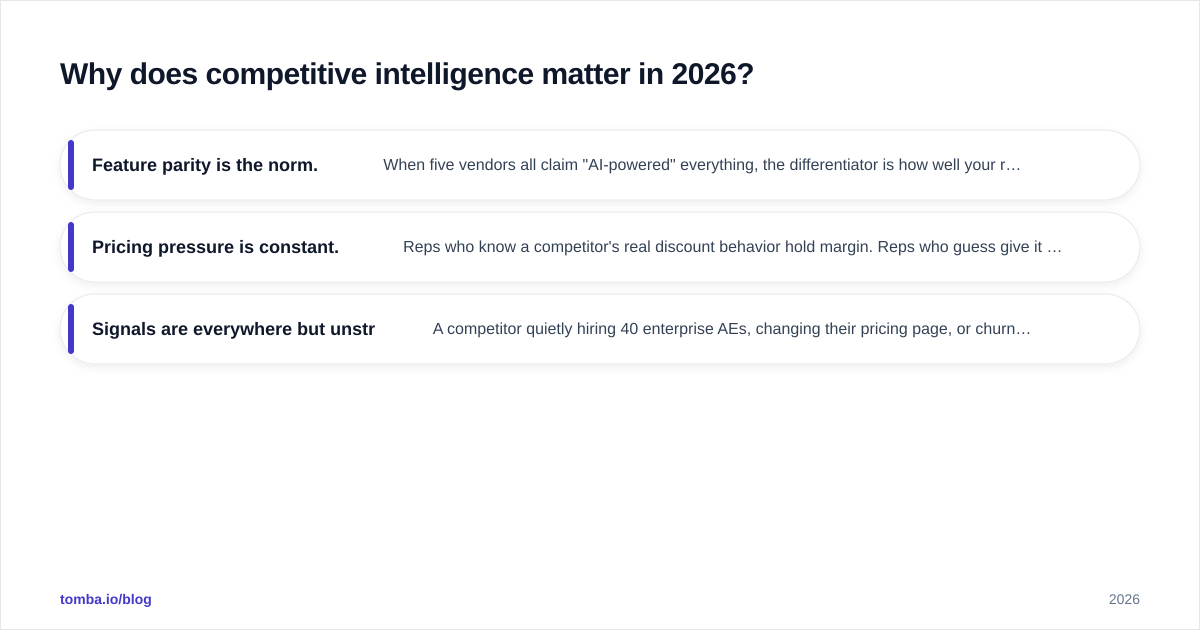
Three forces make CI non-optional this year:
- Feature parity is the norm. When five vendors all claim "AI-powered" everything, the differentiator is how well your rep can frame the comparison — not the feature list.
- Pricing pressure is constant. Reps who know a competitor's real discount behavior hold margin. Reps who guess give it away.
- Signals are everywhere but unstructured. A competitor quietly hiring 40 enterprise AEs, changing their pricing page, or churning a marquee logo are all knowable events. Most teams just never connect them.
The teams that win treat CI as an always-on capability, not a slide someone updates once a quarter. According to Gartner and analyst coverage across the category, sales orgs that operationalize competitive insight see measurable lifts in competitive win rate — the single metric every revenue leader watches.
What are the four types of competitive intelligence?#
Most useful CI breaks into four layers. Each answers a different question, and a mature program runs all four into one place.
- Market intelligence — the macro picture. Category growth, emerging entrants, regulatory shifts, analyst positioning. This tells leadership where to place bets.
- Competitor intelligence — the head-to-head layer. Pricing, positioning, org changes, funding, marketing moves, and win/loss patterns against specific rivals.
- Product intelligence — what competing products actually do. Real capabilities, roadmap signals from changelogs and job posts, and the gaps your sellers can exploit.
- Buyer intelligence — who is in the deal and why. Firmographics, technographics, decision-makers, and the trigger events that put a buyer in-market in the first place.
The mistake teams make is over-investing in the first two and ignoring the fourth. You can know everything about a competitor and still lose because you didn't know who at the account actually held the budget. Buyer intelligence is where good contact data and data enrichment do the heavy lifting — turning a company name into a mapped buying committee with verified emails and roles.
How do you build a competitive intelligence program?#
Start small and make it repeatable. A CI program isn't a tool you buy; it's a loop you run. Here's the practical sequence.
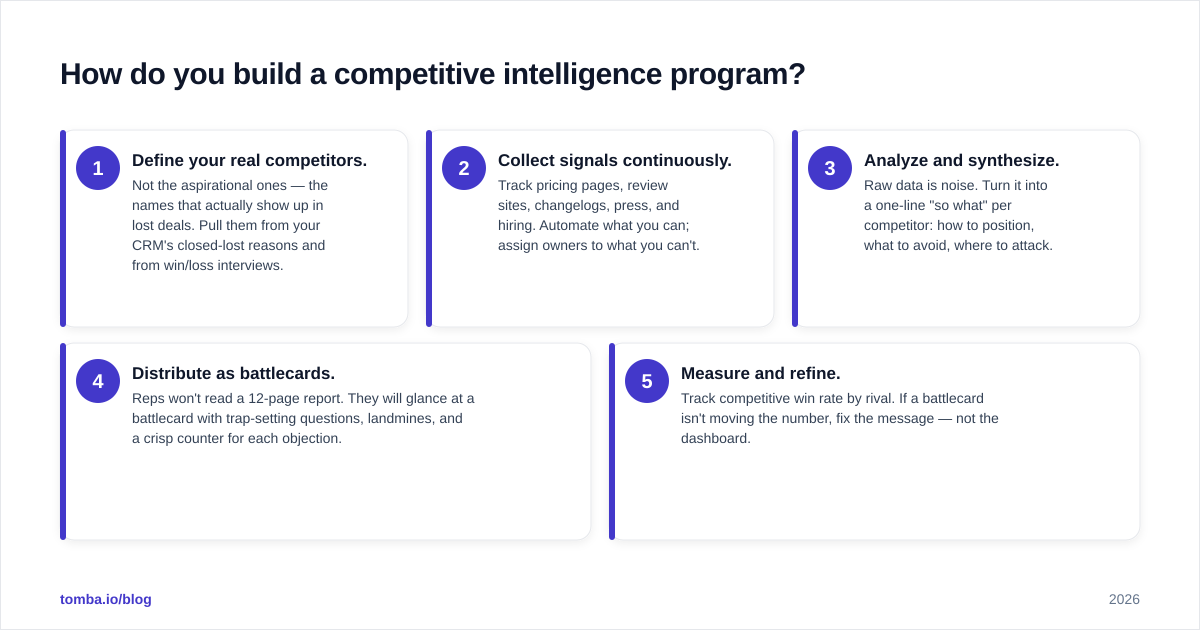
- Define your real competitors. Not the aspirational ones — the names that actually show up in lost deals. Pull them from your CRM's closed-lost reasons and from win/loss interviews.
- Collect signals continuously. Track pricing pages, review sites, changelogs, press, and hiring. Automate what you can; assign owners to what you can't.
- Analyze and synthesize. Raw data is noise. Turn it into a one-line "so what" per competitor: how to position, what to avoid, where to attack.
- Distribute as battlecards. Reps won't read a 12-page report. They will glance at a battlecard with trap-setting questions, landmines, and a crisp counter for each objection.
- Measure and refine. Track competitive win rate by rival. If a battlecard isn't moving the number, fix the message — not the dashboard.
The loop only works if step two is fed with clean, current data. This is where contact and company data quality quietly decides everything. If your account list is built on guessed emails and three-year-old job titles, your "intelligence" is fiction. Pair your CI workflow with a reliable email verifier and accurate firmographics so the people in your battlecards are the people actually in the deal.
What are the best competitive intelligence tools in 2026?#
There's no single "best" — it depends on whether you need dedicated CI analysis, win/loss research, or the underlying data layer that identifies and enriches the accounts you're competing for. Here's how the main categories compare.
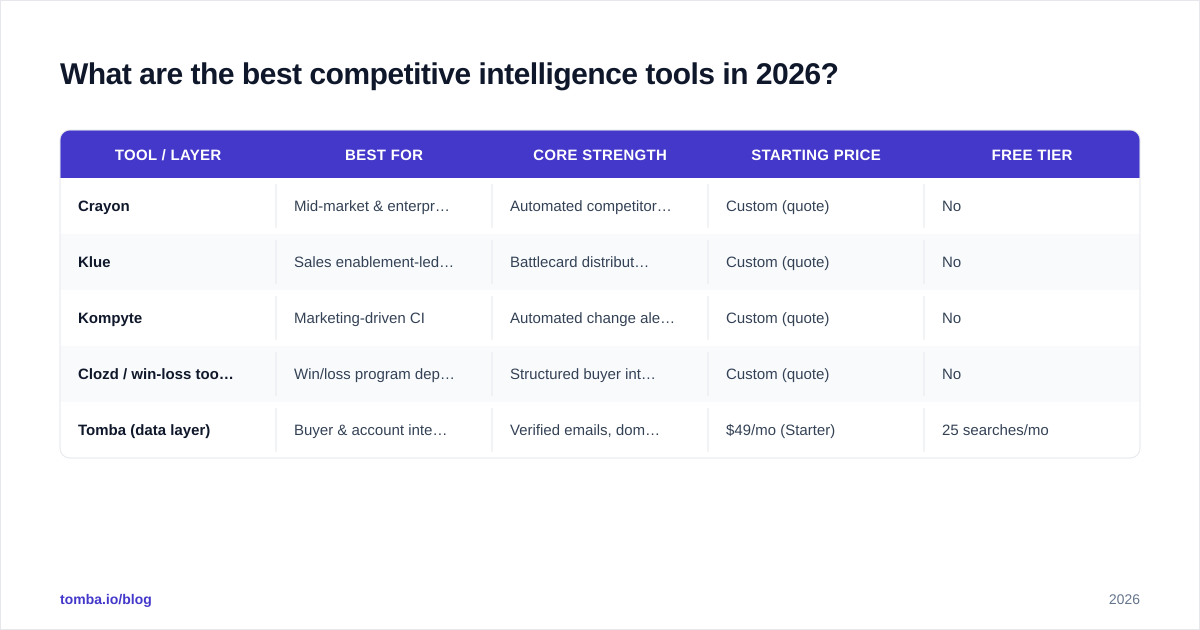
| Tool / Layer | Best for | Core strength | Starting price | Free tier |
|---|---|---|---|---|
| Crayon | Mid-market & enterprise CI teams | Automated competitor tracking + battlecards | Custom (quote) | No |
| Klue | Sales enablement-led CI | Battlecard distribution inside CRM | Custom (quote) | No |
| Kompyte | Marketing-driven CI | Automated change alerts & pages | Custom (quote) | No |
| Clozd / win-loss tools | Win/loss program depth | Structured buyer interviews | Custom (quote) | No |
| Tomba (data layer) | Buyer & account intelligence | Verified emails, domain search, enrichment | $49/mo (Starter) | 25 searches/mo |
A few honest notes on this table:
- Dedicated CI platforms (Crayon, Klue, Kompyte) are excellent at the collection-and-distribution loop but assume you already know which accounts and people you're targeting. They analyze competitors, not your pipeline's contacts.
- Win/loss specialists like Clozd run the interview programs that produce the why behind your wins and losses. Powerful, but slower and more qualitative.
- The data layer is the part teams forget to budget for. Before you can build buyer intelligence, you need to resolve a company into its real decision-makers. That's a domain search and enrichment problem, and it sits underneath every CI tool above.
If you're comparing platforms head-to-head, cross-reference real user reviews on G2 and Capterra rather than vendor decks — the objection patterns buyers mention there are themselves a form of competitive intelligence.
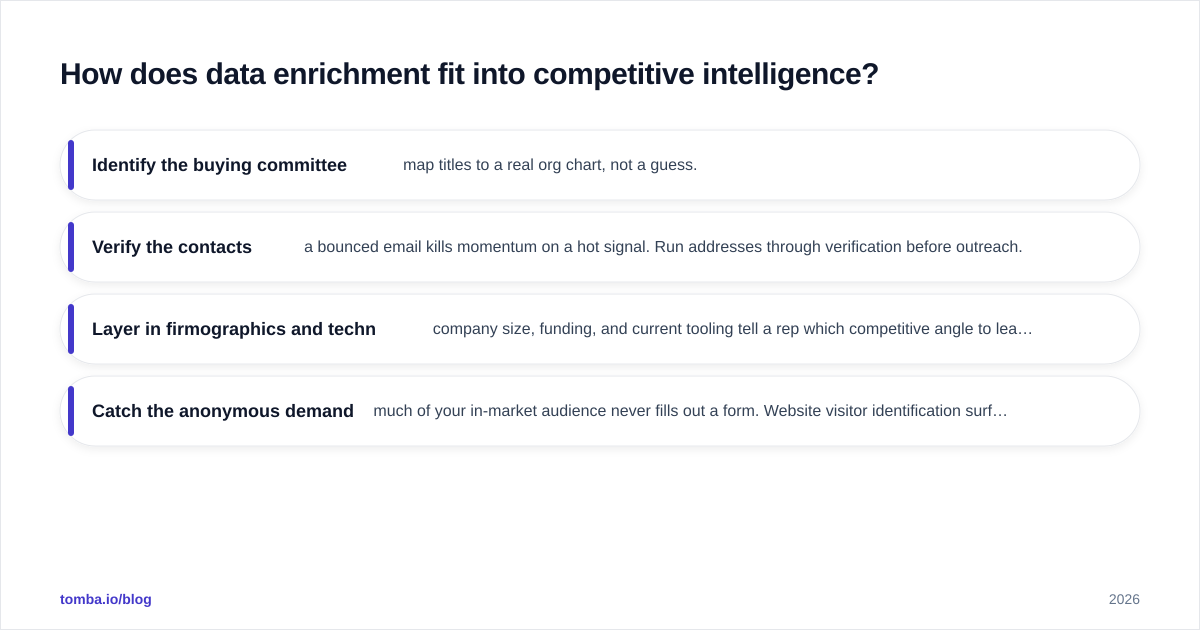
How does data enrichment fit into competitive intelligence?#
Enrichment is the bridge between "we know our competitor" and "we know who's in this specific deal." CI tells you how to compete; enrichment tells you with whom.
Picture a real scenario. Your alerting flags that a target account just posted ten roles mentioning a competitor's platform — a strong signal they've already deployed or are evaluating it. That's a competitive trigger. But it's worthless until you can act on it: who owns that decision, what's their email, who else sits on the committee, and what's the company's tech stack?
That last mile is data work:
- Identify the buying committee — map titles to a real org chart, not a guess.
- Verify the contacts — a bounced email kills momentum on a hot signal. Run addresses through verification before outreach.
- Layer in firmographics and technographics — company size, funding, and current tooling tell a rep which competitive angle to lead with.
- Catch the anonymous demand — much of your in-market audience never fills out a form. Website visitor identification surfaces the accounts already researching you and your rivals.
Tools like Tomba sit in exactly this layer. The email finder resolves a name and company into a verified professional address, while enrichment fills in the context your battlecard assumes you already have. It won't write your positioning — but without it, your positioning never reaches the right inbox.
What metrics prove competitive intelligence is working?#
If you can't measure CI, leadership will defund it. Track these:
- Competitive win rate — your win percentage in deals where a named rival was present. This is the headline number.
- Battlecard engagement — are reps actually opening and using them? Low usage means the content, not the competitor, is the problem.
- Loss-reason quality — are closed-lost notes specific ("lost on price to X") or empty? Specificity is a leading indicator of a healthy program.
- Sales cycle length in competitive deals — good CI shortens it by killing objections earlier.
- Discount depth against specific competitors — reps armed with real pricing intelligence hold margin better.
A simple before-and-after on competitive win rate, segmented by rival, is usually enough to justify the entire program in one quarter.
Common competitive intelligence mistakes to avoid#
- Treating CI as a one-time project. Markets move weekly. A battlecard built six months ago is actively misleading.
- Hoarding intelligence in marketing. If sellers can't reach it in the flow of a deal, it doesn't exist.
- Confusing data volume with insight. Ten dashboards nobody reads lose to one battlecard reps trust.
- Ignoring buyer intelligence. Knowing the competitor cold means nothing if you're emailing the wrong person at a stale address.
- Skipping win/loss interviews. Your own lost deals are the highest-signal CI source you own, and most teams never mine them.
Avoiding these is mostly discipline, not budget. The cheapest improvement available to most teams is simply making their CI usable and their underlying contact data accurate.
Where should you start?#
Start with the loop, not the logo. Pick your three real competitors, write one battlecard each, wire up basic change alerts, and commit to running five win/loss conversations this quarter. Then make sure the accounts and contacts feeding that work are real — because competitive intelligence built on bad data is just confident guessing.
If your gap is the data layer — identifying the right buyers at the accounts you're competing for and reaching them with verified contact details — that's where Tomba's Email Finder earns its place in the stack. Find professional emails by domain, name, or company, verify them before you send, and enrich them with the firmographics your battlecards assume. Start free with 25 searches a month, then scale on the Starter plan at $49/mo once your CI program is humming. The analysis wins deals; the data makes sure it reaches the people who can say yes.
// get started
Find, verify and enrich your first contacts today
Start on the free plan with 25 searches a month, then scale when your team is ready.
Free plan · No credit card required · GDPR & CCPA
// about the author