Cold Calling Tech Metrics: The 2026 KPI Stack That Closes
Dials are vanity. Learn the cold calling metrics that actually predict pipeline in 2026 — connect rate, conversation rate, and the dialer tech that surfaces them.
Most cold calling dashboards measure effort. The ones that grow pipeline measure whether the effort is working. That gap — between activity metrics and outcome metrics — is where reps burn out and managers misread their own teams.
This guide breaks down the cold calling metrics that matter in 2026, why the old "smile and dial" numbers mislead you, and how modern dialer and data tech surfaces the signals that actually predict revenue.
TL;DR#
- Dials are an input, not a result. Track connect rate, conversation rate, and conversation-to-meeting rate before you celebrate volume.
- Connect rate is now a data problem, not a calling problem. Bad phone numbers cap your ceiling — accurate B2B contact data does more for connects than any script.
- The "north star" of cold calling is meetings booked per 100 dials, segmented by list quality, time of day, and rep.
- 2026 tech stacks combine parallel/AI dialers, conversation intelligence, and enriched contact records — each feeds a specific metric.
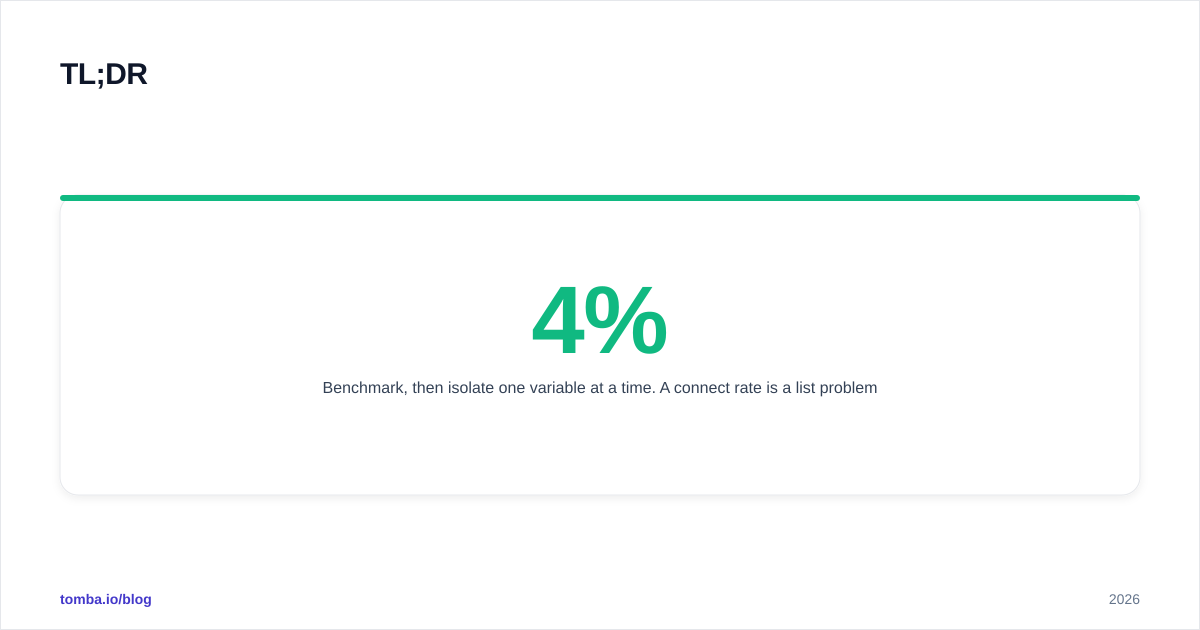
- Benchmark, then isolate one variable at a time. A 4% connect rate is a list problem; a 12% connect rate with a 1% meeting rate is a messaging problem.
What are cold calling metrics, really?#
Cold calling metrics are the quantitative signals that tell you whether your outbound phone motion is moving prospects toward a meeting — and where it's leaking.
Think of your call motion like a factory line. Raw material goes in (a list of contacts), passes through stations (dial → connect → conversation → meeting), and product comes out (booked pipeline). A single number like "300 dials today" tells you the conveyor belt is moving. It says nothing about how many units survive each station. The metrics that matter are the conversion rates between stations, because that's where you find the broken machine.
Here's the funnel every cold calling team is actually running, whether they measure it or not:
Each transition has its own rate, its own typical failure mode, and — critically — its own fix. Confusing a connect-rate problem with a pitch problem is the single most common diagnostic error in outbound, and it sends managers coaching scripts when they should be cleaning data.
Which cold calling metrics actually matter in 2026?#
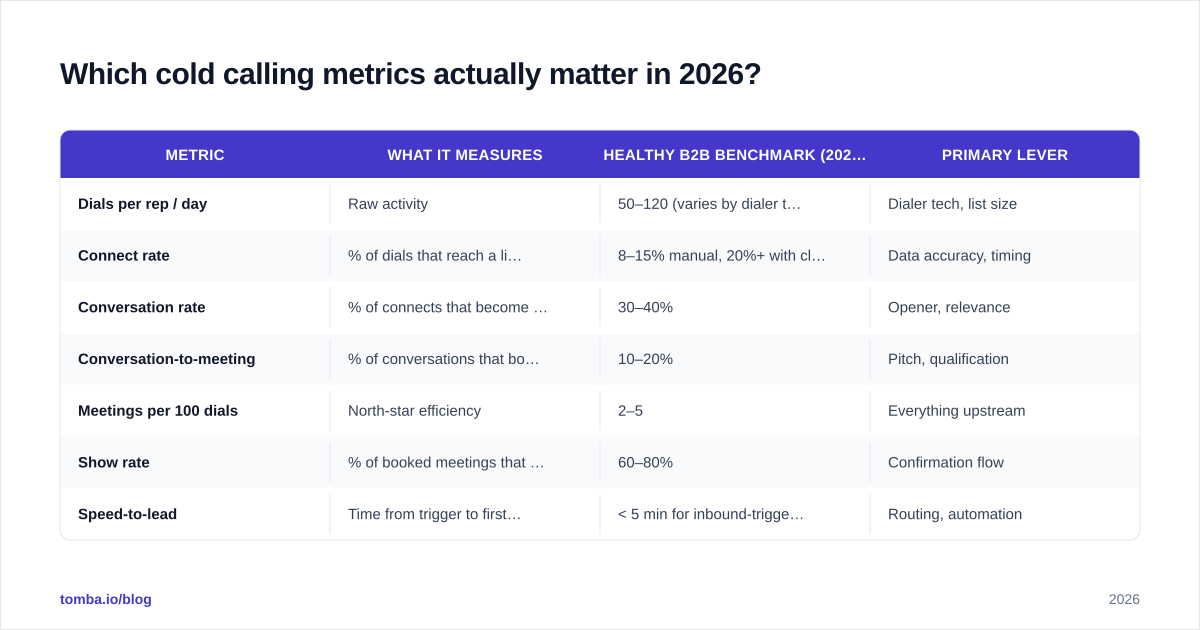
Not all KPIs earn their place on a dashboard. Below is the working set that separates teams who scale from teams who just get louder.
| Metric | What it measures | Healthy B2B benchmark (2026) | Primary lever |
|---|---|---|---|
| Dials per rep / day | Raw activity | 50–120 (varies by dialer type) | Dialer tech, list size |
| Connect rate | % of dials that reach a live person | 8–15% manual, 20%+ with clean data | Data accuracy, timing |
| Conversation rate | % of connects that become a real talk | 30–40% | Opener, relevance |
| Conversation-to-meeting | % of conversations that book | 10–20% | Pitch, qualification |
| Meetings per 100 dials | North-star efficiency | 2–5 | Everything upstream |
| Show rate | % of booked meetings that attend | 60–80% | Confirmation flow |
| Speed-to-lead | Time from trigger to first dial | < 5 min for inbound-triggered | Routing, automation |
A few of these deserve a closer look because they get misread constantly.
Connect rate is the most under-appreciated metric in outbound. Reps treat low connects as a calling-effort problem and dial harder. But if 40% of your numbers are wrong or stale, no amount of effort fixes it — you're dialing into a void. This is now squarely a data problem. Pulling verified direct dials with a phone finder and validating them before the campaign often lifts connect rate more than a week of script coaching.
Meetings per 100 dials is your north star because it normalizes everything. Rep A who makes 40 dials and books 3 meetings is outperforming Rep B who makes 120 dials and books 4 — even though Rep B "looks" busier. Volume without efficiency is just expensive noise.
Why do vanity metrics like dial count mislead managers?#
Because activity is easy to measure and outcomes are not — so teams optimize what's visible.
When a manager rewards dial count, reps rationally respond: they dial fast, hang up on voicemails instantly, skip research, and spray a low-quality list. Dial count goes up. Pipeline goes flat. The metric created the behavior, and the behavior killed the result. This is Goodhart's Law in action — when a measure becomes a target, it stops being a good measure.
The fix isn't to ignore activity. It's to pair every input metric with the outcome rate it should produce. Report dials and connect rate together. Report conversations and conversation-to-meeting together. The moment a rep can't inflate one number without tanking the paired ratio, the gaming stops.
There's a deeper point here that ties into response rate thinking from email: the channel is different, but the principle is identical. Reach quality beats reach quantity. A smaller list of verified, well-targeted contacts almost always out-converts a bigger list of guesses.
How does dialer and data tech change which metrics you can see?#
Modern tech doesn't just speed up calling — it exposes metrics that were invisible a few years ago, and it shifts the bottleneck from "how many calls" to "how good are the calls."
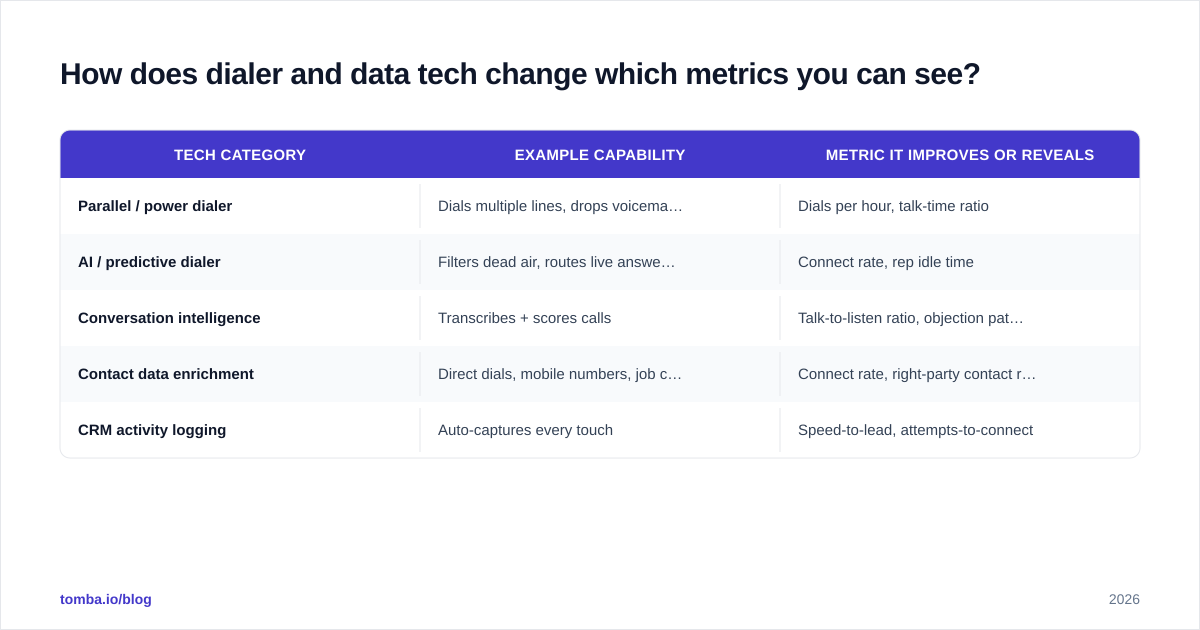
Here's how the major tech categories map to the metrics they unlock:
| Tech category | Example capability | Metric it improves or reveals |
|---|---|---|
| Parallel / power dialer | Dials multiple lines, drops voicemails | Dials per hour, talk-time ratio |
| AI / predictive dialer | Filters dead air, routes live answers | Connect rate, rep idle time |
| Conversation intelligence | Transcribes + scores calls | Talk-to-listen ratio, objection patterns |
| Contact data enrichment | Direct dials, mobile numbers, job changes | Connect rate, right-party contact rate |
| CRM activity logging | Auto-captures every touch | Speed-to-lead, attempts-to-connect |
The pattern: dialers fix the top of the funnel (more attempts, more connects per hour), while data and conversation intelligence fix the quality of each step. Buying a faster dialer when your real problem is bad numbers is like installing a wider faucet on a clogged pipe.
If you want a vendor-neutral view of how conversation intelligence scores calls, Gong's resources are a solid primer on talk-to-listen ratios and objection tracking. For broader software comparison and verified reviews, G2's sales engagement category is the standard reference buyers actually trust.
What's the right way to benchmark and diagnose your numbers?#
Diagnose top-down, fix one variable at a time, and always segment — aggregate numbers hide the story.
Start at the north star (meetings per 100 dials) and walk backward through the funnel until you hit the first rate that's below benchmark. That's your bottleneck. Everything downstream is wasted effort until you fix it.
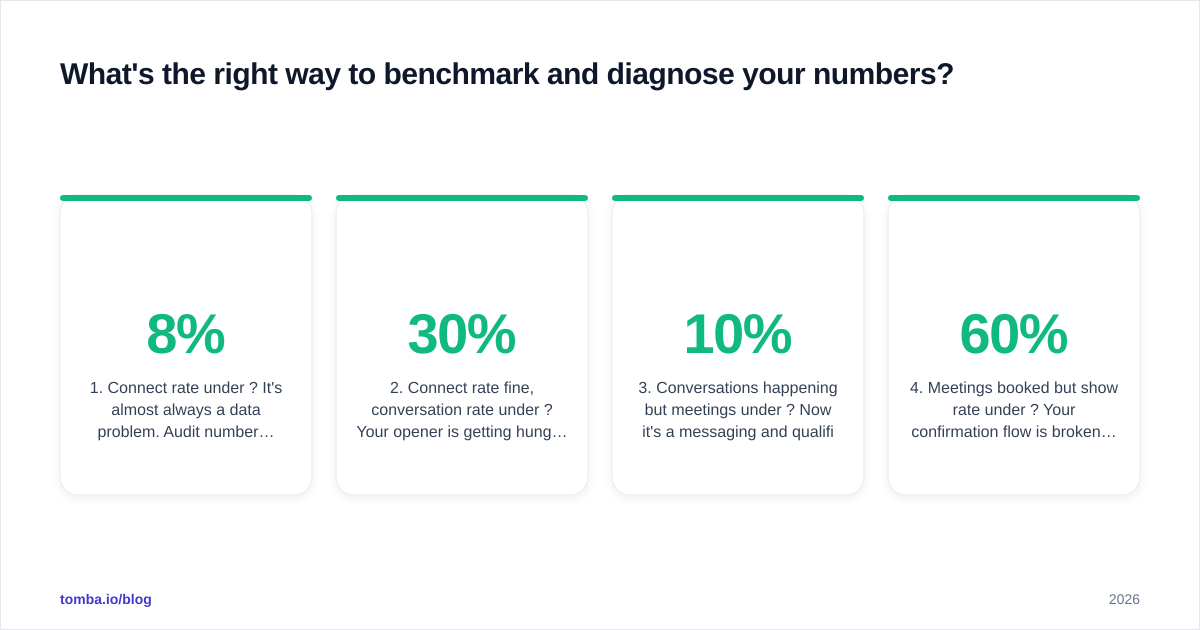
A practical diagnostic ladder:
- Connect rate under 8%? It's almost always a data problem. Audit number accuracy and call timing before touching the script. Verified direct dials and mobile numbers are the highest-leverage fix here.
- Connect rate fine, conversation rate under 30%? Your opener is getting hung up on. The first 10 seconds are the problem, not the pitch.
- Conversations happening but meetings under 10%? Now it's a messaging and qualification problem. This is where call coaching and conversation intelligence earn their keep.
- Meetings booked but show rate under 60%? Your confirmation flow is broken, not your calling.
The discipline that makes this work is segmentation. Slice every metric by rep, by list source, by industry, by time-of-day, and by call attempt number. A team-wide 11% connect rate might hide a 22% rate on verified lists and a 4% rate on a scraped one. The average tells you nothing; the segments tell you exactly where to spend.
This is also where data hygiene compounds. Feeding your dialer enriched, deduplicated records — using something like data enrichment to fill in missing mobile numbers and flag job changes — quietly lifts every downstream metric because you're not wasting dials on people who left the company six months ago.
How do you build a cold calling metrics dashboard that drives behavior?#
Build it around paired metrics, segment filters, and a single north star — then review it weekly with reps, not just at quarter-end.
A dashboard that actually changes behavior has three layers:
- The headline: meetings per 100 dials, trended weekly. One number everyone rallies around.
- The funnel: connect → conversation → meeting → show, each shown as a rate, not a raw count, so reps see where they leak.
- The cuts: filters for rep, list source, and time block, so coaching conversations start from evidence instead of opinion.
Avoid the two classic dashboard failures. The first is the wall of vanity — twenty activity counters and zero conversion rates, which trains the wrong behavior. The second is the lagging-only view — only showing closed-won, which arrives too late to coach against. Good dashboards lead with the ratios reps can change this week.
One operational note: your metrics are only as clean as your CRM logging. If half the calls never get logged, every rate is fiction. Auto-logging via your dialer-CRM integration isn't a nice-to-have — it's the foundation the whole measurement system stands on. Connecting your stack through a HubSpot integration or similar keeps activity capture honest without relying on reps to log manually.
What should you do next?#
Pick your single weakest funnel rate and fix the one input that drives it — don't redesign everything at once.
For most teams in 2026, that weakest rate is connect rate, and the root cause is data. You can have the best dialer, the sharpest opener, and the most disciplined dashboard, and still stall out because 30–40% of your phone numbers are wrong. The cheapest, fastest lift available to most outbound teams isn't a new script or a new tool — it's better contact data feeding the tools they already own.
That's the lever Tomba is built for. Use the Tomba Email Finder to enrich your target accounts with verified contact details, pair it with the phone finder for direct dials, and feed clean, accurate records into your dialer so every metric downstream has a fair chance to perform. Start on the free tier (25 searches/month), and check Tomba pricing when you're ready to scale from a handful of accounts to a full outbound motion. Fix the data, and the dashboard fixes itself.
// get started
Find, verify and enrich your first contacts today
Start on the free plan with 25 searches a month, then scale when your team is ready.
Free plan · No credit card required · GDPR & CCPA
// about the author