Follow-Up Email After No Response: 2026 Templates That Work
Most replies come from follow-ups, not the first email. Here are the timing rules, templates, and sequence structure that turn silence into responses in 2026.
TL;DR
- A single send almost never works. Most B2B replies arrive on the second through fifth touch, so the follow-up email after no response is where deals are actually won.
- Space touches 3–4 business days apart, change the angle each time, and keep every message under 90 words.
- Never just "bump" a thread with "just checking in." Add a new reason to reply — a resource, a trigger event, or a sharper question.
- Cap a sequence at 5–7 touches, then send a clean breakup email that often pulls the highest reply rate of all.
- Bad data kills good copy. Verify addresses before you start so your sequence lands in the inbox, not in a bounce log.
Why does a follow-up email after no response matter so much?#
Because silence usually means "not right now," not "no." A prospect who ignored your first email was busy, traveling, or skimming on a phone — not rejecting you. The follow-up is your second, third, and fourth chance to catch them at a better moment.
Think of it like knocking on a neighbor's door. One knock when they're in the shower gets you nothing. That doesn't mean they're avoiding you — it means you knocked once. Sales email works the same way: persistence, spaced politely, is the difference between a dead thread and a booked call.
The data backs this up. Vendors that publish aggregate sequence stats consistently show that the majority of positive replies come after the first email. According to HubSpot's sales benchmarks, a large share of conversions happen on later touches that most reps never send because they quit after one or two tries. The rep who sends a structured five-touch sequence simply gets more shots on goal than the rep who sends one email and moves on.
So the real question isn't "should I follow up?" It's "how do I follow up without being annoying?" That's what the rest of this guide covers.
How long should you wait before following up?#
Wait 3–4 business days between most touches — not 24 hours, not two weeks.
Too fast reads as desperate and clutters the inbox before your first email has had time to breathe. Too slow and the prospect has forgotten who you are, so each email starts from zero. The 3–4 day window keeps you top of mind while respecting that people have jobs other than reading your pitch.
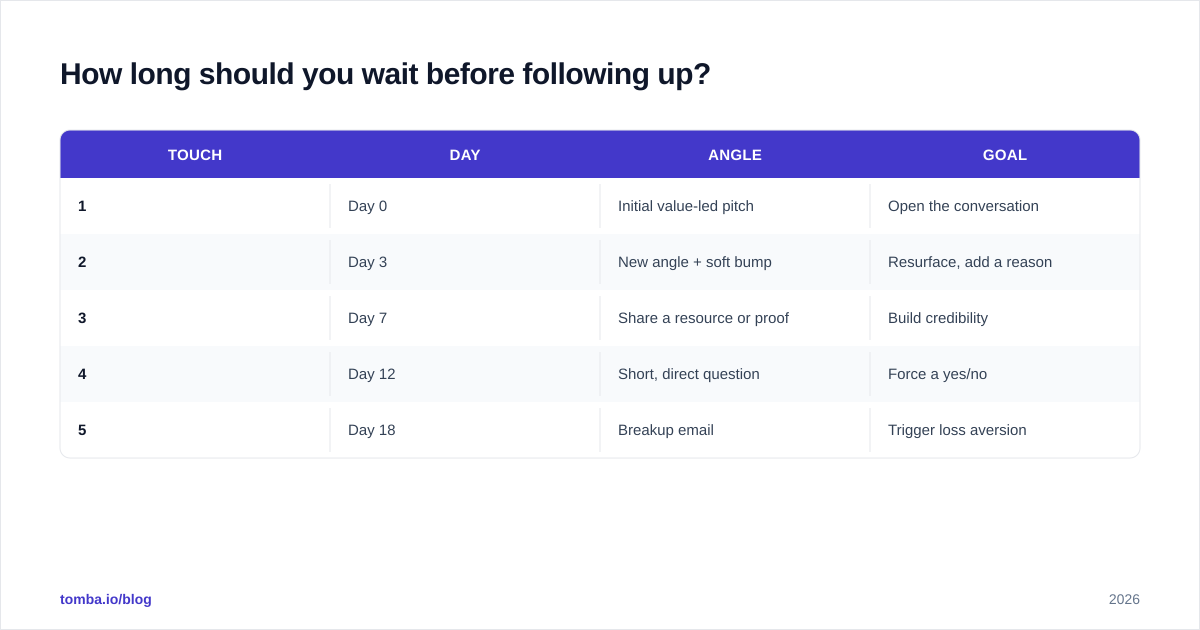
Here's a cadence that works for a standard B2B outbound sequence:
| Touch | Day | Angle | Goal |
|---|---|---|---|
| 1 | Day 0 | Initial value-led pitch | Open the conversation |
| 2 | Day 3 | New angle + soft bump | Resurface, add a reason |
| 3 | Day 7 | Share a resource or proof | Build credibility |
| 4 | Day 12 | Short, direct question | Force a yes/no |
| 5 | Day 18 | Breakup email | Trigger loss aversion |
Adjust the spacing for context. After a demo or a warm intro, tighten it to 2 days. For cold, senior prospects, you can stretch to 4–5 business days without losing the thread. Send between Tuesday and Thursday, mid-morning in the prospect's timezone, and avoid Monday inbox-clearing and Friday afternoons.
One non-negotiable: stop the moment they reply, book, or ask you to stop. A sequence is a safety net, not a script you run on autopilot regardless of what the human on the other end does.
What makes a follow-up email actually get a reply?#
Give the prospect a fresh reason to respond every single time. The fastest way to get ignored twice is to send "just circling back" — it adds zero new information and signals you have nothing to say.
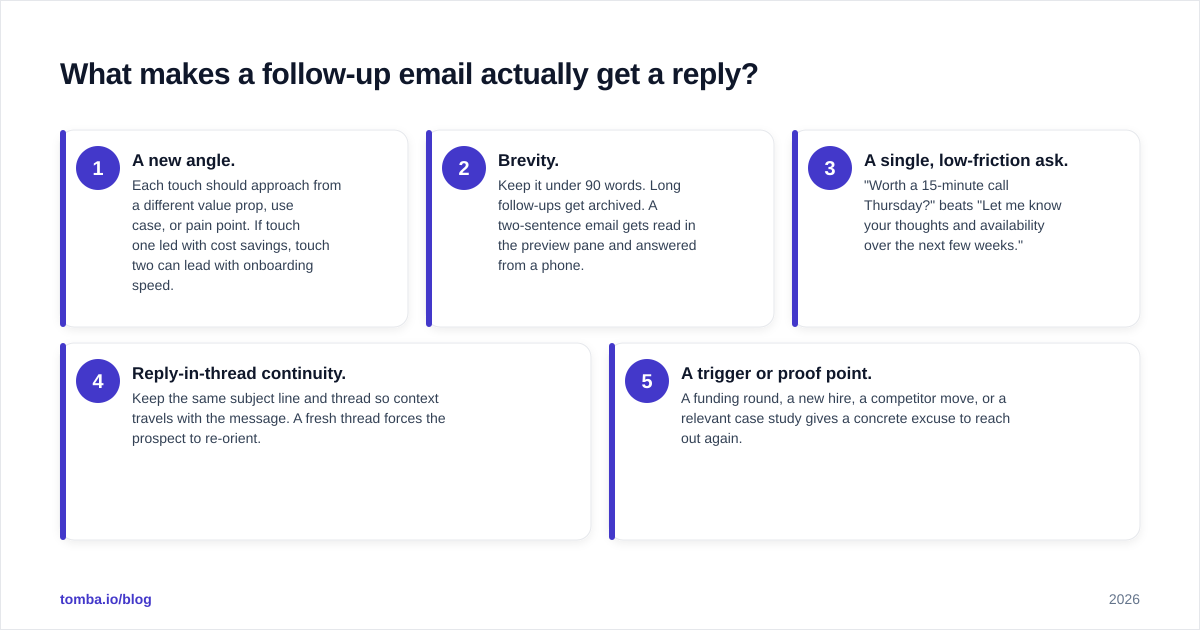
Strong follow-ups share five traits:
- A new angle. Each touch should approach from a different value prop, use case, or pain point. If touch one led with cost savings, touch two can lead with onboarding speed.
- Brevity. Keep it under 90 words. Long follow-ups get archived. A two-sentence email gets read in the preview pane and answered from a phone.
- A single, low-friction ask. "Worth a 15-minute call Thursday?" beats "Let me know your thoughts and availability over the next few weeks."
- Reply-in-thread continuity. Keep the same subject line and thread so context travels with the message. A fresh thread forces the prospect to re-orient.
- A trigger or proof point. A funding round, a new hire, a competitor move, or a relevant case study gives a concrete excuse to reach out again.
If you're stuck on the opening line, a cold email AI writer can draft variants you then trim down by hand. And before you obsess over body copy, fix your subject lines — half the battle is getting the email opened at all. A quick pass through a subject line generator surfaces angles you'd miss writing cold.
Follow-up email templates that recover dead threads#
Steal these, then make them sound like you. Each is built for a specific touch in the sequence above. Swap the brackets, cut anything that feels like filler, and never send two in a row that lead with the same angle.
Template 1 — The gentle bump (Touch 2, Day 3)#
Subject: Re: [original subject]
Hi [First name],
Floating this back to the top of your inbox in case it slipped through. The short version: [one-line value prop tied to their role].
Worth a quick look, or should I follow up next quarter instead?
[Your name]
The "or should I follow up next quarter" line gives an easy out, which paradoxically makes people more likely to engage now.
Template 2 — The resource add (Touch 3, Day 7)#
Subject: Re: [original subject]
Hi [First name],
Thought of you when I saw this — [link to a relevant guide, benchmark, or case study]. [Similar company] used the same approach to [specific result].
Happy to walk you through how it'd map to [their company]. Open to 15 minutes this week?
[Your name]
This touch leads with giving, not asking. The case study does the selling so you don't have to.
Template 3 — The trigger event (any touch)#
Subject: Congrats on [trigger — funding, launch, new role]
Hi [First name],
Saw the news about [trigger]. Teams hitting this stage usually run into [specific problem] — that's exactly where we help.
Worth a short call to see if it's relevant?
[Your name]
Trigger-based emails consistently outperform generic bumps because the timing feels earned, not random.
Template 4 — The direct question (Touch 4, Day 12)#
Subject: Re: [original subject]
Hi [First name],
Quick one: is [problem] a priority for [their team] this quarter, or am I catching you at the wrong time?
Totally fine either way — just don't want to keep landing in your inbox if it's not relevant.
[Your name]
A yes/no question is easier to answer than an open-ended pitch, and "wrong time" gives them a graceful exit that often turns into "actually, let's talk."
Template 5 — The breakup (Touch 5, Day 18)#
Subject: Closing the loop
Hi [First name],
I haven't heard back, so I'll assume the timing isn't right and stop reaching out. If that changes, my door's open — just reply here.
Wishing [their company] a strong [quarter/year].
[Your name]
The breakup email frequently earns the highest single-touch reply rate in a sequence. Loss aversion is real: people who ignored four emails suddenly respond when you signal you're walking away.
For more plug-and-play structures across the whole funnel, browse Tomba's cold email templates library and adapt the ones that fit your motion.
How many follow-ups is too many?#
Cap a single sequence at 5–7 touches, then stop or move the contact to a long-term nurture. Beyond that, reply rates flatten and unsubscribe (or worse, spam complaint) rates climb. Each complaint chips away at your sender reputation, which quietly tanks deliverability for every future send.
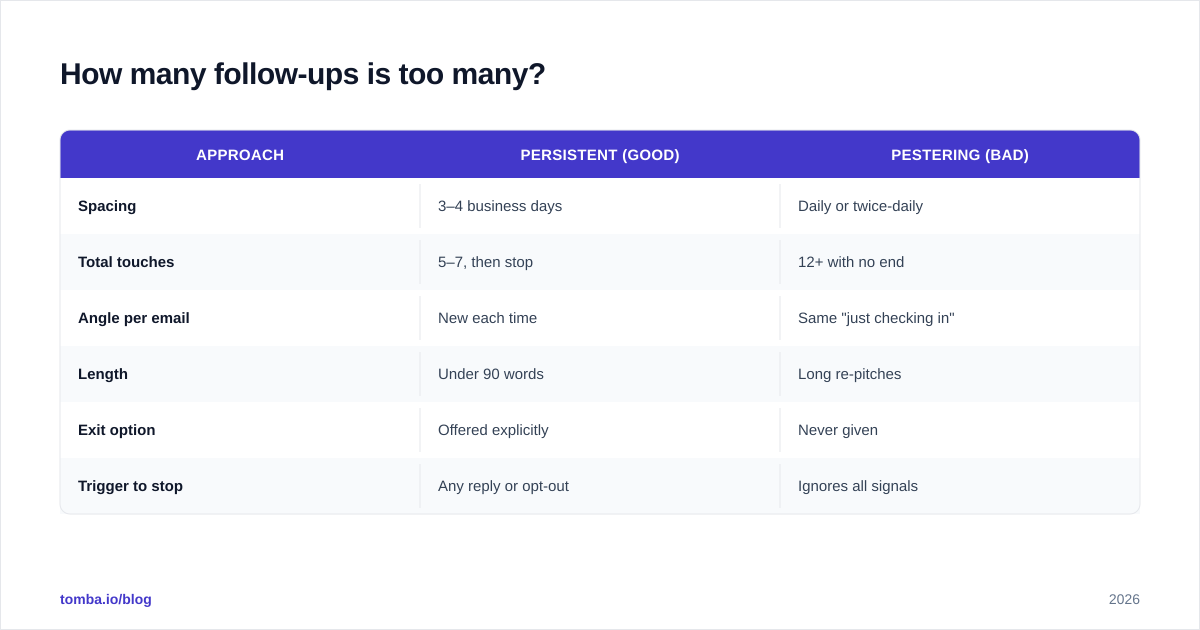
There's a difference between persistent and pestering:
| Approach | Persistent (good) | Pestering (bad) |
|---|---|---|
| Spacing | 3–4 business days | Daily or twice-daily |
| Total touches | 5–7, then stop | 12+ with no end |
| Angle per email | New each time | Same "just checking in" |
| Length | Under 90 words | Long re-pitches |
| Exit option | Offered explicitly | Never given |
| Trigger to stop | Any reply or opt-out | Ignores all signals |
The mechanical side matters as much as the count. If a chunk of your sequence bounces, mailbox providers read that as spammy behavior and start routing even your valid emails to spam. That's why list hygiene is part of follow-up strategy, not a separate chore — protect your response rate by keeping the list clean before and during the campaign.
How does data quality change your follow-up results?#
A flawless sequence sent to a wrong or dead address gets you nothing — verification is the foundation under every template above. You can write the best breakup email of your career, but if it bounces, the only thing you've built is a worse sender reputation.
Two data problems quietly sabotage follow-up campaigns:
- Bounces. Sending to invalid addresses spikes your bounce rate and trains spam filters to distrust your domain. Run your list through an email verifier before the first touch so every send lands on a real mailbox.
- Wrong person. Following up with someone who left the company three months ago wastes five touches. Confirm the contact still holds the role, and find the right replacement when they don't.
This is where sourcing and outreach connect. Use a reliable email finder to pull verified, current addresses by name and domain, then layer your sequence on top. Good copy amplifies good data; it can't rescue bad data. Reps who treat verification as optional spend their follow-up energy heating up a dead inbox.
For a deeper look at how Tomba sources and validates contacts, the data accuracy breakdown shows why a verified-first workflow beats spray-and-pray volume — and platforms like G2 catalog how teams compare verification tools when accuracy is the deciding factor.
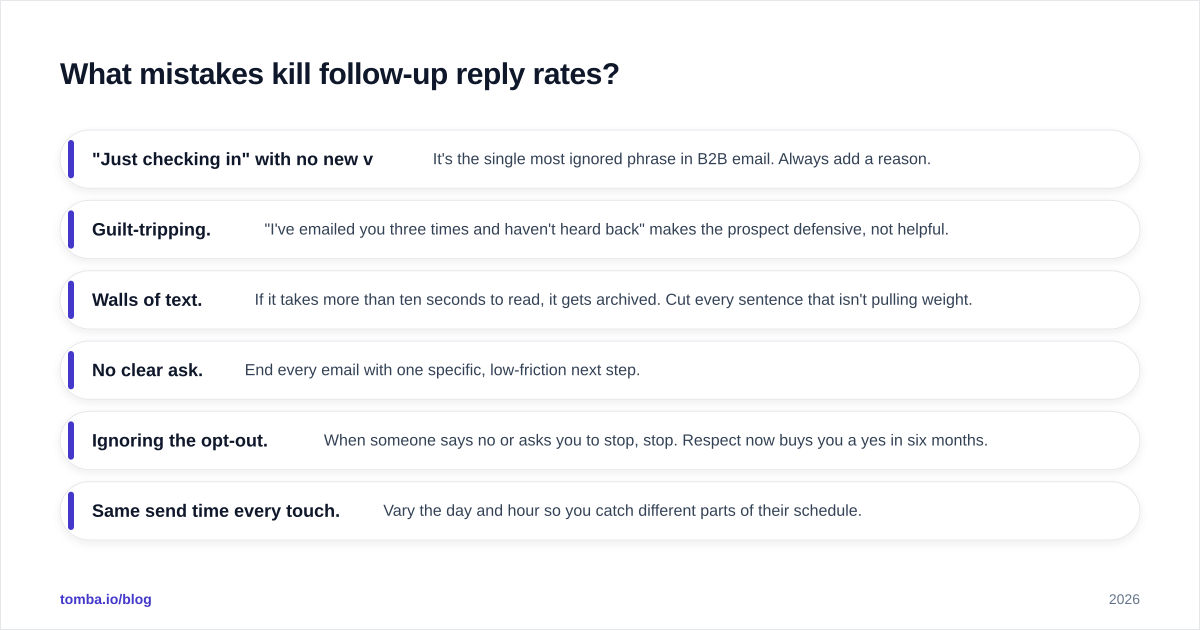
What mistakes kill follow-up reply rates?#
Avoid these and you'll already beat most reps:
- "Just checking in" with no new value. It's the single most ignored phrase in B2B email. Always add a reason.
- Guilt-tripping. "I've emailed you three times and haven't heard back" makes the prospect defensive, not helpful.
- Walls of text. If it takes more than ten seconds to read, it gets archived. Cut every sentence that isn't pulling weight.
- No clear ask. End every email with one specific, low-friction next step.
- Ignoring the opt-out. When someone says no or asks you to stop, stop. Respect now buys you a yes in six months.
- Same send time every touch. Vary the day and hour so you catch different parts of their schedule.
- Skipping personalization. A reference to their company, role, or a recent trigger lifts replies more than any clever subject line.
Run your draft through a spam check and a readability pass before it goes out — small friction points like spammy phrasing or a missing personal detail are the difference between the inbox and the promotions tab. Reputable references like Backlinko's email outreach research reinforce that personalized, value-led follow-ups outperform generic bumps by a wide margin.
Build your follow-up engine on verified data#
Great follow-up copy is only half the equation. The other half is reaching the right person at a working address, every time. Before you load these templates into your sequencer, source your prospects with the Tomba Email Finder — find professional emails by domain, name, or company, verified at the point of discovery so your carefully crafted touches actually arrive.
Start free with 25 searches a month, then scale up as your pipeline grows — see Tomba pricing, with paid plans from $49/mo. Pair clean data with the sequence above, and the silence you've been getting turns into a calendar full of replies.
// get started
Find, verify and enrich your first contacts today
Start on the free plan with 25 searches a month, then scale when your team is ready.
Free plan · No credit card required · GDPR & CCPA
// about the author