Objection Reply Emails: 12 Templates to Win Deals in 2026
Stop losing deals to "no budget" and "send me info." Here are battle-tested objection reply emails, a reframe framework, and templates you can paste today.
Most reps lose the deal twice: once when the prospect raises an objection, and again when they fire back a defensive, copy-pasted reply that reads like an argument. An objection reply email is your single best chance to keep a stalled conversation alive — and most people waste it.
This guide breaks down how to write objection reply emails that move deals forward instead of ending them, with a repeatable framework and 12 templates you can adapt today.
TL;DR#
- An objection reply email is a written response that acknowledges a prospect's concern, reframes it, and proposes a low-friction next step — without sounding defensive.
- The highest-converting replies follow a 4-part structure: Acknowledge → Reframe → Evidence → Ask.
- The five objections that kill most B2B deals are price, timing, authority, status quo ("we already use X"), and silence (the non-reply).
- Speed matters: replies sent within an hour see materially higher engagement than next-day responses.
- Templates get you 80% of the way; the last 20% is personalization from real research on the account and contact.
What is an objection reply email?#
An objection reply email is the message you send after a prospect pushes back — on price, timing, fit, or relevance — designed to keep the conversation moving rather than win an argument.
Think of it like a tennis rally. A weak reply slams the ball straight at your opponent and the point ends. A strong reply places the ball where they can return it, so the rally continues. Your goal is never to "beat" the objection; it's to extend the exchange until both sides see whether there's a real fit.
Technically, the objection reply sits in the middle of your email outreach sequence — after the opener has earned a response, but before the deal is qualified. Because the prospect has already engaged, the stakes are higher than a cold open. Get it wrong and they ghost; get it right and you book the meeting.

Why do most objection replies fail?#
Three reasons, in order of frequency:
- They defend instead of explore. The instinct is to justify your price or your product. But an objection is rarely a final verdict — it's a request for more information or reassurance. Defending signals you didn't hear them.
- They're too long. A prospect who raised a one-line objection will not read seven paragraphs. The reply should be shorter than the objection felt.
- They have no ask. Reps acknowledge the concern, then trail off with "let me know your thoughts." That hands all the work back to a busy buyer. Every objection reply needs a specific, low-effort next step.
The fix for all three is a structure that forces brevity, curiosity, and a clear ask.
What framework should you use for objection reply emails?#
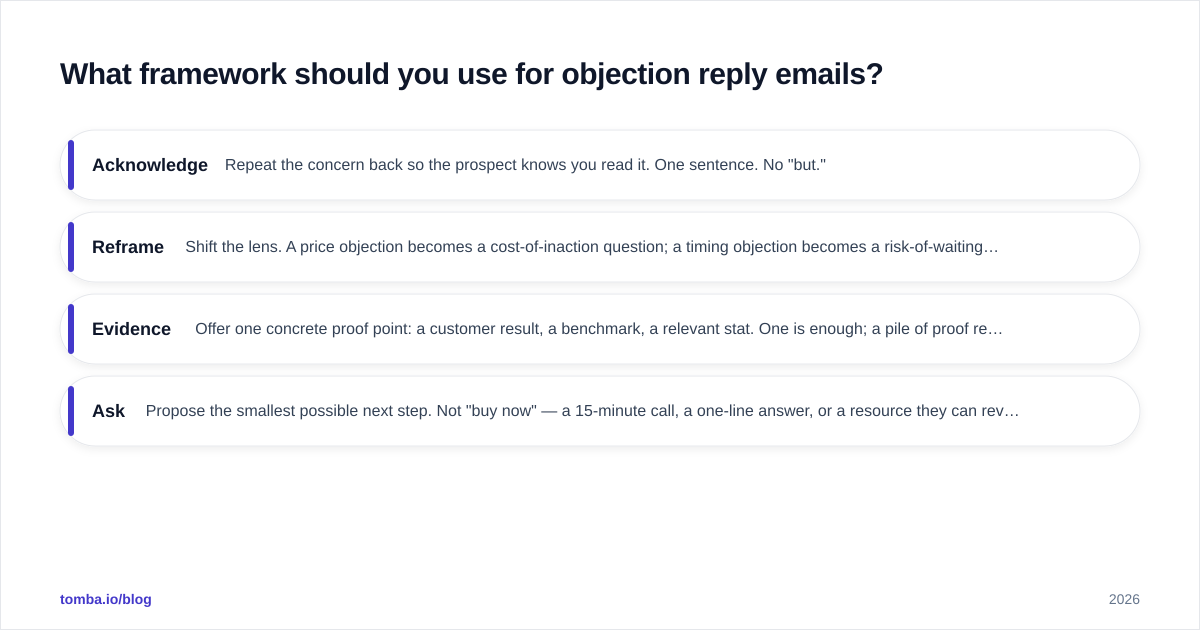
Use the Acknowledge → Reframe → Evidence → Ask sequence. It works because it mirrors how people actually want to be persuaded: heard first, challenged gently second, shown proof third, and given an easy yes last.
Here's what each step does:
- Acknowledge — Repeat the concern back so the prospect knows you read it. One sentence. No "but."
- Reframe — Shift the lens. A price objection becomes a cost-of-inaction question; a timing objection becomes a risk-of-waiting question.
- Evidence — Offer one concrete proof point: a customer result, a benchmark, a relevant stat. One is enough; a pile of proof reads as desperation.
- Ask — Propose the smallest possible next step. Not "buy now" — a 15-minute call, a one-line answer, or a resource they can review.
The diagram above maps each stage to the emotional state you're trying to create. Keep the whole email under 90 words and the structure does the heavy lifting.
Which objections should you prepare for?#
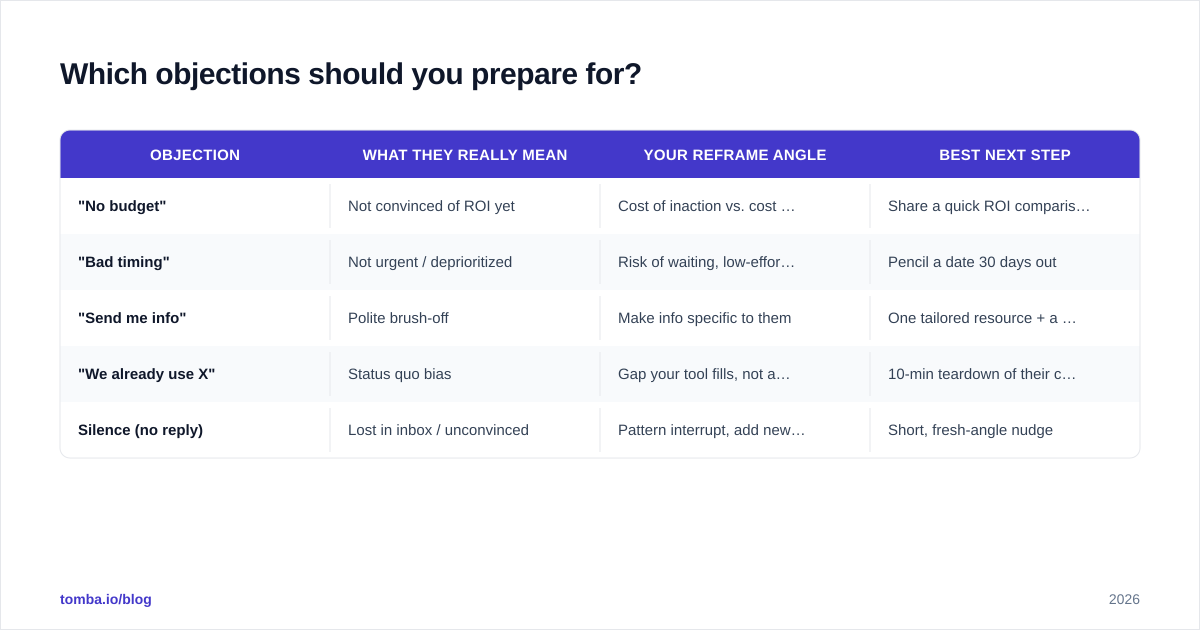
Five objections account for the vast majority of stalled B2B deals. Prepare a reply pattern for each before you need it.
| Objection | What they really mean | Your reframe angle | Best next step |
|---|---|---|---|
| "No budget" | Not convinced of ROI yet | Cost of inaction vs. cost of tool | Share a quick ROI comparison |
| "Bad timing" | Not urgent / deprioritized | Risk of waiting, low-effort start | Pencil a date 30 days out |
| "Send me info" | Polite brush-off | Make info specific to them | One tailored resource + a question |
| "We already use X" | Status quo bias | Gap your tool fills, not a rip-and-replace | 10-min teardown of their current setup |
| Silence (no reply) | Lost in inbox / unconvinced | Pattern interrupt, add new value | Short, fresh-angle nudge |
Notice that the "real meaning" column is almost never the literal words. That gap is where your reframe lives.
What do great objection reply emails actually look like?#
Below are templates for the five core objections, each following the framework. Swap the brackets for real details — generic templates underperform personalized ones every time.
1. The "no budget" reply#
Subject: Re: pricing
Hi [Name] — totally fair, budget's tight everywhere right now.
Quick reframe: most teams we work with weren't looking to add spend — they were trying to stop losing [specific cost, e.g. "8 hours a week on manual list-building"]. [Customer] cut that to under an hour and reallocated the time to outreach.
Worth a 15-minute look at whether the math works for [Company]? I can send a one-page ROI breakdown first if that's easier.
2. The "bad timing" reply#
Hi [Name] — appreciate the honesty, timing is everything.
One thought: the teams that wait a quarter usually face the same problem a quarter bigger. No pressure to start now — but would it help to pencil in a 20-minute scoping call for [month] so it's ready when you are?
3. The "send me info" reply#
Hi [Name] — happy to. Rather than dump a deck on you, here's the one piece most relevant to [their specific use case]: [link].
Quick question so I send the right follow-up: is [specific challenge] the main thing you'd want this to solve, or is it more about [alternative]?
That closing question is the engine. It converts a brush-off into a reply.
4. The "we already use X" reply#
Hi [Name] — makes sense, [Competitor] is solid for [their strength].
Most folks who switched to us kept [Competitor] for [X] and used us for [the gap, e.g. "verified emails on catch-all domains"], where accuracy was costing them bounces. Want a 10-minute teardown of where your current setup might be leaking deliverability?
5. The silence / no-reply nudge#
Hi [Name] — circling back with something more useful than "just following up."
Since we last spoke, [new trigger: a feature, a stat, a relevant change]. Thought of [Company] specifically because [reason]. Still worth a conversation, or should I close the loop for now?
The "should I close the loop" line gives them an easy out — which, paradoxically, often earns a reply. People respond to a graceful exit more than another ask.
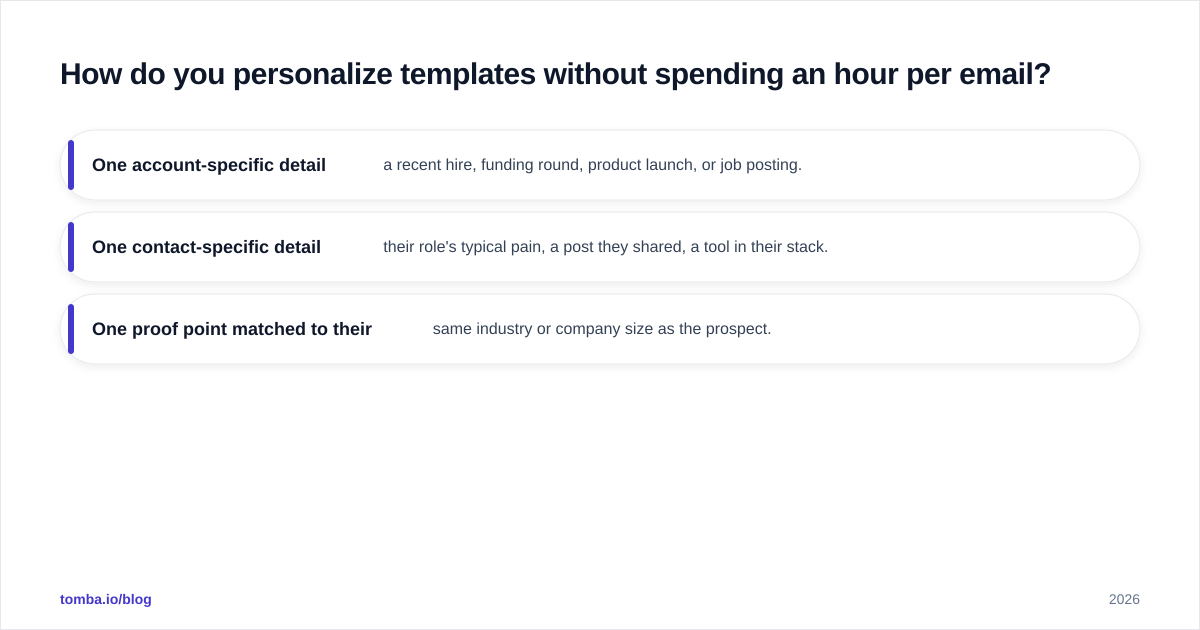
How do you personalize templates without spending an hour per email?#
Personalization is a research problem, not a writing problem. The writing takes two minutes once you have the inputs.
Build a quick pre-send checklist:
- One account-specific detail — a recent hire, funding round, product launch, or job posting.
- One contact-specific detail — their role's typical pain, a post they shared, a tool in their stack.
- One proof point matched to their segment — same industry or company size as the prospect.
The bottleneck is usually getting accurate contact data in the first place. If you're rebuilding lists or enriching stale records, a data enrichment step before you write keeps you from personalizing to the wrong person. Tools like HubSpot's free CRM and call-analysis platforms such as Gong can surface the talk tracks and objection patterns your buyers actually use, which makes your reframes sharper.
For drafting at scale, an AI cold email writer can generate first-pass variations of each template — but treat the output as a draft, not a send. The framework above is what keeps AI copy from sounding like AI copy.
When should you send an objection reply — and how fast?#
Send fast, but not instantly. The sweet spot is within the same business hour for warm threads and within a day for colder ones.
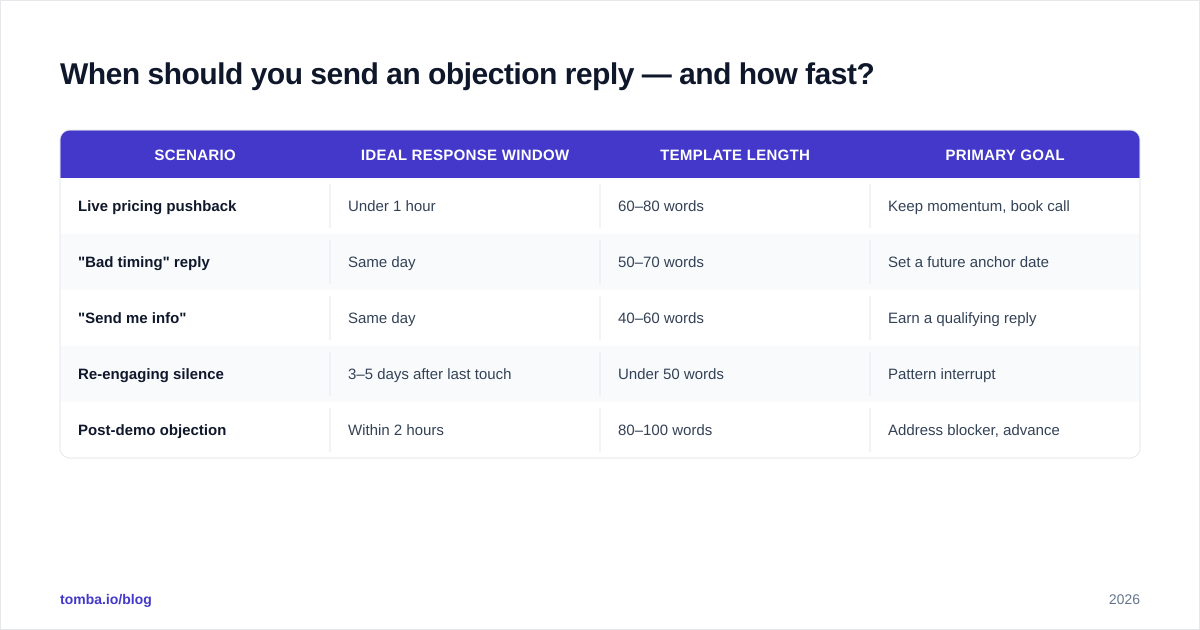
Here's a practical SLA by objection type and how the approach differs from a generic follow-up:
| Scenario | Ideal response window | Template length | Primary goal |
|---|---|---|---|
| Live pricing pushback | Under 1 hour | 60–80 words | Keep momentum, book call |
| "Bad timing" reply | Same day | 50–70 words | Set a future anchor date |
| "Send me info" | Same day | 40–60 words | Earn a qualifying reply |
| Re-engaging silence | 3–5 days after last touch | Under 50 words | Pattern interrupt |
| Post-demo objection | Within 2 hours | 80–100 words | Address blocker, advance |
Speed signals that the deal matters to you. But a fast, sloppy reply is worse than a thoughtful one an hour later — never trade the framework for raw velocity. Track your own email response rate by objection type so you learn which replies actually convert for your market, then double down on those patterns.
How do you handle objections you can't answer in an email?#
Some objections need a conversation, not a clever paragraph. Security reviews, multi-stakeholder buy-in, or deep technical doubts don't fit in 90 words — and pretending they do reads as evasive.
For those, the email's only job is to earn the meeting. Acknowledge the concern, validate that it deserves a real discussion, and propose the call:
"That's exactly the kind of thing worth 20 minutes rather than a back-and-forth over email — I'd want to bring [our solutions engineer] who can answer the technical side properly. Does Thursday work?"
This also screens for seriousness. A prospect unwilling to take a short call over a genuine blocker was rarely going to close anyway. You learn that faster by asking than by writing a fourth essay-length reply. Resources like Salesforce's selling guides reinforce the same point: complex objections are signals to escalate the channel, not to win the rally over text.
How do you measure whether your objection replies are working?#
Track three numbers, not vanity opens:
- Objection-to-reply rate — of prospects who raised a given objection, how many replied to your handling email? This isolates the quality of your reply, not your list.
- Objection-to-meeting rate — how many advanced to a booked call. The real scoreboard.
- Objection recurrence — if the same objection keeps killing deals at the same stage, the problem is upstream (targeting, positioning, or pricing), not your reply copy.
Tag every objection in your CRM so these roll up automatically. Over a quarter, you'll see which templates earn meetings and which quietly die. Kill the losers, clone the winners, and keep a living library of your best-performing objection reply emails. The reps who compound this advantage treat their objection library like a product — versioned, tested, and improved every month.
Bringing it together#
Objection reply emails are won on preparation, not improvisation. Build a reply pattern for each of the five core objections, run every draft through Acknowledge → Reframe → Evidence → Ask, keep it under 90 words, and always close with the smallest possible next step. Personalize with one account detail, one contact detail, and one matched proof point — then send fast.
The single biggest multiplier sits before the writing: reaching the right person with accurate contact data. A flawless reframe sent to a bounced address or the wrong stakeholder converts nothing. Start your sequence on solid ground with the Tomba Email Finder — find and verify professional emails by name, company, or domain so every objection reply you craft actually lands in the inbox of the person who can say yes. Pair it with a verified list and your templates do the rest. See Tomba pricing to start free with 25 searches a month and scale as your pipeline grows.
// get started
Find, verify and enrich your first contacts today
Start on the free plan with 25 searches a month, then scale when your team is ready.
Free plan · No credit card required · GDPR & CCPA
// about the author