LinkedIn Social Selling in 2026: The Complete B2B Playbook
Social selling isn't posting and praying. Here's how top B2B reps use LinkedIn to build pipeline in 2026 — with a repeatable framework, metrics, and tooling.
LinkedIn Social Selling in 2026: The Complete B2B Playbook
Social selling is using your professional network — mostly LinkedIn — to find, research, warm up, and convert buyers, instead of cold-blasting strangers. Done right, it shortens sales cycles and lifts reply rates because the buyer already half-knows you before you ever pitch.
Done wrong, it's "post a quote graphic, spray 40 connection requests, copy-paste a pitch DM." That's not social selling. That's cold outreach wearing a LinkedIn costume.
This is the playbook for doing it right in 2026.
TL;DR#
- Social selling = trust at scale, not DM spam. You build authority and relationships first, then convert demand you helped create.
- Four pillars run the system: optimize your profile, find the right buyers, engage before you pitch, and convert with a warm, specific ask.
- Your LinkedIn SSI (Social Selling Index) is a directional metric, not a scoreboard. Pipeline and reply rate matter more.
- Tooling multiplies effort. Pair LinkedIn with enrichment and an email finder so social touches become multi-channel sequences.
- Measure leading and lagging indicators. Track profile views, reply rate, meetings booked, and influenced pipeline — not vanity likes.
What is LinkedIn social selling, really?#
Think of social selling like becoming a regular at a coffee shop versus knocking on doors in a neighborhood you've never visited. The door-knocker (cold outreach) gets a few sales through sheer volume and a lot of slammed doors. The regular (social seller) gets introduced around, trusted, and asked for advice — and the sales follow.
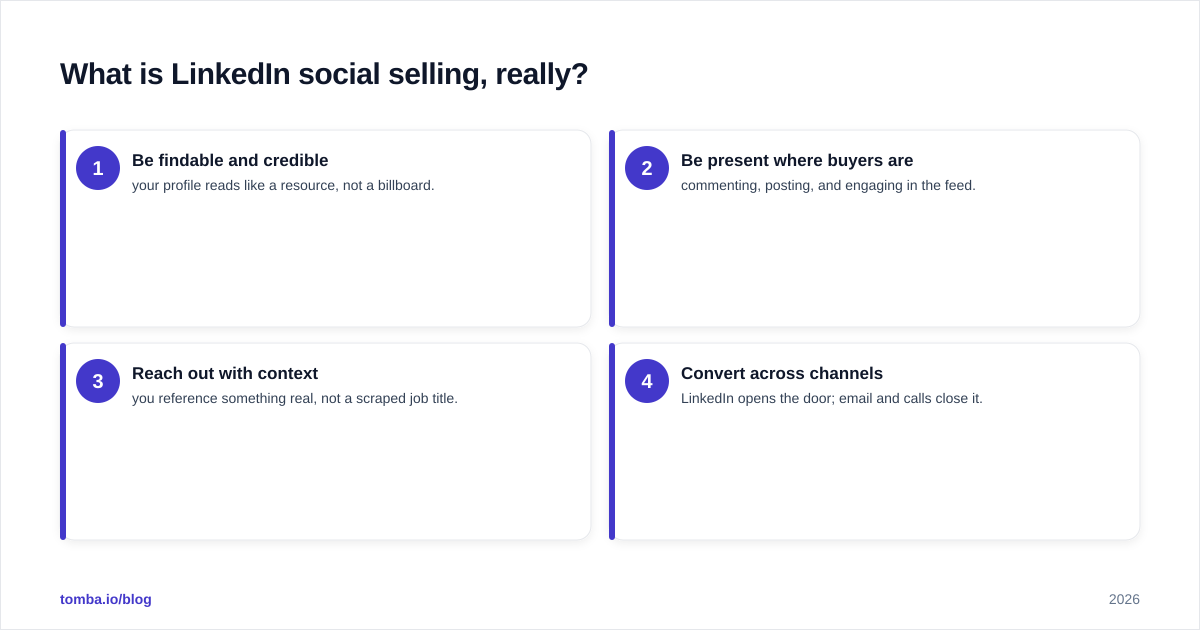
Concretely, social selling is a repeatable loop:
- Be findable and credible — your profile reads like a resource, not a billboard.
- Be present where buyers are — commenting, posting, and engaging in the feed.
- Reach out with context — you reference something real, not a scraped job title.
- Convert across channels — LinkedIn opens the door; email and calls close it.
The mistake most reps make is collapsing all four steps into step 3. They skip the credibility and presence, then wonder why their connect-and-pitch DM gets ignored.
Why does social selling work better than cold spray in 2026?#
Because buyers changed. By 2026, B2B buyers complete most of their research before they ever talk to a rep, and they actively screen out generic outreach. According to LinkedIn's own sales research, reps who consistently engage their network outperform peers on quota attainment — not because the platform is magic, but because relationship-led outreach matches how buyers want to buy.
Three forces make social selling the higher-leverage play:
- Inbox fatigue. Cold email volume keeps climbing, so reply rates on generic sends keep falling. A warm LinkedIn touch cuts through.
- Buyer self-education. Buyers want a resource, not a closer. The rep who teaches gets the meeting.
- Trust signals are public. Your content, mutual connections, and engagement history are all visible. That's social proof working for you 24/7.
Social selling doesn't replace cold email or LinkedIn outreach — it makes both convert better by warming the prospect first.
What is the social selling framework?#
Here's the system. Each pillar feeds the next, and you run the loop continuously rather than treating it as a one-time campaign.
Pillar 1 — Optimize your profile as a resource#
Your profile is your landing page. Buyers click it after every comment and connection request. Fix these first:
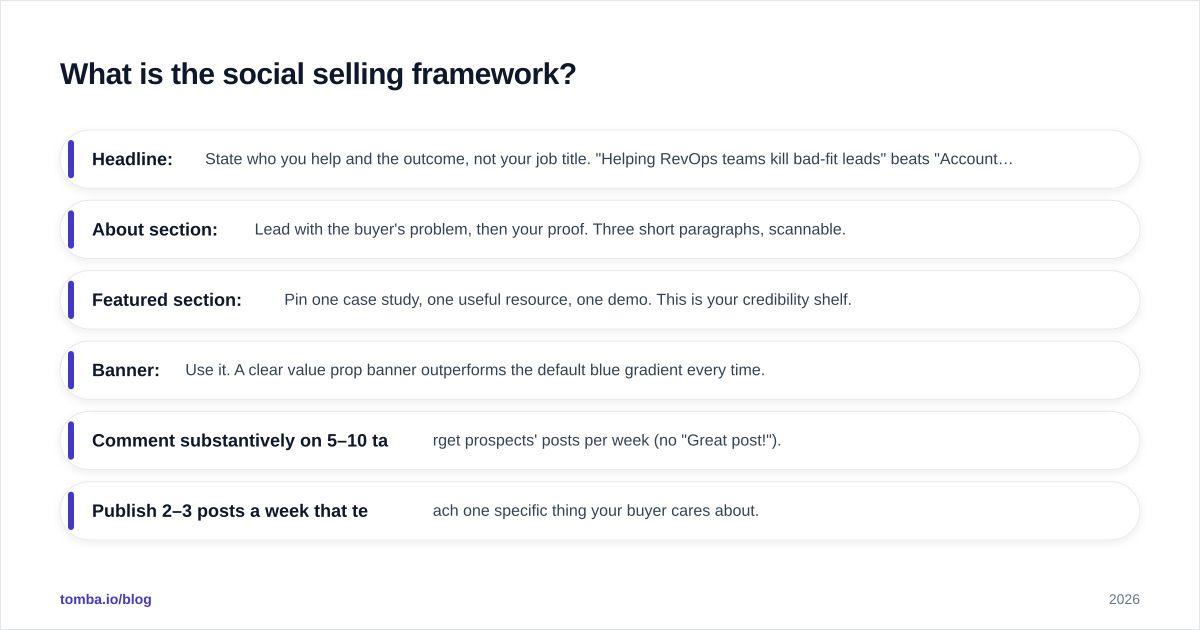
- Headline: State who you help and the outcome, not your job title. "Helping RevOps teams kill bad-fit leads" beats "Account Executive at Acme."
- About section: Lead with the buyer's problem, then your proof. Three short paragraphs, scannable.
- Featured section: Pin one case study, one useful resource, one demo. This is your credibility shelf.
- Banner: Use it. A clear value prop banner outperforms the default blue gradient every time.
A profile tuned this way turns passive profile views into inbound replies.
Pillar 2 — Build a targeted prospecting list#
You can't social-sell to everyone. Define your ideal customer profile, then build a list using LinkedIn Sales Navigator filters — title, industry, headcount, recent job changes, and shared groups.
The gap most reps hit: LinkedIn shows you the person but not their work email or direct phone. That's where enrichment closes the loop. Run your target list through data enrichment and a LinkedIn finder to attach verified contact details, so a single LinkedIn touch can branch into a full multi-channel sequence.
Pillar 3 — Engage before you pitch#
This is the pillar everyone skips, and it's the one that works. Before any ask, spend two to four weeks showing up:
- Comment substantively on 5–10 target prospects' posts per week (no "Great post!").
- Publish 2–3 posts a week that teach one specific thing your buyer cares about.
- Share and tag thoughtfully when a prospect's win is genuinely relevant.
By the time you reach out, you're a familiar name, not a cold stranger.
Pillar 4 — Convert with a warm, specific ask#
Now the outreach lands. Reference the real context — a comment they made, a post they shared, a trigger event like a funding round. Keep the first message about them, end with a low-friction ask (a question or a resource, not a 30-minute demo request).
Social selling vs. cold outreach: which should you use?#
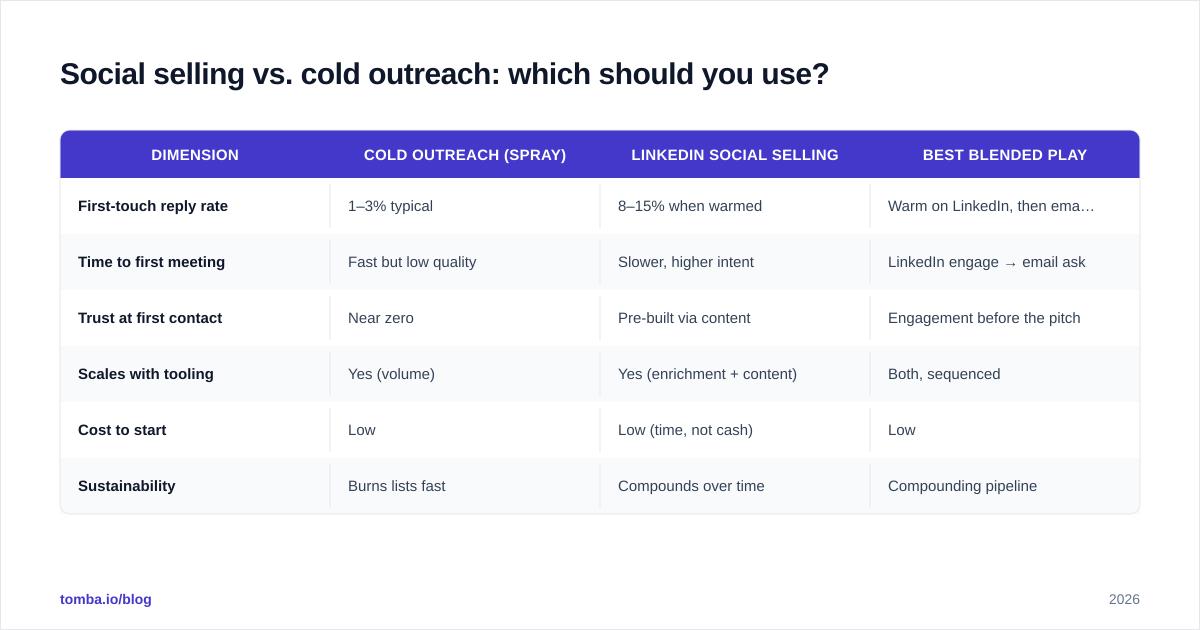
Both. They're not rivals — they're stages of the same motion. Here's how they compare across the dimensions that matter to a B2B rep.
| Dimension | Cold outreach (spray) | LinkedIn social selling | Best blended play |
|---|---|---|---|
| First-touch reply rate | 1–3% typical | 8–15% when warmed | Warm on LinkedIn, then email |
| Time to first meeting | Fast but low quality | Slower, higher intent | LinkedIn engage → email ask |
| Trust at first contact | Near zero | Pre-built via content | Engagement before the pitch |
| Scales with tooling | Yes (volume) | Yes (enrichment + content) | Both, sequenced |
| Cost to start | Low | Low (time, not cash) | Low |
| Sustainability | Burns lists fast | Compounds over time | Compounding pipeline |
The takeaway: cold outreach gives you reach, social selling gives you conversion. Stack them. Warm the buyer on LinkedIn, enrich their contact data, then run a multi-touch email and call sequence that references the social interaction.
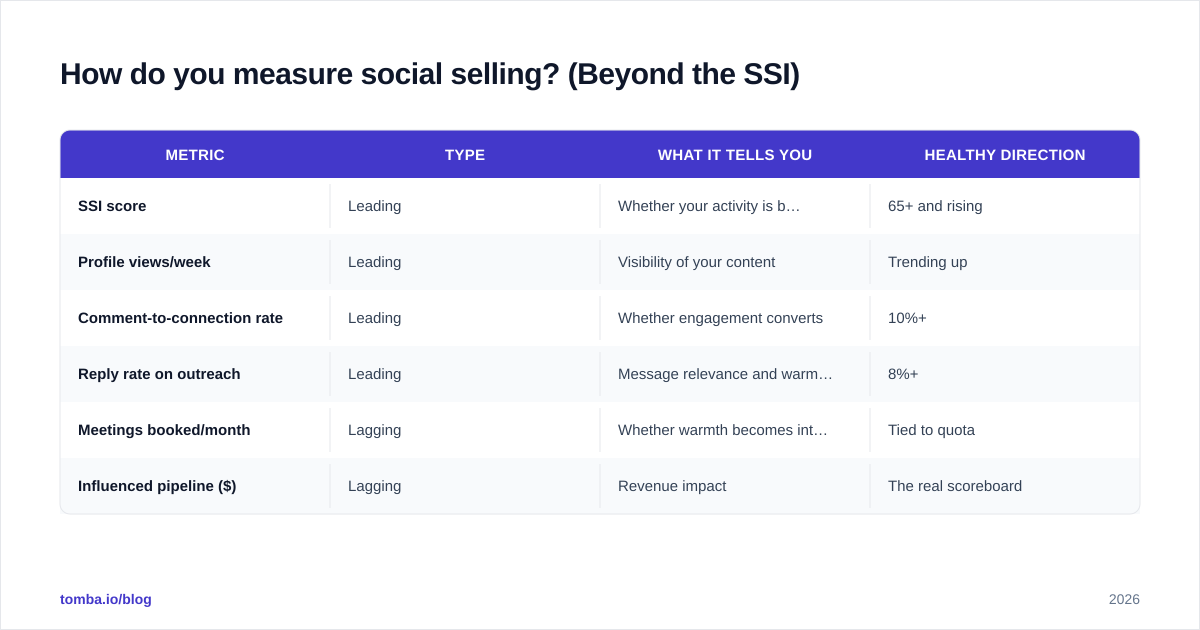
How do you measure social selling? (Beyond the SSI)#
LinkedIn gives every member a Social Selling Index (SSI) — a 0–100 score across four components: establishing your brand, finding the right people, engaging with insights, and building relationships. It's a useful directional signal and a free diagnostic, but it is not your goal. You can have a 78 SSI and zero pipeline.
Track these instead, split into leading and lagging indicators:
| Metric | Type | What it tells you | Healthy direction |
|---|---|---|---|
| SSI score | Leading | Whether your activity is balanced | 65+ and rising |
| Profile views/week | Leading | Visibility of your content | Trending up |
| Comment-to-connection rate | Leading | Whether engagement converts | 10%+ |
| Reply rate on outreach | Leading | Message relevance and warmth | 8%+ |
| Meetings booked/month | Lagging | Whether warmth becomes intent | Tied to quota |
| Influenced pipeline ($) | Lagging | Revenue impact | The real scoreboard |
Watch the leading indicators weekly so you can correct course; report the lagging ones monthly to prove ROI. If your SSI is high but reply rate is low, your problem is the ask, not your visibility. Pair this with your team's response rate benchmarks to know whether you're above or below par.
What tools do you need for social selling at scale?#
You can start with a free LinkedIn account and discipline. To scale past a handful of conversations a week, you need a small stack:
- LinkedIn Sales Navigator — advanced filters, saved lists, and lead alerts. The system of record for who you're targeting.
- A CRM — HubSpot, Salesforce, or Pipedrive — to log touches and not drop balls. Connect it with a HubSpot integration so social and email activity live in one timeline.
- Enrichment + email finding — to turn a LinkedIn profile into a reachable, verified contact. This is the multiplier that lets one social touch become a real sequence.
- A scheduling and sequencing tool — to run the email and call steps that follow the LinkedIn warm-up.
The connective tissue is contact data. A LinkedIn connection is great, but a connection plus a verified email and a direct line is a sequence you can actually run. Tomba's LinkedIn email extractor and email verifier bridge that gap, so you stop losing warm prospects to "I couldn't find their email." Compare options on G2 before you commit budget.
What are the most common social selling mistakes?#
Avoid these and you're ahead of most reps on the platform:
- Pitch-slapping. Connecting and immediately pitching. It tanks your reply rate and your reputation.
- "Great post!" comments. Generic engagement is invisible. Add a perspective or a question.
- Posting into the void. Content with no point of view gets no traction. Teach one specific thing per post.
- No follow-through off-platform. LinkedIn warms the lead; if you never move to email or a call, the deal stalls. Enrich and sequence.
- Chasing SSI instead of pipeline. A balanced SSI is a means, not the end.
- Skipping verification. Sending to a guessed email address torches your sender reputation. Always verify before you send.
How long until social selling produces pipeline?#
Expect 30–60 days to see leading indicators move (profile views, replies, comment-to-connection rate) and 60–90 days for meaningful pipeline, assuming consistent weekly activity. Social selling compounds — the content and relationships you build in month one keep paying off in month six. It's a flywheel, not a faucet. Reps who quit at week three never see the curve bend.
The fastest accelerant is consistency plus contact data. When you can instantly turn an engaged LinkedIn prospect into a verified, multi-channel contact, every social interaction becomes a pipeline opportunity instead of a dead-end like.
Start turning connections into pipeline#
LinkedIn gets you the conversation. Verified contact data gets you the deal. Once you've warmed a prospect with comments and content, don't let the thread die on the platform — turn that profile into a reachable, verified contact and run a real multi-channel sequence.
Tomba's Email Finder finds professional email addresses by name, company, or domain, then verifies them so your follow-up actually lands. Start free with 25 searches a month, and see Tomba pricing when you're ready to scale — Starter is $49/mo, Growth $99/mo. Pair it with your LinkedIn motion and watch your warm connections become booked meetings.
// get started
Find, verify and enrich your first contacts today
Start on the free plan with 25 searches a month, then scale when your team is ready.
Free plan · No credit card required · GDPR & CCPA
// about the author