Social Media Prospecting in 2026: A Complete Playbook
Spray-and-pray DMs are dead. Here's how social media prospecting actually works in 2026 — channels, signals, message frameworks, and the tools that turn profiles into pipeline.
TL;DR
- Social media prospecting means finding, researching, and warming up buyers on the platforms where they already talk shop — then moving them to a real conversation.
- The channel matters less than the signal. A job change, a funding round, or a comment on a competitor's post beats any cold list.
- DMs convert when they reference something specific. Generic "I'd love to connect and explore synergies" pitches die on arrival.
- The highest-performing teams pair social touches with verified email and phone, so a warm reply on LinkedIn becomes a tracked deal in the CRM.
- Tools do the boring part: surfacing signals, enriching profiles, and finding the contact details social platforms hide.
What is social media prospecting?#
Social media prospecting is the practice of using social platforms — LinkedIn, X, Reddit, niche communities — to identify potential buyers, learn what they care about, and start a relevant conversation that leads to a sales opportunity.
Think of it like working a trade-show floor instead of cold-calling a phone book. On the floor, you see who's at which booth, you overhear what they're complaining about, and you walk up with something useful to say. Social platforms are that floor, running 24/7, with every badge scannable.
Technically, it sits at the intersection of social selling and outbound. Social selling is the long game of building authority and relationships; prospecting is the targeted act of turning that audience — and the audiences around you — into named, contactable leads. You need both, but this post is about the second.
The shift in 2026 is that buyers ignore anything that smells automated. Open rates on templated LinkedIn blasts have cratered, and platforms now throttle accounts that fire identical messages at scale. The winners went the other way: fewer touches, more research, real triggers.
Which platforms actually work for prospecting?#
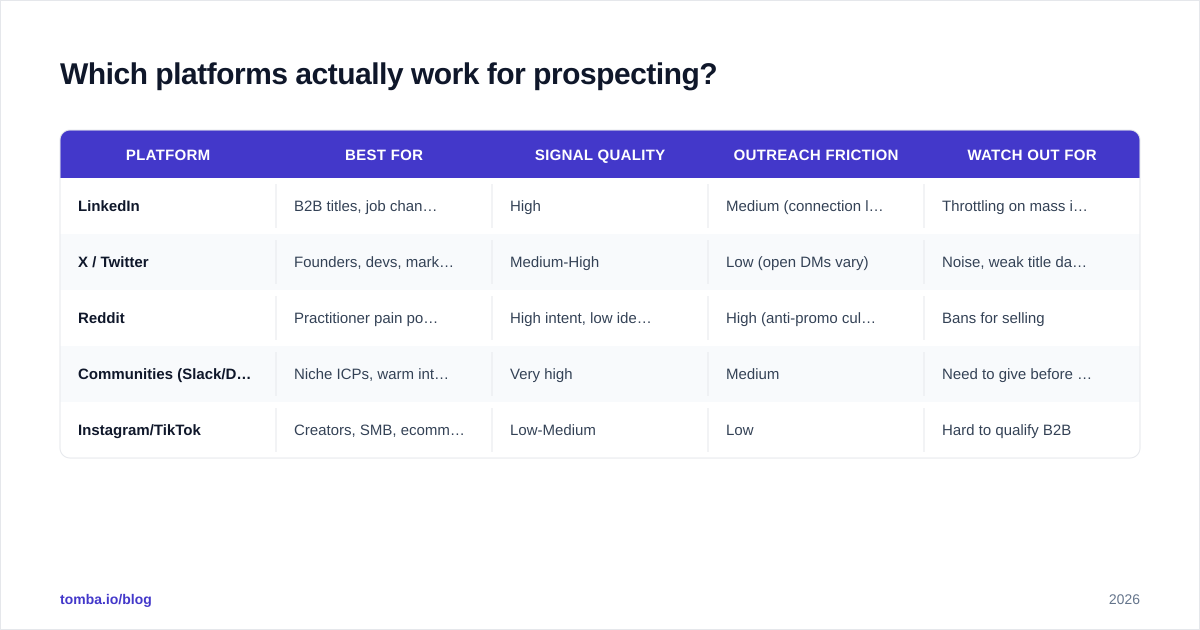
Short answer: go where your buyer already posts, not where prospecting is easiest for you.
LinkedIn remains the backbone for most B2B teams because intent and identity are both visible — job titles, company moves, and professional content all in one place. But it is no longer the whole story. X (Twitter) is where many technical and founder-led buyers argue in public. Reddit and Slack/Discord communities are where practitioners ask real questions before they ever fill out a form.
Here's how the main channels compare for outbound prospecting work:
| Platform | Best for | Signal quality | Outreach friction | Watch out for |
|---|---|---|---|---|
| B2B titles, job changes, exec reach | High | Medium (connection limits) | Throttling on mass invites | |
| X / Twitter | Founders, devs, marketers | Medium-High | Low (open DMs vary) | Noise, weak title data |
| Practitioner pain points | High intent, low identity | High (anti-promo culture) | Bans for selling | |
| Communities (Slack/Discord) | Niche ICPs, warm intros | Very high | Medium | Need to give before you take |
| Instagram/TikTok | Creators, SMB, ecommerce | Low-Medium | Low | Hard to qualify B2B |
The takeaway: LinkedIn for reach and identity, X and communities for depth and warmth. Most strong motions use two channels in tandem — spot a signal on one, engage there, then follow up on another.
How do you find the right prospects?#
You start with a tight definition of who counts, then you let signals do the filtering.
A good prospecting motion is not "everyone with the title VP of Sales." It's "VPs of Sales at 50–200-person SaaS companies who just posted about pipeline problems or hired two SDRs this quarter." The second list is a tenth of the size and ten times more likely to reply.
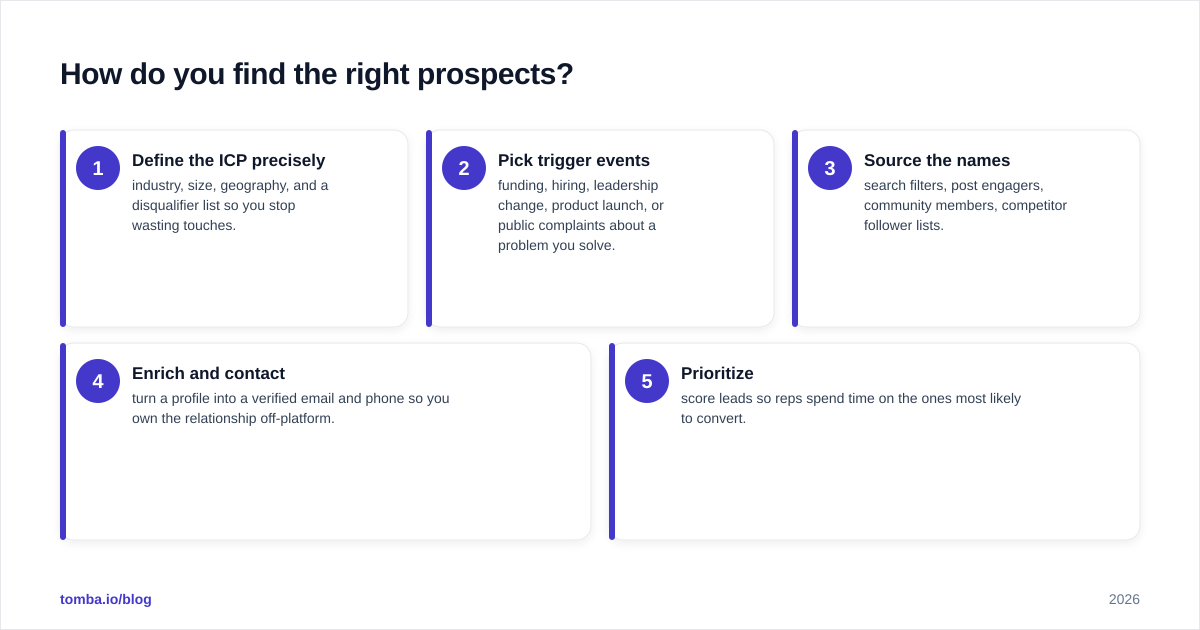
Use this loop to build it:
- Define the ICP precisely — industry, size, geography, and a disqualifier list so you stop wasting touches.
- Pick trigger events — funding, hiring, leadership change, product launch, or public complaints about a problem you solve.
- Source the names — search filters, post engagers, community members, competitor follower lists.
- Enrich and contact — turn a profile into a verified email and phone so you own the relationship off-platform.
- Prioritize — score leads so reps spend time on the ones most likely to convert.
That fourth step is where most social prospecting quietly breaks. You can have a perfect list inside LinkedIn, but if the conversation stays trapped in a platform inbox you don't control, you have no CRM record, no sequencing, and no fallback when they ghost. Pulling a verified work email lets you keep the thread alive. A LinkedIn finder maps a profile to a real address, and an email verifier keeps your bounce rate low so your domain reputation survives.
What signals tell you someone is ready to talk?#
Buying signals beat demographics every time. A perfectly-fit account that's happy with its current vendor is a worse prospect than a slightly-off-fit account in active pain.
Watch for these, roughly in order of strength:
- Job changes — new executives reshape their stack in the first 90 days. A move into a buying role is the single best trigger in B2B.
- Funding rounds — fresh capital means new headcount and new tools. Cross-reference Crunchbase-style sources with your ICP.
- Hiring posts — a team scaling SDRs needs prospecting tools; a team hiring data engineers signals a different need.
- Engagement with relevant content — someone commenting on your post, a competitor's post, or an industry thought-leader is raising their hand.
- Public complaints — "anyone know a better tool for X?" is an open door, if you answer like a peer, not a vendor.
The mechanics matter. When you reach out within 24–48 hours of a trigger, response rates jump because your message lands while the problem is top of mind. Tracking response rate by trigger type tells you which signals actually convert for your market, so you can double down.
How do you write DMs that get replies?#
Lead with relevance, not with yourself. The reader's first silent question is "why are you in my inbox?" — answer it in the first line.
A reliable structure:
- The hook (one line): the specific reason you're reaching out — their post, their hire, their move. No "Hope you're well."
- The bridge (one line): connect that to a problem you credibly solve, framed as their outcome, not your feature.
- The ask (one line): a low-commitment next step — a question or a resource, not "15 minutes on my calendar."
Compare the two:
❌ "Hi {FirstName}, I'd love to connect and explore how our AI-powered platform can drive synergies for your team. Open to a quick call this week?"
✅ "Saw your post about SDR ramp time — the 3-month thing is brutal. We cut that to 5 weeks for two teams your size by fixing the data layer first. Worth me sending the 1-pager on how?"
The second works because it proves you read something, it speaks to their outcome, and the ask costs them nothing. For more patterns, our cold email templates translate directly to DMs — the channel changes, the psychology doesn't.
A few rules that hold across platforms:
- Keep it under 60 words. Long DMs read as pitches.
- Never paste the same message twice in a row — platforms detect it and so do humans.
- Mirror their language. If they say "pipeline," don't say "revenue funnel optimization."
- Follow up two or three times, spaced out, each adding something new — not "just bumping this."
Social-only vs. multichannel prospecting — which wins?#
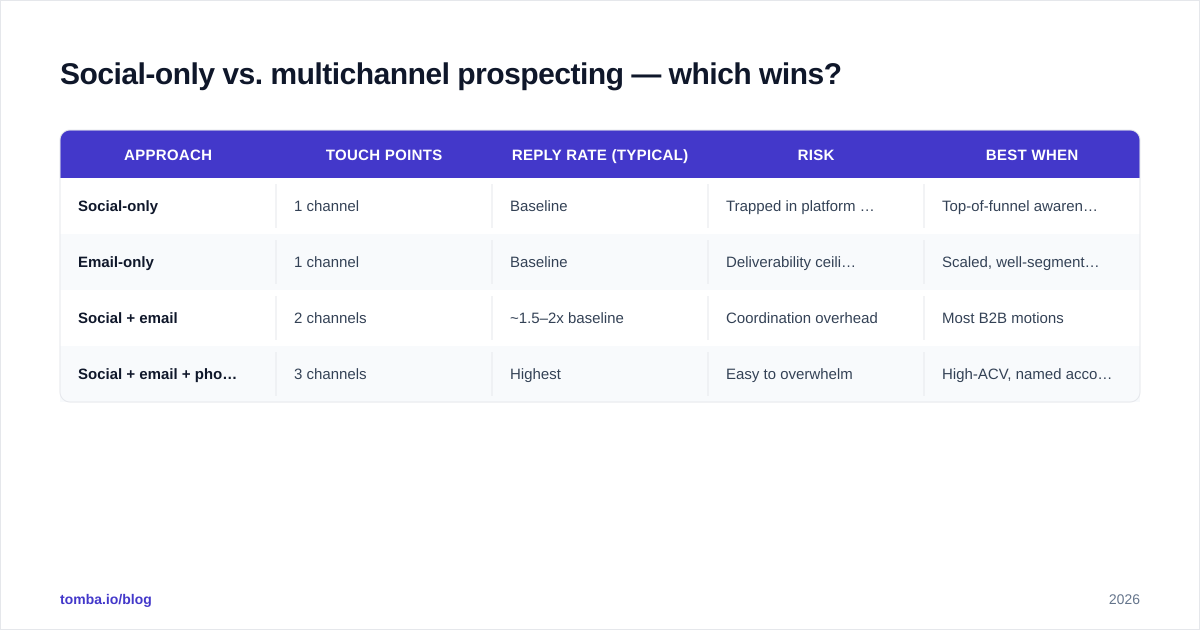
Multichannel wins, and it isn't close — but only when the channels reinforce each other instead of repeating the same message in three places.
The logic is simple: a buyer who sees a thoughtful comment from you, then gets a relevant email, then a well-timed call, experiences a person who keeps showing up usefully. A buyer who gets the identical pitch on LinkedIn, email, and phone in one afternoon experiences a stalker.
| Approach | Touch points | Reply rate (typical) | Risk | Best when |
|---|---|---|---|---|
| Social-only | 1 channel | Baseline | Trapped in platform inbox | Top-of-funnel awareness, warm networks |
| Email-only | 1 channel | Baseline | Deliverability ceiling | Scaled, well-segmented lists |
| Social + email | 2 channels | ~1.5–2x baseline | Coordination overhead | Most B2B motions |
| Social + email + phone | 3 channels | Highest | Easy to overwhelm | High-ACV, named accounts |
To run multichannel you need contact data social platforms don't hand you — verified emails and direct dials. That's the bridge from "I engaged with a profile" to "this is a tracked opportunity." Tomba's data enrichment turns a name and company into a full contact record, and the phone finder adds the direct line for accounts worth a call. According to HubSpot's sales research, reps who personalize and sequence outreach consistently outperform single-channel spray.
What tools do you need (and which are overkill)?#
You need three capabilities, not three dozen subscriptions: signal discovery, contact enrichment, and a place to track the conversation.
- Signal discovery — your platform's native search plus saved searches and alerts. Sales Navigator on LinkedIn earns its price if LinkedIn is your main channel.
- Enrichment and contact finding — to get verified emails and phones off the profile. This is where most social motions leak; fix it first. Tools like G2 let you compare options on real reviews.
- CRM and sequencing — to log every touch and automate the boring follow-ups. Salesforce, HubSpot, or Pipedrive all work; pick the one your team will actually update.
Where teams overspend: stacking five overlapping "AI prospecting" tools that each do a sliver. Where they underspend: data quality. A pretty sequence sent to unverified addresses just trains spam filters to hate you. Keep your sender reputation intact by verifying before you send.
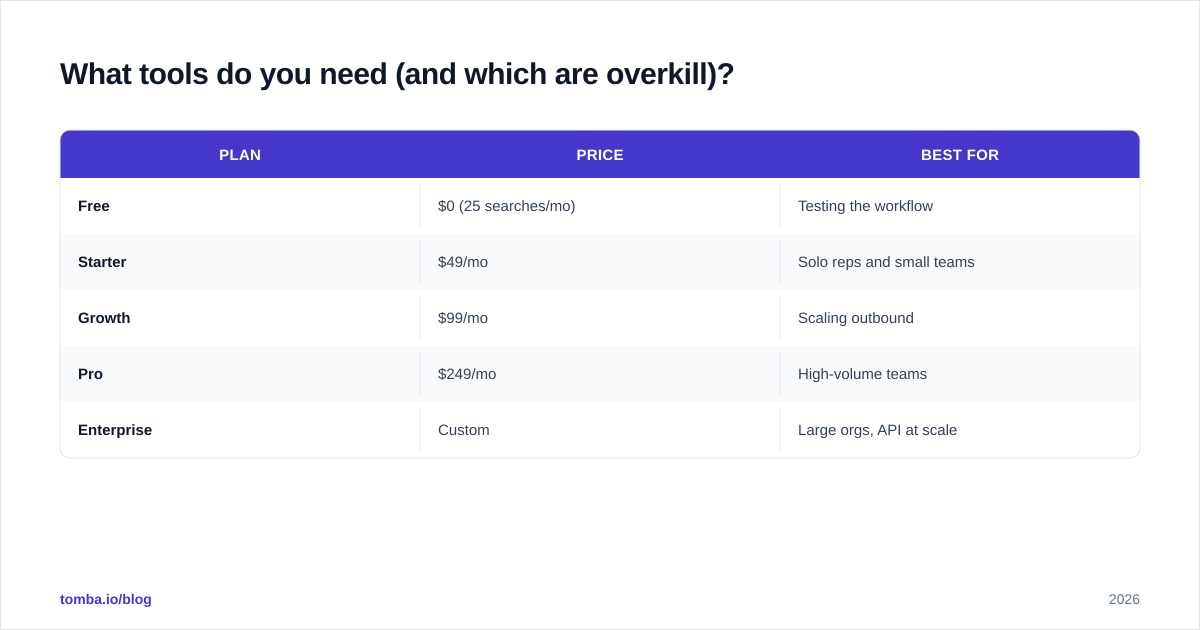
For pricing, here's where a focused tool like Tomba sits so you can sanity-check what you're paying elsewhere:
| Plan | Price | Best for |
|---|---|---|
| Free | $0 (25 searches/mo) | Testing the workflow |
| Starter | $49/mo | Solo reps and small teams |
| Growth | $99/mo | Scaling outbound |
| Pro | $249/mo | High-volume teams |
| Enterprise | Custom | Large orgs, API at scale |
Full Tomba pricing is per-search rather than per-seat, which tends to favor lean teams running targeted motions over bloated all-in-one suites.
How do you measure if it's working?#
Track the funnel, not the vanity metrics. Likes and impressions feel good and predict nothing.
The numbers that matter, stage by stage:
- Connection/accept rate — is your targeting and first-line hook landing?
- Reply rate — is your message relevant? Segment by trigger type to see what works.
- Meeting-booked rate — is your ask sized right?
- Opportunity and win rate — the only metrics finance cares about.
- Time-to-first-touch after a trigger — speed correlates directly with reply rate.
Review weekly, cut what underperforms, and resist the urge to scale a motion before the small version converts. Prospecting that doesn't book meetings at 20 touches won't magically work at 2,000 — it'll just burn your accounts faster.
Putting it together#
Social media prospecting in 2026 rewards the same thing it always did, just more strictly: relevance at the right moment. Pick the two channels where your buyers actually are. Build lists from signals, not titles. Write DMs a human would answer. Then move every promising thread off the platform and into a sequence you control, backed by verified contact data so nothing leaks and nothing bounces.
The platforms give you the signal and the first hello. They don't give you the email, the phone number, or the CRM record — and those are what turn a nice conversation into closed revenue.
That's the gap Tomba Email Finder closes. Spot a buyer on LinkedIn or X, run the profile, and get a verified work email in seconds so your warm social touch becomes a trackable, sequenced opportunity instead of a message lost in a platform inbox. Start free with 25 searches a month, and only scale up once the motion is converting. Find the people, verify the data, and let your reps spend their time talking to buyers who are actually ready.
// get started
Find, verify and enrich your first contacts today
Start on the free plan with 25 searches a month, then scale when your team is ready.
Free plan · No credit card required · GDPR & CCPA
// about the author