Personalization Signals: The 2026 Outbound Sales Playbook
Generic outreach is dead. Learn how to find, prioritize, and act on personalization signals that actually book meetings in 2026 — with a repeatable framework.
TL;DR
- Personalization signals are observable, time-sensitive facts about a prospect or account — a new hire, a funding round, a tech-stack change — that give you a credible reason to reach out right now.
- "Mail-merge personalization" (
Hi {FirstName}, I saw you work at {Company}) is not personalization. Buyers ignore it. Signals are the difference between relevance and noise. - The best-performing outbound teams in 2026 run on a signal stack: identify the trigger, enrich the contact, score urgency, then write one line that proves you noticed.
- You can source most signals for free or cheaply: job boards, LinkedIn, funding databases, press releases, website tech detection, and visitor de-anonymization.
- This guide gives you a 5-step framework, a comparison of signal types by effort and payoff, and the tooling to operationalize it.
What are personalization signals?#
A personalization signal is a specific, observable event or attribute that tells you a prospect is more likely to need what you sell — and gives you a non-creepy reason to start a conversation. Think of it like fishing: spray-and-pray casts a net over empty water, while a signal is the splash that tells you exactly where the fish are biting.
Contrast two opening lines:
- Generic: "Hi Sarah, I wanted to reach out about our sales platform."
- Signal-based: "Hi Sarah — congrats on the VP Sales role you started last month. Most new VPs spend week one auditing pipeline data quality. Curious how yours looks."
The second one works because it's anchored to a real event (a job change), it's timely, and it connects the event to a problem you solve. That's the entire game.
Signals fall into three broad buckets:
- Person-level signals — job changes, promotions, new responsibilities, content they published, conference talks.
- Company-level signals — funding, hiring sprees, leadership changes, M&A, expansion into new markets, layoffs.
- Behavioral/intent signals — website visits, content downloads, review-site research, tech-stack adoption, ad engagement.
The strongest outreach stacks two signals together: a company-level trigger ("they just raised a Series B") plus a person-level fit ("and you own the budget for tooling"). When both line up, your timing is no longer a guess.
Why does mail-merge personalization stop working in 2026?#
Because buyers have seen it ten thousand times. Inserting {FirstName} and {Company} was a competitive edge in 2015. By 2026 every sequencing tool does it by default, every inbox is saturated, and reply rates on token-only personalization have collapsed. According to HubSpot's sales research, relevance and timing now beat volume — and inbox providers increasingly penalize low-engagement bulk sends, which means generic blasts also hurt your email deliverability.
Signals fix three problems at once:
- Relevance — you reference something true and specific, so the prospect believes the email was written for them.
- Timing — events have a window. A new VP is most reachable in their first 90 days; a freshly funded company is buying in the next two quarters.
- Deliverability — better-targeted sends get higher reply rates, which protects your sender reputation and keeps you out of spam.
The catch: signal-based outbound takes more work per prospect. The trick is to make the sourcing of signals systematic so the human effort goes into the message, not the research.
What types of personalization signals should you track?#
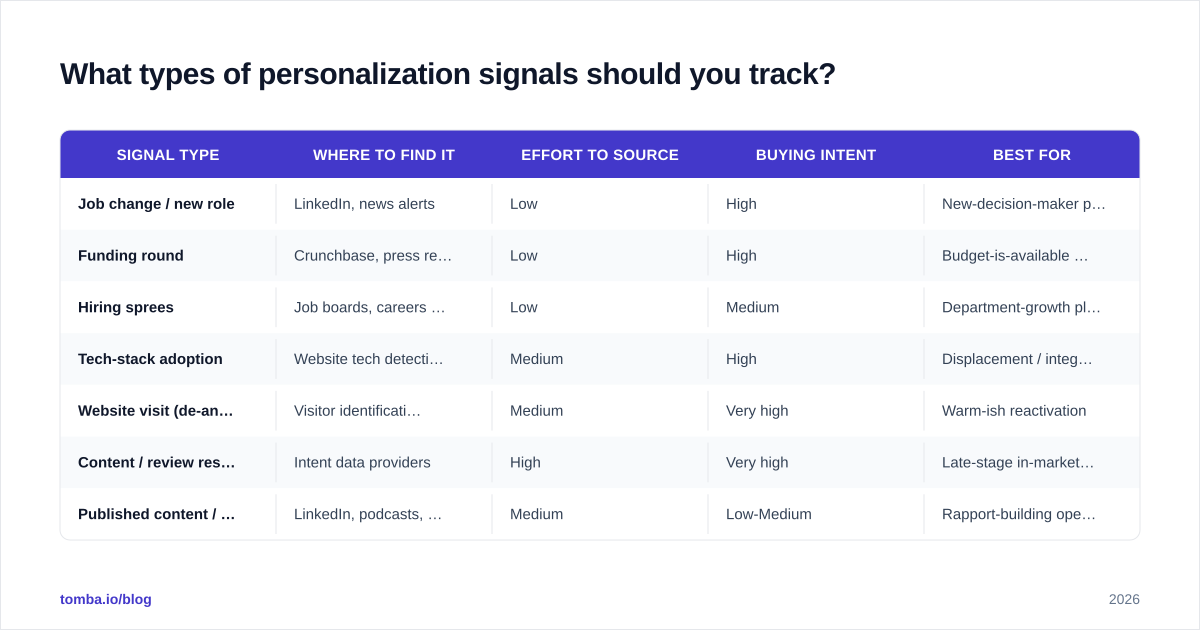
Not all signals are equal. Some are easy to find but weak; others are strong but require tooling. Here's how the common ones stack up.
| Signal type | Where to find it | Effort to source | Buying intent | Best for |
|---|---|---|---|---|
| Job change / new role | LinkedIn, news alerts | Low | High | New-decision-maker plays |
| Funding round | Crunchbase, press releases | Low | High | Budget-is-available plays |
| Hiring sprees | Job boards, careers page | Low | Medium | Department-growth plays |
| Tech-stack adoption | Website tech detection | Medium | High | Displacement / integration plays |
| Website visit (de-anon) | Visitor identification | Medium | Very high | Warm-ish reactivation |
| Content / review research | Intent data providers | High | Very high | Late-stage in-market accounts |
| Published content / talks | LinkedIn, podcasts, blogs | Medium | Low-Medium | Rapport-building openers |
A practical rule: combine one high-intent signal with one easy-to-source signal. For example, a hiring spree (easy) tells you a team is scaling; pairing it with the hiring manager's recent LinkedIn post (rapport) gives you both a reason and an angle.
If you want a deeper taxonomy of how intent data feeds the funnel, the analyst framing from Gartner's sales research is a useful neutral reference for how buying groups actually form.
How do you turn a signal into a contact you can actually reach?#
A signal is useless if you can't email the right person. This is the operational gap most teams hit: they find a great trigger, then waste an hour hunting for a valid email. Sourcing and contact-data need to be a single pipe.
The repeatable flow:
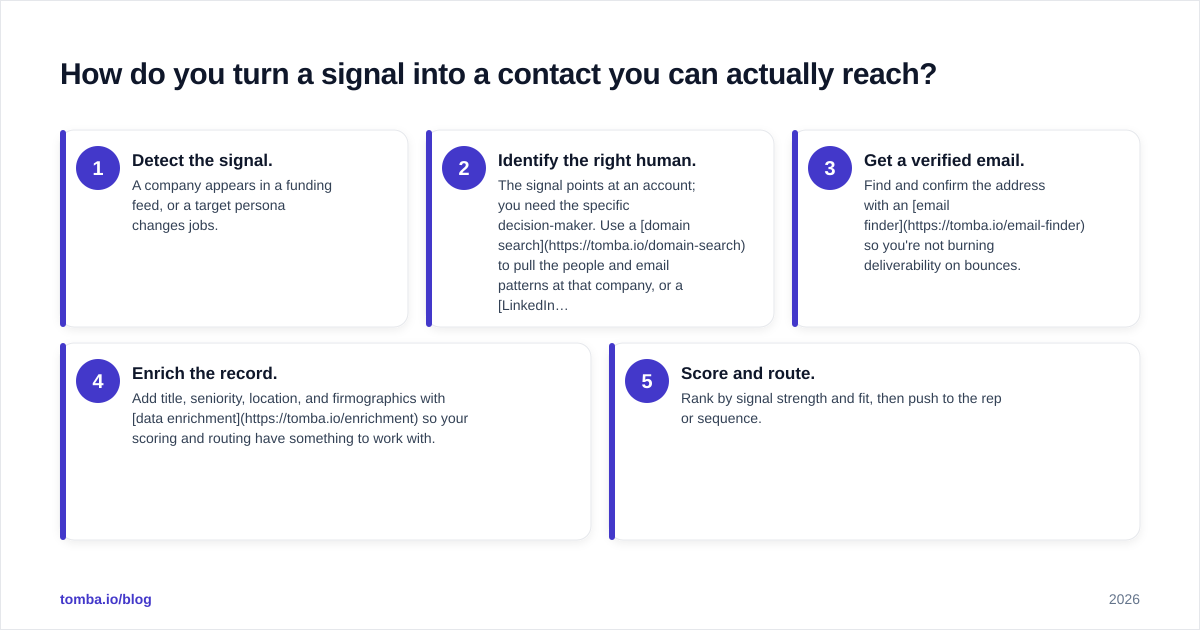
- Detect the signal. A company appears in a funding feed, or a target persona changes jobs.
- Identify the right human. The signal points at an account; you need the specific decision-maker. Use a domain search to pull the people and email patterns at that company, or a LinkedIn finder to convert a profile into a work email.
- Get a verified email. Find and confirm the address with an email finder so you're not burning deliverability on bounces.
- Enrich the record. Add title, seniority, location, and firmographics with data enrichment so your scoring and routing have something to work with.
- Score and route. Rank by signal strength and fit, then push to the rep or sequence.
When a signal is "someone hit your pricing page but didn't fill out a form," start one step earlier with website visitor reveal to de-anonymize the traffic, then run the same enrichment chain. And when all you have is an email address from a list and you need the human behind it, a reverse email lookup closes the gap.
What does a signal-based outbound framework look like end to end?#
Here's the five-step framework the best teams run. Call it Detect → Enrich → Score → Personalize → Send.
Step 1: Detect#
Set up signal feeds before you need them. Cheap, high-yield sources:
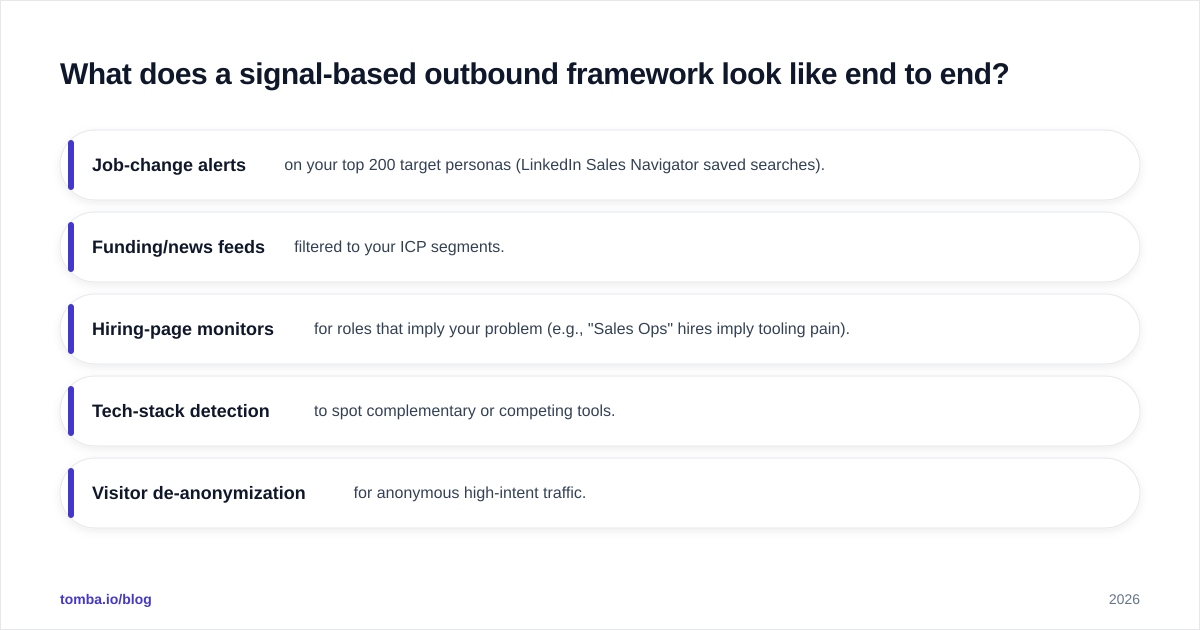
- Job-change alerts on your top 200 target personas (LinkedIn Sales Navigator saved searches).
- Funding/news feeds filtered to your ICP segments.
- Hiring-page monitors for roles that imply your problem (e.g., "Sales Ops" hires imply tooling pain).
- Tech-stack detection to spot complementary or competing tools.
- Visitor de-anonymization for anonymous high-intent traffic.
Step 2: Enrich#
Convert the account-level signal into a complete, reachable contact record: name, verified work email, title, seniority, and phone where relevant. This is where a bulk email finder earns its keep — you can process a whole batch of newly-funded companies in one pass instead of one-off lookups.
Step 3: Score#
Rank by two axes: signal strength (how clearly it implies a need) and fit (how well the account matches your ICP). A simple 1–3 score on each, multiplied, gives you a clean priority queue. Don't overthink it; the goal is to stop reps from treating a "visited pricing page" lead the same as a "downloaded a blog post six months ago" lead.
Step 4: Personalize#
Write one line that proves you noticed the signal, then pivot to the prospect's likely problem. The structure:
[Specific observation about the signal] + [the problem it usually creates] + [a low-friction question].
Resist the urge to write three personalized paragraphs. One credible line beats a wall of flattery. The signal does the heavy lifting.
Step 5: Send#
Sequence with restraint. Signal-based outreach has a shorter shelf life — a job-change angle is stale after 90 days — so your cadence should be tighter and your follow-ups should reference the same signal, not pile on new pitches. Track response rate per signal type so you learn which triggers actually convert for your motion.
Signal-based vs. volume-based outbound: which wins?#
Neither is universally right — it depends on deal size and list size. But the trend line is clear.
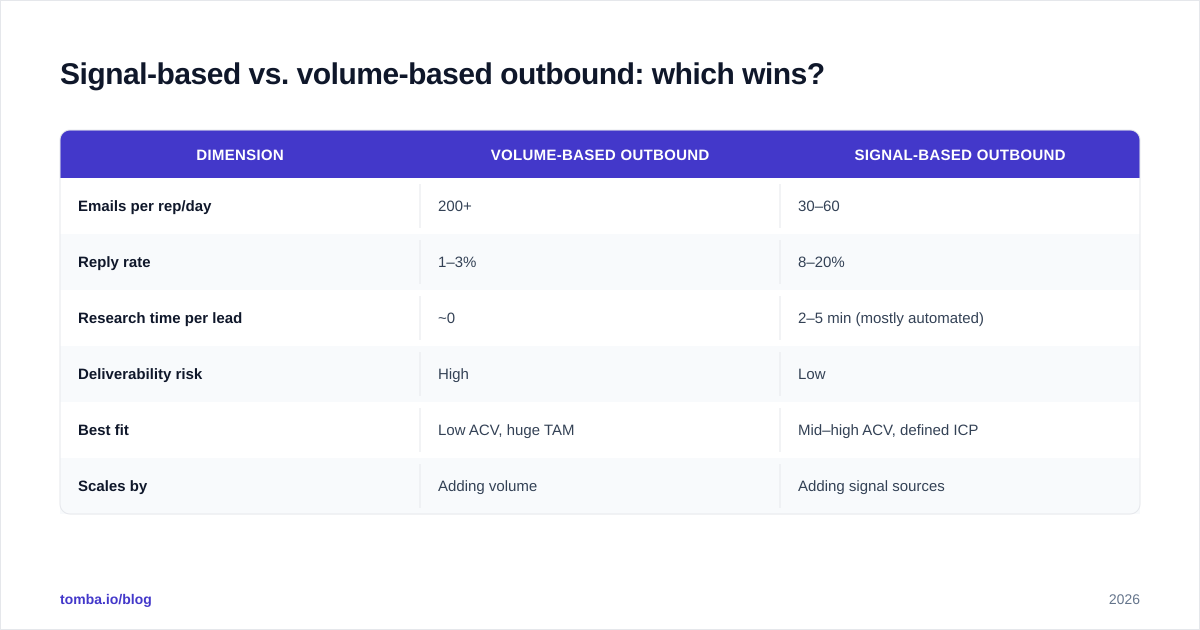
| Dimension | Volume-based outbound | Signal-based outbound |
|---|---|---|
| Emails per rep/day | 200+ | 30–60 |
| Reply rate | 1–3% | 8–20% |
| Research time per lead | ~0 | 2–5 min (mostly automated) |
| Deliverability risk | High | Low |
| Best fit | Low ACV, huge TAM | Mid–high ACV, defined ICP |
| Scales by | Adding volume | Adding signal sources |
The mistake teams make is treating these as opposites. In practice you want signal-based prioritization layered on top of efficient sourcing. Tools handle the boring part (finding and verifying contacts at scale); humans handle the part that converts (the one observed line). For most B2B teams selling above roughly $5K ACV, signal-based wins on every metric that matters except raw activity count — and activity count is a vanity metric.
For an outside read on tooling categories that surface these signals, browse the neutral user reviews on G2's sales intelligence category. It's a good sanity check against vendor claims.
How do you avoid being creepy with signals?#
There's a line between "relevant" and "I'm being watched." Stay on the right side of it:
- Use signals that are public and professional. Job changes, funding, conference talks, public posts — fine. Personal life details scraped from social media — not fine.
- Reference the implication, not the surveillance. Say "congrats on the new role" not "I saw you changed your LinkedIn headline at 9:42pm Tuesday."
- Lead with their problem, not your product. The signal earns you attention; the problem earns you a reply.
- One signal per message. Stacking three observations reads like a dossier.
Done well, signal-based outreach feels like a well-timed introduction from a mutual connection. Done badly, it feels like a stalker with a CRM. The framework above keeps you on the right side because it routes every signal through a problem before it becomes a message.
Build your signal stack with Tomba#
Signals tell you who to contact and when — but you still need verified, reachable contact data to act on them, and you need it fast enough to hit the timing window. That's exactly what the Tomba Email Finder is built for: turn a company, a name, or a LinkedIn profile into a verified work email in seconds, enrich it with title and firmographics, and feed it straight into your sequence. Start free with 25 searches a month, then scale on the Starter plan at $49/mo as your signal sources grow — see full Tomba pricing for Growth and Pro tiers. Stop spraying. Start reaching the right person at the right moment.
Ready to find emails that actually work?
Join 150,000+ professionals who stopped guessing and started sending. Free credits on signup — no credit card required.
Get the Tomba newsletter
Practical outbound tactics and product updates — once every two weeks.
About the author