Sales Sequences and Cadence: The 2026 Outbound Playbook
A single cold email almost never lands a meeting. This guide breaks down how to build sales sequences and cadence that actually convert in 2026 — channel mix, timing, and the metrics that matter.
TL;DR
- A sequence is the ordered set of touches you send one prospect; a cadence is the timing and channel rhythm that governs those touches. You need both.
- One-touch outbound is dead. High-performing teams run 8–12 touches across email, phone, and LinkedIn over 2–4 weeks.
- Timing beats volume: spacing touches 2–3 business days apart and mixing channels lifts reply rates more than simply sending more email.
- Your sequence is only as good as your data — bad contact records sink even a perfect cadence. Verify before you send.
- Measure per-step reply, positive-reply, and meeting-booked rates, then cut the steps that only generate opt-outs.
What is the difference between a sales sequence and a cadence?#
A sequence is what you send; a cadence is when and how you send it. Think of it like a fitness plan. The sequence is the list of exercises — push-ups, squats, a run. The cadence is the schedule: which days, how much rest between sets, how hard you push each session. Run the right exercises on a broken schedule and you burn out; run a perfect schedule with no exercises and nothing happens.
In outbound terms, the sequence is the ordered series of touchpoints aimed at a single prospect — email 1, a LinkedIn view, a call, email 2, and so on. The cadence is the timing and channel logic wrapped around those steps: the gaps between touches, the order of channels, and the rules for when a prospect exits.
Most reps obsess over copy and ignore cadence. That is backwards. You can have a brilliant first line, but if it arrives as a lone email into a busy inbox on a Friday afternoon, it dies. The cadence is what gives your message enough surface area to get noticed.
Why does a single cold email almost never work?#
Because buyers are buried. The average B2B decision-maker gets dozens of cold emails a week and ignores most of them on reflex. A single send has to win attention, build relevance, and earn a reply all in one shot — and it usually does none of those.
Multi-touch sequences win because they compound. Touch one creates faint recognition. Touch three — maybe a call referencing your earlier note — converts that recognition into "I've seen this name before." By touch six or seven, you have moved from cold stranger to familiar pattern. That familiarity is what unlocks replies.
The data backs the intuition: outbound teams that run structured multi-step cadences consistently report higher reply and meeting rates than teams blasting one-and-done emails. Persistence, spaced intelligently, is the single biggest lever most teams are not pulling.
What does a high-performing sales cadence look like in 2026?#
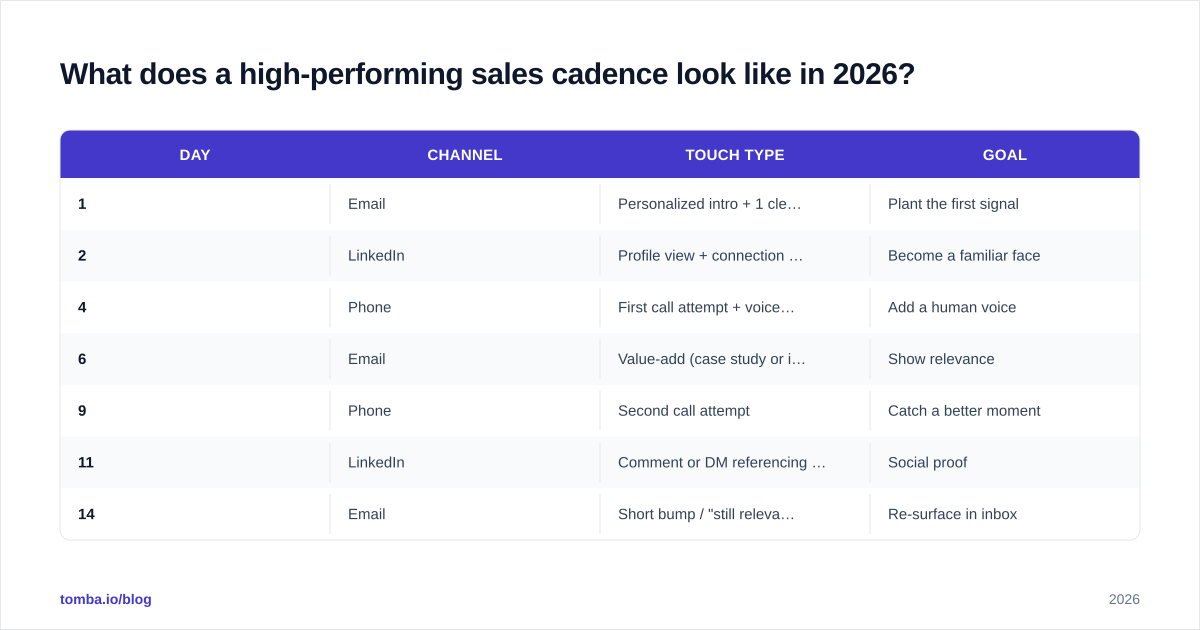
A modern cadence blends three channels — email, phone, and social — across 8 to 12 touches spread over two to four weeks. The exact mix depends on your motion (SMB vs. enterprise) and your data quality, but the skeleton is remarkably consistent across top teams.
Here is a proven 12-touch, 18-business-day cadence you can adapt:
| Day | Channel | Touch type | Goal |
|---|---|---|---|
| 1 | Personalized intro + 1 clear ask | Plant the first signal | |
| 2 | Profile view + connection request | Become a familiar face | |
| 4 | Phone | First call attempt + voicemail | Add a human voice |
| 6 | Value-add (case study or insight) | Show relevance | |
| 9 | Phone | Second call attempt | Catch a better moment |
| 11 | Comment or DM referencing a trigger | Social proof | |
| 14 | Short bump / "still relevant?" | Re-surface in inbox | |
| 18 | Breakup email | Trigger loss aversion |
Notice the rhythm: never two of the same channel back to back, never two touches in one day, and a deliberate breakup at the end. The breakup email — "I'll assume the timing isn't right and close your file" — routinely outperforms earlier sends because it triggers loss aversion.
How many touches and how much spacing is right?#
Aim for 8–12 touches spaced 2–3 business days apart. Fewer than six and you quit before familiarity kicks in; more than fourteen and you cross from persistent into annoying, driving spam complaints that hurt your email deliverability.
Spacing is where most cadences break. Cramming touches into consecutive days reads as desperation and burns the prospect out. Spreading them too thin — a touch every ten days — means the prospect forgets you between sends, so you never compound. Two to three business days is the sweet spot: close enough to build recognition, far enough to feel deliberate rather than automated.
Channel order matters as much as spacing. Lead with email to establish context, layer in a LinkedIn touch to put a face to the name, then call once the prospect has seen you twice. A cold call into someone who has never heard of you converts far worse than the same call after two soft digital touches.
Which channels belong in your outbound mix?#
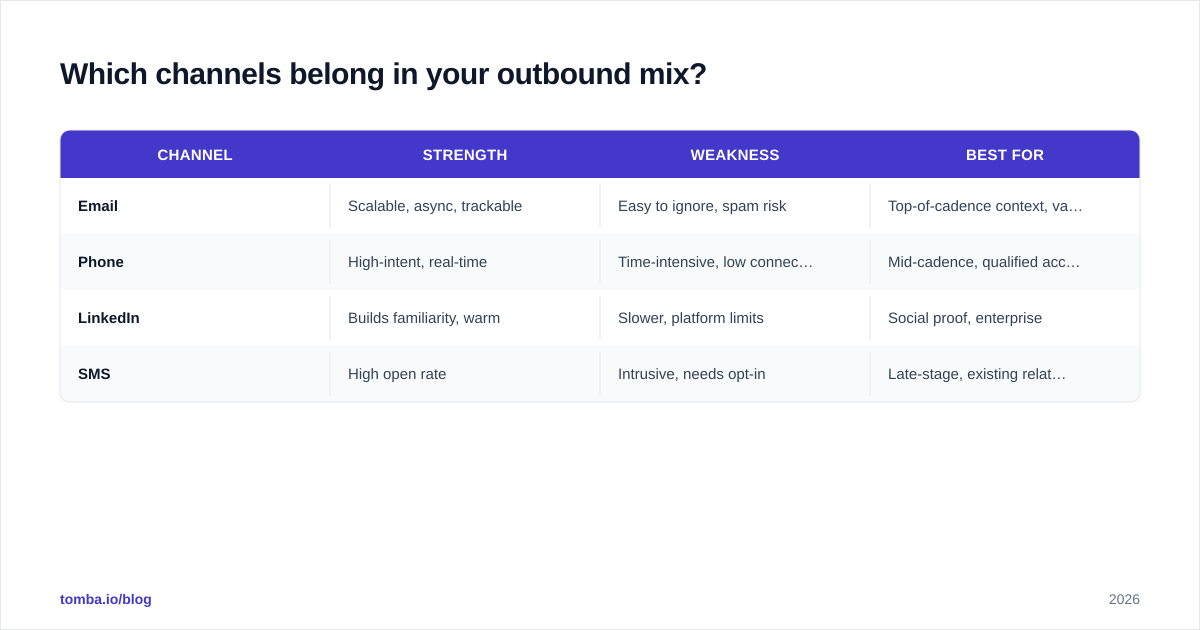
Email, phone, and LinkedIn are the core three — but the weighting shifts by segment. SMB motions lean email-heavy because volume matters; enterprise motions lean on phone and social because each account is worth more personalization. A quick comparison:
| Channel | Strength | Weakness | Best for |
|---|---|---|---|
| Scalable, async, trackable | Easy to ignore, spam risk | Top-of-cadence context, value-adds | |
| Phone | High-intent, real-time | Time-intensive, low connect rate | Mid-cadence, qualified accounts |
| Builds familiarity, warm | Slower, platform limits | Social proof, enterprise | |
| SMS | High open rate | Intrusive, needs opt-in | Late-stage, existing relationships |
The point of multi-channel is not to be everywhere — it is to surround the prospect with consistent, reinforcing signals. A LinkedIn comment that echoes the angle of your last email makes both touches stronger. For more on the social side, see the mechanics of LinkedIn outreach and how it slots into a broader sales automation workflow.

How does data quality decide whether your cadence works?#
Your cadence is only as good as the contacts feeding it. A flawless 12-touch sequence aimed at a bounced email or a wrong phone number generates exactly zero meetings — and worse, a wave of bounces tanks your sender reputation and pushes future sends into spam.
This is the step teams skip, and it quietly kills more outbound than bad copy ever does. Before a single prospect enters a cadence, you need accurate, verified contact data: a real email, a real direct dial, the right title. Garbage in, no meetings out.
Build verification into your pipeline:
- Use an email finder to source professional addresses by name and domain instead of guessing patterns.
- Run every address through an email verifier before the first send to strip bounces and protect deliverability.
- Pull B2B phone numbers so your call steps actually connect instead of dialing dead lines.
- Enrich thin records with titles and company data so personalization tokens never render blank.
Clean data does not just prevent bounces — it raises the ceiling on every other lever. Better targeting means more relevant messaging, which means higher response rate at every step of the cadence.
What tools run sales sequences and cadences?#
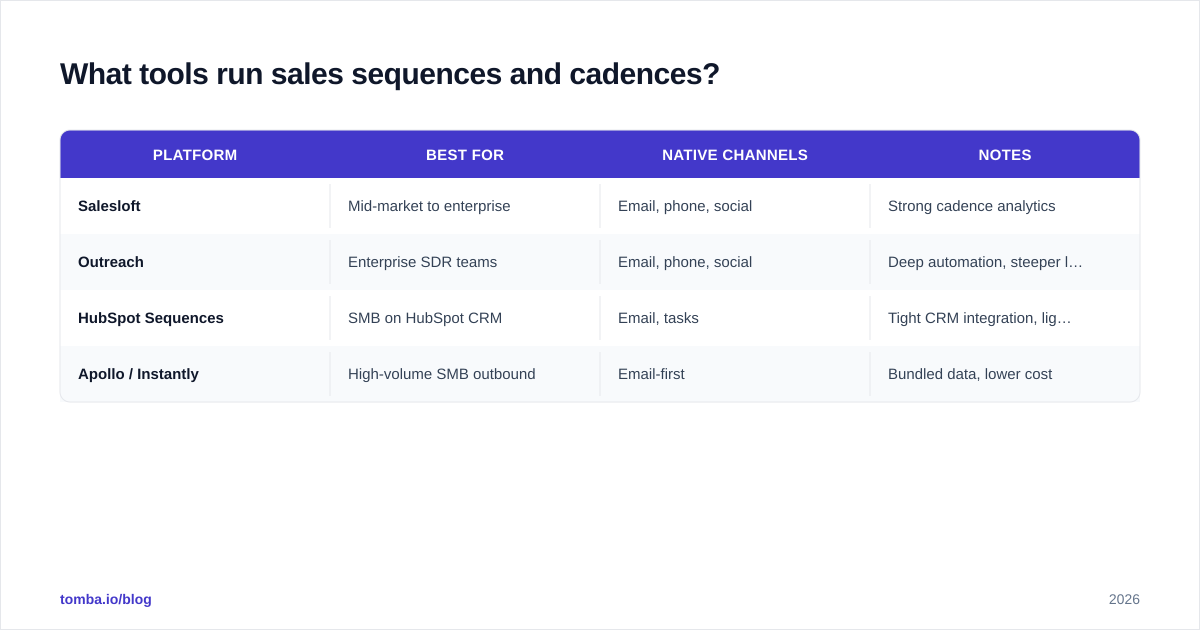
Most teams run cadences through a sales engagement platform layered on top of their CRM. The big three — Salesloft, Outreach, and HubSpot Sequences — all automate step timing, multi-channel touches, and reply tracking. Your choice usually comes down to CRM fit and budget.
| Platform | Best for | Native channels | Notes |
|---|---|---|---|
| Salesloft | Mid-market to enterprise | Email, phone, social | Strong cadence analytics |
| Outreach | Enterprise SDR teams | Email, phone, social | Deep automation, steeper learning curve |
| HubSpot Sequences | SMB on HubSpot CRM | Email, tasks | Tight CRM integration, lighter calling |
| Apollo / Instantly | High-volume SMB outbound | Email-first | Bundled data, lower cost |
Whatever platform you pick, feed it verified data from a dedicated source rather than relying on bundled databases that go stale. You can compare engagement platforms on G2 before committing, and you can wire a data layer in through the HubSpot integration or Salesforce integration so enriched contacts flow straight into your cadences.
What metrics tell you a cadence is working?#
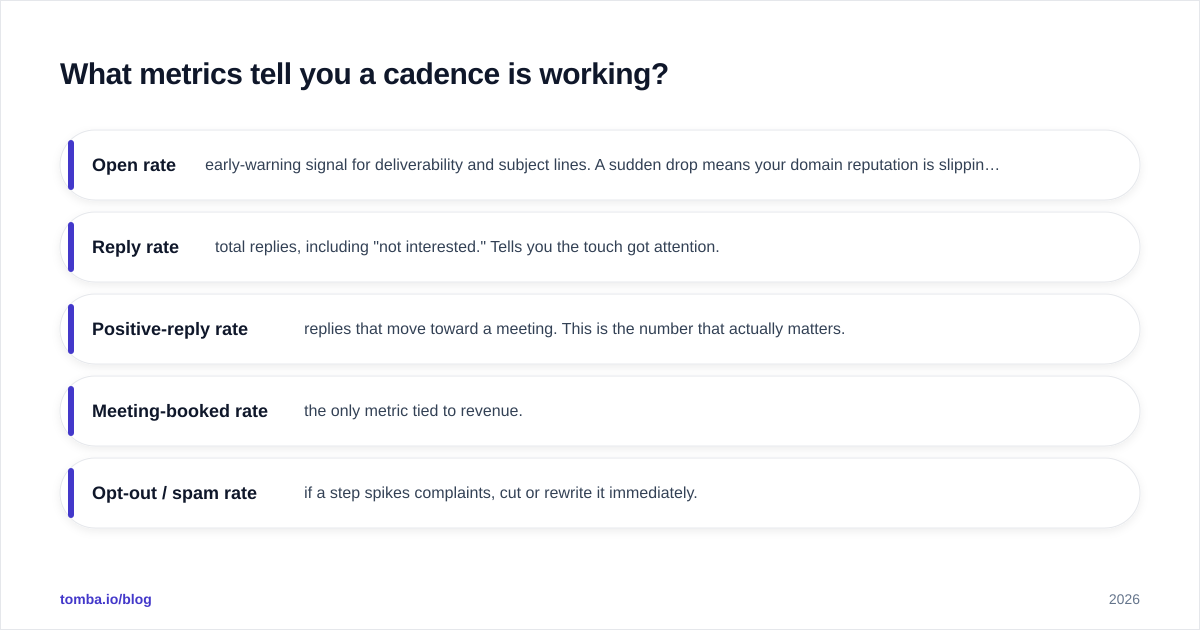
Track reply rate, positive-reply rate, and meetings booked at the step level — not just the campaign average. A campaign-wide reply rate hides which touches pull their weight and which only generate opt-outs.
Watch these per step:
- Open rate — early-warning signal for deliverability and subject lines. A sudden drop means your domain reputation is slipping.
- Reply rate — total replies, including "not interested." Tells you the touch got attention.
- Positive-reply rate — replies that move toward a meeting. This is the number that actually matters.
- Meeting-booked rate — the only metric tied to revenue.
- Opt-out / spam rate — if a step spikes complaints, cut or rewrite it immediately.
The discipline is ruthless pruning. If step 7 generates nothing but unsubscribes, kill it. If your breakup email outperforms touch 4, move that energy earlier. A cadence is a living system you optimize touch by touch, not a template you set and forget. Pair this with a healthy sender setup — warm domains, clean lists, and SPF records — so your metrics reflect message quality, not inbox placement problems.
How do you build your first cadence this week?#
Start small and structured. Pick one ICP segment, build a single 8-touch cadence across email, phone, and LinkedIn, and verify every contact before launch. Run it for two weeks, read the per-step data, then iterate. Do not try to perfect twelve touches and five channels on day one — you will never ship.
The sequence is half the battle. The other half is the data underneath it, and that is where most outbound quietly fails. Source verified emails, real direct dials, and enriched records with the Tomba Email Finder, feed them into your cadence, and let consistent multi-touch outreach do what a single cold email never could. Check the Tomba pricing — a free tier with 25 searches a month lets you test the data quality before you commit a cent. Build the cadence, clean the data, and start booking meetings.
Ready to find emails that actually work?
Join 150,000+ professionals who stopped guessing and started sending. Free credits on signup — no credit card required.
Get the Tomba newsletter
Practical outbound tactics and product updates — once every two weeks.
About the author