Outbound Sales Strategy Planning: The 2026 Playbook
A step-by-step framework for building an outbound sales strategy in 2026 — from ICP and data sourcing to channel mix, cadences, and the metrics that prove it works.
Outbound sales still works in 2026 — but only when it is planned like a system, not improvised like a series of one-off campaigns. The teams hitting quota are not the ones sending the most emails. They are the ones who decided, in advance, exactly who to contact, with what message, on which channels, in what sequence, and how they would measure whether any of it was working.
This guide walks through that planning process end to end.
TL;DR#
- An outbound sales strategy is a documented plan for proactively reaching prospects who have not raised their hand — covering target accounts, data, messaging, channels, cadence, and metrics.
- Start with the ICP and a tight account list, not with tooling. The wrong list makes even perfect copy fail.
- Data quality is the silent killer. Bounced or stale contacts wreck deliverability and skew every downstream metric — verify before you send.
- Multichannel beats email-only. A coordinated mix of email, phone, and LinkedIn lifts reply rates without raising volume.
- Plan the metrics before launch. Reply rate, positive reply rate, meetings booked, and pipeline created tell you what to fix and when.
What is an outbound sales strategy?#
An outbound sales strategy is the plan that governs how your team initiates contact with prospects who have not previously engaged with you. Inbound waits for buyers to come to you; outbound goes and finds them.
Think of it like fishing. Inbound is dropping a baited line in a stocked pond and waiting. Outbound is studying the water, choosing the spot, picking the right lure for the species you want, and casting deliberately. You can catch fish either way — but outbound only works if you know where the fish are and what they bite.
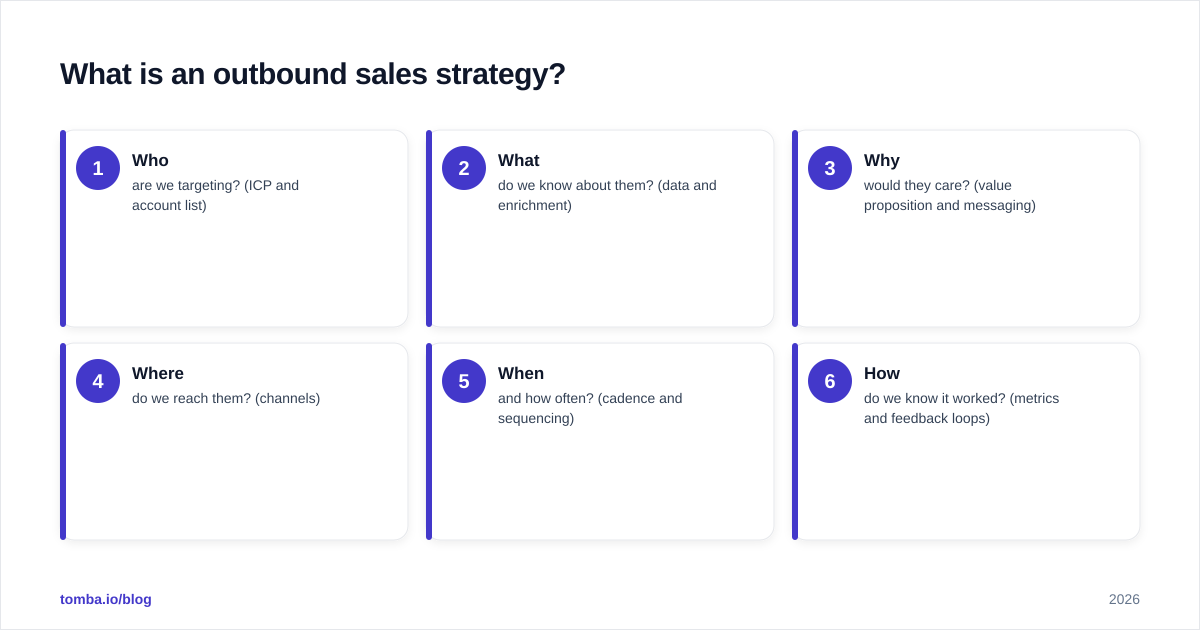
Technically, an outbound strategy answers six questions in writing:
- Who are we targeting? (ICP and account list)
- What do we know about them? (data and enrichment)
- Why would they care? (value proposition and messaging)
- Where do we reach them? (channels)
- When and how often? (cadence and sequencing)
- How do we know it worked? (metrics and feedback loops)
Skip any one of these and the others compensate poorly. Most failed outbound programs are not a copywriting problem — they are a planning problem.
How do you define your ICP and target account list?#
Conclusion first: your Ideal Customer Profile (ICP) is the highest-leverage decision in the entire plan, because everything downstream inherits its quality.
An ICP is not a buyer persona. A persona describes a person ("VP of Sales, 40s, hates manual data entry"). An ICP describes the account worth pursuing — the firmographic and behavioral signals that predict a closed deal.
Build it from your own data, not from aspiration. Pull your last 20–50 closed-won deals and look for patterns:
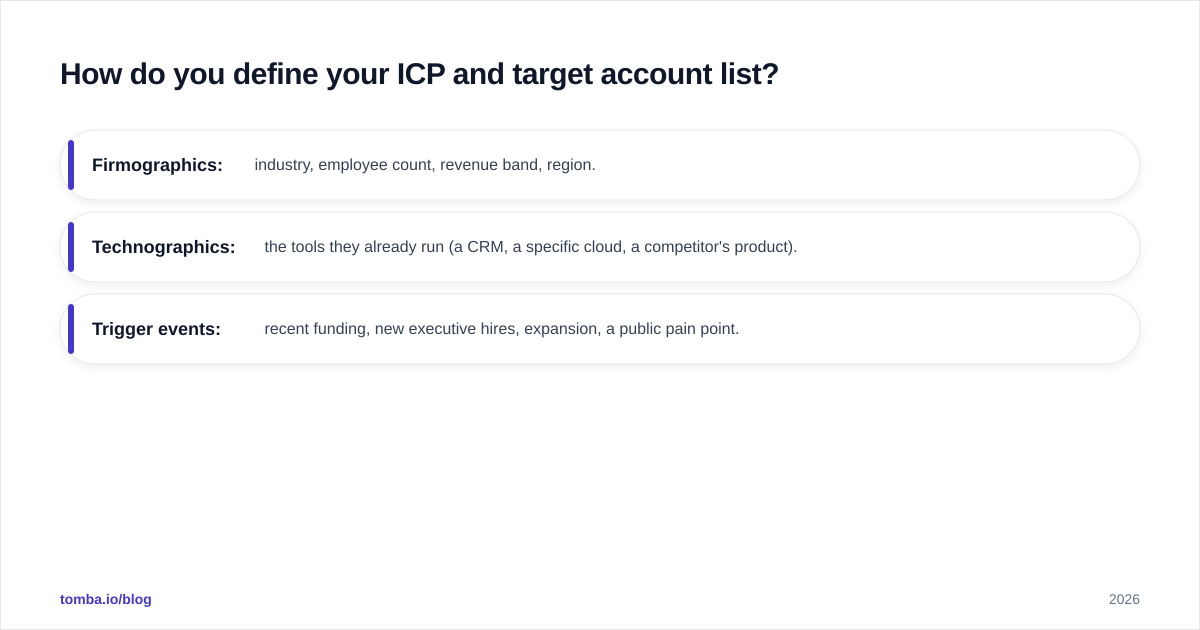
- Firmographics: industry, employee count, revenue band, region.
- Technographics: the tools they already run (a CRM, a specific cloud, a competitor's product).
- Trigger events: recent funding, new executive hires, expansion, a public pain point.
Once the ICP is defined, translate it into a finite, named account list. "Mid-market SaaS companies in North America" is a market, not a list. "These 480 companies that raised a Series B in the last 12 months and use HubSpot" is a list you can actually work.
Forrester's research on ideal customer profiles consistently shows that tightly-defined targeting outperforms broad reach — fewer accounts, worked harder, beats more accounts worked thinly.
Why does data quality decide whether outbound works?#
Because you cannot contact someone you cannot reach, and you cannot trust a metric built on bad records.
Here is the chain reaction a single batch of stale data sets off:
- You email addresses that no longer exist.
- Hard bounces spike.
- Mailbox providers flag your domain.
- Your sender reputation drops.
- Even your valid emails start landing in spam.
- Reply rates crater — and you blame the copy.
The fix is structural, not heroic. Source accurate contact data, then verify it before it ever enters a sequence.
This is where a bulk email finder and an email verifier earn their keep. You find professional addresses for your target list, confirm they are deliverable, and drop catch-all and risky addresses into a separate, lower-priority track. The goal is a clean list where a bounce is the exception, not the cost of doing business.
A practical rule: if more than 3% of a send hard-bounces, stop the campaign and re-verify. You are damaging deliverability faster than you are booking meetings.
What does a multichannel outbound cadence look like?#
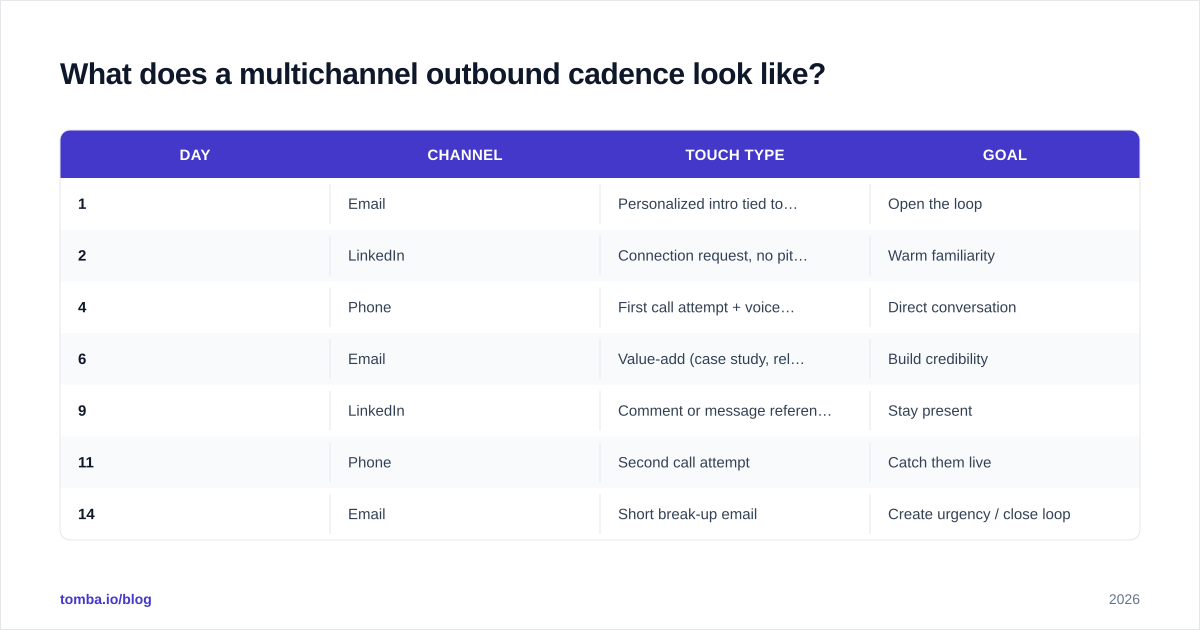
A cadence is the choreographed sequence of touches a prospect receives over a defined window. Single-channel cadences — email only, calls only — leave reply rate on the table. Buyers ignore channels; they respond to relevance, wherever it reaches them.
A balanced 14-day cadence might look like this:
| Day | Channel | Touch type | Goal |
|---|---|---|---|
| 1 | Personalized intro tied to a trigger event | Open the loop | |
| 2 | Connection request, no pitch | Warm familiarity | |
| 4 | Phone | First call attempt + voicemail | Direct conversation |
| 6 | Value-add (case study, relevant insight) | Build credibility | |
| 9 | Comment or message referencing their content | Stay present | |
| 11 | Phone | Second call attempt | Catch them live |
| 14 | Short break-up email | Create urgency / close loop |
Notice the rhythm: no two consecutive touches use the same channel, and every touch has a distinct job. The break-up email on day 14 routinely outperforms earlier sends because it gives the prospect a reason to act now.
For phone-heavy motions, pair this with accurate B2B phone numbers so reps are not burning dials on dead lines. Coordinated LinkedIn outreach works best when the rep has already verified the prospect's role and email, so the messaging stays consistent across channels.

How should you structure the messaging?#
Lead with the prospect's world, not your product. The opening line should prove you did homework; the body should connect a specific pain to a specific outcome; the close should ask for one small, low-friction yes.
A reliable message skeleton:
- Trigger line: "Saw you just opened a second office in Austin —"
- Relevance bridge: "teams scaling that fast usually hit a wall on rep onboarding."
- Proof: "We helped [comparable company] cut ramp time 40%."
- Soft CTA: "Worth a 15-minute look? Open to Thursday?"
Keep emails under 120 words. Write at a sixth-grade reading level. One idea, one ask. If you need a starting point, a library of cold email templates and a subject line generator will get you to a testable first draft faster than a blank page.
The mistake to avoid: personalization theater. Inserting {{first_name}} is not personalization. Referencing the prospect's actual situation is.
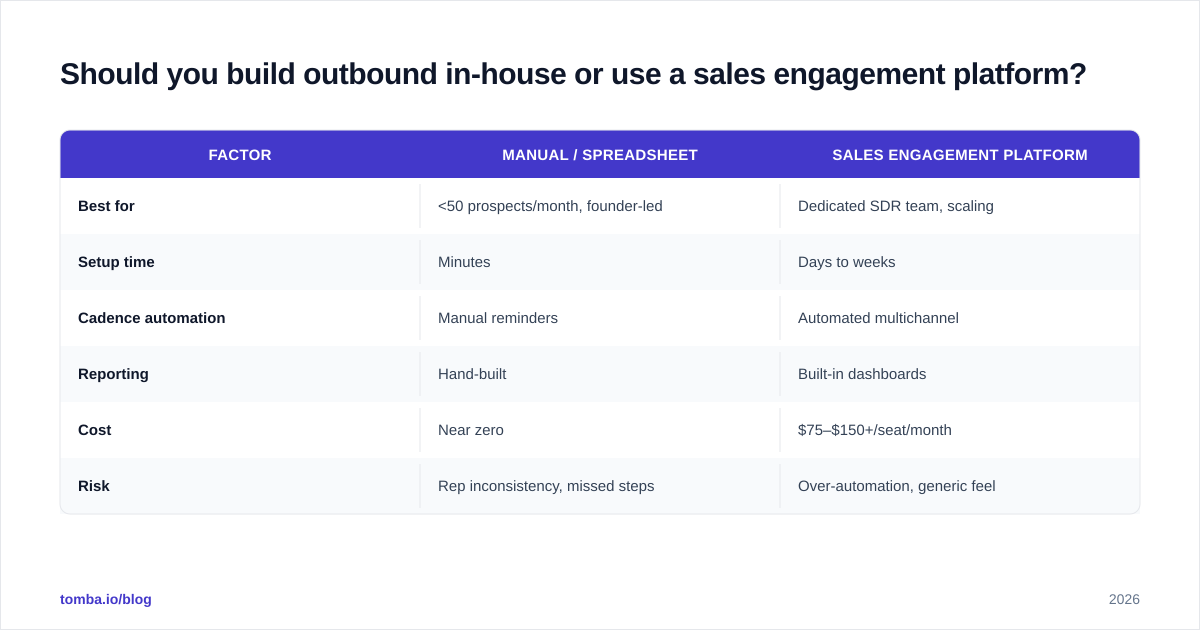
Should you build outbound in-house or use a sales engagement platform?#
It depends on volume and stage. Below is the honest trade-off.
| Factor | Manual / spreadsheet | Sales engagement platform |
|---|---|---|
| Best for | <50 prospects/month, founder-led | Dedicated SDR team, scaling |
| Setup time | Minutes | Days to weeks |
| Cadence automation | Manual reminders | Automated multichannel |
| Reporting | Hand-built | Built-in dashboards |
| Cost | Near zero | $75–$150+/seat/month |
| Risk | Rep inconsistency, missed steps | Over-automation, generic feel |
Most teams graduate from spreadsheets to a platform once they have a repeatable, working cadence — automating a broken process just produces failure faster. Tools like Outreach and Salesloft handle execution; they do not handle strategy or data quality. Those remain your job.
Whatever you choose, the data layer sits underneath all of it. The Tomba API and native HubSpot integration let you feed verified contacts straight into whichever engagement layer you run, so your sequencing tool is never the reason a send bounces.
What metrics prove your outbound strategy is working?#
Plan these before launch, because you cannot improve what you did not instrument.
Track the funnel top to bottom:
- Delivery rate — are emails landing? (Below 95% means a data or deliverability problem.)
- Open rate — directional only in 2026, given privacy changes, but still useful for subject-line A/B tests.
- Reply rate — the first real signal. Aim for 5–10% on a well-targeted list.
- Positive reply rate — replies that want to talk, not opt out. This is the number that predicts pipeline.
- Meetings booked — the conversion that matters to the calendar.
- Pipeline created — the conversion that matters to the CFO.
Review weekly. If reply rate is healthy but meetings are low, the problem is your CTA or qualification. If delivery is low, stop and fix data before anything else. Tie each metric to a single owner so "the numbers are down" always has a next action attached.
HubSpot's sales benchmarks are a reasonable external reference point, but your own trailing 90-day numbers are the only baseline that matters for forecasting.
How do you put the plan into a 30-day launch?#
A strategy that lives in a doc helps no one. Here is a pragmatic rollout.
Week 1 — Foundation. Finalize the ICP, pull the account list, and source contacts. Run every address through verification. Draft your first cadence and three message variants.
Week 2 — Pilot. Launch to a 50-contact subset. Watch delivery and bounce rates obsessively. This week is about catching data and deliverability problems while they are cheap.
Week 3 — Iterate. With pilot replies in hand, kill the weakest message variant and double down on the winner. Adjust cadence timing based on when replies actually arrive.
Week 4 — Scale. Roll the proven cadence to the full list. Lock in your weekly metrics review and assign owners. Now — and only now — consider automating with a sales engagement platform.
Review your Tomba plans against your monthly contact volume so your data budget matches your launch scale rather than capping it.
Common outbound planning mistakes to avoid#
- Building the list last. Tooling and copy get all the attention; targeting decides the outcome.
- Skipping verification to "save time." A bounce-driven reputation hit costs weeks of recovery.
- One channel only. Email-only programs leave the easiest replies uncollected.
- No break-up email. You are abandoning the touch that converts best.
- Vanity metrics. Opens feel good; positive replies and pipeline pay rent.
- Set-and-forget. Outbound decays. A quarterly refresh of the ICP and list is non-negotiable.
Build your outbound on data you can trust#
A great outbound sales strategy is only as good as the contacts feeding it. Before you write a single sequence, make sure every prospect on your list is real, reachable, and current.
Tomba's Email Finder lets you build a clean, verified target list from a name and domain — then push it straight into your CRM or engagement platform through Tomba's integrations. Start free with 25 searches a month, and scale up as your account list grows. Plan the strategy, source the data, and let your reps spend their time on conversations instead of bounces.
// get started
Find, verify and enrich your first contacts today
Start on the free plan with 25 searches a month, then scale when your team is ready.
Free plan · No credit card required · GDPR & CCPA
// about the author