30 60 90 Day Sales Plan: The 2026 Ramp Playbook
A 30 60 90 day sales plan turns your first quarter from a guessing game into a measurable ramp. Here's the framework, the template, and the metrics that actually predict who hits quota.
30 60 90 Day Sales Plan: The 2026 Ramp Playbook
TL;DR
- A 30 60 90 day sales plan is a written ramp contract between a new rep (or newly promoted manager) and their leader, broken into Learn (days 1-30), Apply (days 31-60), and Drive (days 61-90).
- Most reps miss quota because nobody defined what "ramped" looks like. The plan fixes that with named milestones, not vibes.
- For AEs, the realistic benchmark in 2026 is full quota by month 4-6 in SMB, month 6-9 in mid-market, and month 9-12 in enterprise.
- The 60-day window is where most plans break — reps know the product but can't yet predict pipeline. Build it around shadowed-to-solo call ratios.
- Skip the generic Word doc. Tie every milestone to a CRM-visible metric (calls, demos booked, opportunities created, pipeline coverage).
What is a 30 60 90 day sales plan?#
A 30 60 90 day sales plan is a structured roadmap that defines what a new sales hire (or a newly promoted sales leader) will learn, do, and deliver in their first three months on the job. It's split into three 30-day phases — typically labeled Learn, Apply, and Drive — each with explicit milestones, owners, and success metrics.
The plan serves two audiences at once. For the rep, it removes the "what should I be working on?" anxiety that kills the first 90 days. For the manager, it creates a paper trail that makes coaching, course-correction, and (when needed) early termination defensible.
It's also the document that hiring managers ask candidates to present in final-round interviews. A rep who can build a credible 30 60 90 day plan for your specific territory in a 48-hour window is a rep who can build a quarterly territory plan in the job.
Why does every new rep need one in 2026?#
Sales cycles are getting longer. Gartner's latest B2B buying research pegs the average enterprise purchase at 11+ stakeholders and 6-8 months end-to-end. That means a rep who joins in January and "just starts dialing" won't see their first closed deal until summer — by which point their manager has no idea whether they're on track or quietly drowning.
The 30 60 90 day plan compresses that uncertainty. Instead of waiting until day 120 to find out a rep can't run a discovery call, you find out at day 35 when they fail the shadowed-to-solo demo gate. Cheap signal, early.
Three forces make this more important in 2026 than it was five years ago:
- Tool stack complexity. A modern AE touches a CRM, a sequencer, an email finder, a sales engagement tool, a call recorder, a CPQ, and an AI assistant before lunch. "Learn the tools" is no longer an afternoon.
- AI-augmented expectations. Quota assumptions now bake in AI productivity. Reps are expected to be hitting 2024 SDR activity volume in their second month, not their fifth.
- Buyer self-education. Buyers arrive at the first call already 60% through the journey. New reps who can't add expert insight in call one get screened out fast.
What goes in each phase of a 30 60 90 day sales plan?#
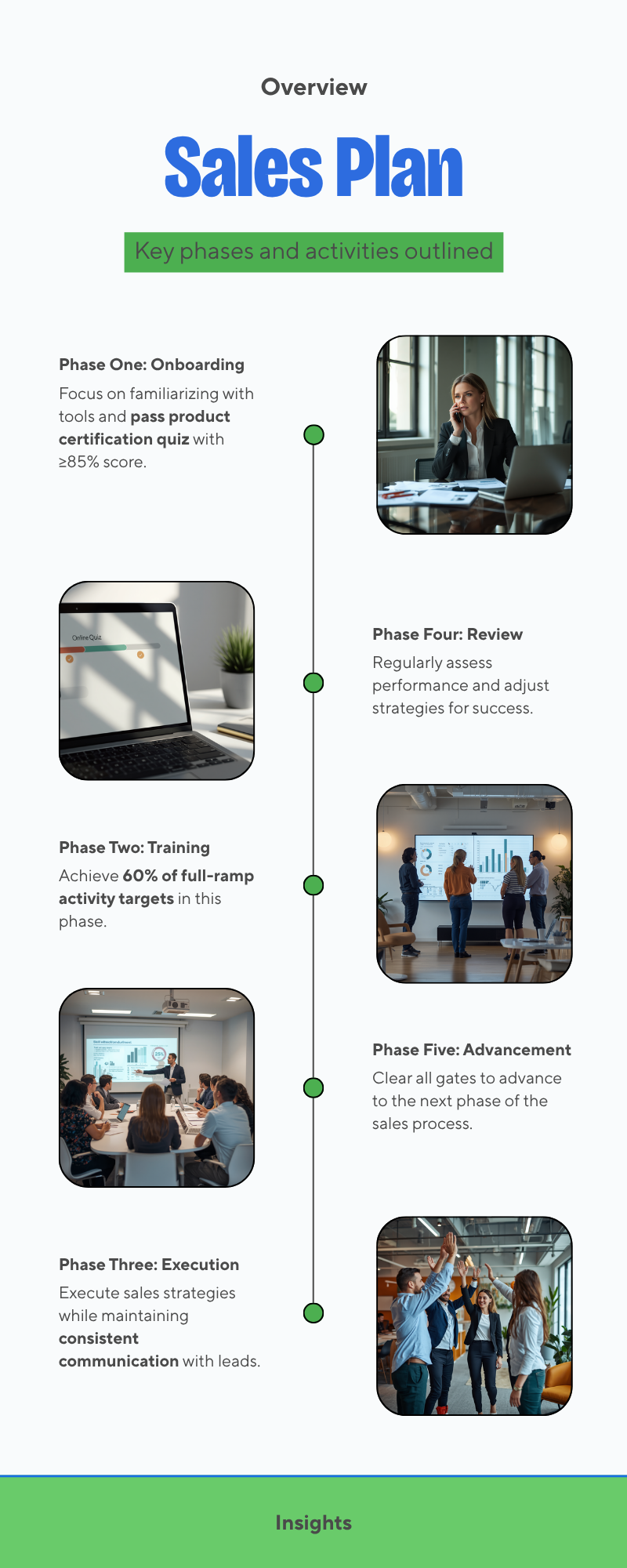
Phases are not buckets to dump tasks into. Each phase has a theme, a dominant activity, and a gate the rep must clear to advance.
Days 1-30: Learn#
The goal is competence, not output. Specifically: company, product, ICP, pipeline mechanics, and tool stack.
Concrete milestones:
- Complete onboarding curriculum (product, security, compliance)
- Pass product certification quiz (≥85%)
- Shadow 10 live customer calls (5 discovery, 3 demo, 2 negotiation)
- Read the last 20 closed-won and closed-lost deal notes in the CRM
- Build a written ICP brief: 3 industries, 5 personas, 10 trigger events
- Map 50 named accounts from the assigned territory
- 1:1 with 5 cross-functional partners (CS, marketing, RevOps, product, support)
The dominant activity is observation and ingestion. The gate is a 30-day review where the rep presents their territory brief and ICP back to the manager.
Days 31-60: Apply#
The rep starts producing under supervision. The goal is calibrated activity — not just volume, but volume that matches the quality bar.
Concrete milestones:
- Run 3 discovery calls solo (manager listens to recordings)
- Co-run 5 demos with a senior rep (rep owns 2 sections by day 45, full demo by day 60)
- Build outbound sequences for top 25 target accounts
- Source 8-12 qualified opportunities into pipeline
- Achieve 60% of full-ramp activity targets (calls, emails, meetings booked)
- Submit 5 deal reviews using the team's MEDDPICC/SPICED template
- Complete one full deal from cold outreach to first meeting
The dominant activity is supervised execution. The gate is a call-shadow scorecard: can the rep run a 30-minute discovery unassisted and surface budget, authority, timeline, and pain in the notes?
Days 61-90: Drive#
The rep is operating as a full IC, just with smaller deals and tighter oversight. The goal is predictable pipeline contribution.
Concrete milestones:
- Carry full activity quota (calls, emails, meetings)
- Build 3x pipeline coverage vs. quarterly quota
- Close first deal (if SMB) or advance two deals to stage 3+ (if mid-market/enterprise)
- Run weekly forecast call with manager
- Deliver one team session: best win, hardest loss, what changed
- Co-own one cross-functional initiative (e.g., a vertical play with marketing)
The dominant activity is independent execution with metric-based review. The gate is the 90-day pipeline review: does the rep have enough qualified opportunities, in the right stages, with credible close dates, to project on-quota performance by month 6?
How is a 30 60 90 day plan different for an AE vs. an SDR vs. a sales manager?#
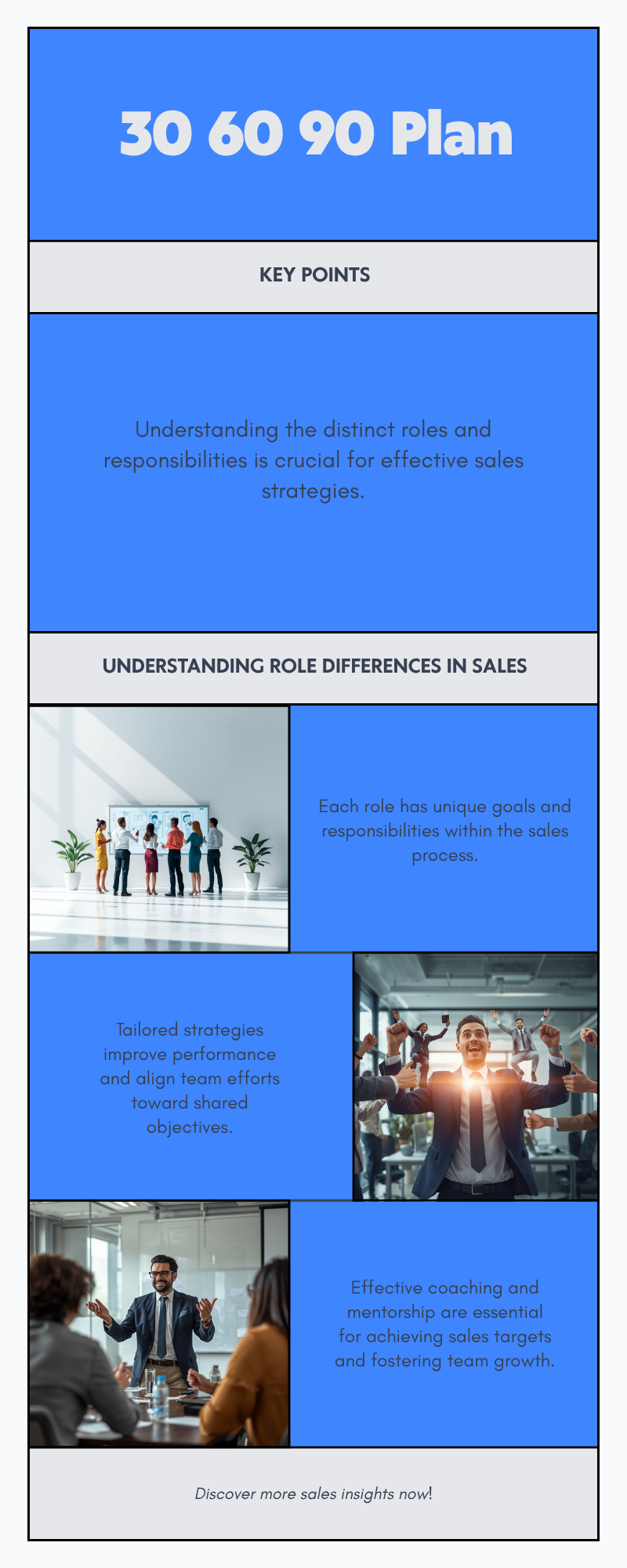
The framework is the same; the deliverables aren't. Here's how the three most common roles diverge.
| Phase | SDR / BDR | Account Executive | Sales Manager |
|---|---|---|---|
| Days 1-30 | Master one sequencer + dialer; pass product cert; shadow 20 calls | Product cert; territory map; shadow 10 deals; build ICP brief | 1:1 with every report; audit pipeline; review last 4 forecast calls |
| Days 31-60 | 60% of ramped dial volume; book first 5 qualified meetings | Run 3 solo discoveries; source 8-12 opps; co-run 5 demos | Run team forecast cadence; identify top/bottom performer per pod; ship first coaching plan |
| Days 61-90 | Full dial quota; 80% of meeting quota; 90% conversion of held meetings | 3x pipeline coverage; first close (SMB) or stage-3+ deals (mid-market) | Hit team activity targets; finalize hiring plan; deliver QBR-quality territory review |
| Primary KPI | Qualified meetings booked | Pipeline created + closed-won | Team attainment % + pipeline coverage |
| Reporting cadence | Daily activity, weekly meetings | Weekly pipeline, biweekly forecast | Weekly team metrics, monthly forecast |
| Gate at day 90 | 80% of meeting quota hit two consecutive weeks | 3x pipeline coverage, one closed deal | Forecast accuracy within ±10% |
The two biggest mistakes managers make are (1) using the AE template for SDRs, which drowns them in non-pipeline activity, and (2) using the IC template for new sales managers, who actually need a leadership ramp that's heavier on listening and lighter on selling.
What does a real 30 60 90 day sales plan look like?#
Here's a stripped-down example for a new SaaS AE selling to mid-market HR leaders. Real plans are longer, but the shape matters more than the volume.
ROLE: Mid-Market AE, HR Tech
QUOTA: $720K annual ($180K/Q after ramp)
RAMP: Full quota by month 6 (40% Q2, 70% Q3, 100% Q4)

DAYS 1-30 — LEARN
- Pass product cert (≥85%)
- Read last 20 closed-won notes; 10 closed-lost notes
- Shadow 5 disco, 3 demo, 2 negotiation calls
- Build account map: 100 named MM HR leaders, top 25 prioritized
- Submit ICP brief by day 28
- KPI gate: territory presentation passes

DAYS 31-60 — APPLY
- Source 10 qualified opps (≥$25K ACV)
- Run 3 solo discoveries; manager reviews recordings
- Co-run 5 demos; own full demo by day 60
- Hit 60% of ramped activity (250 calls, 600 emails, 15 meetings)
- KPI gate: solo discovery scorecard ≥3.5/5

DAYS 61-90 — DRIVE
- Build 3x pipeline coverage ($540K open pipeline)
- Move 4 opps to stage 3+
- Run weekly forecast call
- Close one deal (any size) OR have one verbal commit
- KPI gate: forecast accuracy ±15%, pipeline coverage 3x
If the rep can't articulate this much detail in their interview, they don't understand the role. If the manager can't grade against it weekly, the plan isn't operational — it's decoration.
How do you measure success?#
The single biggest failure mode of 30 60 90 plans is fuzzy success criteria. "Learn the product" is not a milestone. "Pass certification with 85% on the first attempt by day 21" is.
Every milestone should be one of:
- Binary — passed/failed (cert, certification, presentation)
- Numeric — count or percentage (calls made, opps sourced, accuracy %)
- Stage-based — observable artifact in the CRM (opp at stage 2, deal review submitted)
Key metrics to track by role:
| Metric | SDR | AE | Manager |
|---|---|---|---|
| Activity volume (calls/emails) | Daily | Weekly | Weekly aggregate |
| Conversion rate (call → meeting) | Weekly | n/a | Per-rep weekly |
| Pipeline created ($) | n/a | Weekly | Weekly team rollup |
| Pipeline coverage (x quota) | n/a | Biweekly | Biweekly |
| Forecast accuracy (%) | n/a | Monthly | Monthly ±10% target |
| Win rate | n/a | Quarterly | Quarterly |
| Deal cycle length | n/a | Quarterly | Quarterly |
If you want benchmark anchors, HubSpot's State of Sales reports and the Bridge Group SaaS AE Metrics survey publish ramp data annually. Use them as priors, not gospel — your deal size and ICP move ramp by months.
What are the most common mistakes?#
After reviewing hundreds of these plans, the same five errors show up over and over:
- No ICP definition before activity starts. Reps spend day 31 dialing whoever the CRM coughs up. By day 60 they've burned 200 wrong accounts.
- Activity targets without quality gates. "Make 50 calls a day" produces 50 voicemails. Pair every activity target with a conversion gate.
- Tool overload in week one. Stacking the CRM, sequencer, dialer, and AI assistant in the first three days guarantees nothing sticks. Sequence the tool training week-by-week.
- The manager never reads the plan again after day 1. A plan that doesn't get reviewed weekly is theater. Block the time.
- Treating it as a probation document. Reps smell PIPs. Frame the 30 60 90 plan as a development contract, with milestones that scaffold success — not landmines that justify firing.

How do you actually build the plan? (Step-by-step)#
Don't open Google Docs first. Open the CRM.
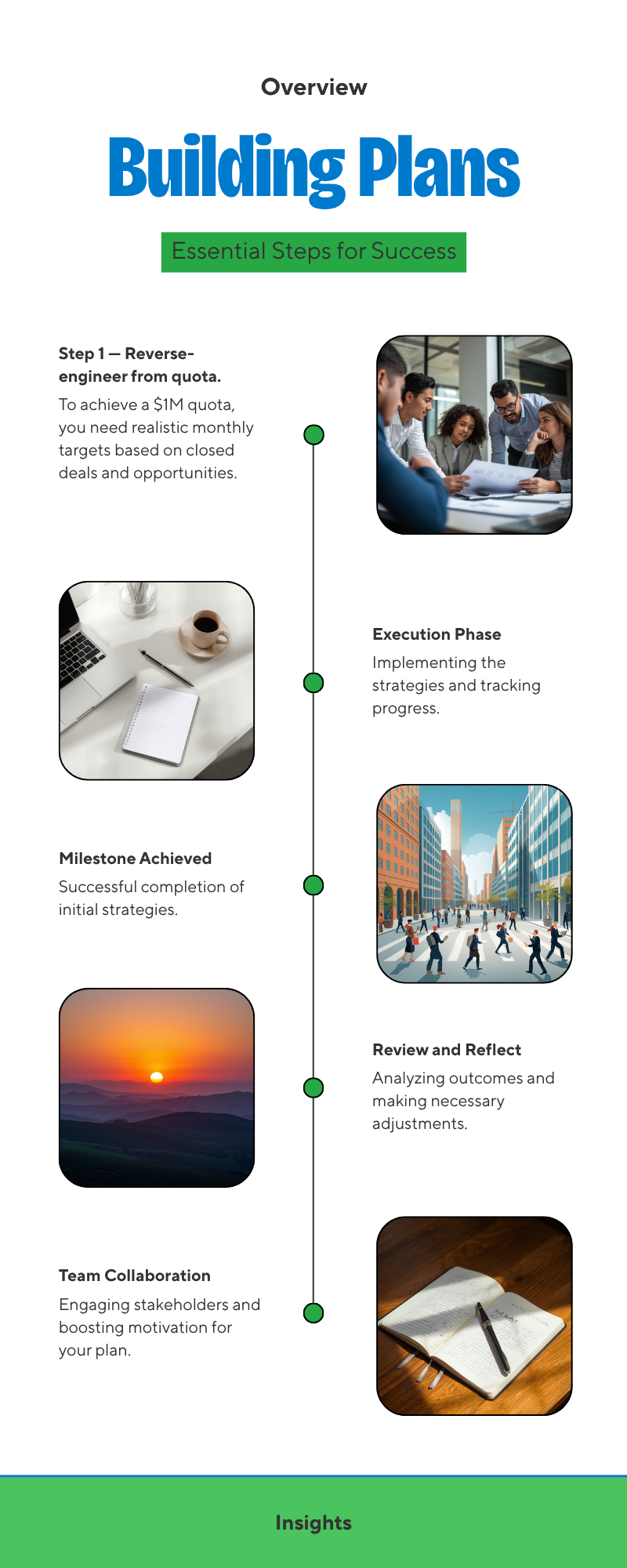
Step 1 — Reverse-engineer from quota. If full quota is $1M annual and average deal size is $40K, you need 25 closed deals/year. At a 25% win rate, that's 100 stage-3+ opps. At a 33% disco-to-stage-3 conversion, that's 300 discoveries. Work backwards through your funnel to get realistic monthly targets.
Step 2 — Map territory and ICP. Pull the last 50 closed-won deals. What industries, sizes, titles, and trigger events show up most? That's the rep's hit list. Use a bulk email finder to enrich the named accounts with verified contacts in week 2 so the rep isn't waiting on ops.
Step 3 — Define the gates. Three gates: end of day 30 (territory presentation), end of day 60 (solo discovery scorecard), end of day 90 (pipeline review). Write the rubric for each gate before the rep starts.
Step 4 — Sequence the tool training. Week 1: CRM + product. Week 2: sequencer + research tools. Week 3: dialer + recorder. Week 4: deal review tools. Don't shotgun.
Step 5 — Schedule the reviews. Block weekly 30-minute 1:1s for ramp-specific coaching (separate from regular 1:1s). Block the three gate reviews as 90-minute meetings with a defined agenda.
Step 6 — Make it visible. Put the plan in a shared doc the rep and manager both update. Reps mark milestones complete; managers comment. No surprises at day 90.
What tools should support the ramp?#
The plan is the contract; tools are the leverage. A new AE ramping in 2026 should have, at minimum:
- A CRM where every milestone maps to a field or report (HubSpot or Salesforce are the defaults)
- A sales engagement tool (Outreach, Salesloft, Apollo, or Instantly)
- A call recorder with AI summaries (Gong, Chorus, Fireflies)
- A contact data source — for verified emails, direct dials, and account enrichment — so the rep isn't spending hour-three of day-one Googling for prospect emails. The Tomba data sources page outlines what good looks like
- A CRM glossary and shared terminology so the rep doesn't get lost in jargon week one
Skipping the contact-data layer is the most common — and most painful — gap. A rep who can identify 25 target accounts but can't reach the decision makers in week 3 is functionally at zero output for the rest of month 1.
How do you adapt the plan for a sales manager hire?#
A new sales manager isn't a senior IC with a bigger laptop. Their 30 60 90 plan inverts the AE template: heavy on listening early, heavy on systems mid-cycle, heavy on team performance late.
- Days 1-30: 1:1 with every direct report, every cross-functional peer, and the top 10 customers. Read the last quarter's forecasts vs. actuals. Sit in on every team ceremony. Change nothing.
- Days 31-60: Audit pipeline hygiene, forecast accuracy, and deal review quality. Identify the top performer (replicate) and the bottom performer (coach or exit decision). Ship one process change — small, visible, reversible.
- Days 61-90: Run a full forecast cycle. Deliver a written territory plan to your VP. Make your first hire/fire decision with evidence.
Managers who try to "make their mark" by week 2 break trust they haven't earned yet. Managers who say "I'm here to listen" but never make a decision lose authority. The 30 60 90 plan is what keeps both extremes honest.
How do you present a 30 60 90 day plan in an interview?#
Hiring managers ask for this in final rounds to test three things: research depth, structured thinking, and revenue intuition.
Don't bring a generic template. Bring:
- A territory hypothesis — three industries you'd prioritize and why, supported by trigger events you've found in the news.
- A named-account list — 20-50 companies with the decision-maker title for each. Yes, this means doing the work before you're paid. That's the test.
- A weekly activity budget — your projected calls, emails, demos, and pipeline by week 12.
- A risk register — what would derail the plan, and how you'd mitigate it.
Candidates who show up with a real ICP, real account names, and real numbers stand out. The plan is the deliverable; the work behind it is the signal.
Closing CTA#
A 30 60 90 day sales plan is only as good as the data it runs on. If your new rep is dialing the wrong contacts or chasing emails that bounce, no framework will save them.
Tomba's Email Finder gives new reps verified business emails for their named-account list on day one — so week three is spent talking to buyers, not hunting for them. Start on the free tier with 25 searches, then move to the $49/month Starter plan when your ramping rep hits stride. Pair it with the HubSpot integration and your 30 60 90 milestones light up in the CRM automatically.
Build the plan. Equip the rep. Watch the ramp shrink.
// get started
Find, verify and enrich your first contacts today
Start on the free plan with 25 searches a month, then scale when your team is ready.
Free plan · No credit card required · GDPR & CCPA
// about the author