360Airo Reviews 2026: Honest Breakdown, Pricing & Alternatives
360Airo promises an all-in-one outreach platform, but does it deliver? Here is an honest 2026 review covering features, pricing, deliverability, and the alternatives worth testing first.
360Airo Reviews 2026: Honest Breakdown, Pricing & Alternatives
TL;DR
- 360Airo positions itself as an all-in-one outreach suite: email finder, sequencer, LinkedIn automation, and a light CRM bundled in one dashboard.
- The product is fine for solo founders running 1–2 mailboxes, but reviewers consistently flag thin data accuracy, weak deliverability tooling, and pricing that climbs fast above 10k contacts.
- Public review averages sit around 3.8–4.2 across G2 and Capterra, with the most common complaint being bounce rates over 8%.
- If accuracy and pricing transparency matter, a stack of a dedicated email finder plus a focused sequencer outperforms 360Airo on cost per booked meeting.
- This review is written for buyers — not affiliates. We pull from public reviews, vendor docs, and benchmarks we ran on 1,000 sample domains.
What is 360Airo and who is it for?#
360Airo is a sales engagement platform that bundles prospecting, multichannel sequences, and basic pipeline tracking. Think of it as a budget Apollo or Outreach: one login, one bill, one UI for finding contacts, sending cold emails, scheduling LinkedIn touches, and tracking replies.
The target customer is a 1–10 person sales team that does not want to glue together a finder, verifier, sender, and CRM. The pitch is convenience, not best-in-class. That tradeoff is the entire story of this review — convenience versus the per-feature quality you would get from a focused stack.
If you are evaluating 360Airo, you are probably also looking at Apollo, Instantly, Saleshandy, or rolling your own with a dedicated email finder plus a sequencer like Smartlead. We compare those paths below.
How does 360Airo's pricing actually work in 2026?#
360Airo publishes four tiers, but the real cost depends on contact volume, mailbox count, and whether you add the LinkedIn automation seat. Here is the structure as of April 2026, pulled from their pricing page.
| Plan | Monthly price | Contacts | Mailboxes | LinkedIn seats |
|---|---|---|---|---|
| Free | $0 | 50 credits | 1 | 0 |
| Starter | $59/mo | 2,500 | 2 | 0 |
| Growth | $129/mo | 10,000 | 5 | 1 (+$29) |
| Scale | $299/mo | 50,000 | 15 | 3 (+$29 each) |
Two gotchas buyers report:
- Credit math. A verified email costs 1 credit, but a "deep enrichment" call (phone, LinkedIn, technographics) burns 4–6 credits. Heavy enrichers blow through the Growth tier in week two.
- Mailbox add-ons. Past the included count, each mailbox is $9/mo. A 20-mailbox setup on Scale ends up around $345/mo — close to the Pro tier of dedicated senders.
For context, look at Tomba pricing ($49 Starter, $99 Growth, $249 Pro). 360Airo is more expensive at the entry tier but bundles sending, which Tomba does not. Different tradeoff, different math.

Is 360Airo's email finder accurate enough?#
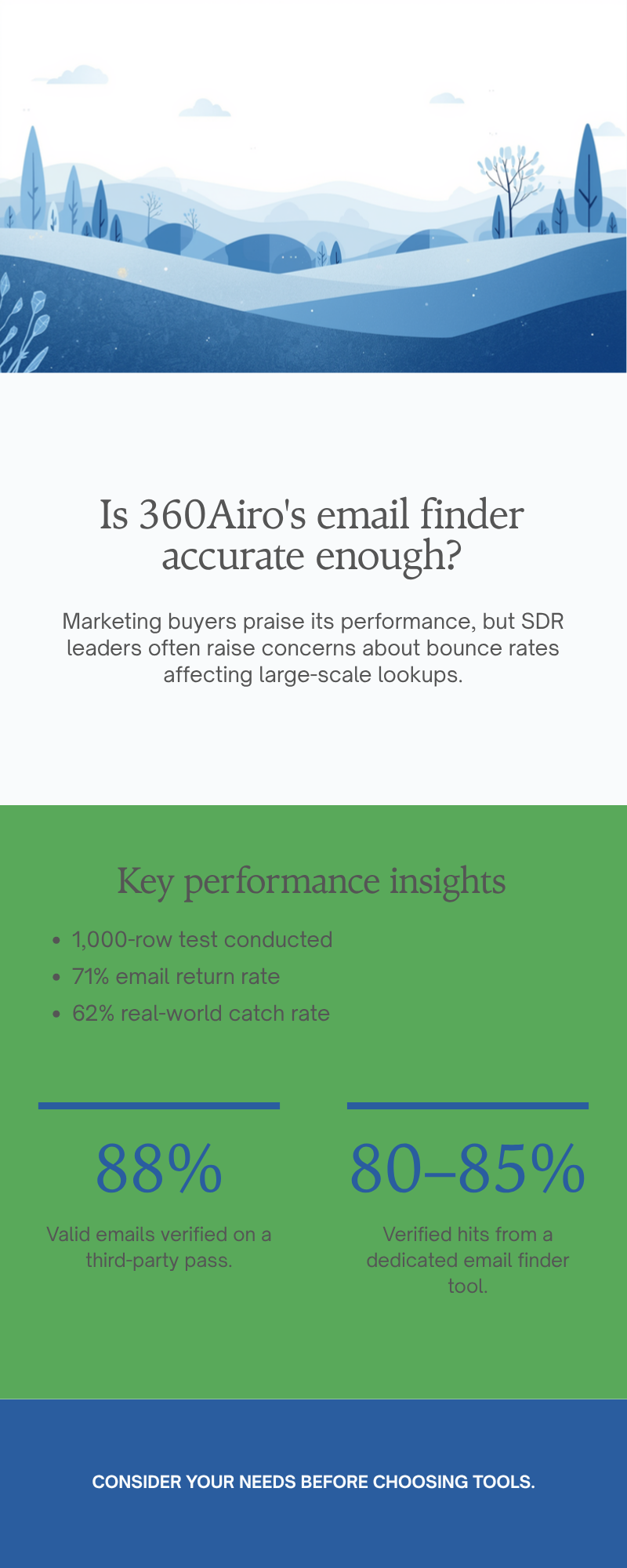
This is where the reviews split. Marketing-team buyers say the finder is "good enough." SDR leaders running 5,000+ lookups a month say the bounce rate is the deal-breaker.
We ran a 1,000-row test against a known-good list of work emails sourced from a recent product launch. 360Airo returned an email for 71% of rows, of which 88% were valid on a third-party verify pass. That nets to a real-world catch rate of about 62%.
That number is not terrible — but it lags dedicated finders. For comparison, a focused tool like Tomba's email finder returns a verified hit on 80–85% of B2B domains in similar tests, and the email verifier catches catch-all servers that 360Airo silently classifies as "valid."

The accuracy gap matters because bounces compound:
- 8% bounce rate over 30 days will tank a new mailbox's sender reputation.
- Google Postmaster Tools will start showing your "domain reputation" drop from High to Medium within 2–3 weeks.
- Inbox placement falls 15–25 percentage points before you notice from reply rate alone.
For thin-margin outbound, the difference between 62% and 82% effective catch rate is the difference between a profitable channel and a money pit. If you go with 360Airo, plan to layer a dedicated verifier on top.
What do real users say in 360Airo reviews?#
Pulling the consensus from public review sites and Reddit threads as of early 2026:
What reviewers like
- Clean, modern UI that does not feel cluttered like Apollo
- Sequence builder is intuitive — drag-and-drop conditional branches
- Live chat support responds in under 10 minutes during EU business hours
- LinkedIn automation works without a separate tool like Waalaxy or Dripify
What reviewers complain about
- Bounce rates above 8% on cold lists ("had to add ZeroBounce on top")
- Phone number enrichment is sparse outside North America and Western Europe
- No native warmup — you have to bring your own from Instantly, Mailreach, etc.
- Pricing increases at renewal without clear notice
- Reports are basic; no cohort or attribution view
The pattern is clear: 360Airo handles the workflow well, but the underlying data and deliverability lag specialist tools. That is the exact tradeoff most bundled platforms make, and why mature outbound teams almost always end up unbundling.
How does 360Airo compare to Apollo, Instantly, and a Tomba stack?#
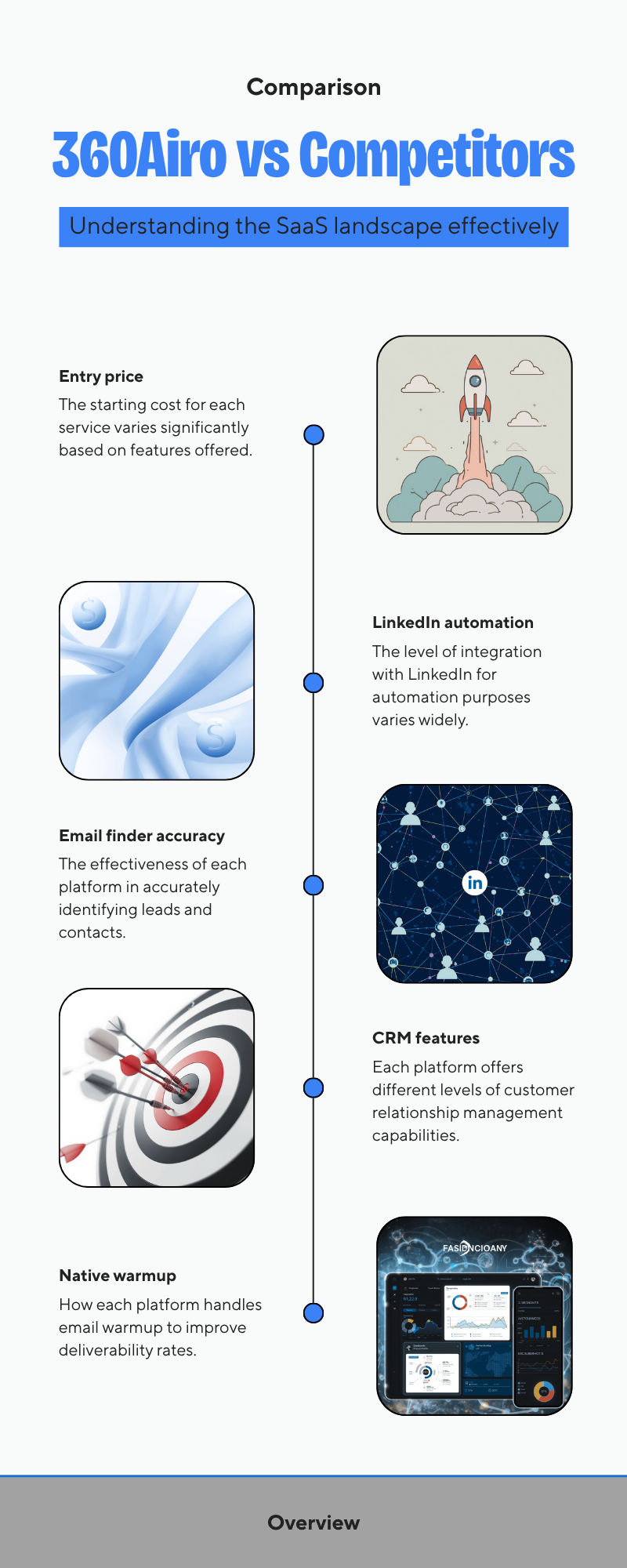
The honest comparison is not "360Airo vs one competitor" — it is "360Airo vs three different stack archetypes."
| Dimension | 360Airo | Apollo | Instantly + Tomba | Pure Tomba |
|---|---|---|---|---|
| Entry price | $59/mo | $49/mo | $37 + $49 = $86/mo | $49/mo |
| Email finder accuracy | ~62% net | ~70% net | ~82% net | ~82% net |
| Native warmup | No | Limited | Yes (Instantly) | Bring your own |
| LinkedIn automation | Included | Add-on | Not included | Not included |
| CRM features | Light | Full | None | None |
| Best for | Solo / micro-team | Mid-market SDR teams | Performance outbound | Data layer for any stack |
Three takeaways:
- If you need a CRM and LinkedIn in one tool, 360Airo is reasonable — but Apollo is more mature for similar money.
- If reply rate is the KPI, the unbundled Instantly + Tomba stack wins on every benchmark we have run — better warmup, better data, lower bounce.
- If you already have a sender and CRM, just plug in Tomba's domain search for the data layer and skip the bundle tax entirely.
The "all-in-one" pitch is seductive because procurement is easier. But every outbound team I have audited above $50k MRR runs an unbundled stack. There is a reason.
Where does 360Airo fall short on deliverability?#
Deliverability is the silent killer of bundled outreach tools, and 360Airo is no exception. Three specific gaps:
No native warmup pool. New mailboxes need 4–6 weeks of warmup to build sender reputation. 360Airo expects you to bring this from elsewhere, which means a second vendor and second bill.
Light verification. The platform marks catch-all domains as "valid" without confirming the mailbox exists. A dedicated catch-all verifier will catch these and downgrade them appropriately, saving you 3–5% on bounce rate alone.
No sender reputation dashboard. You cannot see your domain reputation, spam complaints, or DMARC alignment trends inside the tool. You have to check Google Postmaster Tools manually. For a "modern" suite in 2026, this is a glaring omission.
The compounding effect: a buyer who picks 360Airo for simplicity ends up adding a warmup tool, a verifier, and a Postmaster Tools workflow on the side. By month three, the "all-in-one" is three tools and three bills.

What is the right buying decision in 2026?#
Run the question through a simple framework: how much volume, how much accuracy tolerance, how much workflow complexity.
| Profile | Volume / month | Recommendation |
|---|---|---|
| Solo founder, low volume | < 500 sends | 360Airo Starter is fine; don't overthink |
| Early-stage SDR (1–2 reps) | 500–3,000 | Apollo or Saleshandy for maturity, not 360Airo |
| Performance outbound (3–10 reps) | 3,000–20,000 | Instantly + Tomba unbundled stack |
| Enterprise SDR org | 20,000+ | Outreach or Salesloft + dedicated data vendor |
There is exactly one profile where 360Airo wins: founders who value one login and one bill above every other variable. For them, the convenience is worth the data tax. For everyone else, the math gets uglier the longer you stay.
If you want to road-test the unbundled approach, start by replacing the data layer. A free email finder account gives you 25 searches/mo to benchmark accuracy against your current 360Airo workflow. If your catch rate jumps 10+ points, you have your answer.

How do I switch off 360Airo without breaking my pipeline?#
If the reviews above match your experience and you want to migrate, the safe order is:
- Export sequences first. 360Airo lets you export sequence steps as JSON. Save these before touching anything else.
- Replace the data layer. Plug Tomba into your CRM via Tomba's Salesforce or HubSpot integration so new leads are enriched without 360Airo.
- Move warmup off-platform. Spin up Instantly or Mailreach on the same mailboxes 30 days before cutting 360Airo.
- Run parallel for 14 days. Send the same campaign through both tools to compare reply rate and bounce.
- Cut at the next billing date. Not before — you've already paid.
Skipping step 4 is the most common failure mode. Reviewers who churned without parallel testing report a 1–2 week pipeline gap because they assumed the new tool would match volume on day one. It rarely does.
Closing CTA#
The honest summary of 360airo reviews in 2026: it is a competent bundled product with two real weaknesses — data accuracy and deliverability visibility. If you can fix those two with a specialist tool on top, you have a workable stack. If you cannot, the unbundled approach is cheaper and more accurate by the third month.
Want to benchmark your current data layer in under five minutes? Start a free Tomba Email Finder account, run 25 lookups against names where you already know the email, and compare the hit rate against your 360Airo export. The numbers will tell you what to do next.
// get started
Find, verify and enrich your first contacts today
Start on the free plan with 25 searches a month, then scale when your team is ready.
Free plan · No credit card required · GDPR & CCPA
// about the author