The 5 Ps of Successful Selling: A 2026 Framework Guide
The 5 Ps of successful selling—Prospect, Prepare, Present, Persuade, Persist—turn random sales activity into a repeatable system. Here's how to run each one in 2026.
The 5 Ps of Successful Selling: A 2026 Framework Guide
TL;DR
- The 5 Ps of successful selling are Prospect, Prepare, Present, Persuade, and Persist — a sequential framework that turns scattered sales activity into a measurable pipeline.
- Reps who follow the 5 Ps consistently book 2-3x more meetings than those who skip steps, according to RevOps benchmarks from Gong and Salesforce.
- Each P maps to specific tools: prospecting needs accurate contact data, preparation needs research, presenting needs discovery questions, persuading needs proof, and persisting needs sequencing.
- The framework dates back to 1980s door-to-door selling but holds up because buyer psychology hasn't changed — only the channels have.
- Skip a P and your conversion rate collapses at that exact stage. Diagnose your funnel by P, not by stage name.
What are the 5 Ps of successful selling?#
The 5 Ps of successful selling are Prospect, Prepare, Present, Persuade, and Persist. They describe the five sequential activities every closed deal passes through, regardless of industry, deal size, or channel. Skip one and the deal stalls — usually invisibly until the forecast slips.
Most reps think they "do all five." When you actually audit their week, two or three dominate and the rest get token effort. Top performers spend roughly equal time on each.
The framework predates the internet — Tom Hopkins and other 1980s sales trainers used variations of it for door-to-door teams — but it survived the SaaS era because buyer psychology hasn't changed. Buyers still need to be found, understood, shown, convinced, and reminded.
Why does the 5 Ps framework still work in 2026?#
Three reasons it hasn't been replaced by a flashier acronym:
- It's diagnostic, not prescriptive. When pipeline dies, you can ask "which P failed?" instead of arguing about MEDDIC vs SPIN vs Challenger.
- It maps to your tech stack. Each P has a clear tool category — prospecting tools, research tools, demo tools, proof tools, sequencing tools — so budgeting becomes obvious.
- It's measurable. You can put a conversion ratio on every P and see where money leaks.
Modern sales methodologies layered on top — MEDDPICC, BANT, SPICED — slot inside the Prepare and Present steps without breaking the framework. The 5 Ps are the chassis; methodologies are the engine.
How does each P actually work?#
Here's the operational version of each step — what good looks like in 2026, not the textbook version.
Prospect — find the right people#
Prospecting is the act of identifying companies and individuals who fit your ICP and getting their valid contact details. Two failure modes dominate:
- Volume without fit — scraping anyone who breathes, then complaining about reply rates.
- Fit without volume — researching 10 perfect-fit accounts a week and missing quota.
The fix is a tight ICP filter applied to a wide initial list. Pull 500 accounts that match firmographic + technographic criteria, enrich the right contacts with a bulk email finder, then verify before sending. Bad data is the silent killer here — sending to a stale list torches your domain reputation before the first reply.
Tools to evaluate: a domain-based email finder for known accounts, an Apollo alternative for broad discovery, and a LinkedIn finder for social-first prospects.
Prepare — research before you reach out#
Preparation is the 15-minute account-and-person dive before any first touch. Skip it and your message reads like spray-and-pray.
Minimum viable prep:
- Recent news (funding, hiring, product launch, layoffs)
- Buyer's role tenure and prior companies
- The team's tech stack
- One specific trigger event
This is where AI assists land — they can compress 30 minutes of LinkedIn scrolling into 90 seconds of structured notes. But AI summaries that aren't grounded in real data hallucinate; ground them in verified profile and company data via something like data enrichment.
Present — show value, not features#
Presenting is your discovery call, demo, or proposal. The mistake is treating it as a one-way pitch. The conversion-rate gap between bottom-quartile and top-quartile demos is largely a talk-time gap. According to Gong's research, top reps talk 46% of the time on a demo; bottom reps talk 72%.
Present in three layers:
- Diagnose — confirm the pain you uncovered in Prepare.
- Differentiate — show the specific feature that solves it, not the full product map.
- Quantify — anchor on a number ("typical customer saves 12 hours/week").
Persuade — handle objections with proof#
Persuasion in B2B is not about charisma. It's about supplying the proof your buyer needs to defend the purchase internally.
Standard objection categories and the proof that beats each:
- "Too expensive" → ROI calculator with their inputs
- "Wrong time" → case study from a buyer who said the same thing
- "Need to think" → discovery follow-up isolating the real concern
- "Already have a vendor" → switching playbook with migration support
Persist — follow up until you get an answer#
Most deals die in the gap between "interested" and "signed" because the rep stops following up. Industry research from HubSpot puts the average B2B deal at 5-12 touches before close, but most reps quit after 2-3.
Persistence is not pestering. It's a sequenced cadence with new value at each touch — a benchmark, a case study, a customer quote, a question they haven't been asked. Use sequencing tools or build your own with a Saleshandy alternative.
What does each P cost in time and tools?#
Here's a realistic breakdown of where a quota-carrying AE should spend a 40-hour week, plus the tooling category and budget per seat.
| The P | Weekly time | Tool category | Typical seat cost | Common failure |
|---|---|---|---|---|
| Prospect | 8-10 hrs | Email finder + verifier | $49-$99/mo | Stale lists |
| Prepare | 6-8 hrs | Enrichment + research AI | $50-$200/mo | Skipping personalization |
| Present | 10-12 hrs | Demo + recording | $100-$300/mo | Talking 70%+ |
| Persuade | 4-6 hrs | Proof library + ROI calc | $0-$50/mo | No social proof |
| Persist | 6-8 hrs | Sequencer / cadence | $30-$120/mo | Stopping at touch 3 |
Notice the lopsided spend: most teams overpay for "Present" tools (
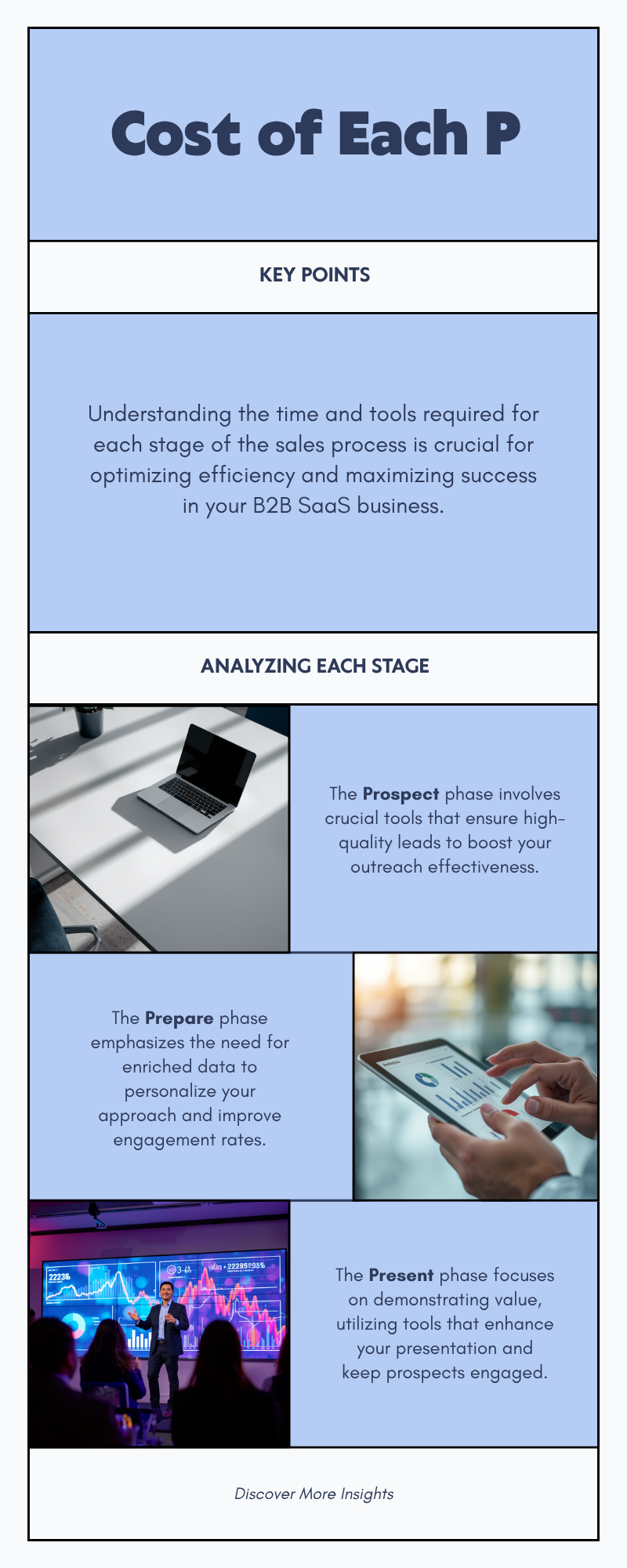
Zoom, Loom, Gong) and underpay for "Prospect" and "Persist," which is exactly where pipeline gets created and saved. Compare your stack against Tomba pricing for the prospecting layer — a $49/mo finder + verifier covers two of the most leak-prone Ps for less than one Gong seat.
How do the 5 Ps compare to other sales frameworks?#
The 5 Ps aren't the only way to organize a sales motion. Here's how they stack up against the methodologies you've probably heard of.
| Framework | Core focus | Best for | Weakness |
|---|---|---|---|
| 5 Ps | End-to-end activity stages | Diagnosing where pipeline dies | Light on qualification rigor |
| BANT | Qualification (Budget, Authority, Need, Timing) | Inbound lead scoring | Buyer-hostile, dated |
| MEDDPICC | Enterprise qualification + champion | $50K+ deals | Overkill for SMB |
| SPIN | Discovery question structure | Consultative selling | Doesn't cover prospecting |
| Challenger | Teach-tailor-take control | Complex change-the-status-quo deals | Hard to coach at scale |
| Sandler | Pain funnel + upfront contract | Resistant-buyer markets | Slow ramp |
The 5 Ps sit at a different layer — they describe what activities to do, while MEDDPICC, SPIN, and Challenger describe how to do the Present and Persuade steps. Pair them; don't pick one.
How do you measure each P?#
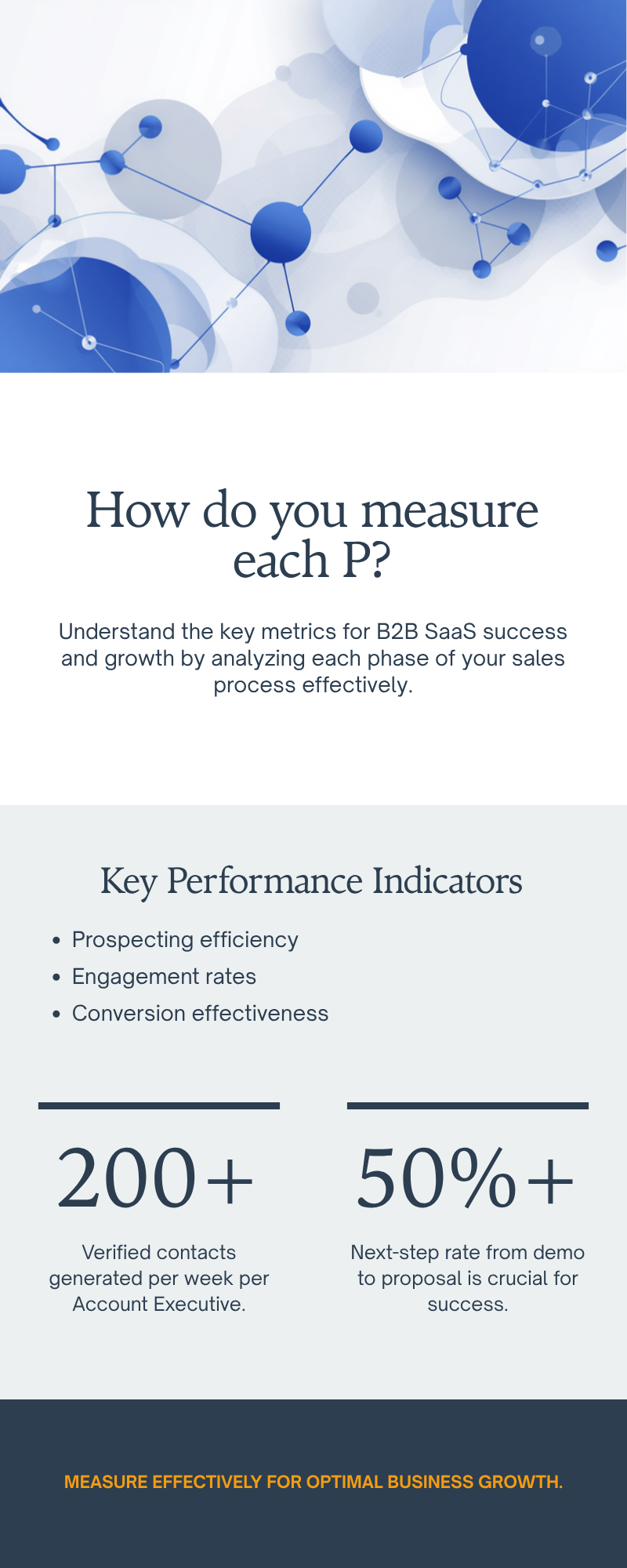
If you can't measure it, you can't fix it. Here's the conversion ratio to track at each stage and the threshold below which you have a real problem.
| The P | Metric | Healthy benchmark | Diagnose if below |
|---|---|---|---|
| Prospect | Verified contacts/week per AE | 200+ | Data source or ICP filter |
| Prepare | Reply rate on first touch | 8-15% | Personalization depth |
| Present | Demo → next-step rate | 50%+ | Discovery quality |
| Persuade | Next-step → proposal rate | 60%+ | Objection handling |
| Persist | Proposal → close rate | 25-40% | Follow-up cadence |
Multiply them: a typical quota-carrying AE who hits all five benchmarks turns ~200 contacts/week into roughly 1-3 closed deals/month at typical SMB price points. Miss any single P and the math breaks fast.
A quick way to instrument this without buying a revenue operations suite: tag every CRM stage with the P it belongs to, then build a single dashboard with the five conversion ratios above. It takes an afternoon and tells you more than most pipeline reviews.
Which P should you fix first?#
Look at your funnel. The first ratio that falls below the benchmark is the P to fix.
- Low contact volume? Fix Prospect — bad data, narrow ICP, or no list-building motion.
- Low reply rate? Fix Prepare — generic outreach, no trigger event, weak subject lines.
- Low demo-to-next-step? Fix Present — over-pitching, under-discovering, no clear next action.
- Stuck deals at proposal? Fix Persuade — missing proof, no champion, weak business case.
- Ghosted after proposal? Fix Persist — quitting too early, sending generic bumps, no value adds.
Don't try to fix all five at once. Pick the worst ratio, ship a 2-week intervention, re-measure. Compounding small wins across all five Ps is how teams double pipeline without doubling headcount.
What about AI — does it replace any of the 5 Ps?#
No, but it changes the cost of each. AI shrinks Prepare from 30 minutes to 2, makes Persist nearly free, and helps draft objection responses in Persuade. It does not replace the human in Present (buyers still want to talk to a person on a $20K+ deal) or in the relationship-building parts of Prospect.
The risk is using AI to scale bad practice. Sending 10x more bad emails is not improvement — it's reputation damage. Use AI inside the 5 Ps, not as a substitute for the framework. Tools like HubSpot's AI features and similar additions in Salesforce are useful, but only when the underlying P is healthy.
Common mistakes when applying the 5 Ps#
- Treating them as parallel, not sequential. You can't Persuade someone you haven't Presented to, and you can't Present to someone you haven't Prepared for. Order matters.
- Outsourcing Prospect entirely. SDR teams that hand off cold lists to AEs without context destroy Prepare. Reps need to know why each name is in the queue.
- Skipping Persist on "good fits." The deals that feel most certain ghost the most because everyone — including the rep — assumes they'll close themselves.
- Mistaking activity for progress. 100 dials/day is not Prospect; it's noise. Verified-fit contacts is the metric.
- Owning Persuade only at the rep level. Marketing should supply 80% of the proof assets (case studies, ROI calculators, comparison sheets). Reps who build their own from scratch are a sign your enablement function is broken.
Build the 5 Ps into your stack with Tomba#
The 5 Ps fall apart at the first step if your contact data is stale or wrong. Prospect is the gateway P — you cannot Prepare for someone whose email bounces, and you cannot Persist if your sequencer is sending into the void.
Tomba's Email Finder gives you the verified contacts the first P depends on, with a free tier (25 searches/mo) to test and a $49/mo Starter plan that covers most solo AEs and small teams. Pair it with the email verifier and you've solved the data half of the framework — leaving you free to focus on the four Ps that need a human.
Start with the free tier, wire it into your CRM, and use the saved time on the Ps that AI can't do for you.
// get started
Find, verify and enrich your first contacts today
Start on the free plan with 25 searches a month, then scale when your team is ready.
Free plan · No credit card required · GDPR & CCPA
// about the author