The 5 Sales Steps Every B2B Rep Must Master in 2026
The 5 sales steps that separate quota-crushers from quota-missers in 2026. A practical breakdown of prospect, qualify, pitch, close, and retain — with frameworks, benchmarks, and tools.
TL;DR#
- The 5 sales steps are prospect, qualify, pitch, handle objections, and close — every B2B deal moves through them whether you name them or not.
- Reps who follow a structured 5-step process close at roughly 28% versus 17% for ad-hoc sellers, according to recent CSO Insights benchmarks.
- The biggest 2026 shift: prospecting now means data-led targeting, not cold lists. Bad data kills steps 2-5 before they start.
- Qualification frameworks (BANT, MEDDIC, CHAMP) are tools, not gospel — pick one per deal stage and stick with it.
- Closing is mostly about how well you did steps 1-4. If you are "closing harder," you skipped something earlier.
What are the 5 sales steps?#
The 5 sales steps are the universal phases every B2B opportunity travels through, from cold lead to signed contract:
- Prospect — find the right accounts and contacts.
- Qualify — confirm fit, pain, budget, and timing.
- Pitch / present — show how you solve the specific pain.
- Handle objections — surface concerns and resolve them.
- Close — get the signature and set up onboarding.
Some training programs stretch this into 7 or 9 steps by splitting "pitch" into discovery + demo, or by adding "follow-up" as its own step. The core motion is still these five. If you can run all five cleanly in 14 days for a mid-market deal, your funnel will print money.
This is also where the sales process and pipeline overlap. The 5 sales steps describe what one rep does on one deal. The pipeline is what the manager sees when 200 of those deals stack up.
Why do the 5 sales steps still matter in 2026?#
Because deals fail in predictable places, and the 5 steps map exactly to where they fail.
A 2025 Gartner survey of B2B buyers found that 77% of customers described their last purchase as "very difficult" — and the friction was concentrated at three points: getting the right person on the call (step 1), confirming the problem was real (step 2), and resolving last-minute risk concerns (step 4). Reps who skip a step do not save time — they push the failure further down the funnel where it costs more.
AI changed the inputs to each step. It did not change the steps. You still have to find the prospect, qualify them, pitch the right thing, handle their concerns, and ask for the close.
| Sales step | What changed in 2026 | What stayed the same |
|---|---|---|
| Prospect | AI-assisted account scoring; intent data is mainstream | You still need a verified email and a real reason to reach out |
| Qualify | Conversation intelligence auto-tags BANT signals | Buyer still has to admit the pain out loud |
| Pitch | Personalized demo environments generated in minutes | Champion still needs a story to retell internally |
| Handle objections | LLM-suggested rebuttals in real time | Trust is built by the rep, not the prompt |
| Close | E-sign + CPQ automation is table stakes | Procurement still has 14 questions |
How does step 1 (prospecting) work in 2026?#
Prospecting in 2026 is data work first, outreach work second.
Top-performing SDRs spend roughly 60% of their prospecting time defining and pulling lists, and only 40% writing and sending messages. The reason: a great message to the wrong person beats nothing, but a great message to the right person beats both.
A clean prospecting workflow looks like this:
- Define ICP firmographics — industry, headcount band, revenue band, geo, tech stack.
- Pull accounts — from a B2B database, intent provider, or your own first-party signals (website visitors, content downloads).
- Identify the buying committee — usually 6-10 people per account in mid-market, per Forrester.
- Enrich with verified contact data — work email, mobile, LinkedIn, title hierarchy.
- Score for priority — fit + intent + recency.
Step 4 is where most teams leak money. A bad email bounces, hurts your sender reputation, and burns the account for the next rep who tries. Use a dedicated email finder and pair it with an email verifier before any list goes into your sequencer. If you need to enrich at scale, bulk email finder workflows let you process a CSV of 5,000 accounts overnight.
For LinkedIn-sourced lists, use a LinkedIn finder to convert profiles into verified work emails rather than guessing.
What does step 2 (qualification) look like?#
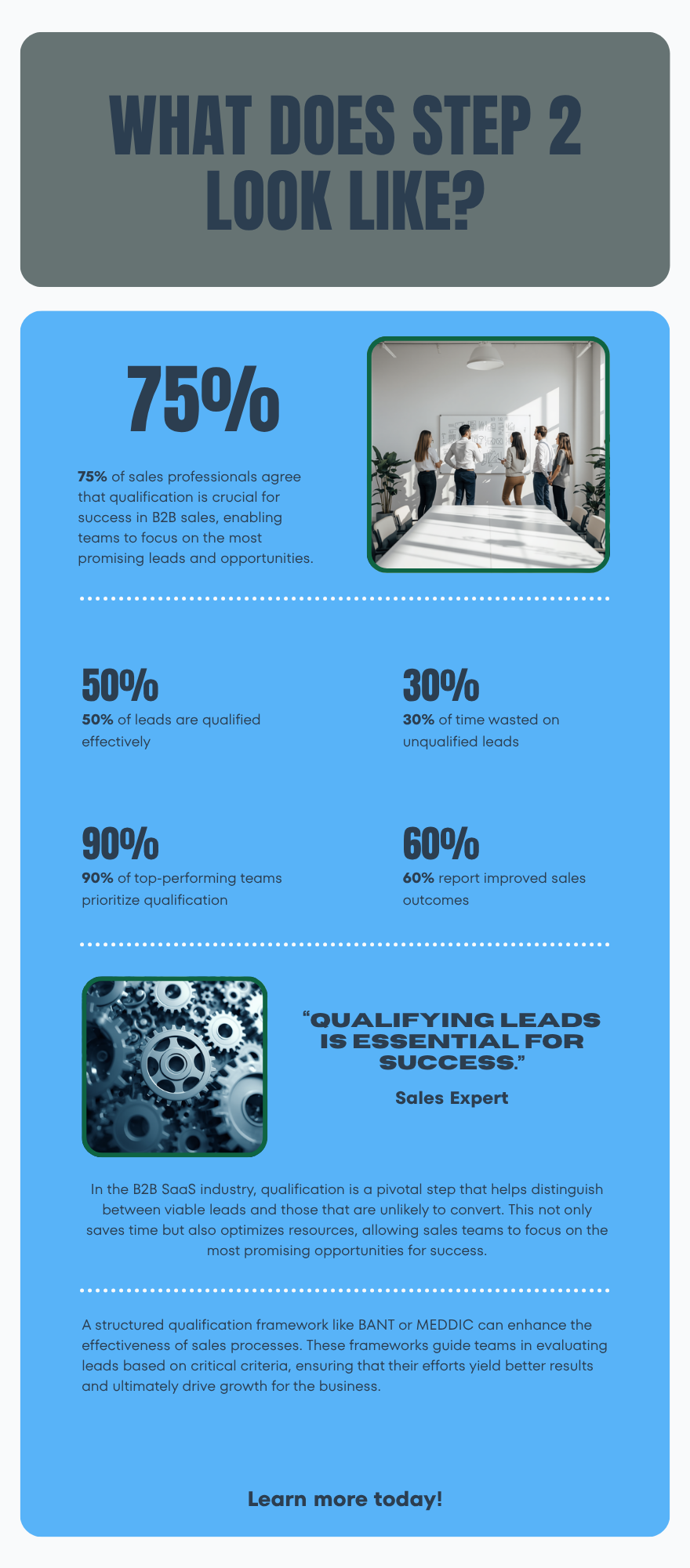
Qualification is the filter that decides whether step 3 happens.
The mistake most reps make is treating qualification as a single discovery call. It is actually a continuous process — every interaction either advances or disqualifies the deal. A useful mental model: by the end of step 2, you should be able to write one paragraph explaining who the buyer is, what specific pain they are paying to solve, who else is involved, and when they want to be live.
Three qualification frameworks dominate B2B sales:
| Framework | Stands for | Best for |
|---|---|---|
| BANT | Budget, Authority, Need, Timing | Transactional / SMB sales |
| MEDDIC | Metrics, Economic buyer, Decision criteria, Decision process, Identify pain, Champion | Mid-market and enterprise |
| CHAMP | Challenges, Authority, Money, Prioritization | Inbound-heavy teams |
| SPICED | Situation, Pain, Impact, Critical event, Decision | PLG and modern SaaS |
The choice matters less than the discipline. A 2024 Salesforce State of Sales report found that reps using any documented qualification framework outperformed unstructured peers by 23% on win rate.
Three questions that disqualify fast:
- "What happens if you do nothing for the next 6 months?" (tests pain severity)
- "Who else needs to bless this besides you?" (tests authority)
- "What is the budget process — annual cycle or discretionary?" (tests money)
What is the right approach to step 3 (pitch and present)?#
The pitch is not your slide deck. The pitch is your buyer's ability to repeat your value to their CFO in 30 seconds.
If your buyer cannot do that after your demo, you have not pitched — you have presented. The fix is structural:
- Open with the buyer's pain in their words, not your value prop.
- Demo the specific workflow that solves that pain, not the full product tour.
- End every demo segment with: "Does that match how you would actually use it?"
- Quantify outcomes with their data, not your case study averages.
A useful rule from the revenue operations playbook: any deal moving from pitch to close should have a written, mutually agreed success criteria document. If you cannot get the buyer to co-author it, you are not in step 3 yet — you are still in step 2.
How do you handle step 4 (objections)?#
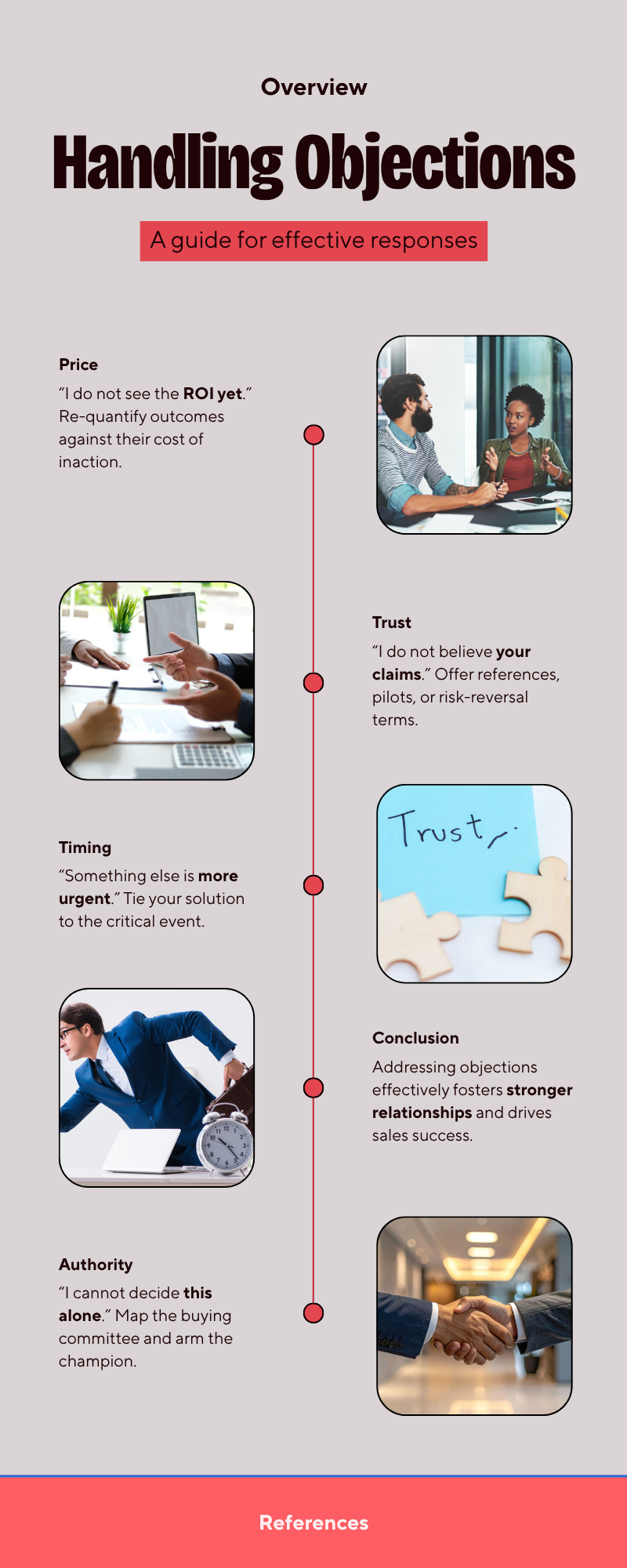
Objections are not rejections. Objections are the buyer telling you what is blocking them from saying yes.
The four objection categories that cover roughly 90% of B2B deals:
| Objection type | What it actually means | What to do |
|---|---|---|
| Price | "I do not see the ROI yet" | Re-quantify outcomes against their cost of inaction |
| Timing | "Something else is more urgent" | Tie your solution to the critical event |
| Authority | "I cannot decide this alone" | Map the buying committee and arm the champion |
| Trust | "I do not believe your claims" | Offer references, pilots, or risk-reversal terms |
The biggest 2026 shift here is that objections often arrive in writing — in a Slack thread the rep never sees, between the champion and procurement. Conversation intelligence and revenue intelligence platforms surface some of these, but the cheapest fix is still to ask the champion: "What questions are coming up internally that I should help you answer?"
What does step 5 (closing) actually involve?#
Closing is administrative if you did steps 1-4 well, and impossible if you did not.
Concrete close mechanics that move deals across the line:
- Mutual close plan — a shared doc listing every step from signature to go-live, with owners and dates.
- Procurement pre-brief — get your contract template, security questionnaire answers, and pricing rationale ready before procurement asks.
- The summary email — after every late-stage call, send a 5-bullet recap. If the buyer corrects a bullet, you just caught a misalignment that would have killed the deal at signature.
- Time-bound concessions — discounts tied to quarter-end signature are normal. Discounts with no expiry teach buyers to wait.
A useful benchmark: in mid-market SaaS, the median time from verbal yes to signed contract is 21 days, per HubSpot's 2025 sales benchmark report. If your deals routinely take 60+ days post-verbal, you have a step 4 problem dressed up as a step 5 problem.
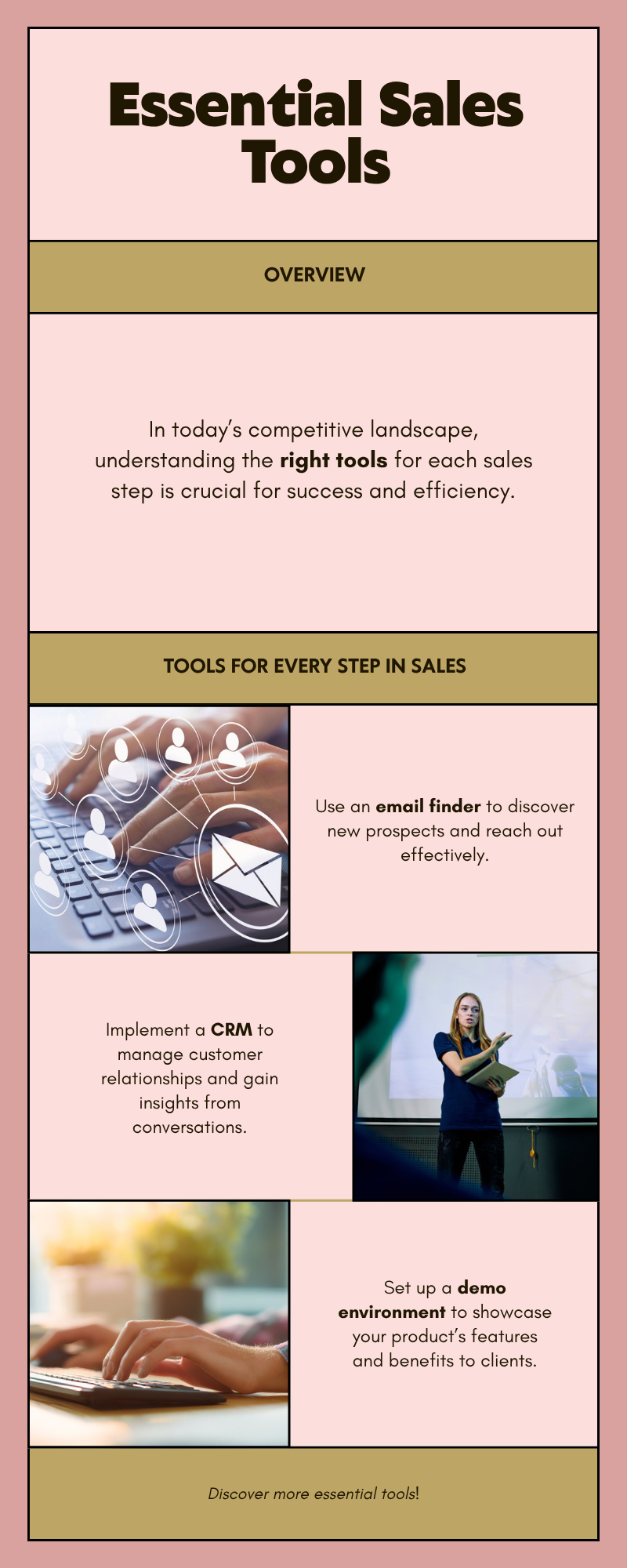
What tools do you need for each of the 5 sales steps?#
| Step | Tool category | What to look for |
|---|---|---|
| Prospect | Email finder + B2B database | Verified emails, real-time refresh, GDPR-compliant sources |
| Qualify | CRM + conversation intelligence | Pipeline stages mapped to your framework, call recording |
| Pitch | Demo environment + content management | Personalized demo data, deck analytics |
| Handle objections | Battlecards + revenue intelligence | Competitor responses, deal risk scoring |
| Close | CPQ + e-sign + mutual action plan | Quote-to-cash automation, shared close plans |
You do not need separate logos for all five. Many teams run prospect + qualify on one stack (data + CRM) and pitch + objections + close on another (sales engagement + CPQ). What you cannot afford is a broken handoff between the two — that is where deals die silently.
For the prospecting end of the stack, see how Tomba compares to alternatives like Apollo and RocketReach. For pricing context across plans, Tomba pricing starts free and scales with credits rather than seats.
How do the 5 sales steps map to pipeline stages?#
The 5 sales steps are what the rep does. Pipeline stages are how the manager forecasts. They overlap, but they are not the same.
A clean mapping:
| Sales step | Pipeline stage | Stage exit criteria |
|---|---|---|
| Prospect | Lead / New | Verified contact, account in ICP |
| Qualify | Discovery / Qualified | Pain confirmed, champion identified |
| Pitch | Proposal / Demo complete | Mutual success criteria signed off |
| Handle objections | Negotiation | Pricing and terms agreed verbally |
| Close | Verbal / Won | Contract signed, kickoff scheduled |
The reason this matters: forecasting accuracy collapses when reps mark a deal "proposal" without exit criteria. A 2025 Forrester study found that companies enforcing exit criteria at every stage forecasted within 8% of actual close, versus 27% variance for teams without.
What are the most common mistakes in each of the 5 sales steps?#
- Step 1: Prospecting from stale lists. If your database has not been re-verified in 6+ months, bounce rates will tank your sender reputation. Run a quick check with a free email checker before launching any campaign.
- Step 2: Skipping disqualification. Reps stay in qualification too long because pipeline coverage targets reward volume, not fit.
- Step 3: Demoing features instead of outcomes. A 45-minute demo with no buyer-stated outcome is a presentation, not a pitch.
- Step 4: Treating objections as the close. The close is what happens after objections clear, not during.
- Step 5: No mutual close plan. Reps who skip the close plan see 30-40% deal slippage past quarter-end.
How long should each of the 5 sales steps take?#
Median B2B SaaS cycle times by deal size, based on 2025 HubSpot and Salesforce benchmarks:
| Deal size | Prospect | Qualify | Pitch | Objections | Close | Total |
|---|---|---|---|---|---|---|
| SMB (<$10K ACV) | 2 days | 3 days | 2 days | 2 days | 5 days | 14 days |
| Mid-market ($10-100K) | 5 days | 10 days | 14 days | 14 days | 21 days | 64 days |
| Enterprise ($100K+) | 10 days | 30 days | 45 days | 30 days | 60 days | 175 days |
If a step is dragging well past the median, it is almost always a sign that the previous step was incomplete. Long objection-handling phases usually mean pitch did not land. Long close phases usually mean objection-handling was rushed.
Conclusion: where to start#
If you take one thing from this: fix step 1 first. Every other step inherits the quality of your prospecting data. A perfect demo to the wrong person is wasted budget; a mediocre demo to a perfectly qualified buyer still closes.
Start by auditing your contact data accuracy this week. Pull a sample of 200 contacts your team plans to email next month and run them through verification. If your bounce rate is above 5%, you are losing deals in step 1 you will never get to step 2 on.
Ready to clean up step 1? Use the Tomba Email Finder to find verified, deliverable B2B emails by domain, name, or company — the free tier gives you 25 searches a month to test the workflow before you commit to a paid plan starting at $49/mo. Pair it with the email verifier for catch-all and full-MX validation, and your top of funnel will finally stop leaking.
// get started
Find, verify and enrich your first contacts today
Start on the free plan with 25 searches a month, then scale when your team is ready.
Free plan · No credit card required · GDPR & CCPA
// about the author