6 Steps of the Sales Process: The 2026 Playbook for B2B Teams
Most reps memorize a sales process, then ignore it. Here are the 6 steps that actually move pipeline in 2026 — with the rituals, tools, and metrics that make each one stick.
TL;DR#
- The 6 steps of the sales process in 2026 are: prospect, qualify, discover, present, close, and retain — every other framework is a remix of these.
- Most teams collapse because step 3 (discovery) is rushed and step 6 (retention) is outsourced to customer success without a handoff.
- Each step needs one owner, one exit criterion, and one metric. Without those three, a process is just a slide.
- Tooling stacks matter less than rituals: a weekly pipeline review beats a $50k CRM upgrade.
- This guide gives you the exit criteria, KPIs, common failure modes, and the tools (including where Tomba fits) for each step.
Sales process diagrams look great in onboarding decks and terrible in the wild. Reps skip steps, managers add steps, and by Q3 the "process" has 14 stages, three of which nobody can define. So let's strip it back.
This is the playbook we'd hand a B2B sales team starting fresh in 2026 — six steps, the questions that gate each one, the metrics that prove it's working, and the failure modes that quietly kill quotas.
Why bother with a formal sales process at all?#
Because unstructured selling is expensive. HubSpot's State of Sales data has consistently shown reps following a documented process win at materially higher rates than ad-hoc sellers, and the gap widens as deal size grows. Pipeline reviews stop being arguments about gut feel and start being arguments about evidence.
A formal sales process gives you four things free-form selling can't:
- Forecastability. Each stage has historical conversion data, so you can predict quarter close within a usable margin.
- Coachability. Managers can intervene at a specific stage instead of vaguely telling reps to "be more consultative."
- Onboarding speed. New hires reach ramp faster because the next action is never ambiguous.
- Handoff quality. Marketing, SDR, AE, CS, and renewals all know where their lane ends.
The trade-off: every stage you add is overhead. That's why we keep it to six.
What are the 6 steps of the sales process?#
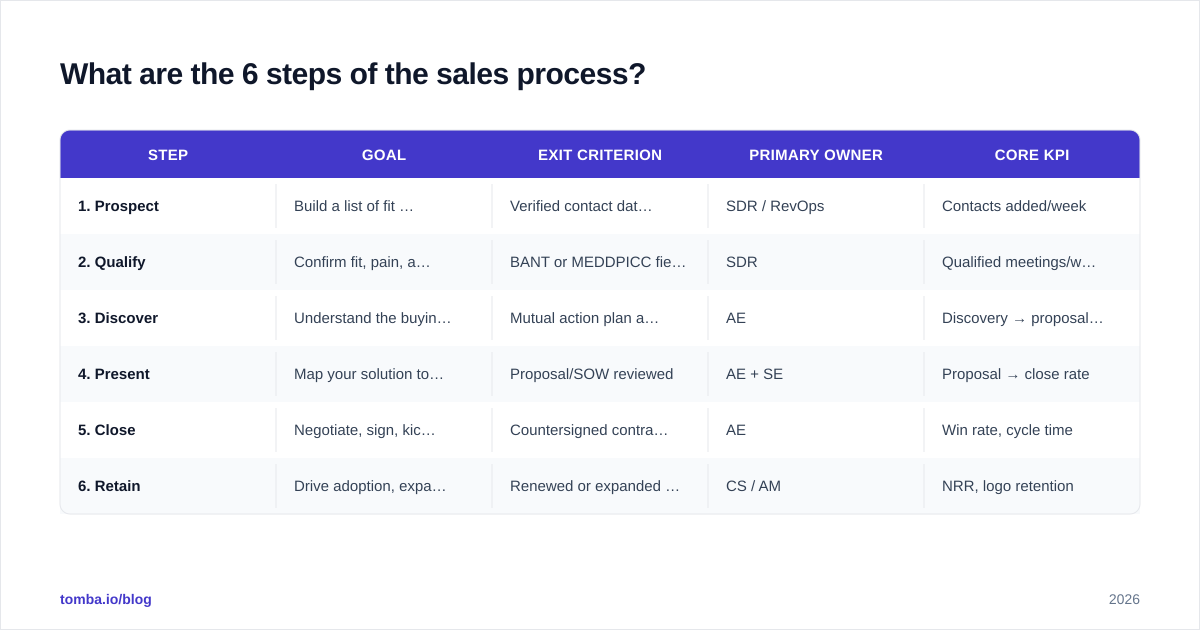
Here they are at a glance, then we'll dig into each one.
| Step | Goal | Exit criterion | Primary owner | Core KPI |
|---|---|---|---|---|
| 1. Prospect | Build a list of fit accounts and contacts | Verified contact data in CRM | SDR / RevOps | Contacts added/week |
| 2. Qualify | Confirm fit, pain, and timing | BANT or MEDDPICC fields filled | SDR | Qualified meetings/week |
| 3. Discover | Understand the buying process and decision criteria | Mutual action plan agreed | AE | Discovery → proposal rate |
| 4. Present | Map your solution to their criteria | Proposal/SOW reviewed | AE + SE | Proposal → close rate |
| 5. Close | Negotiate, sign, kick off | Countersigned contract | AE | Win rate, cycle time |
| 6. Retain | Drive adoption, expansion, renewal | Renewed or expanded contract | CS / AM | NRR, logo retention |
Notice the ownership column. If two people own a step, nobody does.
Step 1: How do you prospect in 2026?#
Prospecting is where most pipeline problems start, because reps confuse "activity" with "accuracy." Sending 400 emails to a scraped list isn't prospecting — it's catch-and-release with your domain reputation.
A 2026 prospecting motion has three layers:
ICP filtering. Start with a tight account list. Industry, size, geography, tech stack, recent funding, hiring signals. Tools like Apollo, ZoomInfo, and Tomba's B2B database let you stack filters until you get a list small enough that every account is genuinely worth working.
Contact resolution. Once you have accounts, you need verified contacts — not a guessed firstname@company.com. Use an email finder to get the address and an email verifier to confirm it deliverable before the first send. Bounce rates above 3% will hurt your sender reputation and torch the whole sequence.
Multi-channel sequencing. Email + LinkedIn + phone, in that order of cost-efficiency. Cold calling isn't dead, but it works best when the prospect has already seen your name in their inbox or feed.
Common failure mode: Reps spend 70% of their day prospecting and 30% selling. If you're paying AE comp for SDR work, fix the org chart.
Exit criterion for step 1: A verified contact, with a documented reason to reach out (trigger event, content engagement, mutual connection), enters the qualification flow.
Step 2: What does qualifying actually mean?#
Qualification is the cheapest stage to lose a deal and the most expensive stage to lose it in. If you disqualify a bad fit at step 2, you save 40 hours. If you disqualify at step 5, you've blown the quarter.
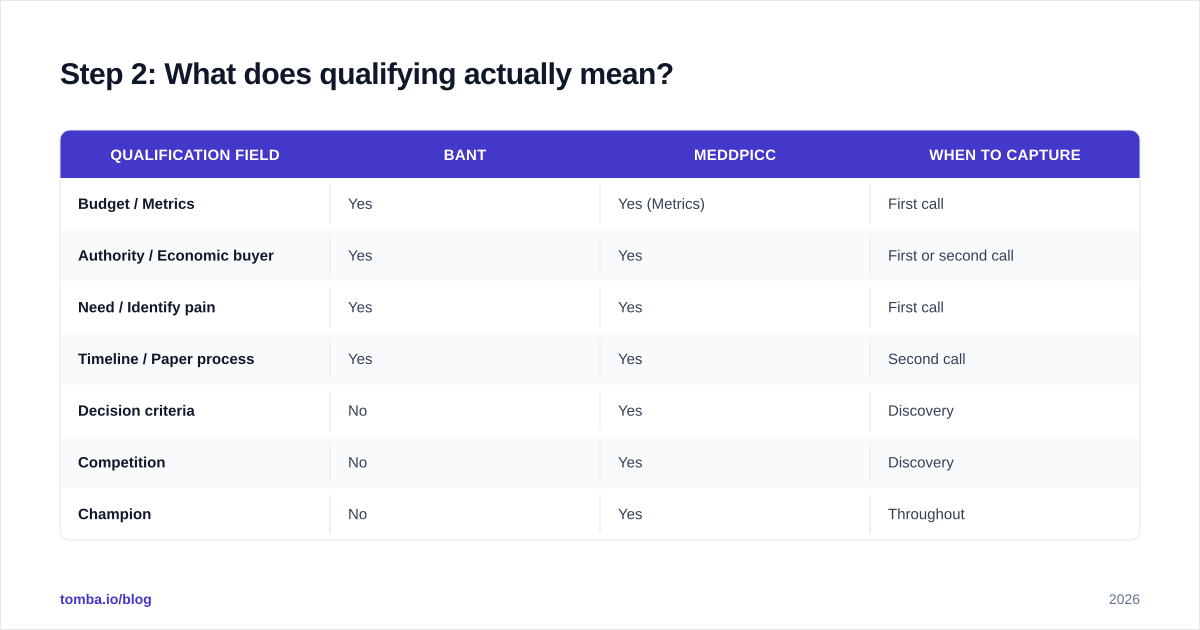
Two frameworks dominate in 2026:
- BANT (Budget, Authority, Need, Timeline) — fast, lightweight, fine for transactional deals under $20k ACV.
- MEDDPICC (Metrics, Economic buyer, Decision criteria, Decision process, Paper process, Identify pain, Champion, Competition) — heavier, designed for enterprise.
Pick one. Don't mix them. Reps with three half-learned frameworks have zero working frameworks.
| Qualification field | BANT | MEDDPICC | When to capture |
|---|---|---|---|
| Budget / Metrics | Yes | Yes (Metrics) | First call |
| Authority / Economic buyer | Yes | Yes | First or second call |
| Need / Identify pain | Yes | Yes | First call |
| Timeline / Paper process | Yes | Yes | Second call |
| Decision criteria | No | Yes | Discovery |
| Competition | No | Yes | Discovery |
| Champion | No | Yes | Throughout |
Exit criterion for step 2: Required fields populated in the CRM, plus a scheduled discovery call. If you can't write a single sentence describing why this prospect should buy now, it's not qualified.
Step 3: How do you run discovery without sounding like an interrogation?#
Discovery is the one step almost every team underweights. It's also the step that determines whether a deal closes at full price or limps to a 40% discount because you never understood what they actually cared about.
Three principles for a 2026 discovery call:
- Earn each question. Front-load value before extracting information. Share an insight from a similar customer, then ask a follow-up that builds on it.
- Anchor on outcomes, not features. "What does this look like in 18 months if it works?" beats "What features do you need?"
- Map the buying group. Single-threaded deals die. Get names, roles, and reporting lines for everyone touching the decision. Tools like Tomba's LinkedIn finder and the reverse email lookup help you fill in the org chart fast.
End discovery with a mutual action plan — a shared document listing every step from now to signature, with dates and owners. If the prospect won't co-author one, they're not a deal, they're a tire-kicker.
Exit criterion for step 3: Mutual action plan signed off, decision criteria documented, demo agenda agreed, multi-threaded into at least two other stakeholders.
Step 4: What goes into a presentation that closes?#
The default sales presentation is a 40-slide product deck. The default sales presentation is also why most deals stall. A 2026 presentation is custom, short, and built backwards from the decision criteria you captured in discovery.
Structure that works:
- Recap (2 slides). What you heard from them. If they nod, you've earned the rest of the time. If they correct you, fix it now before you waste 30 minutes pitching the wrong thing.
- Outcome map (3 slides). For each of their top three criteria, show one screen, one metric, one customer story.
- Why now (1 slide). Cost of doing nothing — quantified.
- What happens next (1 slide). Pricing range, implementation timeline, decision deadline.
Skip the company history. Skip the logo wall. Skip the org chart of your customer success team.
Exit criterion for step 4: Written proposal or SOW delivered, reviewed by the economic buyer, with a verbal acknowledgement of next steps.
Step 5: How do you actually close a B2B deal?#
Closing in 2026 is mostly paperwork management with occasional negotiation theatre. The "always be closing" caricature died about a decade ago. What works now:
- Forecast honestly. If you're calling a deal "commit" but procurement hasn't engaged, you're lying to yourself and your VP. Use a forecast category like "best case" until paper is moving.
- Negotiate on packaging, not price. Discounts trained your prospects to wait. Trade scope, term length, or payment terms before you trade dollars.
- Run a closing checklist. Security review, legal review, procurement, vendor onboarding, MSA vs. order form. Each one is a 1-3 week landmine if you discover it late.
Track your average sales cycle and your win rate by source. If win rate from outbound is half your inbound number, that's not a closing problem — that's a step 2 problem leaking into step 5.
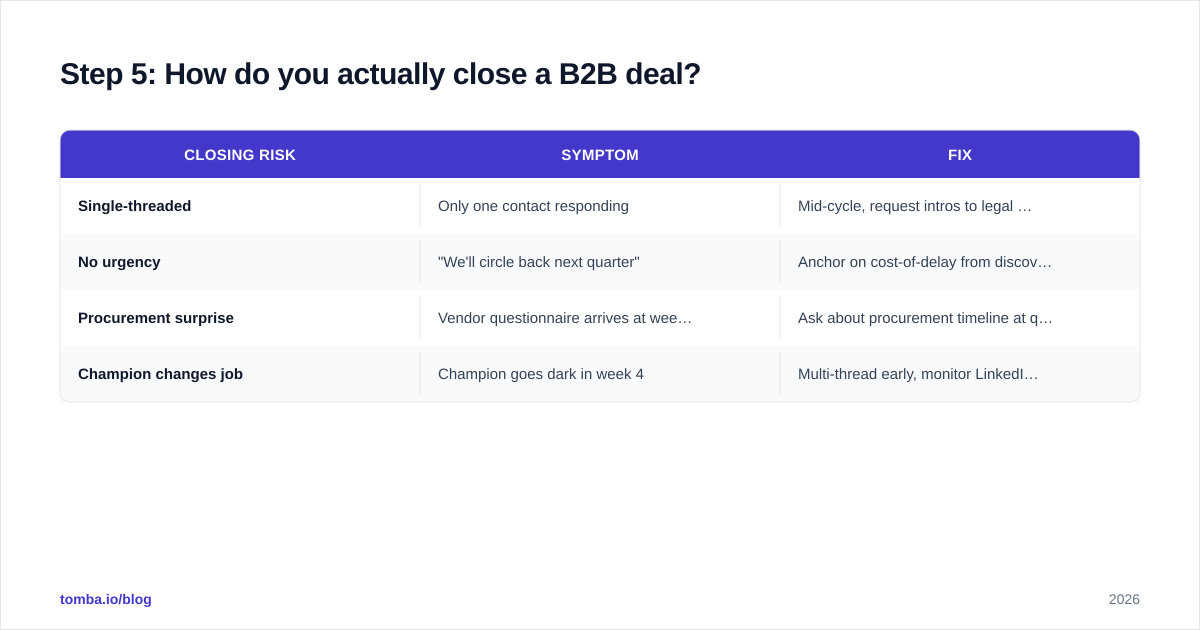
| Closing risk | Symptom | Fix |
|---|---|---|
| Single-threaded | Only one contact responding | Mid-cycle, request intros to legal + finance |
| No urgency | "We'll circle back next quarter" | Anchor on cost-of-delay from discovery |
| Procurement surprise | Vendor questionnaire arrives at week 6 | Ask about procurement timeline at qualification |
| Champion changes job | Champion goes dark in week 4 | Multi-thread early, monitor LinkedIn activity |
Exit criterion for step 5: Countersigned contract and a scheduled kickoff with the customer success team.
Step 6: Why does retention belong in the sales process?#
Because in subscription B2B, the deal isn't closed at signature — it's closed at renewal. Gartner and Forrester research has repeatedly shown net revenue retention is now the single best predictor of enterprise software company valuations. If your sales process ends at "closed-won," your CFO will eventually have a problem.
Retention is technically a customer success motion, but the sales process has to set it up. That means:
- Handoff document. Everything the AE learned in steps 2-5 — pain, criteria, success metrics, stakeholder map — gets passed to CS before kickoff. Don't make the CSM re-interview the customer.
- Defined success metric. What does "working" look like in 90 days? Write it down. Track it.
- Expansion path. If the customer hits the success metric, what's the next product, seat tier, or use case? The AE should know this on day one, not when the renewal countdown starts.
- Renewal ownership. Either the AE or a dedicated renewal manager owns it. "Customer success" alone doesn't have commercial authority.
Use data enrichment to keep the account record fresh — when a champion changes roles, you want to know within a week, not at renewal.
Exit criterion for step 6: Customer renewed or expanded. If neither, you owe yourself an honest post-mortem.
What metrics should you track at each step?#
Don't drown in dashboards. Each step needs one leading metric and one lagging metric.
| Step | Leading metric | Lagging metric | Healthy benchmark (mid-market SaaS) |
|---|---|---|---|
| 1. Prospect | Verified contacts added/week | Meetings booked/rep/week | 5-8 meetings/rep |
| 2. Qualify | Discovery calls scheduled | Qualified opp rate | 30-50% of meetings |
| 3. Discover | Multi-threaded accounts | Discovery → proposal rate | 50-70% |
| 4. Present | Proposals sent | Proposal → close rate | 25-40% |
| 5. Close | Contracts in legal | Win rate, sales cycle | 20-30% overall win rate |
| 6. Retain | Adoption milestones hit | NRR | 110%+ for best-in-class |
If your win rate is 20% and your discovery-to-proposal rate is 80%, you're presenting to deals that aren't real. Tighten step 3. If your win rate is 50% but your meetings/week is 2, you have a top-of-funnel problem, not a closing problem.
What tools do you actually need at each step?#
You don't need 17 tools. You need one tool per category, well-integrated, and rituals that force people to use them.
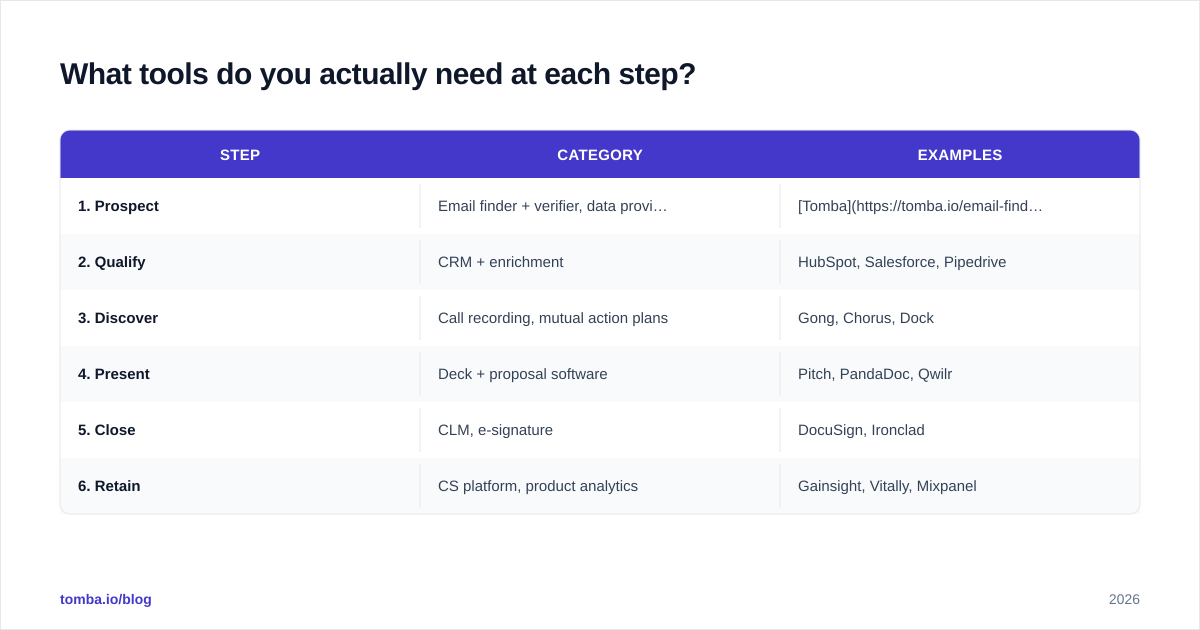
| Step | Category | Examples |
|---|---|---|
| 1. Prospect | Email finder + verifier, data provider | Tomba, Apollo,ZoomInfo |
| 2. Qualify | CRM + enrichment | HubSpot, Salesforce, Pipedrive |
| 3. Discover | Call recording, mutual action plans | Gong, Chorus, Dock |
| 4. Present | Deck + proposal software | Pitch, PandaDoc, Qwilr |
| 5. Close | CLM, e-signature | DocuSign, Ironclad |
| 6. Retain | CS platform, product analytics | Gainsight, Vitally, Mixpanel |
The integration layer matters more than any single tool. If your email finder doesn't push verified contacts directly into your CRM, your reps will copy-paste, and copy-paste is where data goes to die. Tomba's HubSpot integration, Salesforce integration, and Pipedrive integration handle that handoff automatically.
For teams scaling outbound, the bulk email finder lets you enrich a list of 5,000 accounts overnight, so reps spend their morning calling instead of Googling.
How is this different from the 5-step or 7-step models?#
You'll see frameworks ranging from 4 to 10 steps. Most are repackaging the same flow.
| Framework | Step count | What's different |
|---|---|---|
| 4-step (transactional) | Prospect → Pitch → Close → Repeat | No qualification, no retention — works for low-ACV, not B2B |
| 5-step (classic) | Prospect → Qualify → Present → Close → Follow up | Folds discovery into qualification — fine for SMB, weak for enterprise |
| 6-step (this guide) | Prospect → Qualify → Discover → Present → Close → Retain | Separates discovery (the highest-leverage stage) and includes retention as a first-class step |
| 7-step (legacy) | Adds "approach" and "objection handling" | Treats objections as a stage instead of a constant — outdated |
| MEDDPICC stages | 8+ | Qualification framework, not a process — use it inside step 2 |
The right number of steps is the smallest number that captures every decision point. Six is that number for most B2B teams.
What are the most common reasons sales processes fail?#
After auditing dozens of pipelines, five patterns repeat:
- No exit criteria. Stages move forward based on rep optimism instead of evidence. Fix: each stage has a checklist that must be true to advance.
- One owner per stage isn't enforced. "It's a team effort" means nobody is accountable. Fix: name a single owner per stage in your CRM stage definitions.
- Qualification is performative. BANT/MEDDPICC fields get filled with whatever lets the deal advance, not what's true. Fix: managers audit five deals per rep per month.
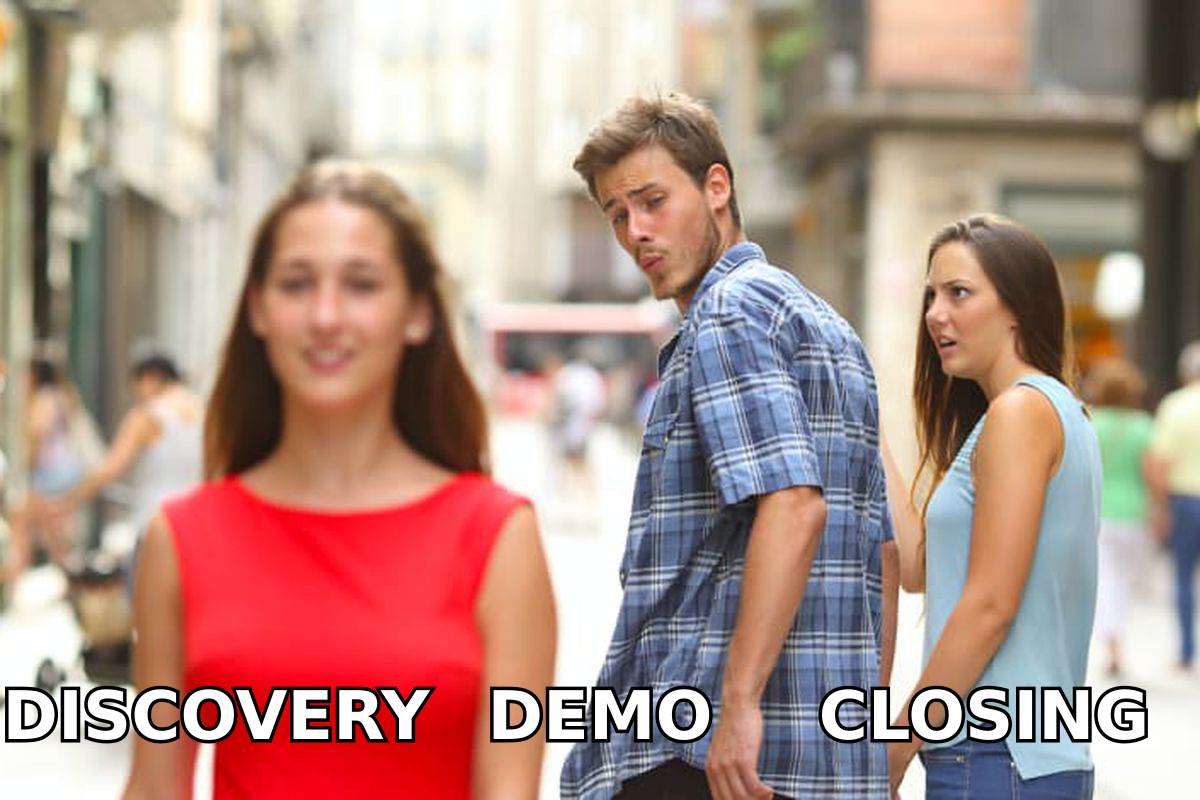
- Discovery is skipped. Reps jump from qualification to demo because demos feel like progress. Fix: no demo until the mutual action plan is signed.
- Retention isn't measured in sales comp. AEs are paid on bookings, not on whether the deal renews. Fix: claw-back or retention bonus on year-two outcomes.
If you fix these five, you've fixed 80% of the gap between your current pipeline and your forecastable pipeline.
How long should each step take?#
It depends on ACV, but here's a reasonable midmarket SaaS baseline ($25-100k ACV).
| Step | Typical duration | Red flag if stuck past |
|---|---|---|
| 1. Prospect | Ongoing | N/A |
| 2. Qualify | 1-2 weeks | 3 weeks (likely not interested) |
| 3. Discover | 2-4 weeks | 6 weeks (no champion) |
| 4. Present | 1-3 weeks | 4 weeks (no economic buyer) |
| 5. Close | 2-6 weeks | 8 weeks (procurement abyss) |
| 6. Retain | Continuous | Day 90 with no adoption signal |
Track cycle time per stage, not just total. A 90-day cycle that spends 60 days in "close" is a paper-process problem. A 90-day cycle that spends 60 days in "discover" is a qualification problem.
Where does Tomba fit in your sales process?#
Tomba sits at step 1 and step 2 — the contact data layer underneath your entire process. If reps can't find verified emails, phone numbers, and LinkedIn profiles for the right people in their ICP, every downstream step inherits that noise.
The Tomba Email Finder gives you accurate contact data on the accounts you're targeting, with verification built in so you're not damaging deliverability before you've earned a reply. Free tier is 25 searches/month, paid plans start at $49/month, and the API plugs into whatever CRM or sequencer you already run. Get the top of your funnel right, and the other five steps get a lot easier.
// get started
Find, verify and enrich your first contacts today
Start on the free plan with 25 searches a month, then scale when your team is ready.
Free plan · No credit card required · GDPR & CCPA
// about the author