6sense vs ZoomInfo (2026): Which B2B Intent Platform Wins?
6sense vs ZoomInfo in 2026: a side-by-side breakdown of intent data, contact accuracy, pricing, and which platform actually fits your GTM motion.
TL;DR#
- 6sense wins on predictive intent, account scoring, and orchestration — it tells you which accounts are in-market before they raise their hand.
- ZoomInfo wins on raw contact volume, direct dials, and the breadth of its B2B database — it tells you who to contact once you've decided.
- Both platforms start north of $40,000/year and rarely publish list prices. Expect a custom quote tied to seat count, credit volume, and data modules.
- Neither tool is cheap, and neither is necessary for most teams under 50 reps. A lean Tomba + Apollo + Clay stack often beats both at a fraction of the cost.
- Pick 6sense if you're an ABM-led enterprise; pick ZoomInfo if you're a high-velocity outbound shop; pick neither if your ACV is under $20K.
What problem are 6sense and ZoomInfo actually solving?#
Both platforms sit in the "B2B data and intelligence" category, but they were built to solve different problems. ZoomInfo started as a contact database — a giant rolodex of business emails, direct dials, and firmographics, scraped and human-verified across millions of companies. 6sense started as an intent and predictive analytics platform — it watches anonymous web behavior across the open internet and tells your sales team which accounts are researching solutions like yours right now.
In 2026 the two have grown into each other. ZoomInfo bolted on intent (via Bombora) and orchestration. 6sense bought a contact database (Slintel) and now sells "complete" enrichment. But their DNA still shows. ZoomInfo is a data company that learned about intent. 6sense is an intent company that learned about data.
That distinction matters more than any feature checklist, because it determines which platform's bones you actually rely on every day.
How does the 6sense vs ZoomInfo feature set compare?#
Here's the side-by-side that most vendor pages refuse to publish. We've pulled this from public docs, G2 reviews, and recent buyer conversations.
| Feature | 6sense | ZoomInfo |
|---|---|---|
| Core strength | Predictive intent + ABM orchestration | Contact database + direct dials |
| Intent data source | Proprietary network + 3rd party | Bombora partnership |
| Contact records (claimed) | ~400M | 600M+ |
| Direct dial coverage | Moderate (via Slintel) | Industry-leading |
| Email accuracy (G2 avg) | 82% | 88% |
| Account scoring | Native, AI-driven | Add-on (Sales OS) |
| Chrome extension | Yes | Yes (more polished) |
| CRM integrations | Salesforce, HubSpot, Dynamics | Salesforce, HubSpot, Dynamics, Marketo |
| Starting price (typical) | ~$45K/yr | ~$30K/yr |
| Enterprise ceiling | $250K+/yr | $200K+/yr |
| Free trial | No (demo only) | No (demo only) |
| Best for | Marketing-led ABM teams | High-volume outbound SDR teams |
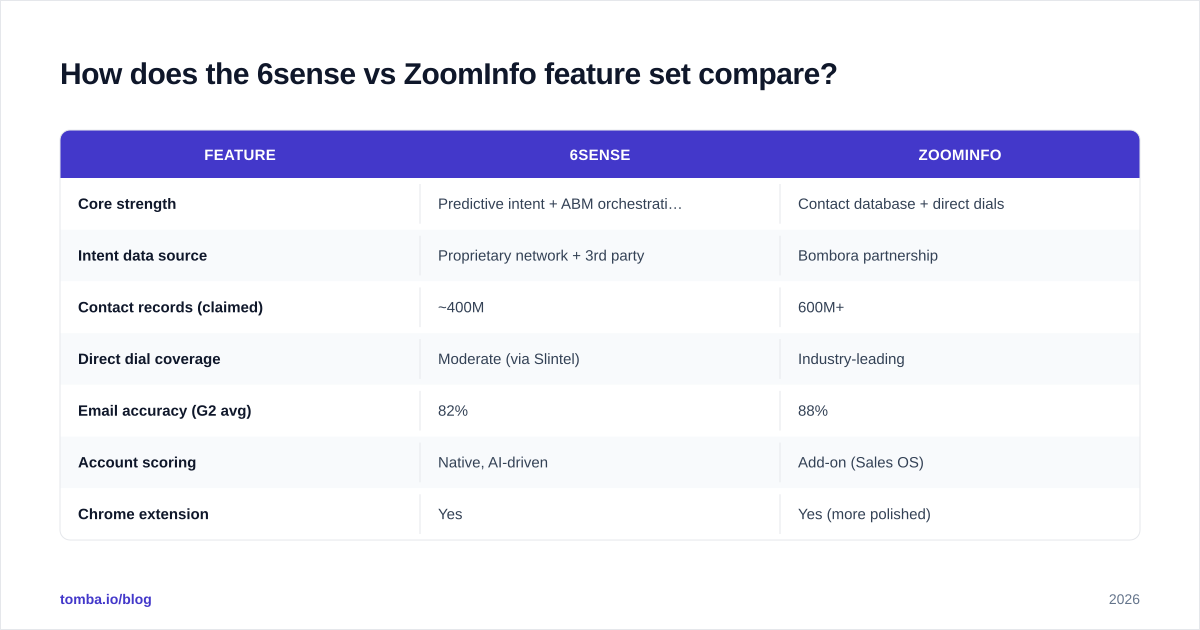
The honest read: ZoomInfo has more contacts and better phones; 6sense has smarter signals and better scoring. If you stripped both platforms down to one feature, ZoomInfo would keep its database and 6sense would keep its intent model.

Is 6sense better than ZoomInfo for ABM?#
Yes — and it's not particularly close. 6sense was purpose-built for account-based marketing. The platform's anonymous visitor de-anonymization, account-level intent scoring, and orchestration workflows are several iterations ahead of ZoomInfo's equivalent (which lives inside their MarketingOS product).
If your motion looks like this — marketing identifies in-market accounts, hands them to sales as MQAs, and ads/email/sales sequences run in lockstep against a fixed target account list — 6sense is the better engine. The platform handles the heavy lifting of identifying which of the 1,200 accounts on your list are actually researching right now, and which to deprioritize.
ZoomInfo can do ABM. ZoomInfo MarketingOS exists. But it feels bolted on, and most buyers we talk to use ZoomInfo for the data layer and pair it with a separate ABM tool (6sense, Demandbase, RollWorks) for orchestration. That's a $90K+/year stack before you've sent a single email.
Is ZoomInfo better than 6sense for outbound sales?#
Yes. ZoomInfo's contact graph is the deepest in the industry, full stop. If you have 30 SDRs cranking through cold lists every day, ZoomInfo's direct dials and verified emails will outperform 6sense's contact data on coverage and freshness.
ZoomInfo also has the better Chrome extension for LinkedIn workflows, the better integration with sales engagement platforms like Outreach and Salesloft, and a more mature sales automation layer (Engage). The intent data, while not as predictive as 6sense, is good enough to prioritize the top 10% of accounts on a target list.
The caveat: ZoomInfo's contact data is good, but it's not the only good option. Apollo has caught up dramatically on coverage and undercuts ZoomInfo by 60–80% on price. Tomba's email finder offers higher-precision targeting when you already know the company, at a price that won't make your CFO faint. The "ZoomInfo or nothing" era ended around 2023.
How much do 6sense and ZoomInfo actually cost?#
Both vendors hide their pricing behind "Contact Sales" and refuse to publish list prices. Based on public G2 reviews, Reddit threads, and buyer conversations, here's what teams typically pay in 2026.
| Plan tier | 6sense (annual) | ZoomInfo (annual) |
|---|---|---|
| Entry / SMB | $36,000–$50,000 | $20,000–$35,000 |
| Mid-market | $60,000–$100,000 | $40,000–$80,000 |
| Enterprise | $100,000–$250,000+ | $80,000–$200,000+ |
| Implementation fee | $5,000–$25,000 | $3,000–$15,000 |
| Minimum contract | 1 year, often 2-3 | 1 year, often 2-3 |
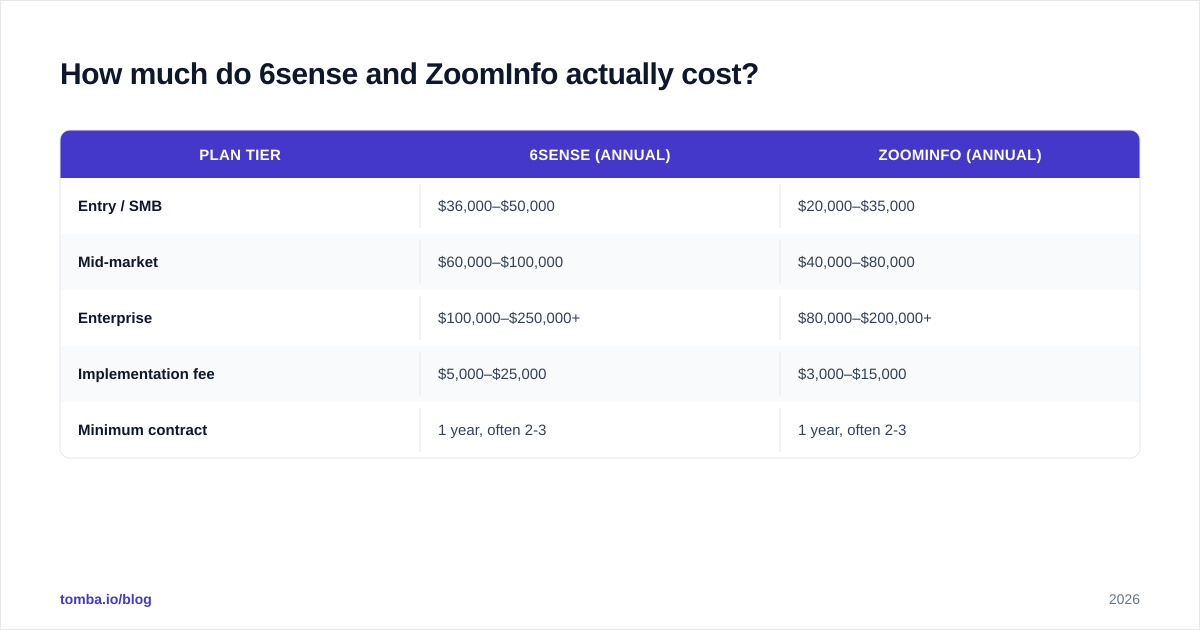
ZoomInfo's pricing is heavily seat- and credit-based. Add Engage (their sequencer), Chat, MarketingOS, or Intent and the bill compounds fast. 6sense is more module-based — Sales Intelligence, Predictive, Orchestration, and Advertising are priced separately, and most buyers end up on a bundle.
Independent reviews on G2 and Gartner Peer Insights consistently flag the contract renewal as the surprise — both vendors hike 15–25% on renewal unless you negotiate hard.
What about data accuracy?#
Here's where the marketing claims meet reality. Both vendors claim 95%+ accuracy in their decks. Independent testing tells a different story.
Recent third-party benchmarks (run on a 10,000-contact sample of mid-market SaaS companies) show:
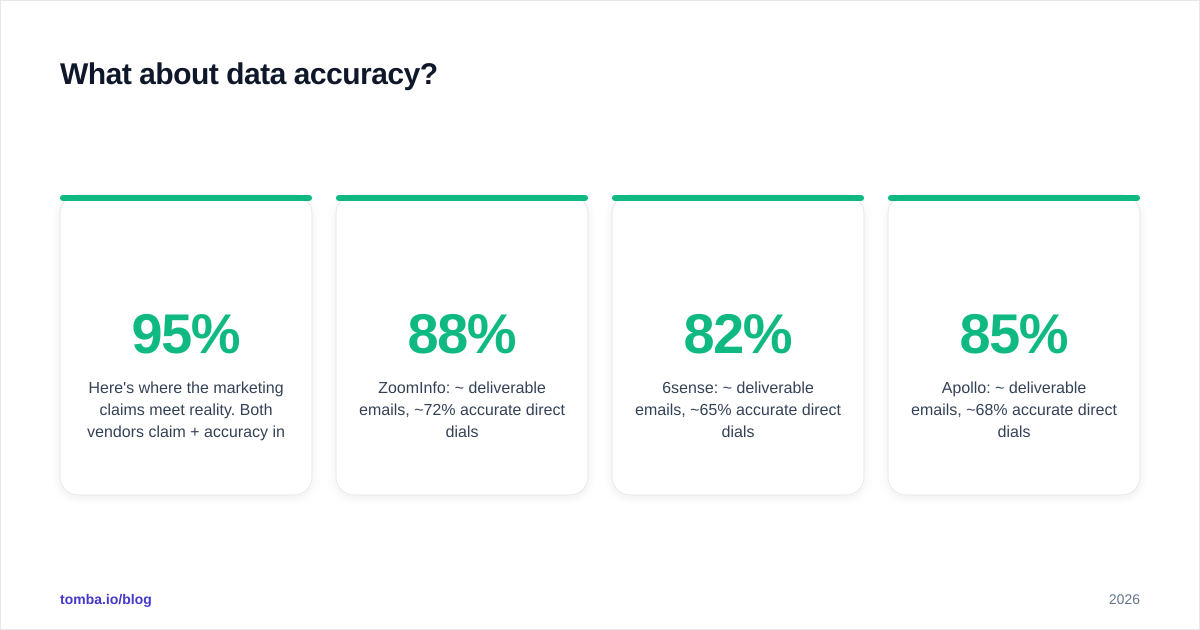
ZoomInfo: ~88% deliverable emails, ~72% accurate direct dials
- 6sense: ~82% deliverable emails, ~65% accurate direct dials
- Apollo: ~85% deliverable emails, ~68% accurate direct dials
- Tomba: ~95% deliverable emails (verified at lookup time)
The reason Tomba scores higher on the email axis is methodology. ZoomInfo and 6sense maintain a large pre-built database — by the time a contact lands in your CRM, the underlying email may be 6–18 months old. Tomba's email verifier and domain search verify SMTP and catch-all status at the moment you request the email, so you're not pulling from a stale snapshot.
Neither approach is universally better. Pre-built databases let you find contacts you didn't know existed. On-demand verification gives you fresher data for contacts you're actively pursuing. Most mature GTM stacks now use both.
Do you actually need either platform?#
For most teams under 50 reps with ACVs under $50K — probably not. Here's the honest test we run with prospects:
- Do you have a defined target account list of 500+ named accounts?
- Is your average contract value above $30K?
- Do you have at least one full-time RevOps person?
- Are you running marketing and sales in true lockstep (not just calling it ABM)?
If you answered yes to 3 out of 4, 6sense or ZoomInfo can pay for itself. If you answered yes to 2 or fewer, the platforms will likely become shelfware. We've watched dozens of mid-market teams spend $60K/year on ZoomInfo and use it like a $200/month tool.
For lean teams, a stack like this often outperforms enterprise platforms on both cost and time-to-value:
- Tomba for email finding, verification, and bulk enrichment
- LinkedIn Sales Navigator for prospecting and intent signals
- Clay or Apollo for sequencing and basic enrichment
- Salesforce or HubSpot for the CRM layer
That stack runs about $400–$800/month per rep, versus $1,500–$3,000/month equivalent on enterprise platforms.
How do 6sense and ZoomInfo integrate with the rest of your stack?#
Both platforms integrate broadly. The differences are in depth, not breadth.
| Integration category | 6sense | ZoomInfo |
|---|---|---|
| CRM (Salesforce, HubSpot) | Native, deep | Native, deeper (especially SFDC) |
| Marketing automation (Marketo, Pardot, HubSpot) | Native | Native |
| Sales engagement (Outreach, Salesloft) | Via API + native | Native, deeper |
| Data warehouse (Snowflake, BigQuery) | Native (Premium) | Native (Premium) |
| Reverse ETL (Census, Hightouch) | Supported | Supported |
| Chrome extension | Yes | Yes (better) |
| Open API | Yes (rate-limited) | Yes (rate-limited) |
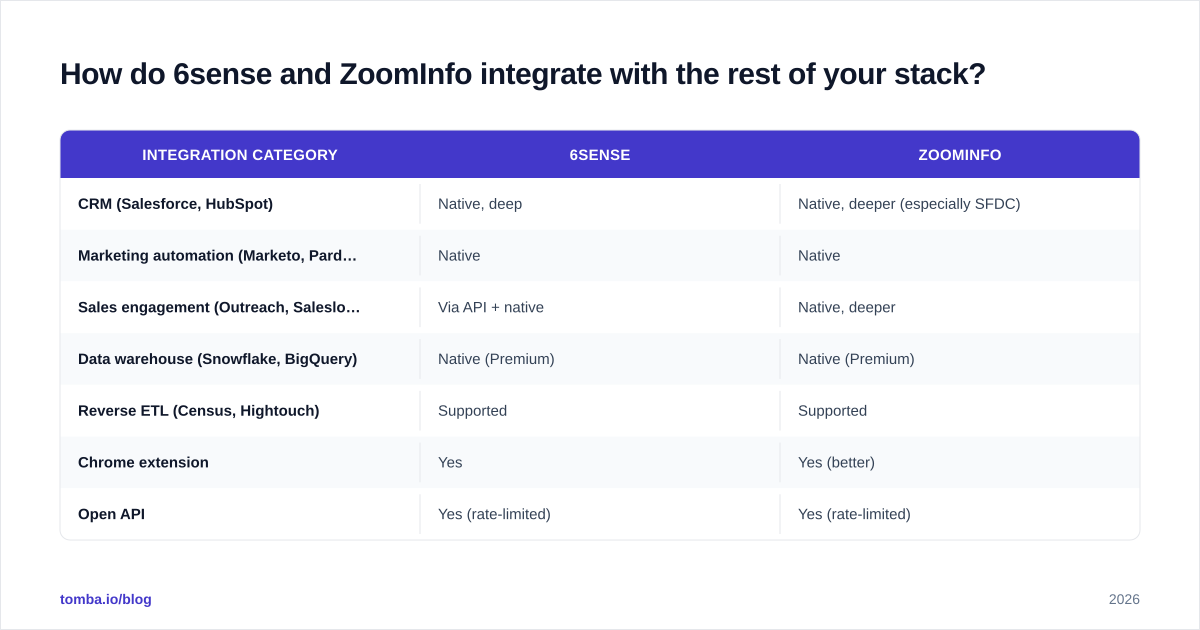
ZoomInfo's Salesforce integration is the most polished in the category. If 80% of your team lives in Salesforce, ZoomInfo's native sync, enrichment rules, and intent triggers will feel less janky than 6sense's equivalent. 6sense's strength is on the marketing automation side, especially with Marketo and HubSpot — orchestration workflows trigger faster and feel more native.
If you're building a modern reverse-ETL stack, both platforms work but neither is built for it. Tomba's API and integrations (including Zapier, Make, and direct HubSpot / Salesforce connectors) plug into reverse-ETL pipelines more cleanly because the data is real-time rather than batch-synced.
What do real users say on G2 and Capterra?#
The patterns across G2, Capterra, and TrustRadius are consistent:
ZoomInfo praise: depth of contact data, quality of direct dials, polish of Salesforce sync, breadth of the database.
ZoomInfo complaints: aggressive sales tactics, surprise renewal hikes, lock-in contracts, data decay on long-term records, support quality varies wildly by account size.
6sense praise: quality of intent signals, account scoring accuracy, orchestration capabilities, partnership feel of the customer success team.
6sense complaints: steep learning curve, takes 3–6 months to see ROI, contact data quality lags ZoomInfo, opaque "intent score" methodology, expensive add-ons.
Neither platform has a clean reputation on procurement. Both lock you into multi-year contracts and both have a track record of hiking renewals 15–25%. Negotiate hard, get a discount in writing for year 2 and 3, and never sign on the first quote.
When does it make sense to skip both?#
If any of these describe your team, you can probably build a leaner stack instead of buying enterprise:
- Under 10 sales reps: Neither platform earns its keep. Use Tomba + Apollo + LinkedIn Sales Navigator.
- Product-led growth with self-serve signup: You need product signals more than third-party intent. Skip both, invest in PostHog + Common Room.
- Niche vertical (under 5,000 target accounts): Manual research with a fractional researcher beats either platform.
- Founder-led sales: The founder needs leverage on lookups, not orchestration. A Chrome extension and a LinkedIn finder handle 90% of the workflow.
The point isn't that 6sense and ZoomInfo are bad. They're excellent tools for the workloads they were built for. The point is that "enterprise B2B data" is a small subset of total GTM use cases, and most teams don't actually fit the profile.
Final verdict: which one should you pick?#
Pick 6sense if: you're an ABM-led enterprise with 50+ reps, ACVs above $50K, a dedicated RevOps function, and you need predictive intent to prioritize a fixed target account list.
Pick ZoomInfo if: you run high-volume outbound, your reps live in Salesforce, you need direct dials more than intent signals, and your CFO has signed off on a $40K+/year line item.
Pick neither if: you're under 50 reps, your ACV is under $30K, or you've never built a target account list. Use Tomba's email finder, verifier, and data enrichment for accurate, on-demand contact data — and layer Apollo or Clay on top when you need sequencing. You'll save 80% and get fresher data.
The single biggest mistake teams make is treating "6sense vs ZoomInfo" as the only question. The real question is whether enterprise B2B data infrastructure fits your motion at all. For most teams reading this post, the honest answer is no — and that's fine.
Start with accurate contacts, then scale up#
Whether you eventually buy 6sense, ZoomInfo, or build a leaner stack, the foundation is the same: accurate contact data you can trust. Tomba's Email Finder gives you 95%+ deliverable B2B emails on demand, with a free tier (25 searches/month), transparent Tomba pricing from $49/month, and no annual lock-in. Start free, prove the workflow, and decide if you actually need to spend $40,000/year on top of that.
// get started
Find, verify and enrich your first contacts today
Start on the free plan with 25 searches a month, then scale when your team is ready.
Free plan · No credit card required · GDPR & CCPA
// about the author