The 8 Steps of the Selling Process: A 2026 Playbook
The 8 steps of the selling process explain how modern reps move strangers to signed deals. Here's the 2026 playbook with examples, tools, and a comparison of old vs new tactics.
TL;DR#
- The 8 steps of the selling process are prospecting, preparation, approach, presentation, handling objections, closing, follow-up, and referral generation.
- In 2026 the framework still works, but each step now leans on data, intent signals, and AI assistants instead of cold dials and gut feel.
- Reps who skip steps (especially preparation and follow-up) lose the deal to competitors who didn't.
- Use a verified contact source, a tight qualification framework, and a documented next-step at every stage — that's where pipeline math actually compounds.
- Skip to the comparison table if you want to see the old playbook vs the 2026 version side by side.
What is the 8-step selling process?#
The 8-step selling process is a repeatable framework that takes a sales rep from "I don't know this company" to "we have a signed contract and a referral." It was codified in mid-20th-century sales training (Dubinsky's "Steps to Successful Selling," later refined by every enterprise sales org from Xerox to Salesforce) and it has held up because the underlying buyer psychology hasn't changed: people still need to be found, understood, convinced, reassured, and serviced.
What has changed is the toolkit. In 1995 a rep ran the eight steps with a phone book, a fax machine, and a yellow legal pad. In 2026 the same rep runs them with intent data, an email finder, a CRM, an AI note-taker, and a sequencer. The steps are identical. The leverage isn't.
Why does this framework still matter in 2026?#
Because pipeline is a math problem, and the 8 steps are the variables. Skip prospecting and your funnel starves. Skip qualification and you waste demos on tire-kickers. Skip follow-up and a competitor who didn't will eat your lunch — the average B2B deal needs five to twelve touches before close, and most reps stop at two.
According to HubSpot's State of Sales research, top-performing reps are 2x more likely to follow a documented sales process than underperformers. The 8-step model is the most widely taught documented process in B2B. If you don't have your own, this is the one to start with.
What are the 8 steps of the selling process?#
Here's the full sequence. Each step has a clear objective, a clear exit criterion, and a clear failure mode if you rush it.
Step 1 — Prospecting#
Objective: Build a list of accounts and contacts that match your ideal customer profile (ICP).
What it looks like in 2026: You define an ICP (industry, headcount, tech stack, region, trigger event). You pull a target account list from a B2B database. You enrich each account with verified work emails and direct phone numbers. You score them by fit and intent before a single outreach goes out.
Tools: An email finder, a B2B database, and intent providers like Bombora or 6sense.
Failure mode: Prospecting from generic scraped lists. You burn your domain reputation, your reps' morale, and your monthly send quota — and you still don't book meetings.
Step 2 — Preparation (Pre-approach)#
Objective: Know enough about the prospect that the first touch doesn't feel like a stranger interrupting their day.
What it looks like in 2026: Before you reach out, you've read the company's last earnings call or funding announcement, scanned their job postings for hiring signals, checked the buyer's LinkedIn for tenure and prior roles, and looked at what stack they run (BuiltWith, Wappalyzer, your own website tech checker).
Exit criterion: You can name one specific reason this account, this person, this week.
Failure mode: "Hi {{FirstName}}, I noticed you're in {{Industry}}…" — the prospect's spam filter has seen that opener 400 times this month.
Step 3 — Approach (First contact)#
Objective: Earn permission for a real conversation.
What it looks like in 2026: A multi-channel sequence — cold email + LinkedIn touch + occasional cold call — sent at human pace, personalized to the trigger you found in Step 2. The first email is short (under 90 words), references the specific trigger, and asks for a small commitment (15 minutes, a reply, a link click).
Tools: A sequencer (Instantly, Smartlead, Outreach), a verified email list to protect deliverability, and SPF/DKIM/DMARC set up correctly.
Failure mode: Spray-and-pray volume without verification. Most cold-outreach disasters start here, not in the copy.
Step 4 — Presentation (Discovery + Demo)#
Objective: Show the prospect a specific picture of their problem solved by your product.
What it looks like in 2026: Discovery first, demo second — never reversed. You run a structured discovery call (BANT, MEDDIC, SPICED — pick one and stick with it), then tailor the demo to the two or three pains the prospect actually surfaced. Generic "feature tour" demos are a 2010 artifact.
Failure mode: Showing the full product. You lose the prospect at minute six because they're hearing about three features they don't need before the one they do.
Step 5 — Handling objections#
Objective: Surface and resolve the real reason the prospect hasn't said yes.
What it looks like in 2026: You categorize objections into one of four buckets — price, timing, authority, fit — and have a documented response pattern for each. Most "price" objections are actually "value" objections; most "timing" objections are actually "priority" objections. Diagnose before you treat.
Failure mode: Discounting on the first objection. You teach the prospect that your price is negotiable, and you teach your CFO that you're a margin problem.
Step 6 — Closing#
Objective: Get a signature on a contract with terms both sides can defend.
What it looks like in 2026: A mutual action plan (MAP) shared with the buyer two to four weeks before close, listing every step required to sign: legal review, security questionnaire, procurement, signature. Close dates that come from a MAP slip half as often as close dates that come from the rep's gut.
Failure mode: "Just checking in to see if you got my last email." That's not a close, that's a haunting.
Step 7 — Follow-up (Onboarding handoff)#
Objective: Make sure the customer realizes value fast enough to renew.
What it looks like in 2026: A formal handoff to customer success with a recorded kickoff call, a documented success plan, and a 30/60/90-day check-in cadence. The sales rep stays involved through the first value milestone — that's where churn risk lives.
Failure mode: Closing the deal and disappearing. Year-one churn is a sales problem, not a CS problem.
Step 8 — Referral generation#
Objective: Turn one closed-won into the seed of the next three.
What it looks like in 2026: Ask for the referral at the moment of peak satisfaction (usually a confirmed value milestone in month two or three), and make it easy — a written intro template, a specific name suggestion, a clear incentive if you offer one.
Failure mode: Never asking. Most reps don't. The ones who do close their next quarter with 20–40% warm pipeline.
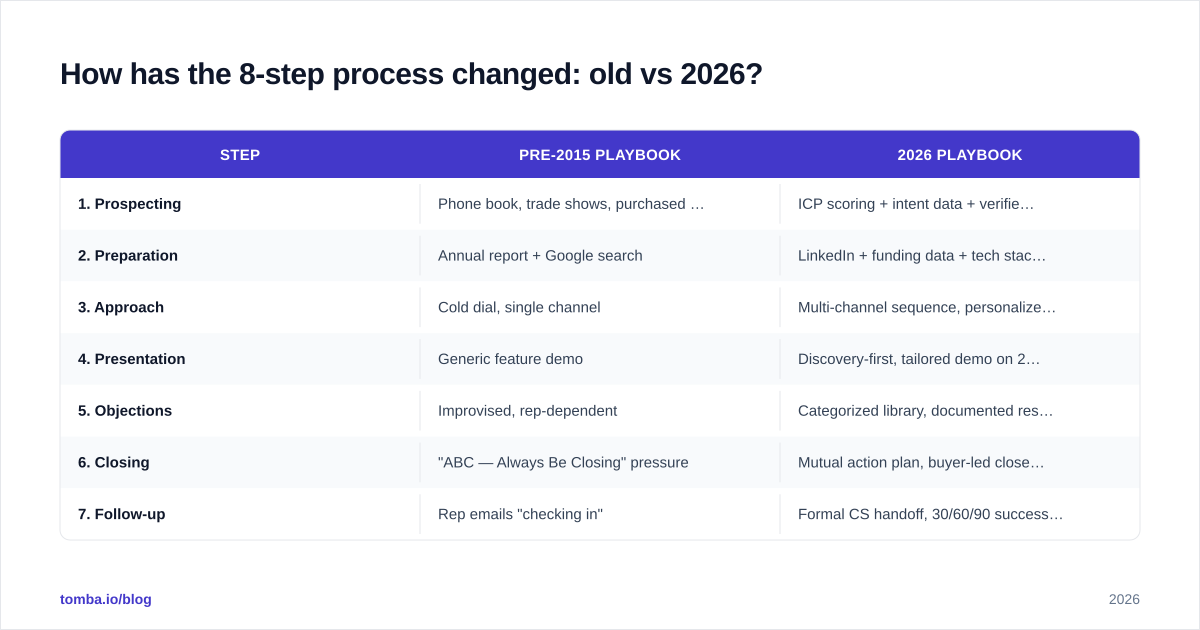
How has the 8-step process changed: old vs 2026?#
Same eight labels, different mechanics at every step. Here's the side-by-side:
| Step | Pre-2015 Playbook | 2026 Playbook |
|---|---|---|
| 1. Prospecting | Phone book, trade shows, purchased lists | ICP scoring + intent data + verified emails |
| 2. Preparation | Annual report + Google search | LinkedIn + funding data + tech stack + trigger events |
| 3. Approach | Cold dial, single channel | Multi-channel sequence, personalized opener, deliverability-protected |
| 4. Presentation | Generic feature demo | Discovery-first, tailored demo on 2-3 pains |
| 5. Objections | Improvised, rep-dependent | Categorized library, documented responses |
| 6. Closing | "ABC — Always Be Closing" pressure | Mutual action plan, buyer-led close date |
| 7. Follow-up | Rep emails "checking in" | Formal CS handoff, 30/60/90 success plan |
| 8. Referral | Maybe at renewal | Asked at peak satisfaction, templated intro |
| Tool stack | Rolodex + spreadsheet | CRM + sequencer + email finder + AI notes |
| Avg. touches to close | 3–5 | 8–12 |
The labels look identical. The underlying tradecraft is unrecognizable.
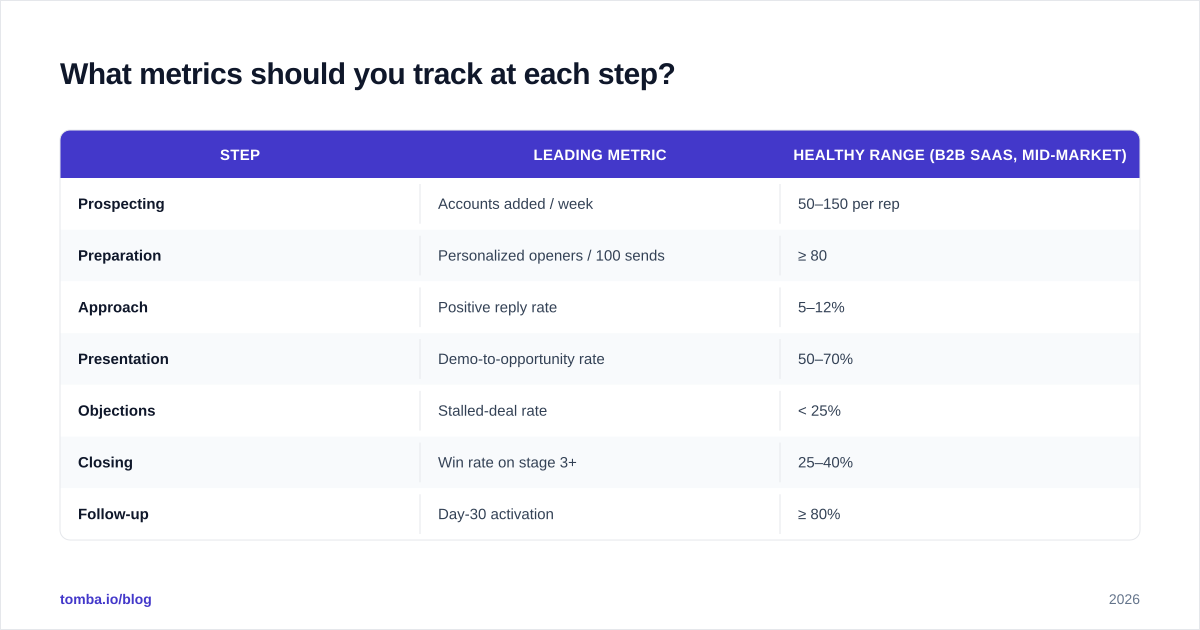
What metrics should you track at each step?#
Each step has a leading indicator that tells you whether the next step will hit its target. If you only measure closed-won, you find out you're broken 90 days too late.
| Step | Leading Metric | Healthy Range (B2B SaaS, mid-market) |
|---|---|---|
| Prospecting | Accounts added / week | 50–150 per rep |
| Preparation | Personalized openers / 100 sends | ≥ 80 |
| Approach | Positive reply rate | 5–12% |
| Presentation | Demo-to-opportunity rate | 50–70% |
| Objections | Stalled-deal rate | < 25% |
| Closing | Win rate on stage 3+ | 25–40% |
| Follow-up | Day-30 activation | ≥ 80% |
| Referral | Referrals / closed-won | 0.3–0.8 |
Build a dashboard with one row per step and a target per metric. Reviews get a lot shorter when "where are we weak?" has a number, not a vibe.
Which tools support each step in 2026?#
You don't need one tool per step — most modern stacks consolidate into four or five platforms covering all eight stages. The shortlist:
| Need | Tools |
|---|---|
| Prospecting + enrichment | Tomba, Apollo, ZoomInfo, Tomba alternatives to Apollo |
| Email verification & deliverability | Tomba, ZeroBounce, email verifier |
| Sequencing & cadence | Instantly, Smartlead, Outreach, Salesloft |
| CRM | HubSpot, Salesforce, Pipedrive |
| Conversation intelligence | Gong, Chorus, Fathom |
| Mutual action plans | Dock, Recapped, Aligned |
A clean prospecting layer is the highest-leverage choice you'll make. A bad list breaks every step downstream — deliverability, demo quality, even your closer's pipeline math. Compare the major options on G2's email-finder category before you commit.
What's the most common mistake reps make?#
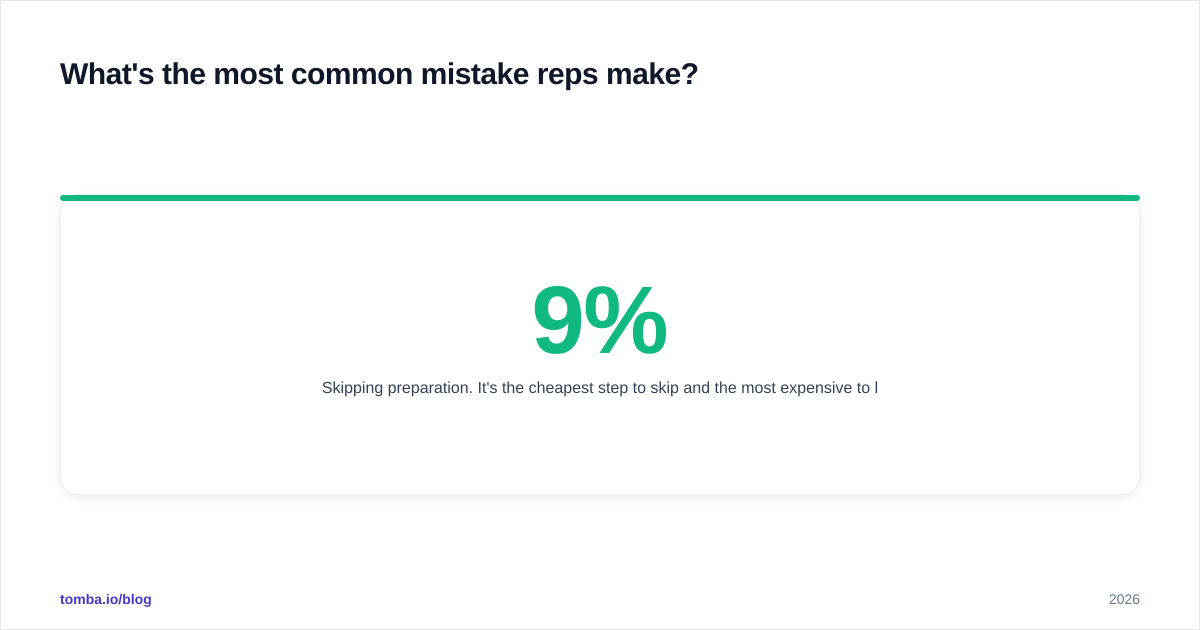
Skipping preparation. It's the cheapest step to skip and the most expensive to lose — a 90-second LinkedIn check before an outbound email is the difference between a 9% reply rate and a 1% reply rate.
The second most common: declaring victory at "closed-won" and walking away from follow-up. Renewal revenue is 2-5x cheaper to acquire than new logos. Sales reps who treat onboarding as somebody else's problem cap their own commission ceiling.
How do you implement this in a small team?#
If you're a 1–5 person sales team, don't try to build the full stack on day one. Implement in this order:
- Document the ICP in one page. Industry, headcount, tech, trigger, budget signal.
- Stand up clean prospecting. A verified email finder + a CRM is enough for the first 90 days.
- Write one sequence per persona. Three emails, two LinkedIn touches, one optional call.
- Pick a discovery framework. SPICED is the easiest one to teach.
- Build an objection library from your last 20 lost deals — read the notes, group the reasons, write a 3-sentence response to each.
- Adopt a MAP template. A shared Google Doc works for the first year.
- Schedule the CS handoff. Put it on the calendar before the contract is countersigned.
- Ask for referrals on a cadence. Day 60 and day 180 by default.
You'll know it's working when the metrics in the table above stop being vibes and start being numbers.
How does Tomba fit into the 8-step process?#
Tomba sits at Step 1 and Step 3 — the foundation of the entire pipeline. The Tomba Email Finder returns verified work emails (with confidence scores and SMTP-level checks) so your sequencer never wastes a send on a bounce. The domain search maps every employee on a target account in one query, which is the fastest way to build an ICP-matched contact list. And the bulk email finder lets you process a list of 1,000 target accounts in minutes instead of weeks.
Tomba pricing starts free (25 searches/month, no card), then $49/month Starter, $99/month Growth, and $249/month Pro — competitive with every comparable email-finder vendor in the category, and cheaper than the enterprise databases that bundle a sequencer you'll never use.
If your funnel is leaky at Step 1 — bad list, bounces, low reply rates — that's the highest-ROI place to fix things. Start a free trial of the Tomba Email Finder, feed verified contacts into your sequencer, and watch the rest of the 8-step machine actually start to move.
// get started
Find, verify and enrich your first contacts today
Start on the free plan with 25 searches a month, then scale when your team is ready.
Free plan · No credit card required · GDPR & CCPA
// about the author