The 80/20 Rule in Sales 2026: Pareto Playbook for Reps
The 80/20 rule says 80% of revenue comes from 20% of accounts. Here's how top reps in 2026 use Pareto to cut prospecting time and double quota attainment.
The 80/20 Rule in Sales 2026: Pareto Playbook for Reps
TL;DR
- The 80/20 rule in sales (Pareto principle) says roughly 80% of revenue, deals, and referrals come from 20% of accounts, reps, and activities.
- In 2026, the rule is sharper than ever: AI-assisted prospecting amplifies the gap between top reps and the rest, and bloated CRMs hide the 20% that actually matter.
- Apply it in four places: accounts you target, reps you coach, activities you do daily, and content you reuse.
- The trap: most teams identify the top 20% but keep spending 80% of their time on the wrong 80%.
- Use a tight ICP, contact-level enrichment, and quarterly account scoring to keep your 20% list honest.
What is the 80/20 rule in sales?#
The 80/20 rule in sales is the application of the Pareto principle — Vilfredo Pareto's 1896 observation that 80% of effects come from 20% of causes — to revenue, pipeline, and activity. It's not a law. It's a heuristic. The actual split in your business might be 70/30, 90/10, or in elite outbound teams, closer to 95/5.
Three places where it shows up reliably:
- Revenue concentration: ~20% of customers produce ~80% of ARR.
- Rep performance: ~20% of reps close ~80% of new business.
- Activity ROI: ~20% of your prospecting activities generate ~80% of meetings booked.
If you've ever exported a CRM "closed-won" report and stack-ranked deals by ACV, you've already seen the curve. The top sliver dominates. The rest is noise dressed up as pipeline.
Why does the Pareto principle apply so strongly to B2B sales?#
B2B sales is a power-law game, not a normal distribution. Three structural forces concentrate outcomes:
- Network effects on buyer side. Enterprise buyers cluster. Once you land one Fortune 500 logo in a vertical, the next three are warmer than 100 cold accounts in an unrelated vertical.
- Compounding rep skill. A rep with a slightly better opener gets a slightly higher reply rate, which means more meetings, which means more reps, which means a better opener next month. Small advantages compound.
- Data quality decay. Most CRM rows are stale within 18 months. The 20% that's freshly enriched and verified is where deals actually live. If you're not running a proper email verifier over your list quarterly, your 80% is even worse than the math suggests.
This is why "more pipeline" rarely solves the problem. More bad pipeline just dilutes the 20%.
Where does the 80/20 rule show up in your sales org?#
Five places, ranked by financial impact:
1. Customer revenue concentration#
Pull your last 12 months of closed-won. Sort by ACV. The top quintile almost always covers 70-85% of total revenue. These are the accounts that deserve a real ABM motion — named SDR, custom landing pages, executive sponsor.
2. Rep contribution#
In most teams of 10+ AEs, two or three reps carry the quarter. The bottom half barely covers their fully-loaded cost. The Bridge Group's annual reports have shown this for over a decade.
3. Pipeline activity#
Of 100 cold emails sent, maybe 20 get opened, 5 reply, 1 books. The same Pareto curve hides inside every funnel stage. Audit your sequences and you'll find one variant doing the heavy lifting.
4. Lead source ROI#
If you track sources honestly, one or two channels (LinkedIn outbound + referrals, or paid search + content) usually produce 80% of qualified meetings. The rest are vanity.
5. Time allocation#
This is the brutal one. Most reps spend 80% of their day on the 80% of accounts that will never close. Calendars are upside down.
How do you find your top 20% accounts?#
Stop guessing. Score them.
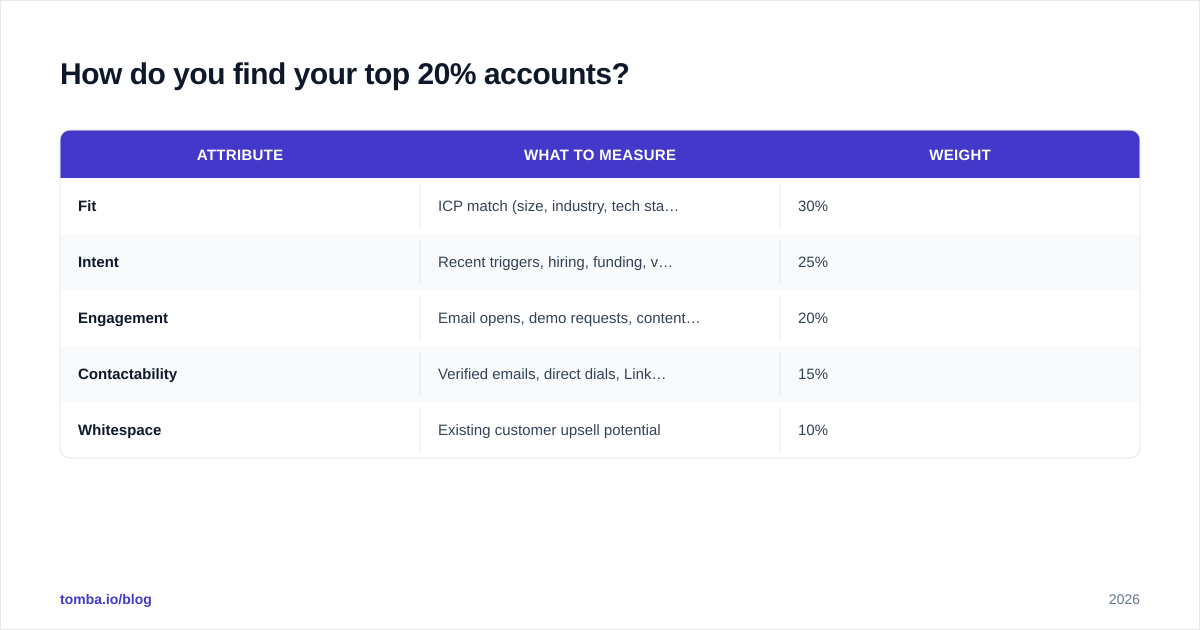
A workable scoring rubric in five attributes, each 1-5:
| Attribute | What to measure | Weight |
|---|---|---|
| Fit | ICP match (size, industry, tech stack) | 30% |
| Intent | Recent triggers, hiring, funding, visits | 25% |
| Engagement | Email opens, demo requests, content downloads | 20% |
| Contactability | Verified emails, direct dials, LinkedIn presence | 15% |
| Whitespace | Existing customer upsell potential | 10% |
Anything ≥ 18 of 25 is a Tier 1 account. That list — usually 15-25% of your TAM — is where 80% of your team's effort should land. The rest get nurture sequences or auto-tiered down.
To run this monthly without a 6-figure RevOps team, you need clean contact data feeding the scoring engine. That's where an email finder plus data enrichment pulls the weight — you can't score a contact you don't have a verified email for.
How do top reps apply the 80/20 rule daily?#
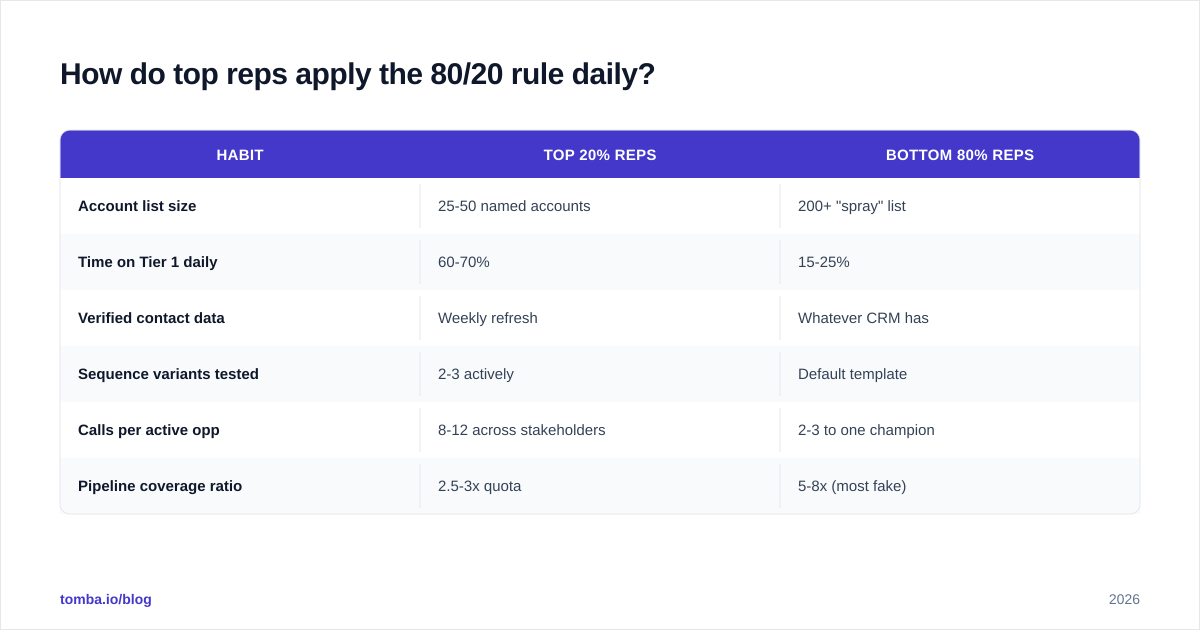
The behavior of top-quintile AEs in 2026, based on observation across SaaS teams:
| Habit | Top 20% reps | Bottom 80% reps |
|---|---|---|
| Account list size | 25-50 named accounts | 200+ "spray" list |
| Time on Tier 1 daily | 60-70% | 15-25% |
| Verified contact data | Weekly refresh | Whatever CRM has |
| Sequence variants tested | 2-3 actively | Default template |
| Calls per active opp | 8-12 across stakeholders | 2-3 to one champion |
| Pipeline coverage ratio | 2.5-3x quota | 5-8x (most fake) |
Notice the counterintuitive ones: top reps have less pipeline coverage and fewer accounts. They're not playing a volume game. They're playing a concentration game.
What activities should you stop doing?#
The 80/20 rule is as useful as a stop-doing list as it is a start-doing list. Cut these:
- Manually researching emails one at a time. Use a bulk email finder and reclaim 5+ hours a week.
- Sending the same sequence to all account tiers. Tier 1 gets handcrafted, Tier 2 gets templated, Tier 3 gets automated. No exceptions.
- CRM hygiene theater. Cleaning 4,000 stale records helps no one. Archive everything older than 18 months, then run a catch-all verifier over what remains.
- Discovery calls with low-fit prospects. A 30-minute call you should have disqualified in pre-call research is a tax on your top 20%.
- Forecast meetings about Tier 3 deals. If a deal isn't in your top 20% of expected revenue, it doesn't need a weekly slot.
Is the 80/20 rule the same as the Pareto principle?#
Yes and no. The Pareto principle is the underlying statistical observation (a power-law distribution where a small portion of inputs drives most of the output). The 80/20 rule is the colloquial label and rule of thumb. The actual numbers vary — Joseph Juran, who popularized Pareto in management, called it the "vital few and the trivial many."
For deeper context, the Pareto principle Wikipedia entry covers the original economic data on land ownership, and HubSpot's guide on Pareto in sales walks through the management application.
How does 80/20 apply to sales coaching?#
If 20% of your reps drive 80% of revenue, the temptation is to over-invest in the stars. That's a mistake.
The leverage is in the middle 60% — reps who already get product, already hit ~70% of quota, and who could move up a tier with focused coaching. The bottom 20% you either ramp or replace; coaching them rarely shifts the curve.
Concretely:
- Top 20%: Get out of their way. Remove blockers. Hand them better accounts.
- Middle 60%: 1:1 coaching weekly, ride-alongs, sequence reviews. This is where the dollar of coaching returns the most.
- Bottom 20%: 30-60-90 PIP with clear, measurable activity and outcome thresholds. No mystery.

What's the 80/20 rule for cold outbound in 2026?#
Outbound has gotten harder. Reply rates that were 8-12% in 2022 are 1-4% on cold lists in 2026. The Pareto skew is sharper, not weaker.
The 2026 outbound 80/20 playbook:
- 20% of your TAM is reachable right now. The rest are out-of-market. Don't email them — wait for an intent signal.
- 20% of your messaging variants will do 80% of the work. Run weekly A/B tests on subject lines and openers, kill the losers ruthlessly.
- 20% of your channels are working. For most B2B teams in 2026, that's LinkedIn DMs + verified email + occasional phone. SMS is dead. Cold InMail is dying.
- 20% of your contact data is the only data you should trust. Catch-all domains, role-based emails, and unverified guesses pollute the rest. Use a proper domain search flow.
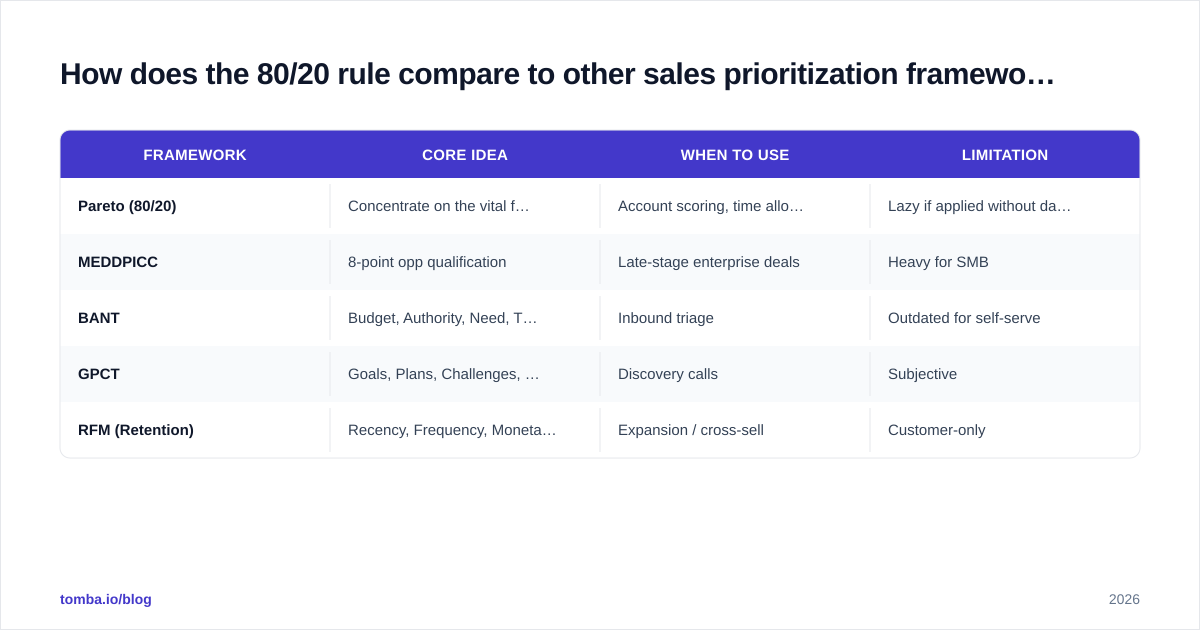
How does the 80/20 rule compare to other sales prioritization frameworks?#
| Framework | Core idea | When to use | Limitation |
|---|---|---|---|
| Pareto (80/20) | Concentrate on the vital few | Account scoring, time allocation | Lazy if applied without data |
| MEDDPICC | 8-point opp qualification | Late-stage enterprise deals | Heavy for SMB |
| BANT | Budget, Authority, Need, Timing | Inbound triage | Outdated for self-serve |
| GPCT | Goals, Plans, Challenges, Timeline | Discovery calls | Subjective |
| RFM (Retention) | Recency, Frequency, Monetary | Expansion / cross-sell | Customer-only |
The 80/20 rule isn't a replacement for these — it's the meta-layer. You use Pareto to decide which accounts deserve a MEDDPICC review at all.
What are the common mistakes when applying the 80/20 rule?#
- Confusing concentration with complacency. "20% of customers drive 80% of revenue" is also a churn risk warning. Losing one account in the top quintile can wipe a quarter.
- Ignoring the long tail entirely. The bottom 80% is where your future top 20% comes from. Don't kill the nursery — automate it.
- Misreading rep performance. Sometimes the "top 20%" reps just got the best accounts. Normalize for territory before you fire anyone.
- Static lists. Your Tier 1 list 12 months ago is not your Tier 1 list today. Re-score quarterly. Mergers happen. Buying committees turn over. Champions leave.
- Skipping data quality. All Pareto analysis assumes the data is real. If your CRM contact emails are 40% stale (industry average), your scoring is fiction.
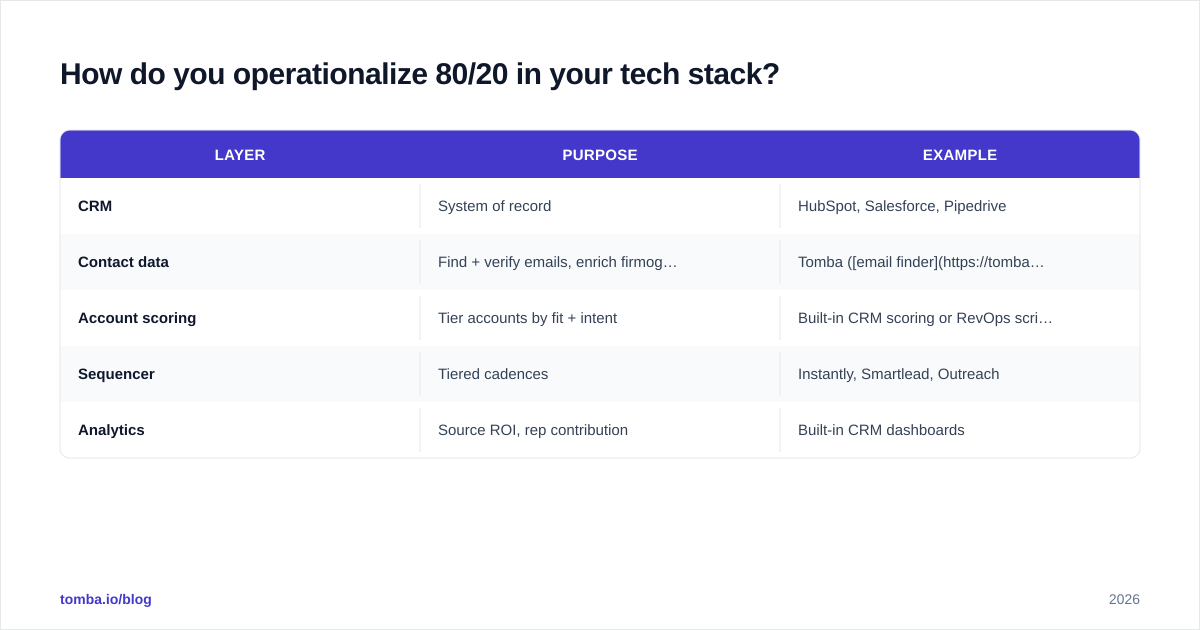
How do you operationalize 80/20 in your tech stack?#
A lean stack in 2026 that supports a Pareto operating model:
| Layer | Purpose | Example |
|---|---|---|
| CRM | System of record | HubSpot, Salesforce, Pipedrive |
| Contact data | Find + verify emails, enrich firmographics | Tomba (email finder, enrichment) |
| Account scoring | Tier accounts by fit + intent | Built-in CRM scoring or RevOps script |
| Sequencer | Tiered cadences | Instantly, Smartlead, Outreach |
| Analytics | Source ROI, rep contribution | Built-in CRM dashboards |
The point is not the logos. The point is that every layer must answer one question: "Is this serving the top 20%?" If a tool serves all accounts equally, it's hiding the curve from you.
Frequently asked questions#
Does the 80/20 rule always apply? It's a heuristic, not a law. Run your own numbers. In subscription businesses with high retention, expect a tighter skew (90/10 is common). In transactional SMB, it's looser (70/30).
Should I fire the bottom 80% of customers? No. Reprice or re-tier them. Bottom-tier customers are often great references, future expansion, or product feedback. Just don't spend AE time on them.
How often should I re-run my 20% analysis? Quarterly for accounts, monthly for activities, weekly for sequence variants.
Is 80/20 just an excuse to be lazy? Only if you skip step one — actually doing the analysis. Reps who "apply 80/20" without ever pulling the data are guessing. That's worse than spraying.
Stop guessing which 20% matters — get verified contact data#
The 80/20 rule only works if your underlying data is real. You can't tier accounts you can't reach, score reps fairly on bad lists, or run A/B tests on dirty domains. Most sales orgs lose 20-40% of their addressable revenue because their CRM thinks a stale catch-all is a valid contact.
Start by getting your top-20% accounts properly enriched. Tomba's Email Finder returns verified, role-targeted contacts at the source level — not guessed permutations — so you can tier accurately, sequence the right people, and stop wasting time on dead inboxes. The free tier covers 25 searches a month, and paid plans start at $49/mo. See full Tomba pricing.
The 80/20 rule rewards teams that act on it. Pull your closed-won export this week, build your Tier 1 list, verify every contact, and put 70% of your calendar against them. Six weeks from now you'll see the curve bend.
// get started
Find, verify and enrich your first contacts today
Start on the free plan with 25 searches a month, then scale when your team is ready.
Free plan · No credit card required · GDPR & CCPA
// about the author