8x8 vs Dialpad in 2026: Which UCaaS Platform Wins?
8x8 vs Dialpad in 2026 — pricing, AI features, call quality, and integrations compared so sales teams pick the right phone platform without surprises.
8x8 vs Dialpad in 2026: Which UCaaS Platform Wins?
Picking a business phone system in 2026 is no longer a question of who has the cheapest seat. It is a question of which AI handles your call notes, which platform survives a global outage, and which one integrates with the CRM your reps actually log into. 8x8 and Dialpad both promise the full unified communications stack — voice, video, SMS, and contact center — but the gap between them shows up the moment a sales team starts dialing.
TL;DR#
- 8x8 wins on global voice coverage, contact center depth, and bundled CCaaS for hybrid sales/support orgs.
- Dialpad wins on native AI quality, ease of setup, and modern UX — best for SMB and mid-market sales teams.
- Pricing is closer than the marketing pages suggest: both start near $15–$30/user/mo, both get expensive at the AI-CCaaS tier.
- Integrations are roughly even with HubSpot and Salesforce; Dialpad has the edge with Gong, 8x8 with Microsoft Teams.
- If you live in a CRM and just need a smart dialer with note-taking AI, Dialpad. If you run a 100-seat contact center across 20 countries, 8x8.
What is 8x8 and what does it actually do in 2026?#
8x8 is one of the older UCaaS vendors — it has been selling cloud phone systems since well before "UCaaS" was a category. The 2026 product is now called the 8x8 Platform for CX, a single stack that bundles unified communications (voice, video, chat, SMS) with a contact center (CCaaS), CPaaS APIs, and an AI layer called Intelligent Customer Assistant.
The core pitch hasn't changed: one platform, one bill, one SLA — across 55+ countries with PSTN replacement.
Real strengths in 2026:
- Global voice quality. 8x8 still owns the "we'll cover your offices in São Paulo, Manila, and Berlin under one tenant" niche.
- Contact center depth. Native omnichannel routing, quality management, workforce engagement, and supervisor coaching all sit in the same admin console.
- Microsoft Teams integration. 8x8 Voice for Teams is a certified direct-routing option that doesn't force users out of Teams.
Weak spots: the UI shows its age, especially the admin console; mobile and desktop apps lag the polish of Dialpad or Zoom; and the AI features feel bolted-on rather than built-in.
What is Dialpad and what's different about it?#
Dialpad is the newer challenger. Founded by ex-Googlers, it shipped one of the first real-time call transcription products in 2017, and that AI-first heritage shows. The 2026 lineup splits into Dialpad Connect (UCaaS), Dialpad Sell (AI sales dialer), Dialpad Support (contact center), and Dialpad Meetings.
Dialpad's calling card is Dialpad Ai (Dialpad's branding, not a typo) — proprietary speech models trained on 6+ billion minutes of business calls. It transcribes live, summarizes in real time, scores sentiment, and surfaces objection-handling playbooks on screen mid-call.
Strengths:
- Best-in-class native transcription. Accuracy beats most third-party transcribers and runs in real time.
- Sales-team UX. Dialpad Sell layered with coaching prompts and CRM auto-logging feels purpose-built for AEs.
- Quick deploys. Most SMBs are live in under a day; admins don't need a partner.
Weak spots: contact center depth is improving but still trails 8x8 and Genuesys; international PSTN coverage is narrower; and the cheapest Dialpad plan locks you out of the AI features that make it interesting.
Is 8x8 better than Dialpad? The honest answer#
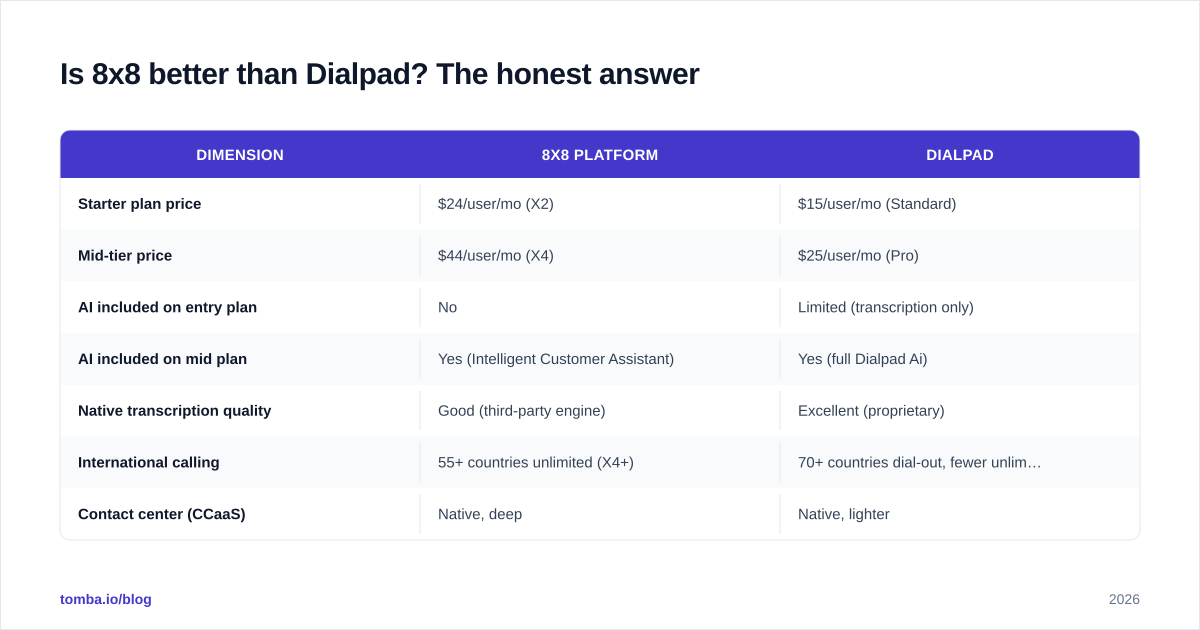
Neither platform is strictly better — they target different buyers. Here is a side-by-side on the dimensions that actually drive switching costs in 2026.
| Dimension | 8x8 Platform | Dialpad |
|---|---|---|
| Starter plan price | $24/user/mo (X2) | $15/user/mo (Standard) |
| Mid-tier price | $44/user/mo (X4) | $25/user/mo (Pro) |
| AI included on entry plan | No | Limited (transcription only) |
| AI included on mid plan | Yes (Intelligent Customer Assistant) | Yes (full Dialpad Ai) |
| Native transcription quality | Good (third-party engine) | Excellent (proprietary) |
| International calling | 55+ countries unlimited (X4+) | 70+ countries dial-out, fewer unlimited |
| Contact center (CCaaS) | Native, deep | Native, lighter |
| Microsoft Teams integration | Certified direct routing | Available, less polished |
| Salesforce integration | Yes | Yes |
| HubSpot integration | Yes | Yes |
| Gong / Chorus | Via API | Native |
| Setup time (50 seats) | 2–4 weeks | 2–5 days |
| Mobile/desktop app polish | Functional | Modern, fast |
| Public uptime SLA | 99.999% | 100% (advertised) |
| Best fit | Hybrid UC+CC, global ops | SMB/mid-market sales teams |
The short version: Dialpad is faster to love, 8x8 is harder to outgrow.
How does 8x8 vs Dialpad pricing compare in 2026?#
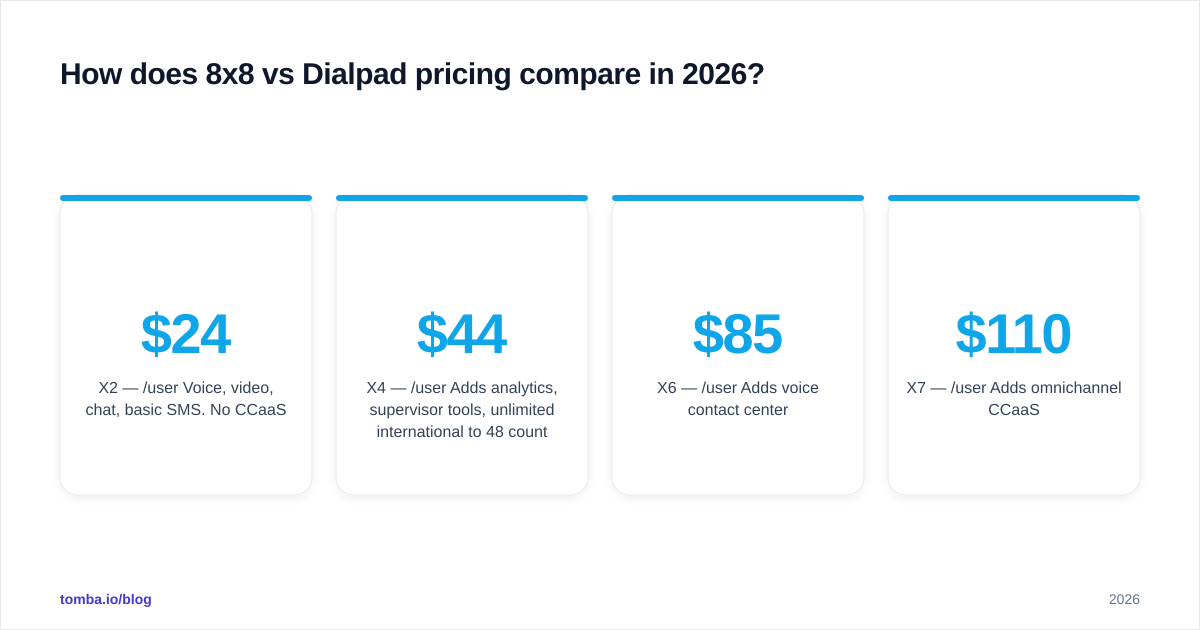
Both vendors moved to "AI is a tax on every seat" pricing in 2025, which makes the entry tiers cheap and the useful tiers expensive. Here are the published rates:
8x8 Platform (2026):
- X2 — $24/user/mo. Voice, video, chat, basic SMS. No CCaaS.
- X4 — $44/user/mo. Adds analytics, supervisor tools, unlimited international to 48 countries.
- X6 — $85/user/mo. Adds voice contact center.
- X7 — $110/user/mo. Adds omnichannel CCaaS.
- X8 — $140/user/mo. Adds quality management + speech analytics.
Dialpad (2026):
- Standard — $15/user/mo (annual). Calling + meetings + SMS.
- Pro — $25/user/mo. Adds CRM integrations, 10 office locations, local numbers in 70+ countries.
- Enterprise — custom (typically $35–$45/user/mo).
- Dialpad Sell — $60/user/mo. Adds coaching, objection handling, sales playbooks.
- Dialpad Support — $80/user/mo. Adds contact center routing + QA.
A 50-seat sales team paying for Dialpad Sell lands around $36k/year. The 8x8 X6 equivalent (voice CCaaS) lands around $51k/year. For pure UC without CCaaS, Dialpad is the cheaper option at every tier.
For more detail on how sales tooling stacks up against communication platforms, check our breakdown of the Apollo alternative landscape — both 8x8 and Dialpad have to live alongside an engagement layer.
Which has better AI features for sales teams?#
If you only read one section, read this one — it is the biggest functional gap.
Dialpad Ai features in 2026:
- Real-time transcription with speaker diarization (95%+ accuracy in clean audio).
- Live sentiment scoring shown to the rep and the manager.
- Real-time coaching cards triggered by keywords ("price", "competitor X", "discount").
- Auto-generated call summaries pushed to Salesforce/HubSpot.
- Ai Recap on Dialpad Meetings — action items, decisions, next steps.
- Ai Playbooks — track whether reps followed the script ("Did they discover budget? Y/N").
- Ai Scorecards — auto-QA every call against a rubric.
8x8 AI features in 2026:
- Post-call transcription and summarization (third-party engine, English-first).
- Intelligent Customer Assistant — IVR-style bot for customer self-service.
- Speech analytics on the X8 plan — keyword spotting, trend reports.
- Conversational IVR for inbound routing.
- Agent assist (suggested responses, knowledge base lookup) — newer, less mature.
The pattern: Dialpad's AI is built for the rep at the point of the conversation. 8x8's AI is built for the supervisor reviewing trends after the fact. Different jobs.
If you want to layer AI workflows around either platform — auto-prospecting from a transcript, enrichment off a captured email — the Tomba API is the kind of glue you'd typically add. Both 8x8 and Dialpad expose webhooks for end-of-call events that make this trivial.
Is 8x8 or Dialpad better for outbound sales?#
For outbound, Dialpad Sell is the more focused product. Three reasons:
- Power dialer with local presence. Reps see local-area numbers chosen automatically.
- CRM logging that actually works. Salesforce/HubSpot fields get populated from the transcript, not the rep.
- Coaching in the rep's ear, not just the manager's dashboard. A rep new to the script doesn't have to remember 14 objections — Dialpad surfaces the right rebuttal on screen.
8x8 can do outbound — the X4 plan has a dialer and Salesforce integration — but it is not the product's center of gravity. You can build an outbound stack on 8x8; Dialpad is one out of the box.
If your bottleneck is finding contacts rather than calling them, pair either platform with an email finder and a phone finder so reps aren't dialing stale lists.
How do call quality and reliability compare?#
Both vendors publish 99.999%+ uptime. The real test is what happens during an incident.
8x8 routes calls through 35+ data centers globally with active-active failover. The last major incident was a regional Asia-Pacific outage in 2023; recovery was inside 90 minutes. The X-series carriers Tier-1 voice routes in most markets, so PSTN quality is consistent.
Dialpad runs on Google Cloud Platform with multi-region failover. Its public status page in 2026 shows fewer than 10 hours of degraded service across the year — solid, but call quality on international long-distance is more variable because Dialpad relies more heavily on internet routes than dedicated PSTN.
For a sales team in one country dialing prospects in the same country, the difference is invisible. For a support org handling inbound from 20+ countries, 8x8 still wins on consistency.
You can verify their public status pages directly at status.8x8.com and status.dialpad.com — both are transparent.
What do reviewers actually say on G2?#
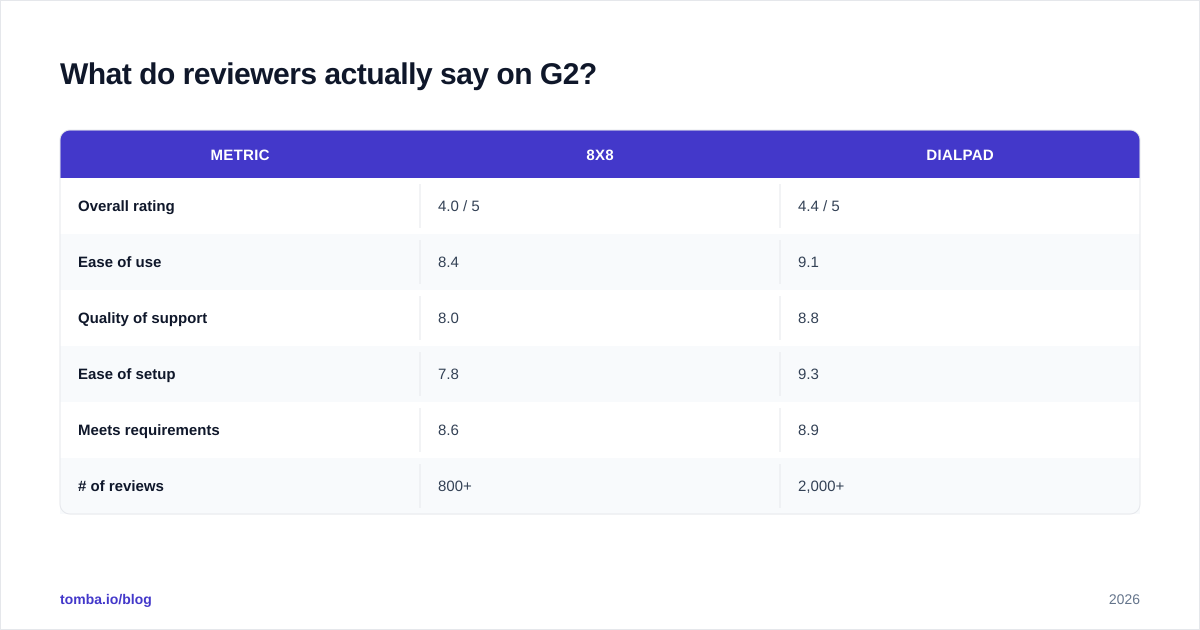
Pulling G2 data as of Q1 2026:
| Metric | 8x8 | Dialpad |
|---|---|---|
| Overall rating | 4.0 / 5 | 4.4 / 5 |
| Ease of use | 8.4 | 9.1 |
| Quality of support | 8.0 | 8.8 |
| Ease of setup | 7.8 | 9.3 |
| Meets requirements | 8.6 | 8.9 |
| # of reviews | 800+ | 2,000+ |
The pattern is consistent across Capterra and Gartner Peer Insights: Dialpad scores higher on usability and support; 8x8 scores higher on feature depth and enterprise readiness. Buyers who switched away from 8x8 most often cited admin complexity and dated UI. Buyers who switched away from Dialpad most often cited contact-center gaps and pricing creep when adding AI features.
Which integrations matter most?#
A phone system that doesn't talk to your CRM is a glorified landline. Both platforms cover the basics; the difference is in depth.
Both have native integrations for: Salesforce, HubSpot, Microsoft 365, Google Workspace, Slack, Zendesk, ServiceNow, Okta, OneLogin.
8x8-only or stronger:
- Microsoft Teams direct routing (certified)
- Freshdesk
- NetSuite
- Bullhorn (staffing CRM)
Dialpad-only or stronger:
- Gong (native, deep)
- Chorus (native)
- Front
- Outreach.io
- Salesloft
If you're already paying for Gong and Outreach, the lift to plug Dialpad in is roughly zero. If you're a Microsoft shop and Teams is the center of gravity, 8x8 has the advantage.
If you're standing up the outbound motion from scratch, a typical stack is: CRM + Dialpad Sell + an engagement tool + a contact-data layer like Tomba's data enrichment to keep CRM records current. Compare options in our Outreach alternative and Salesloft alternative breakdowns.
Which one should you pick? A decision framework#
Use this short rubric — if you check 3+ boxes in a column, you have your answer.
| Pick 8x8 if… | Pick Dialpad if… |
|---|---|
| You run a contact center > 50 seats | Your team is < 50 reps and outbound-heavy |
| You have offices in 5+ countries | You're US/UK/Canada-focused |
| Microsoft Teams is the daily UI | Salesforce or HubSpot is the daily UI |
| You need omnichannel (voice + chat + SMS + social) routing | You need fast call notes + coaching |
| You have a partner/VAR to do the rollout | You want to be live next week |
| Compliance frameworks (HIPAA, PCI, FedRAMP) are mandatory | You value modern UX over feature depth |
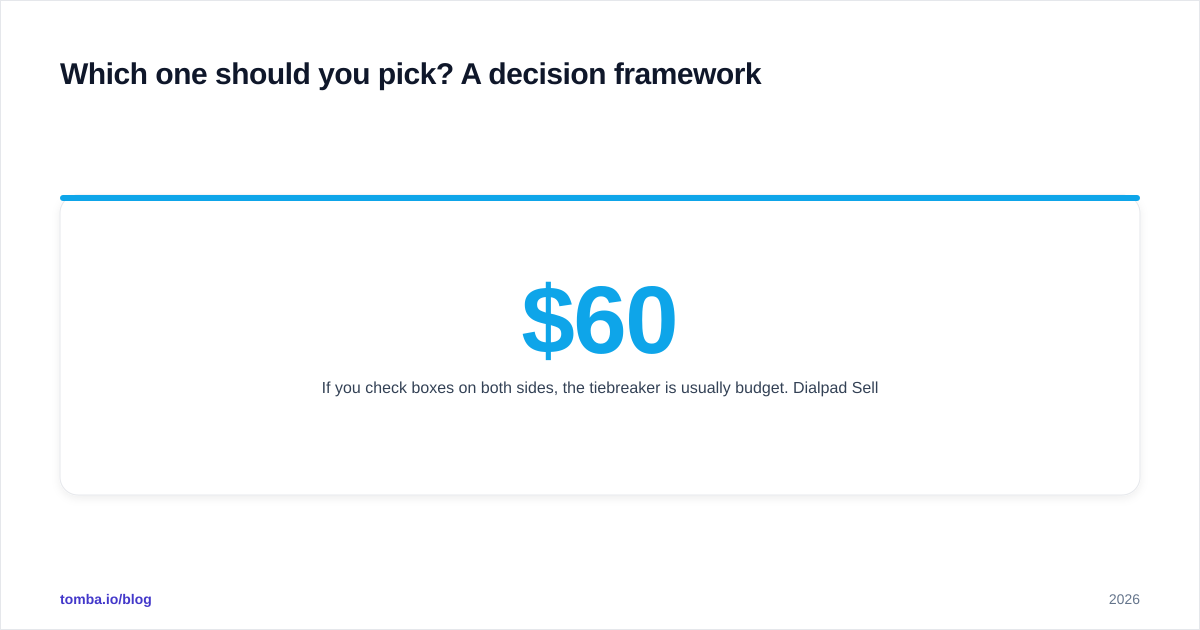
If you check boxes on both sides, the tiebreaker is usually budget. Dialpad Sell at $60/seat is cheaper than 8x8 X6 at $85/seat for an outbound team. 8x8 X2 at $24/seat is cheaper than Dialpad Pro at $25/seat for basic UC — but the gap closes the moment you need AI.
What are the alternatives worth considering?#
Don't anchor on a two-horse race. The 2026 UCaaS market still has real depth:
- RingCentral — feature-equivalent to 8x8, stronger US footprint, similar pricing.
- Zoom Phone — cheapest path if you already pay for Zoom Meetings.
- Nextiva — strong SMB pricing, growing AI features.
- Aircall — Dialpad-like UX for European teams.
- Microsoft Teams Phone — best if you're already deep in M365.
If outbound speed is the bottleneck rather than the phone system itself, building a clean prospecting layer pays off faster than switching dialers. Start with a bulk email finder to keep the top of the funnel full and a LinkedIn finder to source contacts your CRM doesn't already have.
Frequently asked questions#
Is Dialpad cheaper than 8x8? At the entry tier yes — $15 vs $24/user/mo. At the AI-enabled mid tier, Dialpad Pro at $25 is still cheaper than 8x8 X4 at $44. Once you add contact center, the gap narrows.
Does 8x8 have real AI in 2026? Yes, but it's mostly post-call analytics and IVR automation. Dialpad's AI is more rep-facing and real-time.
Can either replace Zoom for video? Both ship native video. 8x8 Meet handles up to 500 participants; Dialpad Meetings handles 150 on Pro, more on Enterprise. Neither replaces Zoom for webinars or 1,000+ attendee events.
Will I lose my phone numbers if I switch? Both vendors port numbers in/out. Plan for 2–4 weeks of porting on US numbers, longer internationally.
What about SMS compliance (10DLC)? Both support 10DLC registration in the US. Dialpad's flow is faster to register; 8x8's is more enterprise-controlled.
Where Tomba fits in your phone stack#
A dialer is only as useful as the contact list feeding it. Before your reps dial on 8x8 or Dialpad, they need clean, verified contact data — and that's where Tomba slots in. Use the Tomba Email Finder to source decision-maker emails, run email verification before sequences, and pull mobile numbers with the phone finder so power-dialed lists actually connect. Plans start at $49/mo for Starter, with a free tier of 25 searches/month if you want to test it against your current sample list. Pair a clean list with whichever platform you pick — 8x8 or Dialpad — and your connect rate stops depending on the dialer's brand and starts depending on the data underneath it.
// get started
Find, verify and enrich your first contacts today
Start on the free plan with 25 searches a month, then scale when your team is ready.
Free plan · No credit card required · GDPR & CCPA
Get the Tomba newsletter
Product and data updates
// about the author